
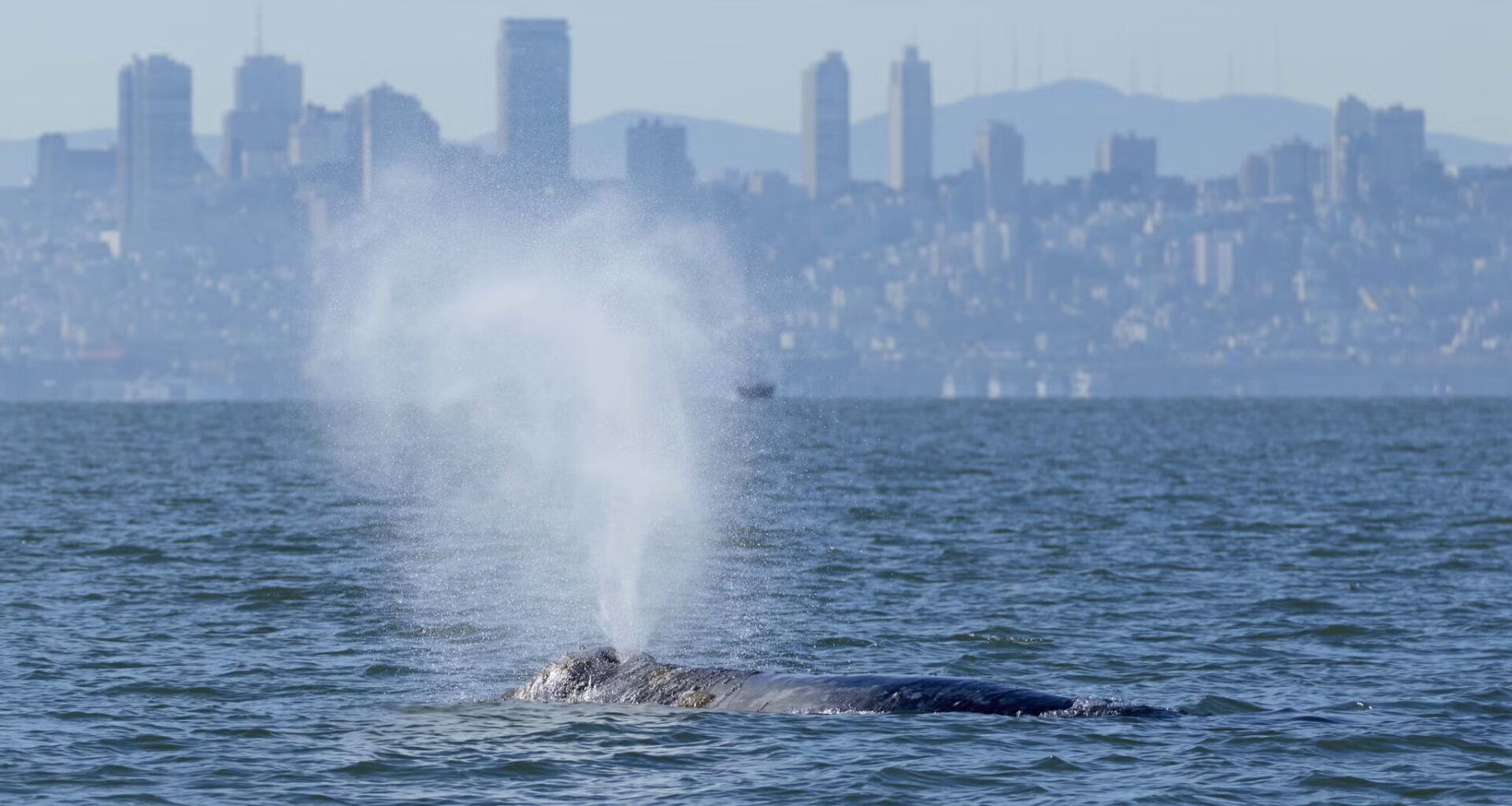
A gray whale found dead near San Francisco’s Pier 80 was killed by injuries consistent with a vessel strike, according to the Marine Mammal Center. The death is the 13th gray whale recorded in the Bay Area this year as scientists track more whales entering and lingering in San Francisco Bay.
Darrin Allen/NOAA Permit #26532
A gray whale found dead near Pier 80 in San Francisco Bay was killed by injuries consistent with a vessel strike, marking the 13th gray whale found dead in the Bay Area this year, according to the Marine Mammal Center.
The adult male whale was reported June 4 near the eastern San Francisco waterfront and towed to Angel Island State Park, where scientists from the Marine Mammal Center and the California Academy of Sciences performed a necropsy. The examination found blunt force trauma, including a broken vertebra and hemorrhaging behind the skull, the center said.
Article continues below this ad
The death adds to a troubling year for gray whales in and around San Francisco Bay, where scientists say more of the animals are lingering during their migration and dying after encounters with vessels in one of the West Coast’s busiest waterways.
The Marine Mammal Center’s most recent data lists 13 gray whales found dead in the Bay Area in 2026. Four of those deaths have been classified as suspected vessel strikes, six as undetermined or without a necropsy, two with necropsy results pending and one as suspected orca predation.
San Francisco Chronicle Logo
Make us a Preferred Source to get more of our news when you search.
Add Preferred Source
Gray whales migrate each year between breeding lagoons off Mexico and feeding grounds in the Arctic, a round trip of roughly 12,000 miles. San Francisco Bay is not typically a place where the whales would spend long periods, but scientists have documented a sharp increase in gray whales entering the bay since 2018.
The whales appear to be using the bay’s warmer, shallower waters to rest and search for food during migration, the Marine Mammal Center said. To enter and leave the bay, whales must pass through the Golden Gate Strait, a narrow channel used by cargo ships, tankers, ferries, tour boats, fishing vessels and recreational boats.
Article continues below this ad
A study published this spring in Frontiers in Marine Science found that at least 18% of identified gray whales seen entering San Francisco Bay from 2018 through 2025 later died there. Researchers said the actual death rate is probably higher because some carcasses sink, drift out to sea or are too decomposed to identify.
Researchers have said gray whales can be difficult for mariners to spot because they surface low in the water, and fog and heavy traffic can further reduce reaction time.
Last month, researchers from UC Santa Barbara’s Benioff Ocean Science Laboratory, the U.S. Coast Guard’s Vessel Traffic Service, the Marine Mammal Center and WhaleSpotter launched an AI-assisted detection system that uses thermal cameras to identify whale blows and heat signatures in the bay. The system is designed to alert mariners so vessels can slow down or change course.
“We’re relieved to have these cameras going live during this critical moment in the gray whale season,” Rachel Rhodes, a Benioff Ocean Science Laboratory scientist leading the project, said in a statement.
The first camera was installed at a Coast Guard communications station on Angel Island, aimed toward Treasure Island and the Bay Bridge, an area where whale activity overlaps with vessel traffic.
Article continues below this ad
A second detection system is planned for MV Lyra, a San Francisco Bay Ferry vessel that runs between Vallejo and downtown San Francisco.
SF Bay Ferry Executive Director Seamus Murphy said that the agency is working on whale protection protocols, including monitoring, communication, education, route adjustments and speed reductions when whales are present.
The new thermal monitoring system, Murphy said, is “the next evolution of our work.”