
It’s a Friday morning in mid-April and Oakland Animal Control officers Celeste Beas and Ashley Mitchell are driving through deep East Oakland. They’re responding to a call that one of their colleagues, Maya Sandifer sorts through at the office on 29th Avenue to set their priorities for the day.
The women are part of a small team of five officers who handle all the animal-related calls that come through the Oakland Police Department’s non-emergency line, as well as their own.
The officers work in two shifts between 7 a.m. and 7:30 p.m., seven days a week. A sixth officer’s position is close to being filled, according to Joe DeVries, director of Oakland Animal Services, which oversees the Animal Control division, and a seventh will be posted if Mayor Barbara Lee’s proposed budget is adopted.
The team responds to reports of animal cruelty; rescues sick and injured animals, including small wildlife; and recovers dead animals — though the California Department of Fish and Wildlife handles wildlife calls in most instances, according to DeVries.
The officers also often find themselves educating people about how to properly care for a pet, or providing information about resources for animal owners who might not have the funds to properly do so on their own.
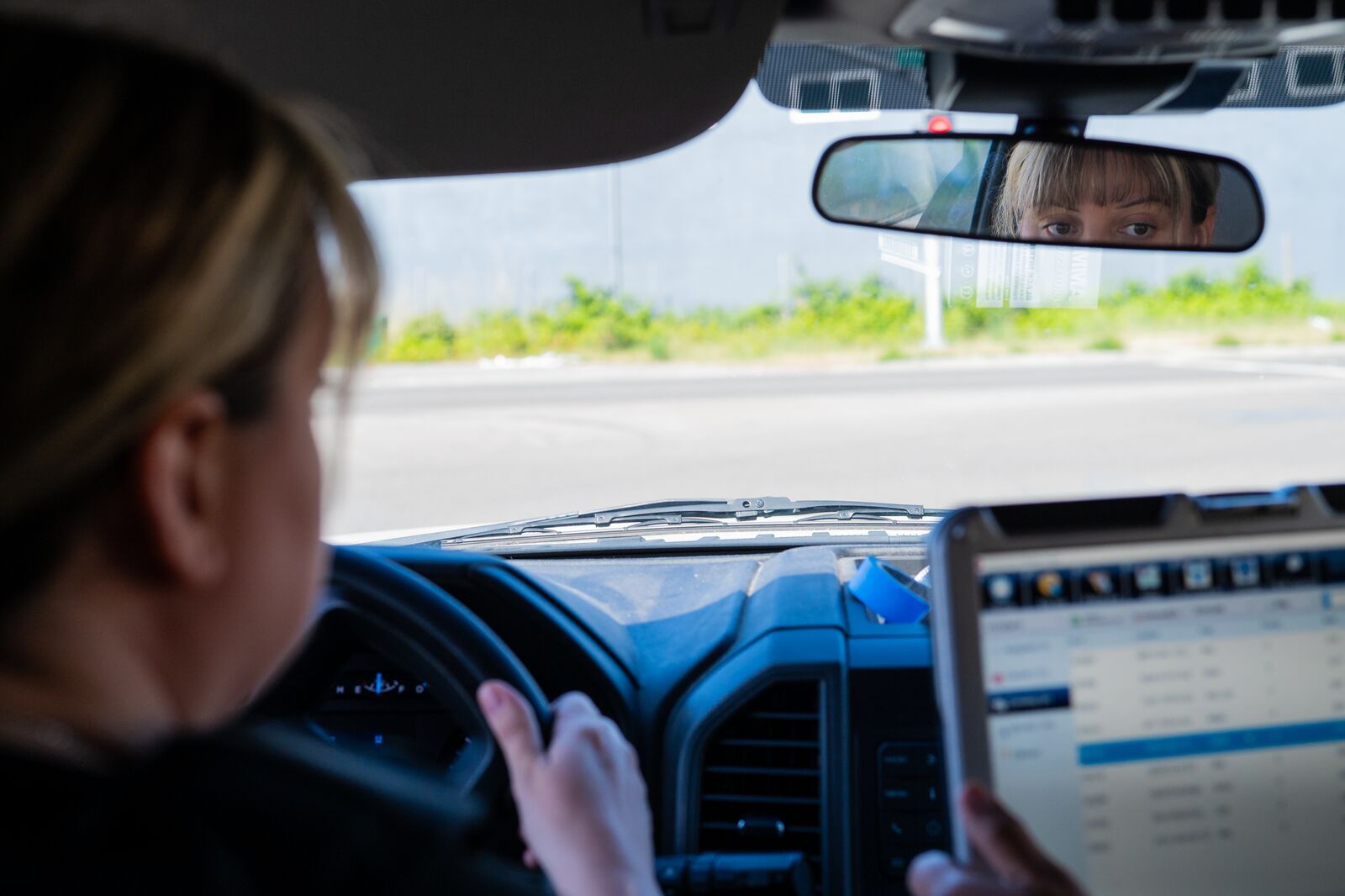 Officer Ashley Mitchell drives around Oakland alongside Beas responding to calls fielded back at the office by their colleague, officer Maya Sandifer. Credit: Tyger Ligon for The Oaklandside
Mitchell and Beas have responded to some wild calls during their time with Oakland Animal Control: like the time when they teamed up with Highway Patrol officers to chase a goat that was running loose on the freeway; or the day they responded to an OPD drug bust where the officers had to seize a 350-pound pig on the property.
The first call today was a report of an injured seagull, which took them to a parking lot at Eastmont Center outside of Gazzalli’s Supermarket, at the corner of 73rd and Bancroft avenues.
“The call says that the seagull is standing on a cinder block,” Beas says, reading off the call notes on the truck’s laptop.
“I don’t think the seagull is going to be on a cinder block,” Mitchell responds as she pulls into the parking lot. Then, a moment later, she says, “I see it. It’s right there with a dangling wing.”
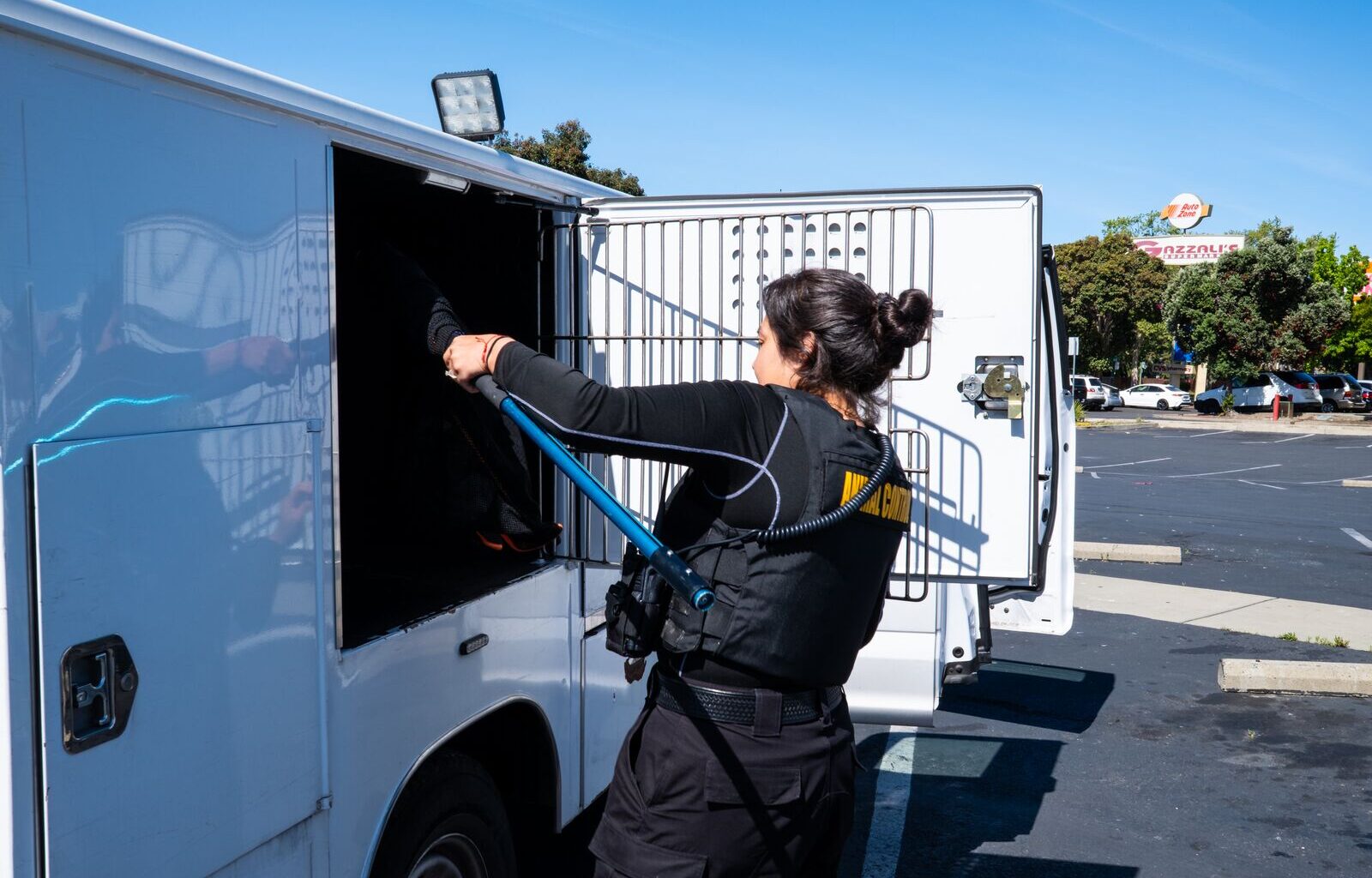
Mitchell parks hastily in the mostly empty parking lot. Both officers jump out, and Beas grabs a black net attached to a long pole. In less than a minute, the two have captured the injured seagull, who was too weak to evade them. The bird could only awkwardly wobble, in a failed attempt to hide behind a car.
Since the seagull is alert and doesn’t appear to be in pain, Baes places it in a cage in the back of the truck. Once back at the shelter, she says, it will be picked up by the Yggdrasil Urban Wildlife Rescue, a nonprofit that rehabilitates injured wildlife across the Bay Area, and likely transferred to the International Bird Rescue in Fairfield.
Mitchell says they’ve picked up other seagulls with similar injuries that have gone on to live relatively normal lives.
A few years ago, she says, she caught one off Embarcadero with a fishing line wrapped around one of its wings. It had been tangled around the wing for so long that it had already cut off the blood supply. When she cut off the line, the wing fell off.
“If I would’ve sent it to rehab, it would have gotten euthanized,” Mitchell says. Since she assessed the bird and found no other injuries, she decided to just let it go. Now, she says, “the seagull walks between Embarcadero and Jack London Square where there’s plenty of food. Some people still call about him but now we know it’s the same bird.”
 Officer Beas assesses the injured seagull. Once back at the shelter, the bird will go to a wildlife rescue. Credit: Tyger Ligon for The Oaklandside
 The bird has a dislocated wing with its bone exposed. Credit: Tyger Ligon for The Oaklandside
The gull is the first of eight calls stacked up for Beas and Mitchell this morning.
“The way we prioritize calls is aggressive and injured first,” Beas says. “A dog in a hot car, that’s a top priority.”
California’s animal cruelty law, Mitchell explains, “applies to animals and vehicles only when the weather is hazardous to their condition, which is only hot days here.”
Most people don’t seem to know that, Mitchell says, because Animal Control constantly gets calls about animals in vehicles, especially since it is not uncommon for the unhoused population to keep their pets in their cars.
“A lot of people think that just like it is illegal for children to be left in a car, it’s the same for animals, but it’s not,” Mitchell says.
Experience in animal care helps the officers see what others might miss
Mitchell and Beas tell us they both started in the field as vet techs, or veterinary technicians, which requires training at a board-certified education institution and thousands of hours of clinical practice, training they say has been a huge asset in helping them assess cases they come across — and recognize animal abuse.
Beas says she began as a vet tech for almost six years, then came to Oakland Animal Services as an animal care attendant — taking on duties like intake paperwork, providing food and water, and administering medications — and finally became an officer when a position opened up five years ago.
Mitchell says she had wanted to be an animal control officer since she was a kid. She says she worked as a vet tech for a private practice, then at OAS. When an officer position opened up, she jumped at the chance. She’s been with OAS for 15 years.
Becoming an animal control officer requires even more steps, including passing the California Peace Officer Standards and Training and the California Animal Law Enforcement Academy training programs. Many officers, Mitchell says, do additional training on their own, on topics such as forensics and interrogation techniques.
“Some people might think that we are just dog catchers,” Mitchell says. “They don’t know all of the training we have to go through.”
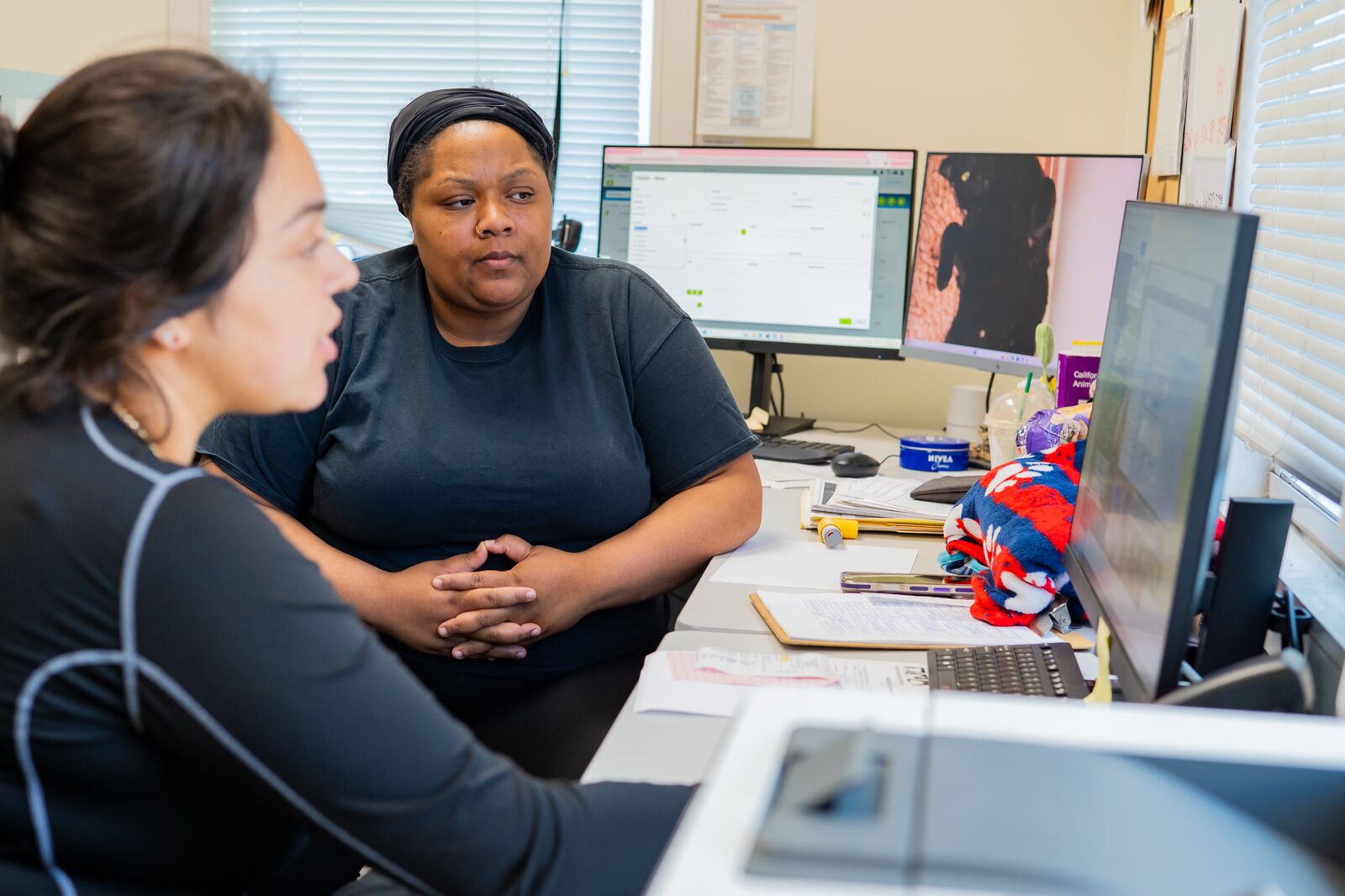 Officers Sanfider (left) and Beas discussing the calls Beas and Mitchell will respond to for the first half of the day. Credit: Tyger Ligon for The Oaklandside
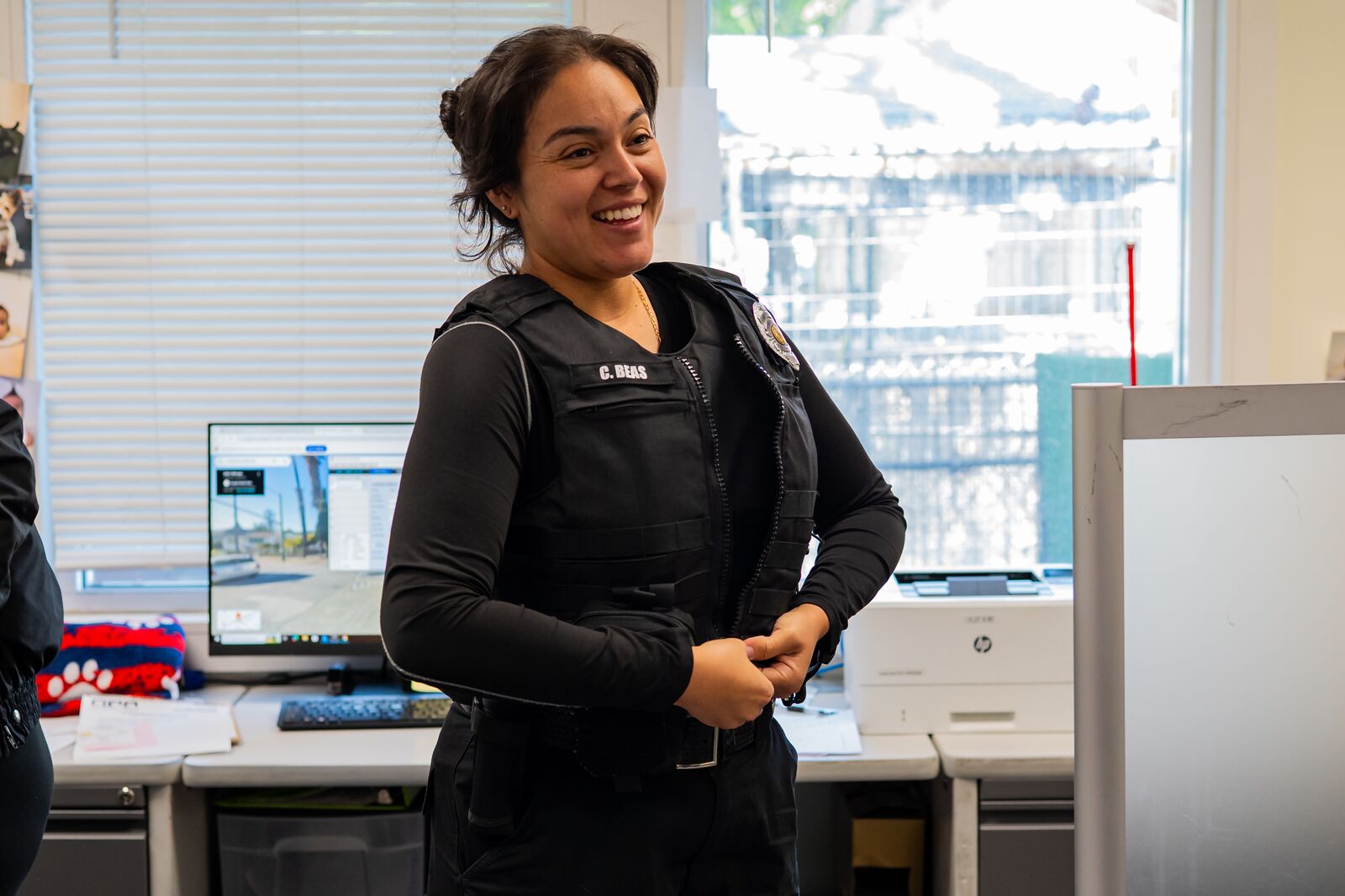 Officer Beas putting on her vest before heading out for the morning. Credit: Tyger Ligon for The Oaklandside
As we drive across Oakland, Beas and Mitchell say that over their time as animal control officers they have witnessed some incredibly difficult cases. Mitchell says some people they have encountered are capable of “horrific acts.”
“I had a case not long ago where the dog owners were beating them,” Mitchell says. “I went to do the wellness check and I seized both dogs. Between the two, one dog had 31 broken bones in its body of all different healing, broken ribs, broken legs, injuries that weren’t necessarily visible to the naked eye. The second one had 11 fractures.”
Mitchell says one of the dogs was transferred to Idaho to receive specialized care to reconstruct badly healed bones, and the other dog, who had lesser injuries, was adopted shortly after those injuries healed.
Cases involving negligence, Mitchell says, aren’t always given priority by the district attorney’s office unless they can be charged as a felony, and look like a “strong case with undoubtable evidence.”
One case she remembers involved a woman who had stomped the head of her Aussie pitbull puppy for peeing on itself because it wasn’t potty trained yet. Mitchell was able to obtain videos from the building where the woman lived showing the abuse. “She kicked the puppy, stomped its head and fractured the puppy’s skull,” she says. Mitchell fostered the dog until it healed, and the woman, as she recalls, was arrested and banned from owning animals.
Louis Goodman, a public information officer with the Alameda County District Attorney’s Office wrote in an email to The Oaklandside that claims of animal cruelty are reviewed on a case-by-case basis, and charging decisions are made accordingly.
Hold off on calling for a dead rat in your home
Last year, DeVries said, officers responded to 3,886 field calls, and received 432 more calls that did not require a visit from officers.
Those calls included 940 stray dogs, 284 aggressive dogs, and 682 injured animals. They also included 731 cruelty cases and 73 bites where the dog was still loose and posing a danger. Devries said plenty more bites get reported after the fact. The calls, the officers tell us, primarily come from East Oakland, with a handful in the West, and rarely any from the hills.
According to Beas and Mitchell, animal control receives lots of calls for issues the department isn’t supposed to handle. Calls about wildlife like raccoons or rats found in someone’s home, dead or alive, they say, should be routed to a pest control company. Smaller sick or injured wildlife, such as today’s seagull, are calls they will respond to. The department no longer responds to calls about larger wildlife, like deer, found roaming around private property; they direct those callers to California Fish and Wildlife.
“We don’t have the tools or the medications to handle wildlife,” Mitchell says — though DeVries told us officers can respond to calls involving requests to dispose of a dead deer.
Sometimes people call about a dog who is constantly barking, but that’s a kind of call the officers say they rarely respond to.
 Although the Animal Control Division has a separate phone line from the Oakland Police Department, the officers often receive assignments over radio that come through OPD’s non-emergency line, or directly from police officers who need assistance. Credit: Tyger Ligon for The Oaklandside
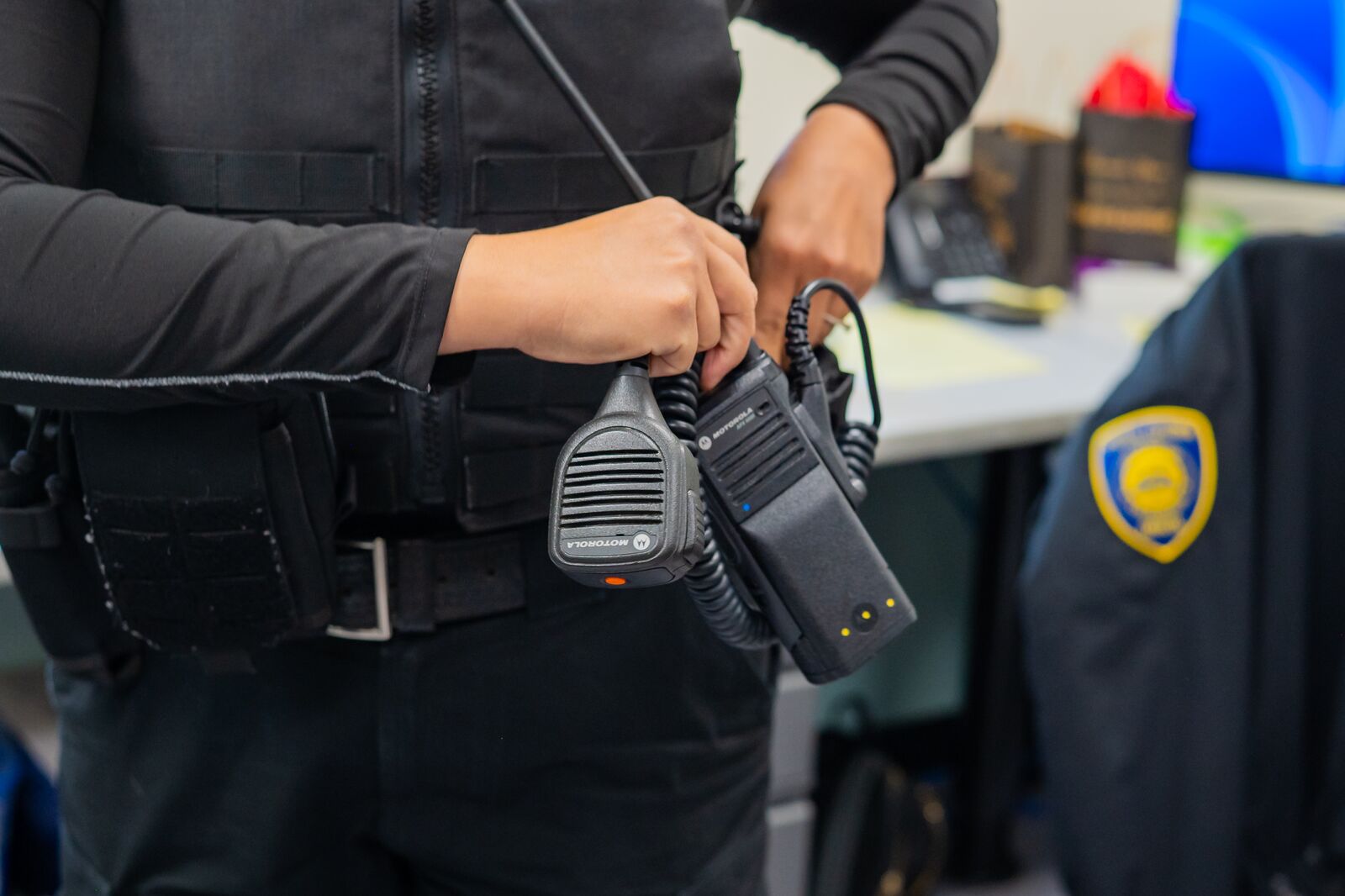 While the onboard computer system is used to send out assignments, officers also receive radios for quick communication with OAS. Credit: Tyger Ligon for The Oaklandside
Mitchell says a lot of dogs who were adopted during the pandemic suffered from separation anxiety once their owners went back to work in the office.
“The barking calls increased through the roof,” she says.
Mitchell says that in some cases, they might go out and do a wellness check to make sure the call doesn’t involve dogs that are in distress from being neglected or abused. But she says that in her years as an officer, no barking call has turned out to be anything serious.
The barking calls sometimes end up with a nuisance abatement letter and a fine, DeVries said, explaining that officers will investigate and then send a compliance notice if the complaint is confirmed and the situation is egregious.
“Huskies, Alaskan malamutes and Frenchies make horrible sounds,” Mitchell says. “People think they’re dying, and it’s an animal in distress. Pitbulls make a whine that sounds like a squeaky pig squeal.”
‘Wild’ calls and false alarms are part of their day
After the rescue of the seagull, Mitchell and Baes pull up to a house on 70th Avenue.
“I have been here before,” Baes says. The call notes mentioned malnourished dogs and 10 puppies that can be seen roaming in the front yard.
“Good morning sir,” Baes says as she approaches the resident through the gate, shortly before his wife walks out of the house to see what’s going on.
The exchange with the dog owners lasts a few minutes. The call was a false alarm. The residents own a pair of Dobermans, and the female dog recently had a litter.
“My previous call was kind of the same call today that the dogs look malnourished,” Beas tells us. “I got here, and the dogs did not look malnourished. They have food, clean water, shelter, and don’t show any potential injuries. My best judgment as an animal control officer, I’m not going to leave a compliance notice, because the dogs have all the basics.”
The officers suggest that the dog owners get the female dog spayed, and leave them with information about what to do if they don’t find homes for the puppies. The puppies, they explain, can be surrendered to the shelter once they are about eight weeks old where they will be placed for adoption. The surrender fees, Mitchell says, can be waived if the owners agree to have the female dog spayed.
Mitchell says it isn’t unusual for a female dog who just had a litter to look malnourished, since the puppies are taking so many nutrients as they nurse. One trick to help nursing dogs gain weight, she says, is to feed them puppy food.
“We’ve done two sites, but there’s six more to go,” Beas says.
“Do you want to try to call back the owner with the aggressive dog for surrender?” Mitchell asks.
Beas calls the owner; she’s not home.
Oakland Animal Services, we learn, offers a program for Oakland pet owners who want to surrender their animals. The pet owner has to first set up an appointment with OAS to discuss their options. If the surrender is approved, officers can pick up the animal for a fee that varies depending on the size of the animal.
Up until mid-May, Oakland Animal Services used to send some dogs with behavioral issues, and dogs that had been under the care of the shelter for too long, to Miranda’s Rescue, a nonprofit in Fortuna, in Humboldt County, that called itself a no-kill shelter. That was until Humboldt County Sheriff deputies responded to complaints of animal cruelty by obtaining a search warrant, then recovered eight dead dogs on the shelter’s property.
The Lost Coast Outpost obtained the affidavit for the warrant, reporting that Oakland Animal Services had transferred 445 animals to Miranda’s Rescue from 2023 through 2025. At $400 per dog, that would have netted the nonprofit an estimated $178,000. The sheriff’s department is investigating allegations of felony animal abuse, animal cruelty, fraud, and conspiracy; the shelter’s owner has denied the accusations.
 Oakland Animal Control officers Ashley Mitchell (left) and Celeste Beas arrive at an apartment complex in West Oakland Oakland to respond to a call about animal cruelty and neglect. Credit: Tyger Ligon for The Oaklandside
On May 22, Devries told The Oaklandside that out of the 205 dogs OAS sent to the rescue last year, only one was found alive at the property. The fate of the other ones remained unknown.
The discoveries have left OAS in a bit of a bind.
“Currently we are over capacity in the shelter,” DeVries told The Oaklandside by email. “And, unfortunately this can mean that our euthanasia rate goes up as dogs deteriorate here and it’s inhumane to keep them for excessive periods of time.”
In the email, DeVries said that OAS is doing its best to expand partnerships, expand adoption hours, and increase the shelter’s foster program.
Even before OAS lost one of its transfer partners, the department was stressed by understaffing, Mitchell and Beas say.
Mitchell says that when she joined OAS as an officer in 2014, the department had 13 officers. Last year, she said, only three officers were handling all the calls because Beas and another officer were out on leave.
“Historically, several years ago, there were more,” Devries confirmed. “But budget challenges saw many of the vacancies frozen over time.”
Mitchell and Beas say the department should have 16 full-time officers to respond to the high number of calls they receive.
Despite the budget constraints, Beas, Mitchell say they do the best they can, responding to calls they didn’t get to on the day they were received if they end up near the location.
Their fourth call, the day The Oaklandside is tagging along, is about a loose white dog around 98th Avenue. Odds are, they say, the dog escaped through the yard and is already back home.
“There’s a dog,” Mitchell says as she pulls into a side street near 98th Avenue. She points to a dog that matches the description from the call: white with brown spots.
As the truck pulls over, a Latino elder is slowly picking up the dog from where it is tucked next to a metal fence.
“Es tuyo?” — is it yours? —, Beas asks in Spanish. “Se escapó de la casa” — he ran away from home — the man tells Beas.
“He’s not yours, you give it to me?” Mitchell playfully asks in English. “No, he’s mine,” the man replies in English, as the small dog rests comfortably in his arms.
In Oakland, all dogs over four months are required to be licensed, with fees ranging from $17 for altered dogs for a one-year license (or $12.75 for senior dogs) to $113 for an unaltered dog ($85 for seniors). According to DeVries, the revenue from the dog licenses goes to fund OAS.
The officers explain that dogs are also required to be on a leash whenever they’re not at home, unless the dogs are at a dedicated dog park. The man won’t get in trouble, they say, because he did the right thing by picking the dog up rather than letting it walk on the sidewalk without a leash.
Unsanctioned dog parks, like Bushrod Park in North Oakland, they tell us, is one of the biggest problems in the city for the officers. Bushrod doesn’t have a designated dog park, but some dog owners who routinely visit have made it into an unofficial dog park where they let their dogs run around off-leash. According to the officers, the Oakland Police Department has begun to crack down on dog owners who let their dogs go off-leash there.
“We don’t have the manpower to patrol parks,” Mitchell says. “We have other calls that we have to get to. We would have to be there every day, all day.”
Sometimes, the officers say, off-leash dogs can result in dog bites or potentially fatal injuries if dogs run into the street.
When there’s a dog bite involved, Mitchell says, the owner is responsible for providing the other party with contact and vaccination information within 48 hours. In Oakland, failure to exchange information in a timely manner can result in a 10-day quarantine of the animal and a $1,000 fine.
Animal cruelty takes a toll
After they resolve the call about the white dog with brown spots on the loose, the officers drive all the way to West Oakland to a new apartment complex on Wood Street.
The caller, Mitchell says, reported a dead dog inside an apartment where a former tenant had moved out after being served with an eviction notice.
The officers have been playing phone tag with the building’s management, and they are hoping today is the day they can figure out what happened. According to the call notes, the tenant left in December, but the dead animal wasn’t discovered until much later. The first call, Mitchell says, didn’t come until April 2 and the officers have been trying to coordinate to pick up the remains and file a report in the week and a half since.
Abandoning an animal, Mitchell explains, is a crime under California law, with charges that can include animal abandonment and animal cruelty.
When the officers arrive at the apartment complex, they meet with the building’s manager, Ashley Babitt, who says she only recently took over running the building in February.
Babitt explains to the officers that as she caught up with the building’s tenant ledger, she found 110 active eviction notices out of the 235 units. The day The Oaklandside visits, the fifth and sixth floors of the building were empty. Babitt says it wasn’t until she started checking every unit with an active eviction notice that she realized one tenant had abandoned their pet.
This isn’t the first time the officers have been called to this building. A few months ago, they say, they rescued a Frenchie another tenant had left behind. Luckily, they say, they were able to rescue the dog and get it treated. One of the vet techs back at the shelter ended up adopting it — not an uncommon occurrence.
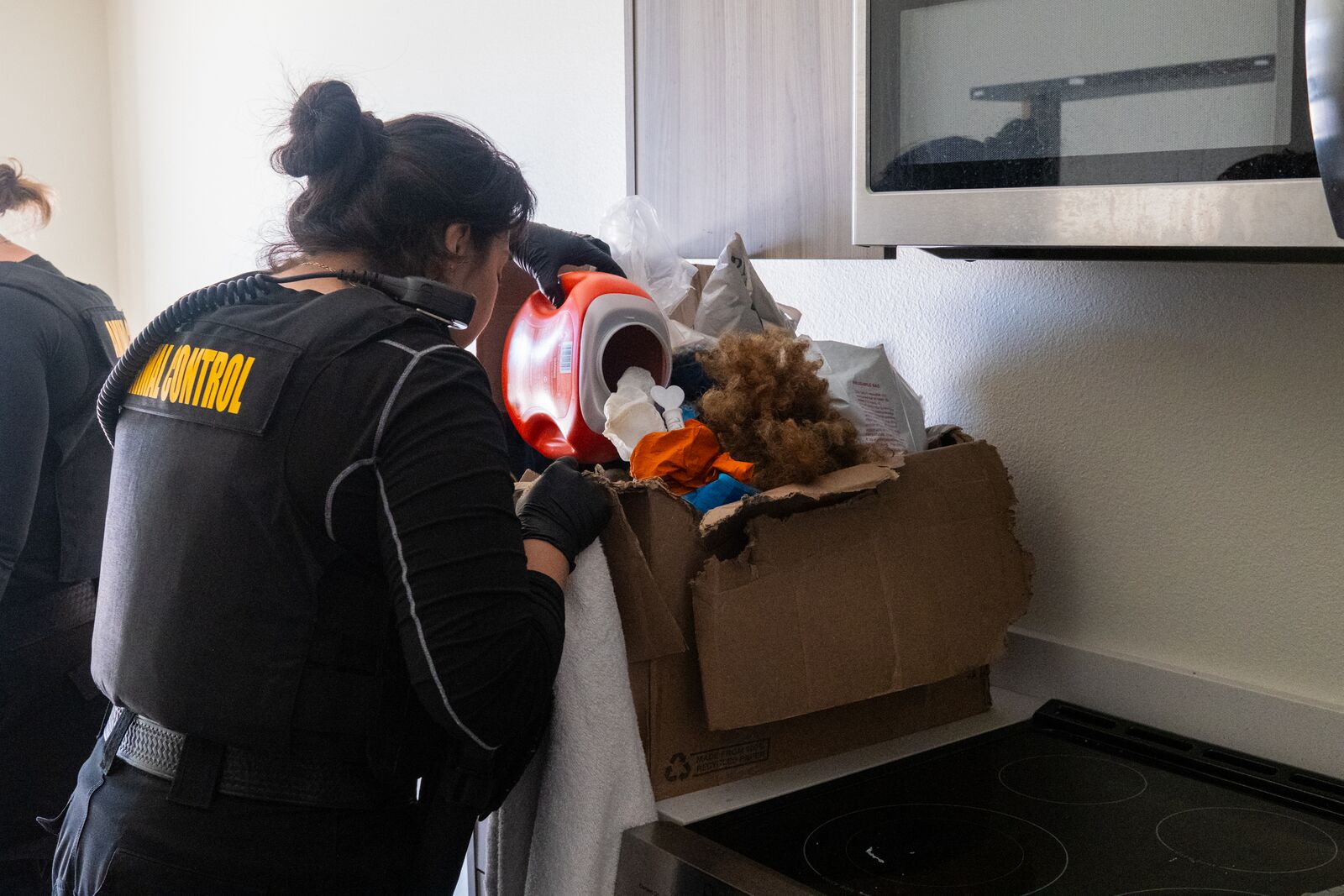 Beas looks through a box left behind by the tenant who abandoned a puppy in an apartment in West Oakland. Credit: Tyger Ligon for The Oaklandside
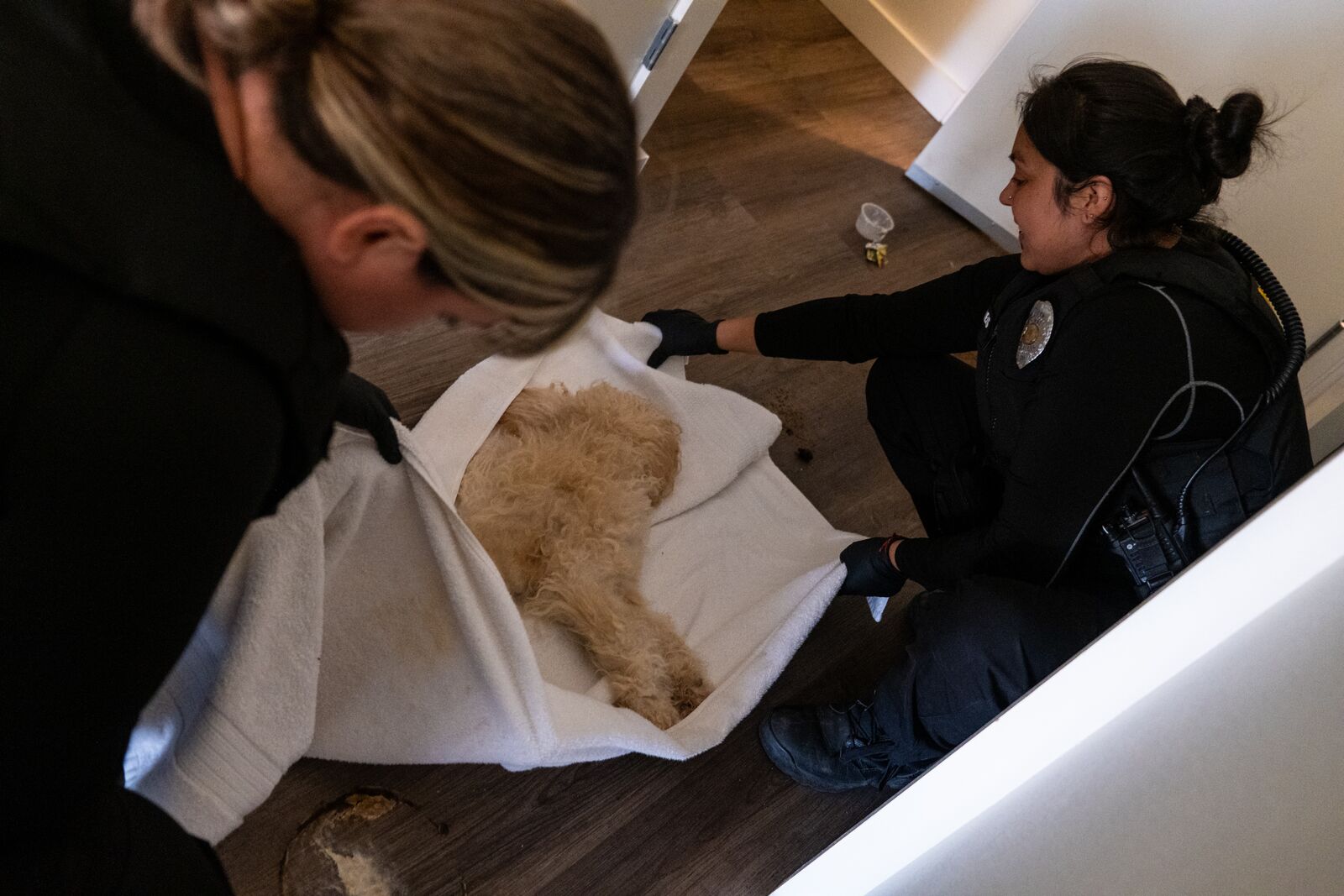 Mitchell (left) and Beas carefully place the remains of the abandoned puppy in a towel. The officers will write a report about this case and submit it to the District Attorney’s office. Credit: Tyger Ligon
This time, there isn’t a happy ending. As the officers walk into the empty apartment, they notice scratch marks by the front door. Empty food packaging, including the tattered remains of a box of Lucky Charms, is scattered about. And right inside the entrance lies the dog, who appears to still be a puppy, who spent the last days of its life desperate for help.
The officers collect evidence from the apartment, take photos, and gently wrap the dog’s remains in a towel. Mitchell and Beas are quiet as they walk back to the truck and carefully place the shrouded puppy in a crate. Their somber looks feel like a clear sign of how difficult this job can be.
“Our jobs are fun, but they are also really hard,” Mitchell tells us. “There’s been a lot of days where I just drive home crying.”
When the officers get back to the office, they’ll fill out a report. The building’s manager provided them with enough information to identify the owner and begin building a case that they will refer to the DA’s office.
The next two calls — the final ones the officers respond to on The Oaklandside’s ride along — had come in around 3 a.m., and the animals in question, one listed as “aggressive” and roaming around near Telegraph Avenue, and another, a pitbull on the loose around Hawthorne and Telegraph avenues, are not in the reported locations by the time the officers arrive several hours later.
Mitchell begins the six miles drive back to OAS. When they stop by the shelter, we hop out. Mitchell and Beas take the time to stretch their legs, check in with Sandifer, and get right back to respond to more calls.
“*” indicates required fields