
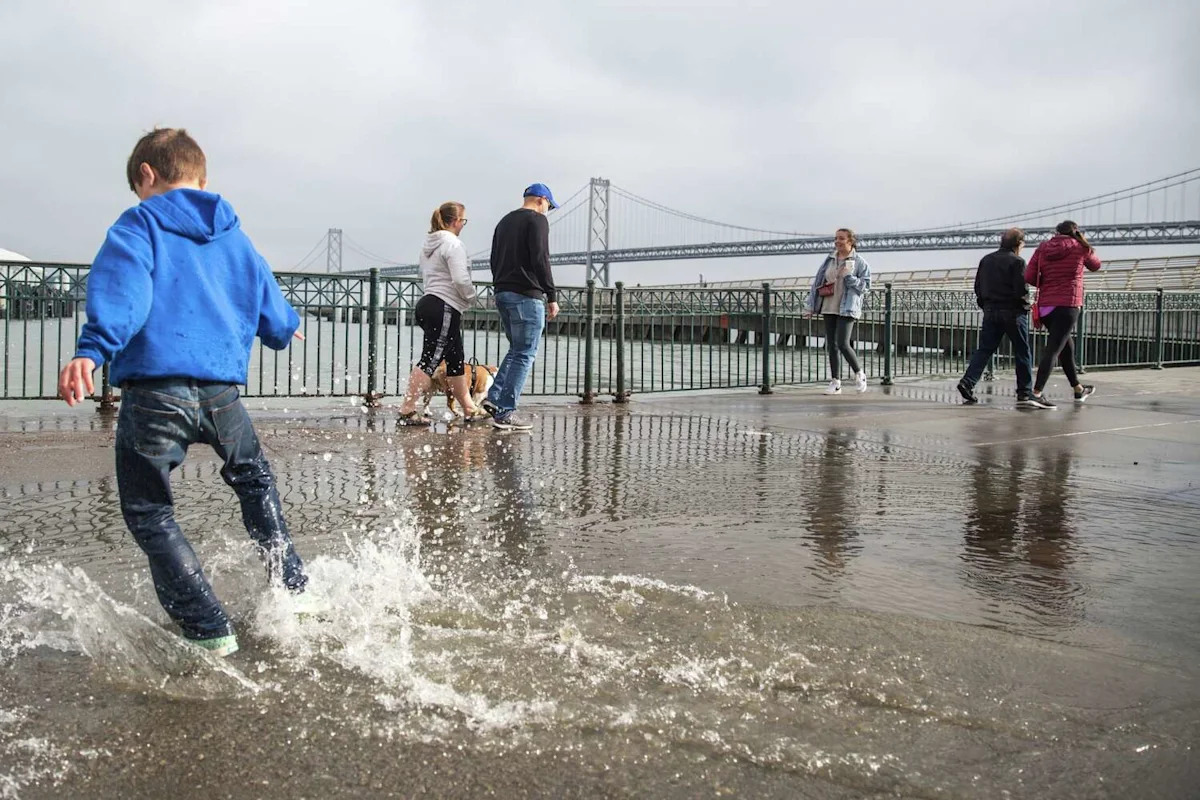
The highest summer tide on record is predicted in San Francisco Bay this weekend – a direct consequence of global warming and a surging El Niño – prompting the National Weather Service to tell residents to expect coastal flooding that’s unusual for this time of year.
Tidal overflow is possible in eastern Marin County, San Francisco’s Embarcadero and other places that are typically inundated by minor coastal flooding.
A coastal flood advisory is in effect from 7 p.m. Thursday to 3 a.m. Wednesday for the shorelines of San Francisco and San Pablo bays. The highest tide is predicted Saturday evening at 10:20 p.m. when water is forecast to be 1.8 feet above the typical high tide level, the weather service said. Tides will also be particularly high on Friday, reaching 1.5 feet at 9:34 p.m.
By comparison, January’s record flooding was far higher, a reflection of the fact that the highest tides are generally in the winter. It peaked with an anomaly of 2.56 feet. However, there has never been a tide higher than 1.69 feet outside the November–March timeframe. The previous summer record occurred in July 2022. Records go back to 1897.
Go deeper with Yahoo Scout
“It’s not going to be (like) January,” said Dylan Flynn, a meteorologist at the weather service.
Flooding on Friday and Saturday nights are projected to exceed the 1 in 100-year expectation for coastal flooding, though once-rare events are becoming more common.
Tides are typically highest in winter and summer when the moon is closest to Earth, but winter king tides can be higher because they are often compounded by precipitation runoff and storm surge from high winds.
But pushing this week’s forecast into flood territory is a combination of factors: El Niño, a marine heat wave, sea level rise and light winds.
As the ocean warms, it also rises, a phenomenon known as thermal expansion. With warmer-than-normal seas extending from California to Hawaii and well south of the equator, tides in the entire eastern Pacific are running higher than usual.

Sea surface temperatures are warmer than normal across nearly the entire northeast Pacific. As the ocean warms, it also rises, a phenomenon known as thermal expansion, which can exacerbate coastal flooding in California. (Baron/Lynx)
“You add all those … things up and you end up with an anomaly or a total additional water above the astronomical tide of about three quarters of a foot,” Flynn said.
The National Oceanic and Atmospheric Administration’s tidal predictions are also based on decades-old sea level data. Forecasters manually increase forecast water levels to account for this outdated data.
“That’s pretty common that we have a half foot or three quarters of a foot above the (old) prediction,” Flynn said. “It’s just a lot more noticeable when we’re getting into this king tide cycle.”
Rising seas are already threatening California’s coastal infrastructure.
Just last week, engineers discovered a massive crack in the Pacifica Municipal Pier, forcing an indefinite closure and demolition of a beloved cafe.
California is bracing for what’s forecasted to be a very strong El Niño. This natural climate pattern typically spurs powerful storms and destructive waves along the U.S. West Coast, causing damage to local infrastructure, NOAA warns. But sea level rise resulting from human-caused global warming puts even more coastline at risk of erosion.
Subscribe
There’s more to San Francisco with the Chronicle. Subscribe today for just 25¢.
This article originally published at San Francisco to see highest-ever summer high tide, flooding this weekend.