
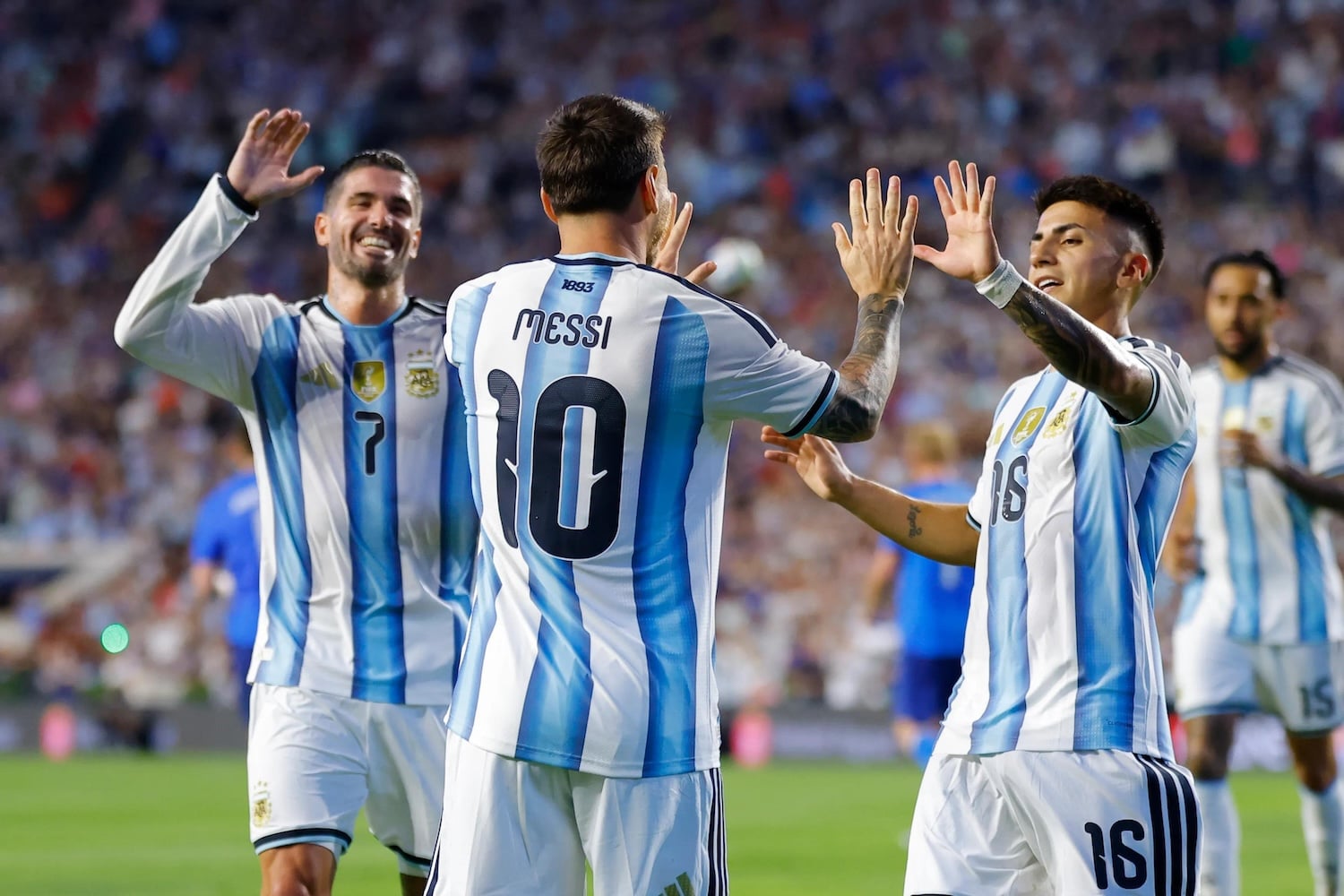
When three nations and 16 cities come together to host the FIFA World Cup 2026, the scale stops feeling like a tournament and starts feeling like geography. A continent becomes the stage as borders soften into corridors. And Southern California—shaped by migration, sport, entertainment, and constant movement—sits inside that landscape with all eyes on it.
San Diego and Los Angeles have always felt connected. Hop on the Pacific Surfliner, and the trip unfolds in one continuous stretch of coastline, passing beach towns, neighborhoods, and city centers.
Traveling from San Diego, everything still feels slightly suspended as the Pacific Surfliner follows the coast north with ocean on one side and a slow suburban blur on the other. San Diego stays in exhale. Los Angeles is already building toward something louder.
This summer, Los Angeles will host eight matches of the FIFA World Cup at Los Angeles Stadium, including the US Men’s National Team opener on June 11, while the region stretches into 39 days of programming across stadiums, parks, transit hubs, beaches, and neighborhoods. Instead of one massive fan hub, Los Angeles is embracing a citywide celebration, with fan zones spread across its entirety.
But this pattern has been rehearsed here for decades. In 1994, Southern California became one of the defining stages of the World Cup, when matches at the Rose Bowl placed global attention on the region and turned local stadiums into international landmarks, confirming its ability to hold the world at scale.
What distinguishes Southern California is not just infrastructure, but cultural permeability. Fashion, music, film, art, and sport constantly overlap here, creating an environment where identity is flexible and always in motion. From the Venice boardwalk, where skate culture shaped modern street style, to global soccer stars rubbing shoulders with Hollywood celebs, to authentic Spanish cuisine moving up and down the I-5 corridor, everything circulates.
The World Cup is not introducing anything new here, it’s showing up for the summer and showing out, revealing what this city has always known about itself. What follows is a look at the fan zones and how Los Angeles turns itself into a city-wide stage for the tournament, one neighborhood at a time.
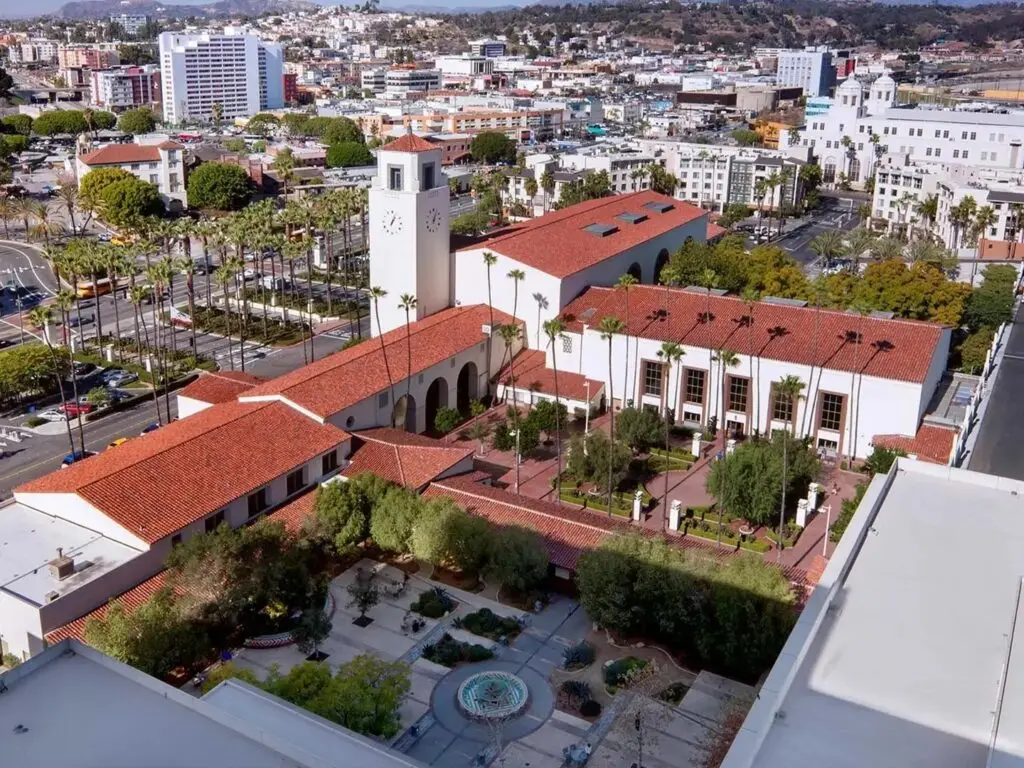 Courtesy of Los Angeles Tourism & Convention Board
Los Angeles Union Station
As the heart of Los Angeles, Union Station is an official Fan Zone June 25-28 during the World Cup, but in practice it never really stops being one.
It is the city’s circulation point, its meeting ground, its pressure valve. Commuters, travelers, match-day crowds, and everyday Angelenos all move through the same space, and everything mixes, overlaps, and scales in real time. In a way, this is where the World Cup stops arriving in Los Angeles and starts moving through it.
The Pacific Surfliner from San Diego to Los Angeles makes that shift feel almost too easy. No stress or gridlock anxiety, just a straight line up the coastline with ocean on one side and everything slowly becoming more built on the other. It’s one of the rare ways into LA that doesn’t feel like arrival as friction. You can sit with a laptop, watch the Pacific drift past, grab coffee from the café car, and let the city come to you in pieces.
That’s the beauty of arriving at Union Station. Instead of feeling like you’re on the edge of the city, you’re immediately surrounded by it. And, inside, the station already reads like a World Cup nerve center: banners, movement, multilingual energy, the sense that something global is about to funnel through this exact point. The Heart of the City Fan Zone only sharpens that feeling, with simultaneous match screens, DJ sets, meet and greets, and immersive activations built around marquee games like USA vs. Türkiye.
From there, the city splits outward.
ROW DTLA feels like the first exhale after arrival. A converted industrial campus turned creative district where restaurants, retail, and open-air courtyards form a self-contained ecosystem. If you’re looking for the perfect first meal in LA, make it lunch at Pizzeria Bianco. The thin-crust pizza is reason enough to go, but the space leaves just as much of an impression.
What I liked most about ROW DTLA is how quickly it resets you after the train. One minute you are stepping off at Union Station, and the next you are in a space that feels like its own version of LA, a city inside a city with some of the most curated shopping I’ve ever seen.
Bodega hides itself behind a convenience-store front, a sneaker and streetwear space disguised as something ordinary, like LA refusing to make anything feel too obvious. The whole campus moves like that, part retail, part gallery, part neighborhood you are only temporarily inside.
Plus, the idea that someone can get on a train in San Diego, stay on the same line, and end up inside a World Cup city without ever crossing a hard border feels almost unreal in the best way. Well until, of course, you experience it yourself.
The Original Farmers Market
The Original Farmers Market has Los Angeles already running at fan zone capacity long before FIFA arrives. Founded in 1934, it’s a stitched-together maze of food stalls, grocery counters, and long-standing vendors that somehow makes global cuisine feel local without trying too hard.
During the World Cup, it becomes an official Fan Zone from June 18 – 21. USA vs. Australia, Mexico vs. Korea Republic, projected over tables of gumbo, empanadas, and sushi rolls that have been sitting next to each other for years like it’s the most normal thing in the world.
Lunch here doesn’t land as a break. Orders fly, languages converge, and people cut through space like they already know where they’re going. Just a few steps away, the Grove turns the volume up in an unmistakably LA way, with shopping bags drowning shoulders and Erewhon smoothies acting like accessories. It’s ridiculous. (It’s perfect).
And close proximity, LACMA folds into the same orbit, which is exactly why it belongs in this fan zone network. Urban Light does what it always does, turns strangers into a shared composition under its glow. Inside, the World Cup is already quietly present, especially in Fútbol Is Life by Lyndon J. Barrois, Sr., where iconic soccer moments are rebuilt from gum wrappers, paint, and glue into something intimate and handmade.
It works here because everything is already overlapping at scale. A global tournament rendered through craft, sitting inside a cultural campus that is steps from where people are already eating, shopping, and gathering.
The City Expands
And then LA starts to split itself open.
On June 20, Downey becomes an official Fan Zone, screening matches like Germany vs. Côte d’Ivoire and Tunisia vs. Japan across a large civic viewing space built for crowds, not polish. There’s an opening ceremony, soccer exhibitions, an art walk, interactive booths, food vendors, and a beer garden that makes it feel like the neighborhood collectively decided to host the world.
Hansen Dam (July 2–5) takes it a step further: LED screens, stadium sound bouncing off water and sky, families showing up early like it’s already a tradition. Magic Johnson Park (July 4–5) brings a different cadence again, just more South LA energy. Whittier Narrows (July 9–11) stretches it into the San Gabriel Valley like the tournament is learning how far it can actually travel.
The pattern becomes obvious pretty quickly. The World Cup isn’t being held in LA so much as it’s being distributed through it, connecting places like Exposition Park, where the city already knows how to act like a built-in fan zone.
The Coliseum sits there like it has been waiting for this moment since the Olympics, while BMO Stadium, the Science Center, and the Natural History Museum stack into one dense cultural cluster that already knows how to hold crowds.
Walking through the Natural History Museum, it felt like the World Cup had already started arriving in small ways. Global exhibits, layered histories, and then suddenly FIFA merch in the gift shop, like the city was quietly rehearsing for what is coming. Nothing about it felt random…it felt placed.
Just outside the park, West Adams resets the pace completely. Lunch at Highly Likely is an absolute must. It is calm, design-forward, full of locals and creatives moving through their day, the ideal reset after the intensity of a fan zone or museum marathon. And that contrast is exactly the point.
The fan zone idea is not just big screens and tourist traps. It is places like this too, already functioning as gathering points without needing a tournament to justify it.
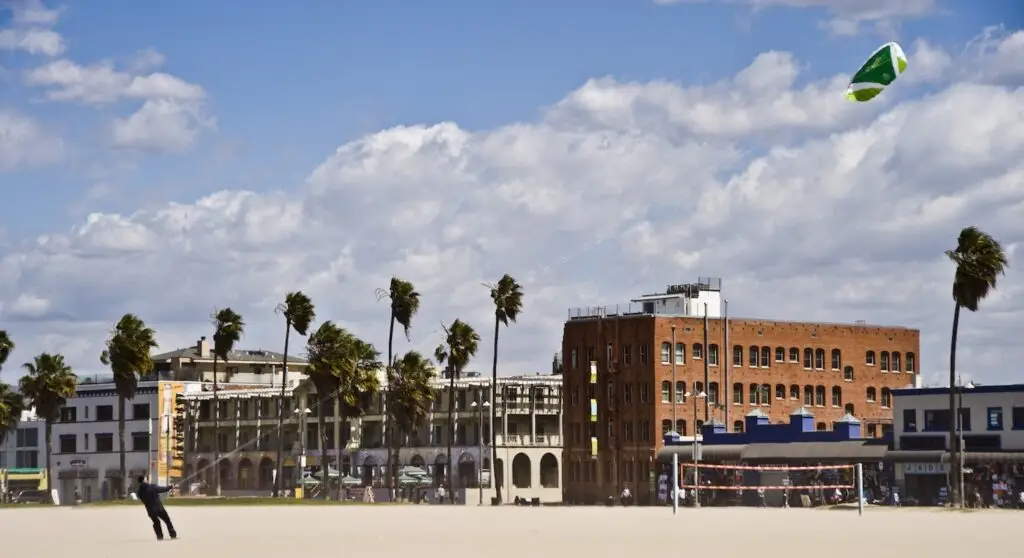 Courtesy of Los Angeles Parks and Recreation
Venice Beach
If you’re going for only one Fan Zone in LA, it needs to be Venice. No debate.
Venice doesn’t really “become” a World Cup site. It already behaves like one on a normal day, just with more sunscreen and louder speakers. So when quarter-finals hit the boardwalk, the whole thing just tips slightly into overdrive.
The Fan Zone stretches across Windward Avenue and the sand, with giant screens, DJs, global food vendors, and that very Venice mix of chaos and confidence that somehow works every time. One minute you are watching a match, the next someone is rollerblading past in a flag cape like that is a completely reasonable life choice.
It is all technically free and open to the public, which feels very Venice: maximal energy, minimal explanation. Then there is the “if you know, you know” layer at Windward Plaza with premium seating and after-parties, for people who want their football with fewer beach grains involved.
Staying at Hotel Erwin basically drops you directly in absolutely everything. It is one of those rare hotels where the location is the entire personality. Rooftop views that feel like the entire coastline is in on it, rooms that look straight onto the action, and Kassi upstairs where you end up eating Greek-inspired food like you didn’t plan anything else that day anyway.
Everything in Venice is walkable in a slightly chaotic, very charming way. Abbot Kinney for shopping that somehow feels curated and casual at the same time. There are even the canals when you need a reset from the boardwalk.
The bike tour through Venice and Santa Monica with Bikes and Hikes LA is where it all starts to click in a different way. You are literally moving through the coastline story while an insanely animated, genuinely excited guide pulls everything together in real time (even my friend I brought along, who has never watched a full soccer match in her life, started getting weirdly invested in the World Cup). It stops feeling like sightseeing and starts feeling like you are accidentally understanding LA.
Between lunch at Gjelina, always buzzing, always slightly overbooked, always worth it, and dinner at Ospi Venice with its famous vodka sauce you should absolutely put on everything (pasta, pizza, chicken parm, no exceptions), it is the kind of place where you sit down thinking you will “quickly eat” and leave remembering that Venice has its own pace and you are just temporarily synced to it.
The Westside Interlude
Before the city fully tips into its final stretch, it pulls back into something quieter on the Westside, like a deep inhale before the ending.
The Getty Center sits above Los Angeles in a way that makes everything feel briefly organized. The noise drops out the higher you go. Hilltop architecture, wide courtyards, Vincent van Gogh’s Irises, and lush gardens that seem to move slower than the rest of the city create a kind of visual pause. From here, LA doesn’t feel chaotic, just mapped out.
It’s also where the World Cup starts to register in a different register. People are spread out on the grass picnicking, looking over a city that will soon hold global crowds, and it feels like the preview version of something larger about to switch on below.
Dinner at Telefèric Barcelona in Brentwood (also a must) brings that calm into something more social again. It is Spain translated into LA without losing its energy: shared plates, paellas arriving in the center of tables, tapas moving constantly, sangria built for conversation that stretches. The room feels alive but not rushed, like everything is happening at once but still making time for itself.
What stands out is how natural it feels here. A Spanish dining culture operating fully inside Brentwood, just minutes from where the city’s biggest stadium and fan zones are preparing to host the world. That’s what makes LA so LA, they layer all these cultures from around the world, not separate.
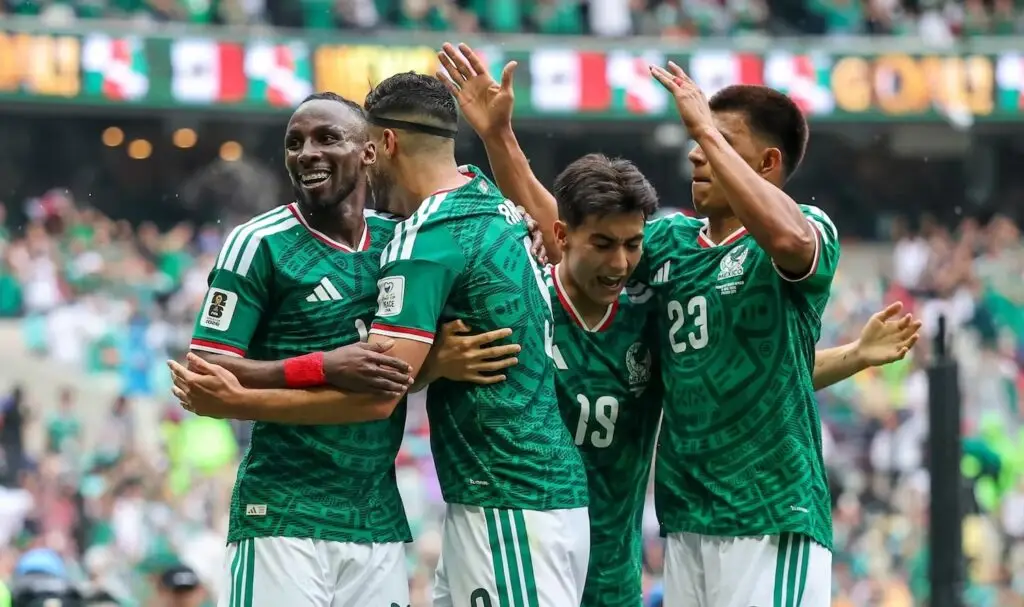 Courtesy of FIFA
The Final Stretch
By the time the World Cup reaches its final phase, it becomes all about Los Angeles Stadium in Inglewood and the final matches.
Even touring the stadium ahead of the tournament, it already feels like a preview of something inevitable. The pitch is real grass stitched into sand and lifted slightly above ground level, making the field feel almost staged inside the space rather than sunk into it. Seating is engineered for closeness, with vertical sightlines designed so there is no bad angle, no visual barrier, no distance that feels accidental.
The video board hangs above everything like a moving skyline, visible from anywhere in the stadium, constantly pulling your attention between the field and the scale of the experience itself. Even the canopy reacts to light and weather, softening the appearance into something that feels less like a fixed arena and more like a venue built to respond to the game.
And the final zones (July 14–15 and July 18–19) expand the moment outward. Fairplex moves the finals inland into a full-scale festival built around the semifinals, third-place match, and final, with interactive exhibits, mascots, and “science of soccer” installations that feel less like a viewing site and more like a temporary world. West Harbor brings it back to the coast, where screens face open water and an active port, crowds set against cargo ships drifting through the background like part of the broadcast. Downtown Burbank closes it at street level, turning the final matches into screenings, street fair energy, and global food that feels structured but uncontained.
PARTNER CONTENT
Liberty Public Market Celebrates 10 Years
Vi at La Jolla Village Brings Good Living to Life
By the end, nothing in Los Angeles feels severed anymore. Stadiums, museums, waterfronts, vintage stores, and city streets all function as one connected grid for the same event, each absorbing a different version of the finale as it passes through.
Maybe that’s the trick. The World Cup 2026 doesn’t begin at Los Angeles Stadium. The tournament begins somewhere between San Diego and Los Angeles, coffee in hand on the Pacific Surfliner, watching the coastline slowly trade one version of Southern California for another.