
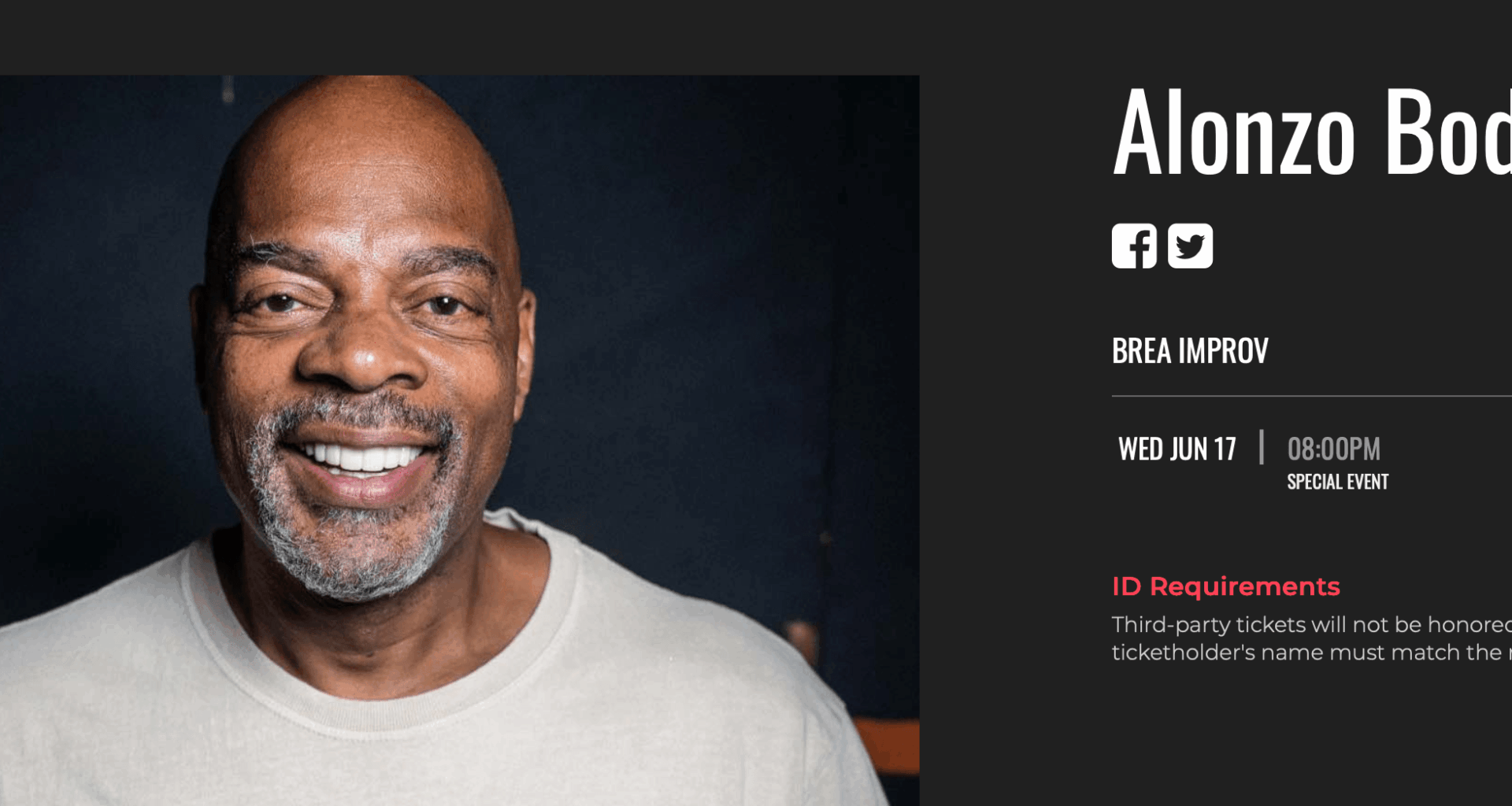
 Alonzo Bodden heads to the Brea Improv for one night only on Wednesday, June 17 at 8:00 pm. A regular panelist on NPR’s Wait Wait… Don’t Tell Me! has been making audiences laugh for more than three decades. Known for his sharp wit, relatable humor, and commanding stage presence, Alonzo Bodden continues to be a favorite on the comedy circuit and television alike. He has written, produced, and starred in several acclaimed comedy specials, including Stupid Don’t Get Tired, Heavy Lightweight, and Historically Incorrect—available on Showtime, Amazon Prime, and YouTube.
Bodden’s career took off after his breakout performance at the “New Faces of Comedy” showcase during the Just for Laughs Festival in Montreal. Soon after, he became a household name as the winner of NBC’s Last Comic Standing. His television credits include appearances on CBS’s Ghosts, ABC’s Dr. Ken and Fresh Off the Boat, and Showtime’s Californication. On the big screen, he’s been featured in Bringing Down the House, Scary Movie 4, and The Onion Movie.
Bodden has also been a guest on numerous talk and late-night shows, including The Tonight Show with Jay Leno, Late Night with Conan O Brien, and Comedy Central’s The Nightly Show with Larry Wilmore, as well as a wide range of popular podcasts. A passionate car and motorcycle enthusiast, Bodden hosted Speed Channel’s 101 Cars You Must Drive and frequently joins Jay Leno on Leno’s Garage.
When he’s not performing stand-up, Bodden brings his quick improvisational style to the music world. He’s a favorite on the signature jazz cruises and has hosted the Capital Jazz Festival in Washington, D.C. Legendary jazz artists like Marcus Miller, Robert Glasper, Christian McBride & Dee Dee Bridgewater have said his spontaneous comedic style is jazz. They also remind him that, unlike them, he hasn’t won any Grammys.
The Fullerton Observer interviewed Alonzo Bodden.
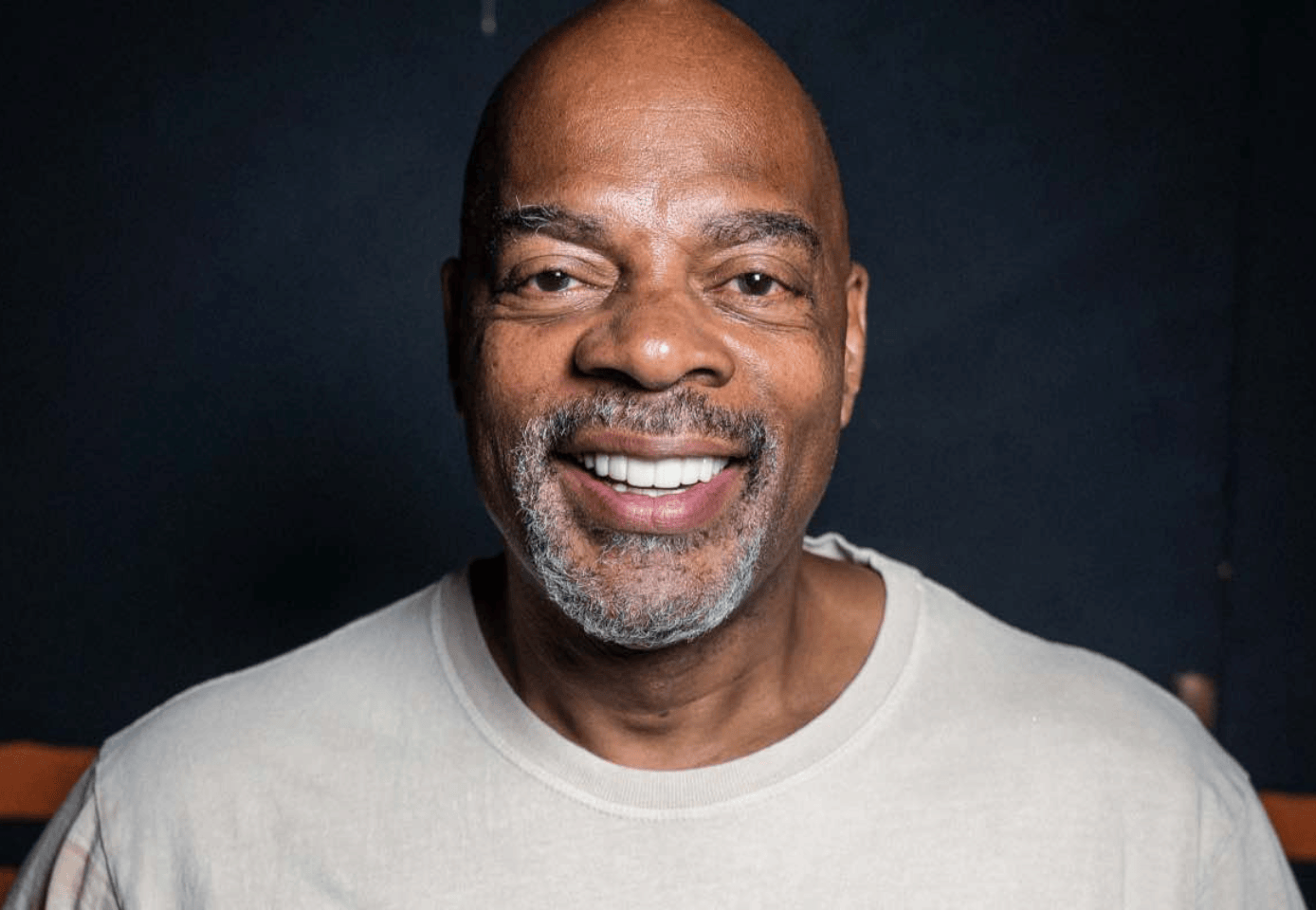 Saskia Kennedy: You used to be an airplane mechanic, is that right?
Alonzo Bodden: Yeah, that was my first career. Long ago, I fixed and built airplanes and worked at Lockheed. I’m the only person on earth who has built the stealth fighter and also entertained flight crews in the Middle East.
Kennedy: What made you change careers?
Bodden: I could always make people laugh. That was always a gift. Then I started training new mechanics. Public speaking is one of the biggest fears people have, but for me, it was the most natural thing in the world. When you put public speaking and being funny together, you start looking at comedy as a career.
Kennedy: It’s an unusual skill to be comfortable in front of a crowd.
Bodden: I think it’s something comics have. Someone once told me we’re comfortable talking to 100 people but nervous talking to one. That’s pretty accurate. I’m definitely introverted unless it’s a crowd. My therapist would tell you that if I go to a party, I leave knowing the same number of people as when I arrived.
Kennedy: What is one of the strangest interactions you’ve ever had with an audience member?
Bodden: There have been so many. One that stands out happened at the old comedy club in Brea. Someone had a seizure during my set. Everything stopped while an ambulance came and took the person away. Then they told me to get back on stage. It was early in my career, so that was the first time I had to figure out how to do material after something like that.
Another time, I asked a woman what she did for a living. She said she was an MP. I assumed she meant military police and joked that she looked a little old for the job. She said, “No, I’m a Member of Parliament.” She was literally a member of the British Parliament.
And then there were shows in Iraq where bombs were going off nearby. The soldiers would say, “That one’s not close.” The comedians were thinking, “That was definitely close.”
Kennedy: How do you maintain your composure when a bomb goes off, or someone has a seizure?
Bodden: You go with it. My favorite thing about comedy is the creativity. I try to live in the moment. You can’t ignore what just happened. Whatever it is, you have to incorporate it and keep going.
I remember performing at the Laugh Factory during the O.J. Simpson Bronco chase. We were doing a comedy show while simultaneously updating the audience on the white Bronco’s whereabouts on the 405 freeway. When you’re new, things like that throw you off. Once you’ve been doing it a while, those unexpected moments can become the most fun part of the show.
Kennedy: You seem willing to address the elephant in the room. Is that something innate or something you cultivate?
Bodden: Sometimes you’re just put in unusual situations. I once did a fundraiser for a hospice. Before we went on stage, they told us everyone in the audience had lost someone at that hospice. Then they said, “Go be funny.” As comedians, we learn to be flexible.
Kennedy: Most people try to avoid talking about uncomfortable realities. Comedians often do the opposite.
Bodden: That’s why audiences appreciate what we do.
Kennedy: How do you go from trying to fit in to standing out?
Bodden: I think every comedian has some part of their personality that gets magnified on stage. Maybe the quiet part becomes loud. Maybe the nice part becomes sarcastic. Whatever it is, something gets turned up.
Kennedy: You’ve worked in stand-up, television, radio, podcasts, and interviews. Which medium do you enjoy most?
Bodden: I really like the radio. I especially enjoy doing NPR’s Wait Wait… Don’t Tell Me!.
Kennedy: You have a great voice for it.
Bodden: Thank you. Television is interesting because it’s its own business. What happens during filming and what viewers ultimately see are often very different things. I have actor friends who love creating characters and costumes. That’s never really been my thing. I just want to be me and say what I want to say. Television involves too many people for that. On the other hand, millions of people can see you, and that’s pretty nice.
Kennedy: How do you decide what topics are worth tackling on stage?
Bodden: Whatever makes me laugh. I talk about things I find funny, stupid, annoying, or interesting.
Kennedy: Do comics have a responsibility to the public to point out how we can be better as human beings?
Bodden: That’s a great question. People criticize comedians for making fun of the government, laws, or corporations. But underneath all of that is the belief that we can do better.
Most comedians are liberal because we expect better. We want democracy to work. We want courts to be fair. We want people to be treated fairly, whether it’s about race, immigration, sexual orientation, or anything else. That’s why we talk about those issues.
Historically, comedians speak for the underdog. They speak for people who aren’t being heard.
I have tattoos of jesters because the court jester was the only person allowed to tell the king the truth. But it had to be funny, or they’d chop off his head. That’s the important part. If it isn’t funny, you’re not doing comedy—you’re preaching. And, by the way, preaching pays better and is tax-free. Don’t think I have considered that career move.
Kennedy: Newspapers try to point out what needs to be improved, too, though usually without the jokes.
Bodden: I remember when news was actually news and not entertainment. I do shows for the Los Angeles Press Club, and it’s always fun to tease journalists about how bad the media has become.
Kennedy: What should people be paying attention to, and how can they become more involved?
Bodden: That’s a tough question. I grew up reading newspapers because my parents believed in staying informed. But not everyone has that luxury. I have friends raising three young children. They don’t have time to follow every story.
People are also exhausted. The country is polarized. Too often, the media gives credibility to nonsense because controversy generates clicks. So what should people pay attention to? As much as they reasonably can.
Kennedy: Does it make your job harder when current events already seem unbelievable?
Bodden: Absolutely. I’ve been saying for years that the hardest part of comedy is creating a reality that’s funnier than the one we’re actually living in. That’s becoming almost impossible.
Today, something you invent as a joke might already be real. Reality keeps outdoing satire.
Kennedy: Many people say comedians make the news easier to digest.
Bodden: That’s probably true. Humor helps people process things that might otherwise feel overwhelming.
Kennedy: Do you write material the day before a show so it’s current?
Bodden: Writing is constant. Whenever something strikes me as funny, I write it down. Then I work it out on stage. Sometimes the idea is funny before it’s polished, and that’s part of the fun.
Tell the folks in Brea that it’ll all be funny, but some of it might still be a work in progress.
Kennedy: It’s impressive how current and spontaneous you are.
Bodden: Thank you. That’s just years of practice. You get better at things when you’ve been doing them for decades.
Kennedy: Do jokes still fall flat?
Bodden: Sure. Usually, it’s not that the joke isn’t funny—it’s that I haven’t figured out the best way to present it yet. Sometimes it takes a year to discover how to communicate what I found funny about an idea.
The difference between a comedian and someone telling a funny story at work is that they can say, “You had to be there.” Comedians don’t get that excuse. We have to bring the audience there with us.
Kennedy: Thank you so much for talking with me.
Bodden: Thank you.