
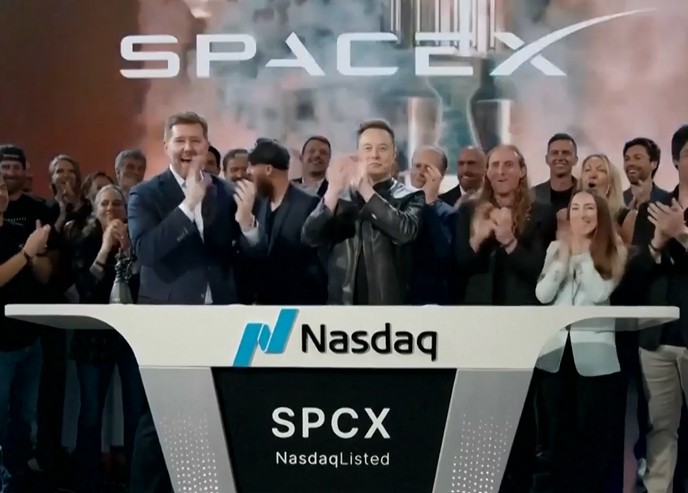
SpaceX shares surged as much as 30% on Friday, reaching over $2.25 trillion in market capitalization and making Elon Musk the world’s first trillionaire.
Though it’s now headquartered in Texas, SpaceX still has many ties to California and the Bay Area. The world’s largest initial public offering is expected to boost California wallets and state tax coffers, enriching over 7,600 Hawthorne (Los Angeles County) SpaceX workers — though not as much as Musk’s financial bonanza.
SpaceX subsidiary xAI is headquartered in Palo Alto and has a San Francisco office in the Mission, coincidentally the ex-headquarters of OpenAI, which is also moving to go public. (Musk co-founded OpenAI and paid its rent.) SpaceX’s X division (formerly Twitter) has offices in Palo Alto and San Jose. SpaceX has 21,000 global employees, but it isn’t clear how many employees the xAI and X subsidiaries have.
SpaceX is already one of the biggest public corporate titans, becoming the sixth-most valuable U.S. public company — nearly double the size of Musk’s Tesla — and making up roughly 3% of the entire U.S. stock market.
Musk owns more than 40% of SpaceX’s common stock, far more than anyone else, but some Bay Area heavyweights have significant holdings. Google’s parent Alphabet owns between 6% to 7.5% of the company, a stake worth around $135 billion to 170 billion on Friday. (Alphabet itself is valued at $4.4 trillion.) San Francisco-based Founders Fund owns around 3% of the company, and Menlo Park-based venture capital giant Sequoia Capital owns around 1.5%, both holdings worth tens of billions of dollars on Friday. Stanford University also has ownership in SpaceX through its investment into Founders Found.
The company’s tax payments are less clear. SpaceX pays California corporate taxes and residents of the state must pay capital gains taxes after they sell stock, ranging from 1% to 13.3%. There’s no current estimate of how much capital gains taxes that California expects to gain, said H.D. Palmer, spokesperson for the California Department of Finance. How many employees decide to sell stock and the timing of sales is impossible to predict, he noted.
“Relative to past IPOs, tax revenues from the SpaceX IPO are likely to be less immediate and more unpredictable. This is because, unlike past IPOs when employees’ restricted stock units became taxable on IPO day, employees at SpaceX have already paid income taxes on their vested restricted stock units,” said Chas Alamo, principal fiscal and policy analyst at the state’s non-partisan Legislative Analyst’s Office. Future tax revenue will depend on the number of pre-IPO investors who sell during the lock-up period and in the future.
SpaceX’s lock-up period allows pre-IPO shareholders to sell up to 20% of eligible shares on the second full day of trading after SpaceX’s first quarterly earnings report. An additional 7% of restricted shares unlock after 70, 90, 105, 120 and 135 days after Friday’s IPO. Amid the AI boom, the analyst’s office previously upgraded the state’s tax revenue outlook by $25 billion last month, but also warned of a potential bubble.
“This upgraded outlook is almost entirely attributable to higher expectations for income tax collections, which are being driven by enthusiasm around AI and the related stock market boom,” the agency said.But staff warned that “we continue to caution that these surging revenues likely are not sustainable. This suggests it would be prudent to approach the state budget as if we are at or near a revenue peak.”
Last year, SpaceX lost nearly $5 billion as it invested heavily in artificial intelligence.
More blockbuster initial public offerings are coming. Anthropic and OpenAI both filed confidentially for IPOs in the last two weeks, and the two AI leaders have valuations nearing $1 trillion each. Both companies are headquartered in San Francisco and thousands of employees are expected to become millionaires or multi-millionaires as a result.