
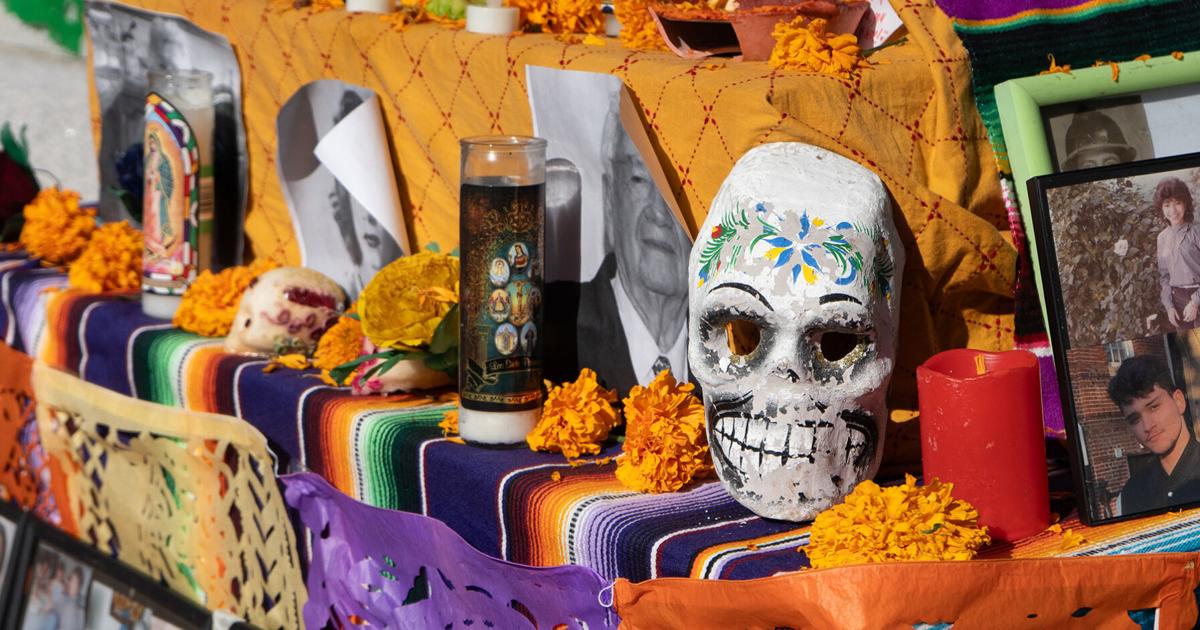
Dozens gathered among marigold flowers, purple petals, small candles and colored decorations for Dia de los Muertos, or Day of the Dead, honoring loved ones who have died. An undertone of resistance laid underneath the varying hues and celebratory displays.
Dia de los Muertos is an approximately 3,000-year-old Mexican holiday rooted in honoring the deceased with food and celebrations. Students gathered at Wurster Hall on Saturday to honor the departed in a Dia de los Muertos altar exhibition with live music and student-made altars.
Campus student Paulette Innamorato created one of the many altars for the annual event. Her altar featured a tree and a sun, aiming to represent a “tree of collective healing,” Innamorato said.
“The roots of the tree represent everything that we’ve endured and overcome,” Innamorato said. “The trunk is the solid strength to overcome the grief we’ve had to endure, and the branches are the light to the next generation.”
According to Innamorato, the piece took her several days to complete and was heavily inspired by the idea that nature is a part of all people. Dedicating her piece to the whole community rather than an individual, she also wrote a three-page description of her creation at the foot of her altar.
The description shared how the altar intended to combine traditional elements of the holiday with Innamorato’s own ideas of healing. She listed things she believes the community needs to remember — such as racism and colonization — reclaim or become.
The poster for the exhibition included phrases “Un mundo sin fronteras,” which translates to “a world without borders,” and “F— ICE” along with a Palestinian flag.
This imagery was reflected in many of the altars, with one containing a chain fence with caution tape. Another altar had barbed wire on top of a wall with images of individuals who died in U.S. Immigration and Customs Enforcement custody, including Lorenzo Antonio Batrez Vargas and Juan Alexis Tineo-Martinez.
“We would not be here today if it were not for our ancestors … the things that they were fighting for, we’re still fighting for today,” Innamorato said. “It’s important to know and to remember where we came from and without remembrance, we can’t move forward. We really need to, in this time, reflect and come together collaboratively to make these changes for a better future for the next generation.”