
What’s at stake?
The Measure P arts grant program promised a new chapter in Fresno’s arts and culture scene, which for year has been starved of civic investment. But two years in, the process is beset with controversy as some still disagree over what types of organizations the program should prioritize.
As the dust settles and the wounds begin to heal from the latest fight over millions of taxpayer dollars for the arts, many Fresno artists and advocates are already gearing up for next year’s funding battle.
That funding comes from Measure P, the three-eighths-cent sales tax that sets aside 12% of its annual revenue for the Expanded Access to Arts and Culture grant program.
From when the first $8.6 million in awards were given in 2024, the grant program marked a never-before-seen civic investment in the arts from Fresno. In a city where both artists and arts organizations have struggled to survive off of Fresno’s philanthropic landscape alone, the 30 years of municipal funds suggested a new path forward.
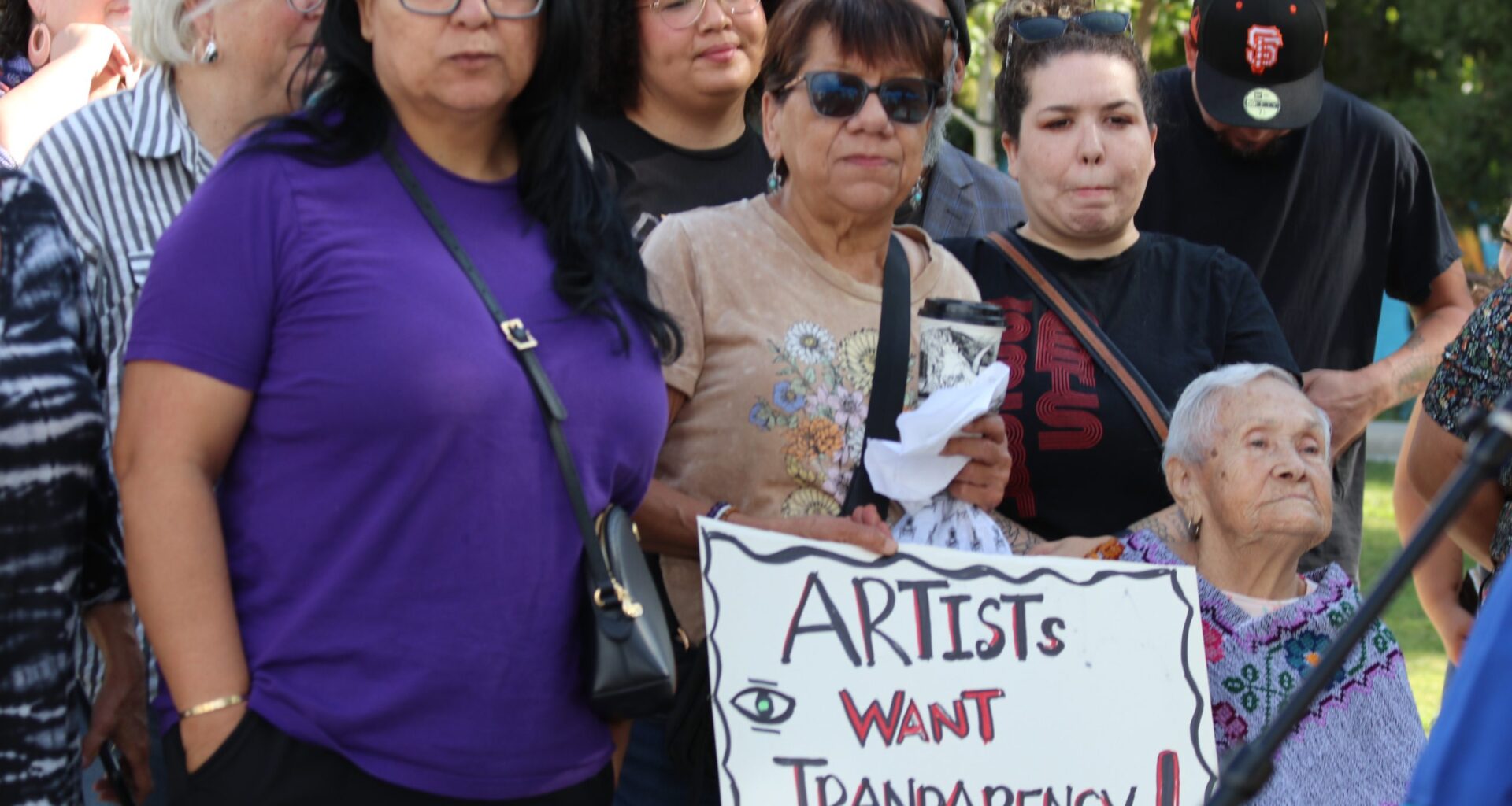
But in its first two years, the program has been beset with controversy and chaos as critics called for pauses to the program in a push for greater transparency and equity in the grantmaking process.
For some advocates like Alicia Rodriguez, those improvements are worth holding out for.
Rodriguez is the co-founder of Labyrinth Art Collective. The organization has been awarded grants to support projects in both years one and two.
As part of a coalition of arts organizations led by their Tower District peer Dulce Upfront, funding delays were a risk she and others were willing to take as they pushed for their demands, including that the city committee making recommendations on how to allocate this year’s $6.3 million funding pool begin meeting publicly — a push that was ultimately successful.
Now that the city’s Parks, Recreation and Arts Commission (PRAC) has approved year two’s grants despite the delays, there are some questions Rodriguez and other advocates want answered before the next cycle begins.
Some of that hinges on a core tension that’s been around since the inception of Measure P: Should it prioritize legacy arts organizations that have served Fresno for decades, or startups that need support to find their footing? Should it focus on sustaining large organizations with bigger bills, or on small organizations that are trying to scale up?
There are disparate answers to that question across Fresno’s arts ecosystem. But not all the visions of how to improve the process are as divisive.
Some suggestions, like coming up with a stipend for the volunteers who review and score dozens of grant applications, have received support from the community coalition as well as city officials — and hinge instead on whether or not the administrator of the grant program, the Fresno Arts Council, can secure additional funding for that purpose.
Despite the already-tense past few months, these debates could come to a head again in the next 60 days, as the opportunity to update grant guidelines will come in December, according to the PRAC.
The 80-20 ratio
On the question of what kinds of organizations should be prioritized in the grantmaking process, year two’s guidelines — which were drafted by the PRAC and Arts Council and approved by the Fresno City Council with some tweaks — offered an answer.
Overall, 80% of the year’s $6.3 million in funding was set aside for so-called “established organizations” to compete for across two categories. Those organizations are ones that pull in anything over $50,000 in yearly revenue — representing a wide range of nonprofits in Fresno, where a handful carry in revenues near $5 million. The remaining 20% was for two categories set aside for “emerging organizations,” or ones with annual budgets under $50,000.
That left emerging organizations fighting for just over $1 million of the available funds while roughly $5 million was reserved for established organizations.
Not everyone was happy with that ratio.
Combine the 80-20 formula with the award amounts the PRAC ultimately recommended — which ranged from 30% to 90% of what applicants requested — and some worry whether the formula is setting up small organizations for failure.
“If the intent was: there’s this pool of money. We want to give these artists and these brand new emerging organizations an opportunity to use this as their stepping stone, then we actually need to give them a stepping stone,” said Erin Burd, executive director of Arts Enrichment for All and two-time applicant in both Measure P grant cycles.
“Not a pebble.”
Critics, including Ome Lopez of Dulce Upfront, also believe the “lopsided” formula failed to expand access to arts and culture in the way Measure P calls for.
“That imbalance,” Lopez said, “it reflects the design of focusing more attention on providing resources to organizations that already have a lot of access to resources.”
But others, including Arts Council Executive Director Lilia Gonzáles Chávez, have questioned some of the pushback. She said she’s concerned there’s a false equivalency between the size of an organization’s budget and whether they reach underserved populations with their programming.
“The ordinance is very clear to say that it wants to support and sustain existing organizations and increase access to the parts for underserved populations,” she said. “That doesn’t say that some organizations are responsible for serving (the) underserved more than others.
Leaders of larger arts nonprofits have also challenged the idea that established organizations don’t need the funding — revenues are higher, but so are expenses.
“No one is going to be sitting back with their feet up, thanks to Measure P,” said Arianna Paz Chávez, the executive director of Arte Américas and daughter of the Arts Council’s executive director Lilia Gonzáles Chávez.
Since the 80-20 formula comes from the grant guidelines, that is something that can be debated and changed going forward.
Commissioner Laura Ward, who sits on the PRAC, hopes people come to the table to discuss what different formula they would like to see.
“If a lot of people who care about this participate and say 80-20 is not right for year three, we should look at a different allocation for year three,” she said. “Then, that is what we would recommend.”
Deciding who’s in charge of the funds
Over the past two years, tensions have mounted over these and other criticisms of the program administrators for bias and inadequate transparency.
These unresolved debates have left some questioning what happens if no compromise is reached.
“If we don’t find a way to move forward as an arts community, then we do create the perfect opportunity for the city to bring this process in house,” said Chávez, the Arte Américas director.
“And then we all lose.”
In the Measure P ordinance, the Fresno Arts Council is named as the administrator of the grant program. The city approved a five-year contract with the Arts Council to perform those duties in August 2023.
Lopez said that while she wants to see a change in leadership at the Arts Council and a third-party assessment of their ability to manage the grants, she stopped short of saying any other organization in particular should take over.
Gonzáles Chávez defended the Arts Council’s role as a “credible administrator” of the program that’s better poised to run it than any other local agency.
“There is no other entity that has the years of experience doing this work,” she said, “whose sole purpose is to advocate for and support local artists.”
It’s unclear how much of an appetite the city council has for adding this onto their already stacked plate as policymakers. Council leadership shared mixed opinions with Fresnoland about the idea.
Council Vice President Miguel Arias said despite the ongoing need for improvements to the process, Measure P “thoroughly outlined the role of the Arts Council and the arts community undertaking this difficult task.”
“I think it should remain there,” he said.
Council President Mike Karbassi said in a text message that after hearing serious concerns from constituents over the process, he hasn’t made up his mind on whether he would support “any changes to the current arrangement” with the Arts Council.
“I will make that decision when this item returns to the Council for consideration,” he said.
“The Arts Council is a very important organization with good intentions,” he added. “I just want to ensure that practical application of the grants process is within the spirit of Measure P and the goals of the Council when we approved an operating agreement with the Arts Council.”
Public meetings? Paid panelists? Rolling grant cycles?
Despite no shortage of tension, there are some proposed changes to the grantmaking process that are less polarizing.
A key change community advocates championed was making a three-person subcommittee of the PRAC — which was responsible for determining grant amounts for applicants before recommending those to the full commission — meet in public, instead of behind closed doors.
That change was implemented for the subcommittee’s final meeting. Ward, a supporter of the change, said she hopes the PRAC will take action to keep that subcommittee public in the next grant cycle.
There are also several supporters of the idea of paying the panelists that review and score applications. In years one and two, those panelists did that work for free.
“Panelists should get paid, even if it’s a small stipend. It at least puts some regard to the process,” said Rodriguez.
Leaders with the community coalition and the PRAC have also voiced support for staggering the timeline of the different grant categories so not all of them are being decided at once.
“It’s just been such a rush,” Ward said. “It’s a ton of pressure on one process where we’re distributing all of the money at one time.”
For these suggestions, it’s not about reconciling disparate viewpoints. It’s about finding the funding.
Paying panelists is something the Arts Council has already looked into, for instance, Gonzáles Chávez said. But that money can’t come out of the Measure P arts funding due to ordinance requirements. Instead, the Arts Council will have to seek either additional funding from the Fresno City Council or an external grant to subsidize the stipends, she said.
As for implementing rolling grant cycles, that’s also something they need to work out with staff logistically, who oversee multiple different programs throughout the year — not just the Measure P grants.
Opportunities for feedback
Some of the most vocal critics of the process worry whether they’ll face retaliation from the Arts Council.
“I’m honestly curious about how difficult this process is going to be now that I’ve spoken out,” said Rodriguez of Labyrinth.
Regarding people’s fears of retaliation, Gonzáles Chávez said that shouldn’t be a concern, especially since the Arts Council is not in a position to retaliate against applicants in her view.
“Staff of the Arts Council is so removed from the actual scoring” of applications during panel reviews, she said. “Our role is to facilitate the process, respond to questions (and) provide information if there appears to be a misunderstanding or lack of information.”
She added that she’s open to talk with anyone, though adding she doesn’t “appreciate personal attacks.”
The Arts Council’s first step toward gathering feedback on the process and grant guidelines was to send out an online survey to all 134 applicants that received funding in this last cycle.
The Arts Council also plans to host a series of public meetings in the next few months “where the sole purpose will be to accept input from the public on ideas for improving the process.”
Related