
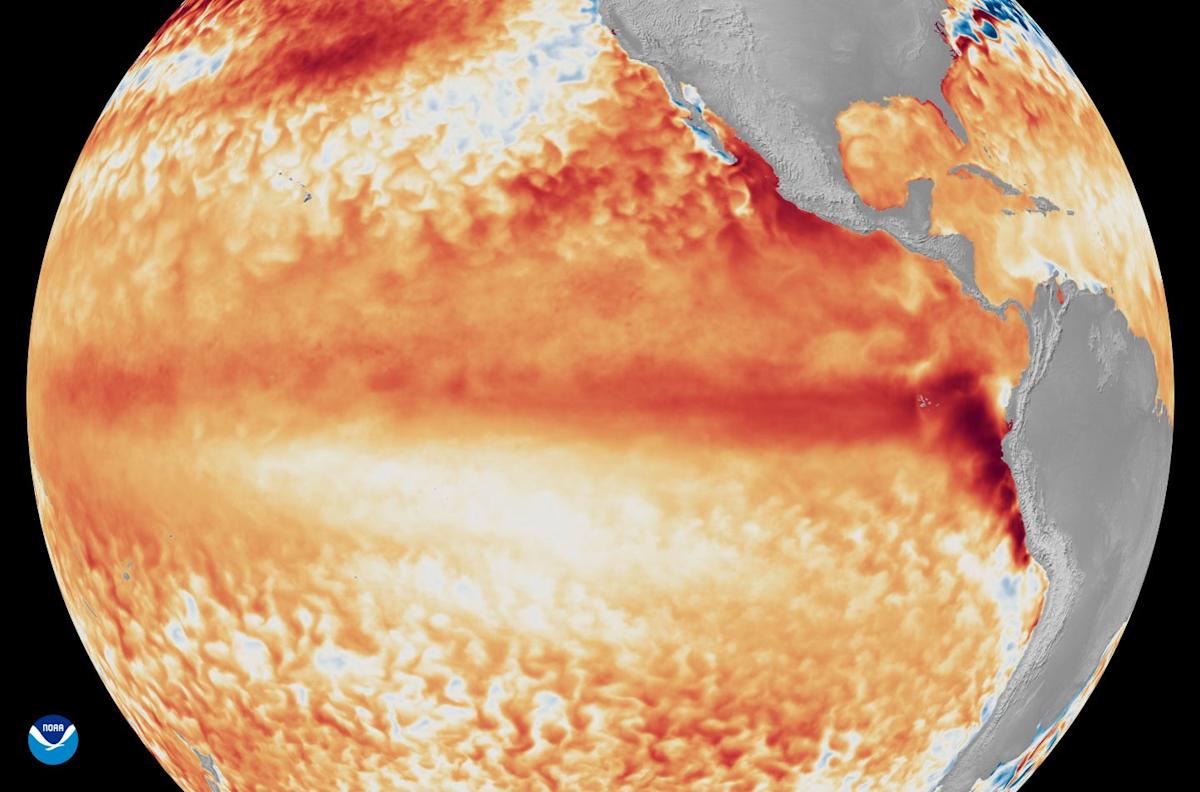
Federal forecasters say El Niño is officially underway — and for California, that likely means a wetter, stormier winter with high stakes for flooding, infrastructure, and the state’s already volatile water cycle.
Globally, the climate pattern — driven by unusually warm Pacific Ocean waters — has a track record of causing trillions in economic losses. Experts warn this one could rank among the most expensive on record as shifting weather disrupts agriculture, supply chains, and economies worldwide.
A 2023 study found past El Niño events triggered massive global income losses, including about $4.1 trillion after the 1982–83 event and roughly $5.7 trillion after the 1997–98 event.
“The current forecasts imply this could be the costliest El Niño on record,” said Justin Mankin, a Dartmouth geographer who studies its economic impacts.
Here’s what to know about El Niño’s potential effect on California and the global economy.
Impact of El Niño on California
For California, El Niño typically tilts the odds toward wetter, warmer winters — but the real-world impact can vary widely depending on storm tracks and intensity.
Here’s what to watch across the state:
Heavy rain and flood risk
Southern California and parts of the Central Coast often see above-normal rainfall during strong El Niño years
That raises the risk of urban flooding, debris flows and dangerous conditions in recent burn scar areas
Reservoirs may refill quickly, but rapid inflows can strain flood-control systems
Snowpack and water supply swings
Warmer storms can mean more rain and less snow in the Sierra Nevada
That can reduce long-term water storage even if overall precipitation rises
Water managers may face a familiar California whiplash — from drought concerns to flood control in the same season
Infrastructure and road impacts
Heavy storms can damage roads, trigger landslides and slow transportation networks
Coastal erosion and high surf events can also threaten shoreline infrastructure
Agriculture upsides and risks
Some crops benefit from increased moisture after dry years
But too much rain can delay planting, damage fields and increase disease pressure
Farm labor and supply chains can also be disrupted during prolonged storms
Wildfire implications
Short term, wetter conditions can reduce fire risk
But increased vegetation growth can create more fuel that dries out in future seasons, setting up longer-term fire concerns
How does El Niño impact the global economy?
El Niño tends to slow down global economic growth and cause trillions in losses, primarily due to the fact that it triggers disruptive weather patterns that impact agriculture, infrastructure, and supply chains.
In the years it forms, El Niño triggers wide-ranging changes in weather and climate patterns that result in a potpourri of global disasters, including devastating floods, crop-killing droughts, plummeting fish populations and an uptick in tropical diseases worldwide, experts say.
“El Niño is a major driver of global weather and climate patterns,” said World Meteorological Organization Secretary-General Celeste Saulo, in a recent statement. “The footprint of an El Niño travels far beyond its origins in the Pacific Ocean, impacting agriculture, energy supplies, trade, water resources, supply chains, and livelihoods across entire regions.”
How El Niño costs stack up
It’s important to recognize that the trillions in losses are not primarily due to immediate disaster damage. Mankin found in his research that these events are a persistent drag on economic growth.
The hazards from El Niño, like droughts, floods, heat waves, and wildfires, trigger immediate damages, but the lasting costs come from what they do to the foundations of growth, such as:
Agricultural losses that carry into later seasons
Interrupted labor
Interrupted schooling and childhood development, which surfaces in the workforce years later
Disruption to commodities markets and the transport sector
Investments that never happen because of the shock
 Although each El Niño can bring different impacts, this World Meteorological Organization graphic shows some of the worldwide impacts that could occur later in 2026. How costly will this El Niño be?
“We know from observations that El Niños can cost the global economy trillions of dollars in damages and lost productivity,” Mankin told USA TODAY. “These costs accrue over years and disproportionately impact countries whose weather and climate is most tied to El Niño.”
“We know that past El Niños, like the 1997-98, cost the economy over $7 trillion by 2003.”
Mankin said that the current El Niño will cost trillions of dollars globally, with more than $1.8 trillion of that in the U.S. alone by 2032.
Because we don’t know precisely how strong this El Niño will become, he said, we don’t know how costly it will be.
El Nino arrives: Satellite image shows warmer-than-average sea-surface temperatures at the equator in the tropical Pacific Ocean (depicted using various shades of red and orange for warmth) during the first week of June 2026. Could this El Niño be the most expensive ever?
“In absolute dollar terms, yes, the current forecasts imply this could be the costliest El Niño on record,” Mankin said. “The current forecasts have El Niño strengthening to over 2 degrees C (3.8 degrees F), which is a very strong event if it pans out.”
At the same time, he said the event is impacting a larger global economy than the last El Niño, so there is more to be damaged. Both of these factors are why the 1997-98 event cost more than 1982-83 one. But while a stronger event raises the odds and the probable scale of impact, the total won’t be known for years because losses compound over time.
“In terms of its relative impact (for instance, as a percent of the current global economy), it will really depend on how strong the event ends up being.”
Some specific impacts to watch
Low rainfall is bad news for some crops: “El Nino is likely to have a negative impact on crop yields in Southeast Asia and India, where El Nino is typically associated with below-normal rainfall,” said Kyle Tapley, enterprise sales executive at Vaisala Xweather’s WeatherDesk. Meanwhile, Indonesian rice farmers are racing to get ahead of the usual planting schedule as they battle the threat of a lengthy dry spell this year. Malaysia’s economic minister warned that El Niño could cause crop yields to fall by an average of 8% to 10% this year.
Fertilizer shortages are a worry: “A Super El Niño, combined with the current Middle East conflict and resulting fertilizer shortages, could have a multiplier effect on wheat, rice, and corn, which are already at risk due to reduced fertilizer availability during the planting season,” said Saskia van Gendt, chief sustainability officer with Blue Yonder, a supply chain management company, in an e-mail to USA TODAY. “This will result in near-term shortages and price increases, along with a prolonged impact, since these crops are used as animal feed and in processed foods.”
Flooding is also a concern in some areas: “During El Niño, increased rainfall is predicted to increase flooding, which may slow transportation and result in higher transportation costs,” van Gendt said. “In other areas, El Niño may worsen droughts and restrict waterways. In 2023-2024, El Niño contributed to low water levels that limited passage through the Panama Canal.”
There is some good news. Some areas actually see an agricultural boost from El Niño: “Some agricultural regions (eastern Brazil, Uruguay, Italy, Romania, and the Caspian Sea region) could see improved crop yields due to warmer temperatures and increased rainfall,” according to van Gendt. “Historically, soybean crop yields have improved during El Niño events.”
And experts say the negative effects of El Niño won’t show up immediately. Van Gendt explains: “It usually takes several months for crop disruptions to translate into higher retail food prices, but consumers may experience earlier cost increases or combined cost increases due to fertilizer shortages. The World Economic Forum predicts that current fertilizer shortages will take six months to a year to affect food supply.”
What is El Niño?
El Niño is a natural climate pattern in which sea surface temperatures in the central and eastern tropical Pacific Ocean are warmer than average. El Niño and its counterpart, La Niña, can influence storms and weather patterns around the world, including hurricanes.
El Niños occur on average about every three to five years and vary in strength, according to the National Oceanic and Atmospheric Administration.
Here in the United States, El Niños typically result in wetter, warmer winters for the West Coast and a milder hurricane season for the Atlantic seaboard.
This article originally appeared on Palm Springs Desert Sun: Why El Niño threatens California’s economy and supply chain