
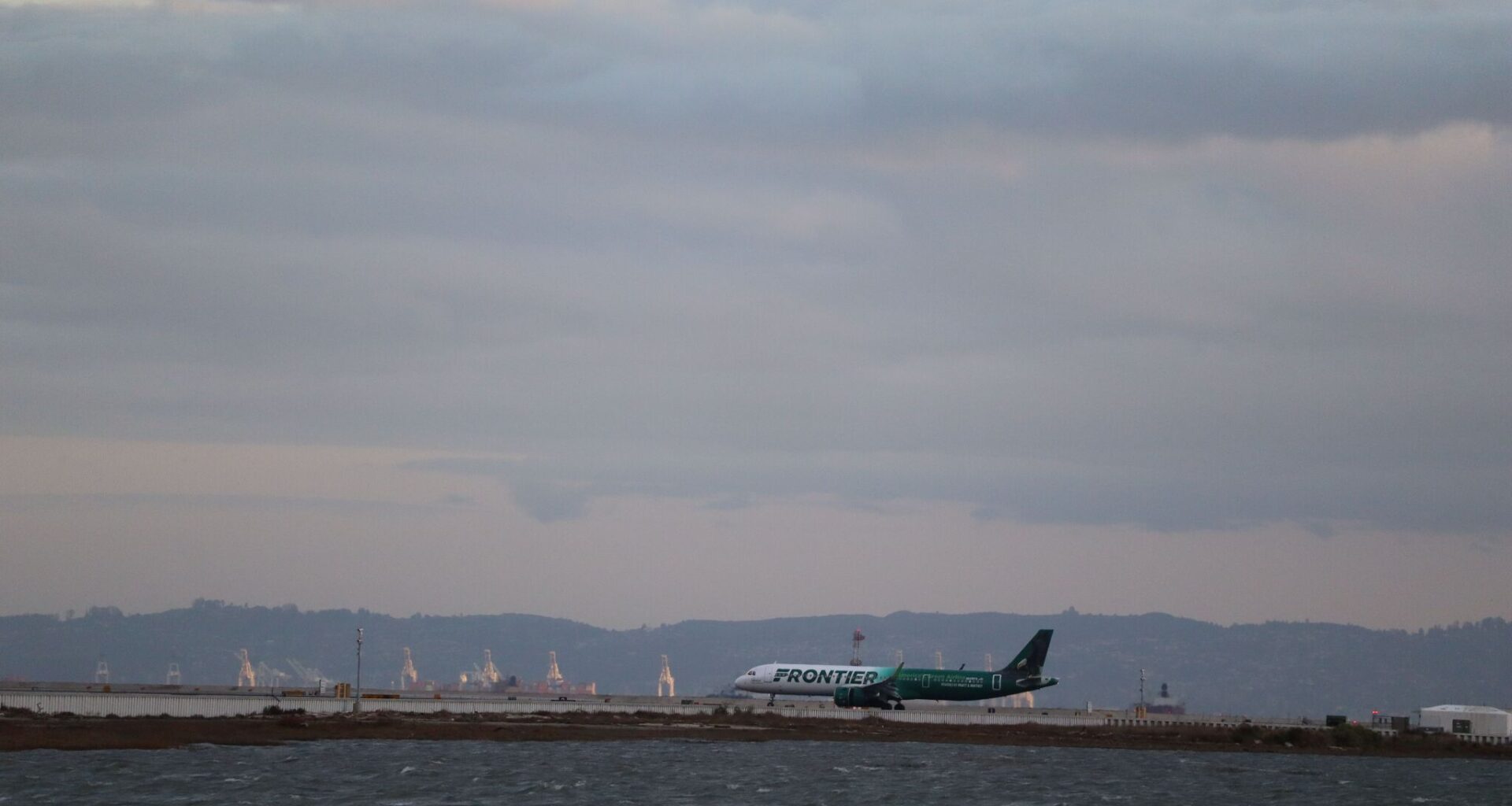
A Frontier Airbus A321neo arriving at San Francisco Airport, with Oakland’s scenic backdrop.
Wirestock/Getty Images
In the latest air travel news, a major low-cost airline is coming back to Oakland after a three-year hiatus; airfares continue to rise sharply with no relief in sight as energy industry executives warn that oil prices “are about to soar”; world airline group says the industry’s profits will be cut in half this year due to fuel prices; United Airlines plans to upgrade the dining experience in its Polaris cabins this summer with the help of a San Francisco chef; American’s Oneworld Alliance is adding another Asia/Pacific carrier to its membership; Delta faces a regulatory delay as it works to deploy new and improved aircraft on its prime transcontinental routes like SFO-New York JFK; American matches Delta in adding Fox One streaming channel to in-flight entertainment as FIFA World Cup matches start; Southwest Airlines adds another interline partnership with a leading foreign carrier.

Frontier Airlines is coming back to Oakland after it ended all service out of the East Bay airport in 2023. The low-cost carrier announced this week that it will launch new service from Oakland to Las Vegas starting Aug. 20, operating 11 flights a week. Frontier is offering a one-way fare of $49 on the route with a purchase deadline of June 16, good for travel “on select days of the week” through Nov. 19. The Points Guy noted that the Oakland-Las Vegas route was previously served by Spirit Airlines before it stopped flying early last month.
Article continues below this ad
Aircraft refuel at Tullamarine Airport in Melbourne.
Fairfax Media via Getty Images
The cost of airfares just keeps going up as the Iran war drags on. When the Bureau of Labor Statistics issued its consumer price index for April last month, it showed that cost of airfare had gone up 20.7% year over year, a much higher increase than most components in the index. Now the May numbers are out, and they put the 12-month increase in airfares at 26.7%, according to the New York Times. The increase in the overall Consumer Price Index for May was 4.2% — trivial compared with the jump in airfares, but still the index’s highest increase in three years. Before the war started in late February, the annual increase in the CPI was just 2.4%. One Mile at a Time’s Ben Schlappig notes that the 12-month 26.7% jump in airfare is misleading: From April through December of 2025, he said, airfares actually dropped just slightly, but from January through May of this year they increased 30%. And Schlappig suggests that consumers shouldn’t expect any relief even after hostilities cease: “The airline business is tough, and it’s understandable that airlines have to recoup some of the increased oil prices. However, airlines insist they plan to keep around these higher fares even when oil prices drop.”
And oil prices could rise even higher before they drop. The U.S. and other nations have been releasing oil from their national reserves to partially offset the major drop in supply, but those reserves are running low. The Washington Post this week reported that oil and gas executives have been warning the White House about this in recent days: “Industry officials say they are doing everything they can to sound an alarm that prices are about to soar as the commercial and government inventories that have mitigated price rises so far are rapidly depleting, according to multiple people familiar with the conversations, who spoke on the condition of anonymity for fear of retaliation from the administration. Some inventories could be wiped out within weeks, the executives have warned, coinciding with the peak summer travel season.”
Article continues below this ad
Profits at the world’s airlines are expected to drop by almost 50% this year, according to the International Air Transport Association, the industry’s trade group. Outgoing IATA Director General Willie Walsh told the group’s annual meeting this week that because of the ongoing conflict in the Middle East, average jet fuel prices are running 70% higher than in 2025, which means airline net profits will drop to $23 billion from last year’s $45 billion, and the industry’s profit margin will fall from 4.2% to 2.0%. “The positive however, is that demand is holding up, even as airlines are raising fares and rates to cope,” Walsh said. “But growth will inevitably be slower, 2.1% for the passenger business and 0.7% for cargo.” He noted that despite higher ticket costs, very few travelers expect to reduce their spending on air travel, as IATA’s consumer polling has found that 49% of travelers expect to spend more this year and 43% plan to spend about the same as they did in 2025. “That bodes well for a strong northern summer peak season,” Walsh said. “The big unknown is how long travelers and shippers can tolerate the higher costs of connectivity.”
A flight attendant passes out refreshments on a flight from San Francisco to Newark, N.J., in October 2020.
Michael Loccisano/Getty Images
Passengers in United Airlines’ Polaris international business class will see a big enhancement of their in-flight dining starting Aug. 1. That’s when United kicks off a collaboration with the Netflix series “Chef’s Table” — one that will bring new Polaris menus curated by 11 “world-renowned chefs” affiliated with the show on “select long-haul routes,” United said. “Each chef developed an in-flight menu inspired by the United city they call home.” The list of chefs includes San Francisco’s David Barzelay, who owns three restaurants in the city — the Mission District’s Lazy Bear, which earned two Michelin stars, along with JouJou in the Design District and True Laurel, also in the Mission District. “The collaboration also includes exclusive, original branded content for United’s inflight entertainment that shows how the airline and world-renowned chefs produced the menus and meals,” as well as “Chef’s Table” video podcasts featuring interviews with the chefs, the airline said in a news release. View from the Wing’s Gary Leff suggests it’s about time the airline overhauled its front cabin dining product: “This is important because it’s a place where the United Airlines premium product has lagged, and because customers no longer choose only on schedule and price,” he noted.
American Airlines’ global Oneworld Alliance plans to add Philippine Airlines as its newest member. PAL this week signed a memorandum of understanding that it will join the group as its 16th member, bolstering Oneworld’s presence in Southeast Asia and adding 31 new destinations to its network. Besides American, leading carriers in Oneworld’s membership include Alaska/Hawaiian, British Airways, Iberia, Cathay Pacific, Japan Airlines and Qantas. Once PAL’s membership is completed, customers of other Oneworld airlines will be able to earn and spend loyalty program miles on Philippine Airlines flights, and elite-level loyalty members will get their usual special perks on those flights — with reciprocal treatment on Oneworld carriers for members of PAL’s Mabuhay Miles program.
Article continues below this ad
United Premium Plus, the airline’s premium economy product, with privacy dividers and built-in reading lights.
Tim Jue Special to SFGATE
We’ve reported previously on how both United Airlines and American Airlines are bringing new planes with enhanced seating configurations to their prime transcontinental routes this year — routes like San Francisco-New York JFK (AA) and SFO-Newark (United). Delta Air Lines has been working for quite a while on a similar effort to bring new Airbus A321neos into service in those premium markets, but now it appears that regulatory delays are pushing back Delta’s plans — perhaps as far as 2028. The problem, according to View from the Wing, is that the new Safran Vue business class seats Delta expected to use in those aircraft still haven’t been certified by the Federal Aviation Administration after a two-year wait. Delta might have to wait another two years for that approval, View from the Wing reported, so the airline is now considering a switch to seats from a different supplier — Thompson Aero’s VantageSOLO seats.

Stay informed, and entertained.
By signing up, you agree to our Terms Of Use and acknowledge that your information will be used as described in our Privacy Policy.
Those seats have already been certified for use in JetBlue’s A321XLRs, so they would just need certification for Delta’s planned configuration in the A321neo. But even if Delta changes business class seat suppliers, it still might not have new lie-flat seats in its A321neos for a couple of years, View from the Wing said — leaving it far behind United and American in offering a new premium product for transcontinental business flyers. In the meantime, Delta has temporarily filled up the front of those aircraft with a whopping 44 domestic first class reclining seats “so that they could at least fly on routes from Atlanta to Los Angeles, San Francisco, Seattle, and San Diego rather than leaving the aircraft parked,” View form the Wing said.
Article continues below this ad
In April, Delta added Fox One to its Delta Sync in-flight entertainment programming, and now American Airlines is doing the same. Why Fox One, and why now? Because Fox One is the official English-language streaming platform for the 2026 FIFA World Cup, which started this month. American said that as of this week, “AAdvantage members can enjoy FOX One for 24 hours free, no credit card required, up to seven times in a calendar year,” including all World Cup matches, on AA domestic flights. Members can connect to the airline’s in-flight Wi-Fi with their AAdvantage login, pick Fox One from the homepage, and follow Fox One registration instructions in order to watch the channel.
Southwest Airlines passengers walk through Los Angeles International Airport on May 13, 2026.
Justin Sullivan/Getty Images
Southwest Airlines, which has been adding international carrier partnerships in recent months, just announced another one: Singapore Airlines. The interline partnership promises seamless connections and single ticketing for customers of both carriers when they link up their itineraries through three U.S. gateway airports served by Singapore and Southwest — San Francisco International, Los Angeles International and Seattle-Tacoma International. Interline itineraries can’t be booked through Southwest, however: “Tickets are available through Singapore Airlines, travel agents, and travel websites,” Southwest said. Other foreign carriers that have signed on as interline partners with Southwest include Icelandair, Turkish Airlines, Japan’s All Nippon Airways, Germany’s Condor, Taiwan’s China Airlines and EVA Air, and Philippine Airlines.
Article continues below this ad