
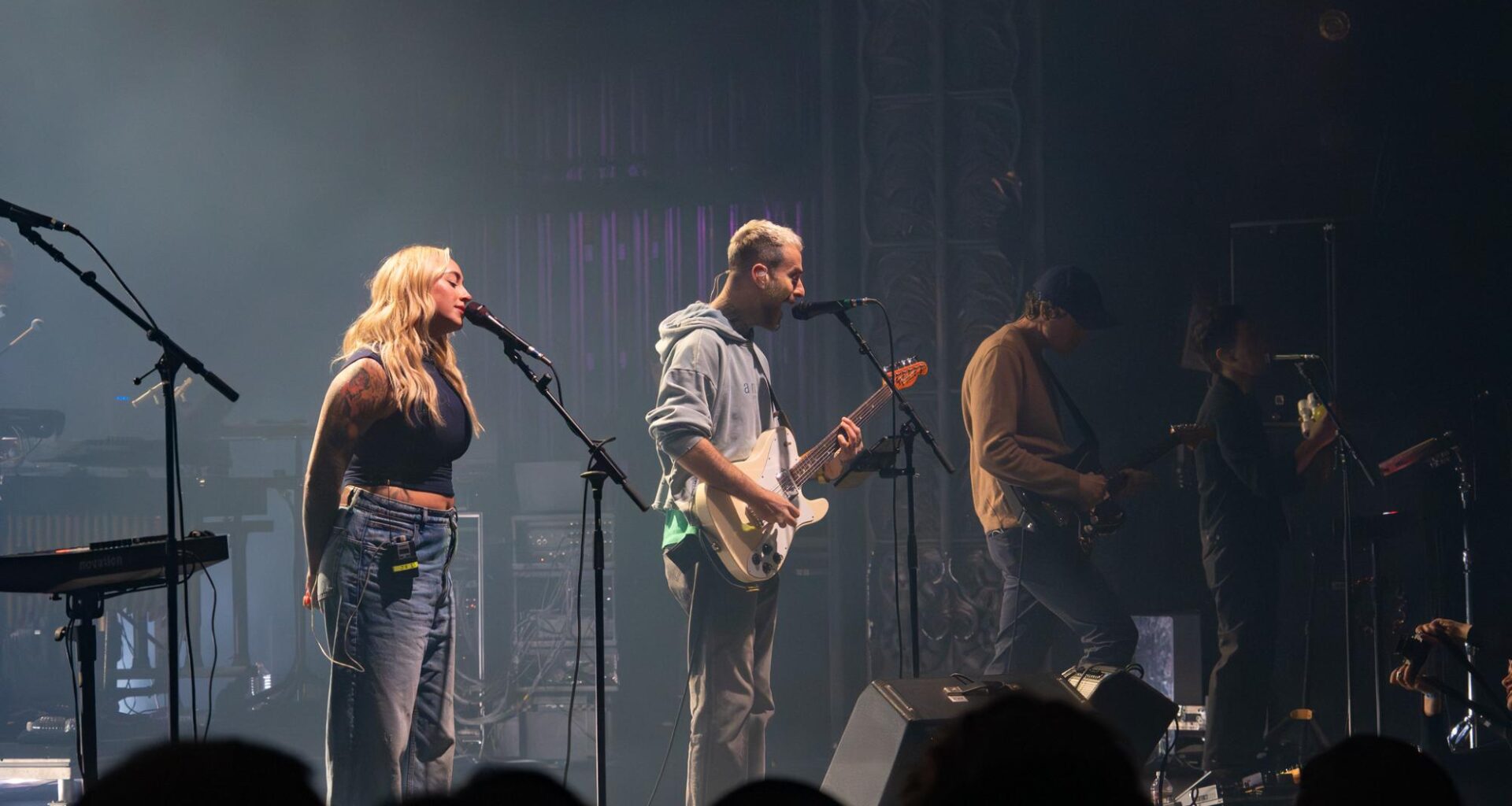
Live music is transportive; it serves as both an escape from distractions and a reminder to stay present. Attending a concert challenges the allure of listening to music alone: There is power in sharing a space and consuming media with others. Such was the case at popular Midwest emo band American Football’s show at The Observatory North Park on May 24.
Under vibrant LED lights and dramatic smoke, the crowd synchronously nodded along to the band’s emotionally and instrumentally intricate songs. The audience featured a vast range of ages, from Generation Z to Generation X folk. Despite this generational difference, the entire sold-out venue felt connected as every person cherished the live music together.
American Football’s musical catalogue largely explores the tribulations of getting older and navigating relationships with a nuanced tone. Through its work, the band critiques the advent of hustle culture, nonchalance, and the omnipresent internet.
In a backstage interview with The UCSD Guardian, American Football drummer and trumpet player Steve Lamos described our present day as “a time where everything feels like it’s a sort of crisis.”
Perhaps that’s why American Football attracts 1.5 million listeners monthly — the band speaks to an era before the digital age pervaded everyday life.
The track “Everyone Is Dressed Up” from “American Football (LP2),” for example, highlights the tension between fast-paced, technology-ridden lifestyles and genuine relationships: “Our love will surely be forgotten by history and scholars / Forever lost in time’s currents.”
After American Football released its first LP, “American Football (LP1),” in 1999, the band didn’t return to the music scene until 2014. Since then, it has released three other projects and is currently touring its most recent album, “American Football (LP4).”
This show was the group’s first at The Observatory since 2018. The diverse yet cohesive setlist consisted of a combination of new songs from “American Football (LP4)” and past records, including American Football’s breakout hit “Never Meant” from its first album and “Bad Moons,” the lyrical pinnacle of its most recent one. The melodic instrumentals flowed together and were enhanced by the audience’s excitement, especially when Lamos picked up the trumpet.
The band also made space for more contemplative moments, such as during the instrumental “The One With the Wurlitzer.” With velvety trumpet and soft guitar notes, this two-and-a-half-minute interlude exuded ambient harmonies that set a serene tone, albeit with a touch of heartache.
Although American Football first released music almost 30 years ago, its fandom substantially grew years after, hence the variety of concertgoers at The Observatory. Midwest emo is a rock subgenre with bittersweet memories, growing pains, and suburban blues at its focal point. Regardless of different bands’ interpretations of such categorical topics, throughlines of melancholy define Midwest emo.
Through wistful descriptions of liminal spaces and coming-of-age tales in late ‘90s and early aughts-era America, the Midwest emo genre, and American Football’s specific sound particularly, appeals to younger listeners who yearn for a simpler time.
As the retroactive concept of Midwest emo music gained popularity in the last decade or so, listeners began to feel a sense of connection to the genre. It satisfied the longing many felt for a time not too far away yet distinctly different from the present.
“For even your age, the ‘90s, late ‘90s, early 2000s represents a time when we had technology, but it hadn’t quite overdetermined what everybody does,” Lamos said.
In this vein, Lamos described Midwest emo as an “interesting invention of a revision of history.”
“Certainly people didn’t use the term; Midwest … emo was like a throwaway term,” Lamos said when reflecting on the band’s start in Illinois. “Now, it’s like a term of pride.”
Sonically, American Football utilizes guitar arpeggios — playing individual notes of a chord instead of strumming them all at once — as well as jazzesque chords.
“In a time of autotune and everything else, the plinky guitars and warbly drums and vocals and everything seem authentic instead of mass produced,” Lamos said.
These techniques shone throughout the show, notably in the concert’s opening track, “Man Overboard.” Guitarists Mike Kinsella and Steve Holmes’ dynamic picking, Lamos’ drumming, and Kinsella’s vocals demonstrated what American Football does best: create various highs and lows within a piece by manipulating typical sonic landscapes with musical inflection points. The unexpected ebbs and flows set the stage for an engaging concert experience: The audience never quite knew what was coming next.
As soon as Kinsella and Holmes played the opening notes of “Never Meant,” the last track before the four-song encore, the crowd broke out in ecstatic cheers. Unlike a solo listening experience, being among the sea of people in this moment felt familial.
While American Football’s music definitely emulates nostalgia, the captivating lighting, intriguing instrumentation, and lively company at The Observatory compelled the crowd to embrace the moment and experience the music viscerally. Whether someone is new to the band or a life-long listener, they can resonate with American Football’s discography and enjoy a worthwhile performance at its next concert.