
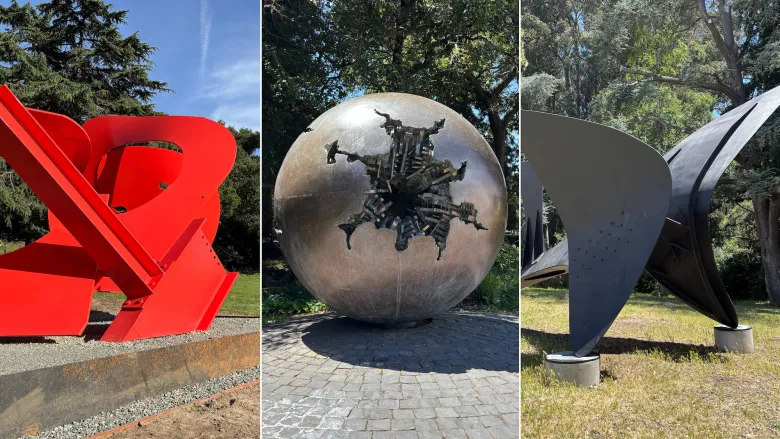
 BAMPFA sculptures on the Cal campus are, from left, by artists Mark di Suvero, Arnaldo Pomodoro and Alexander Calder. Credit: Beverly Bradley
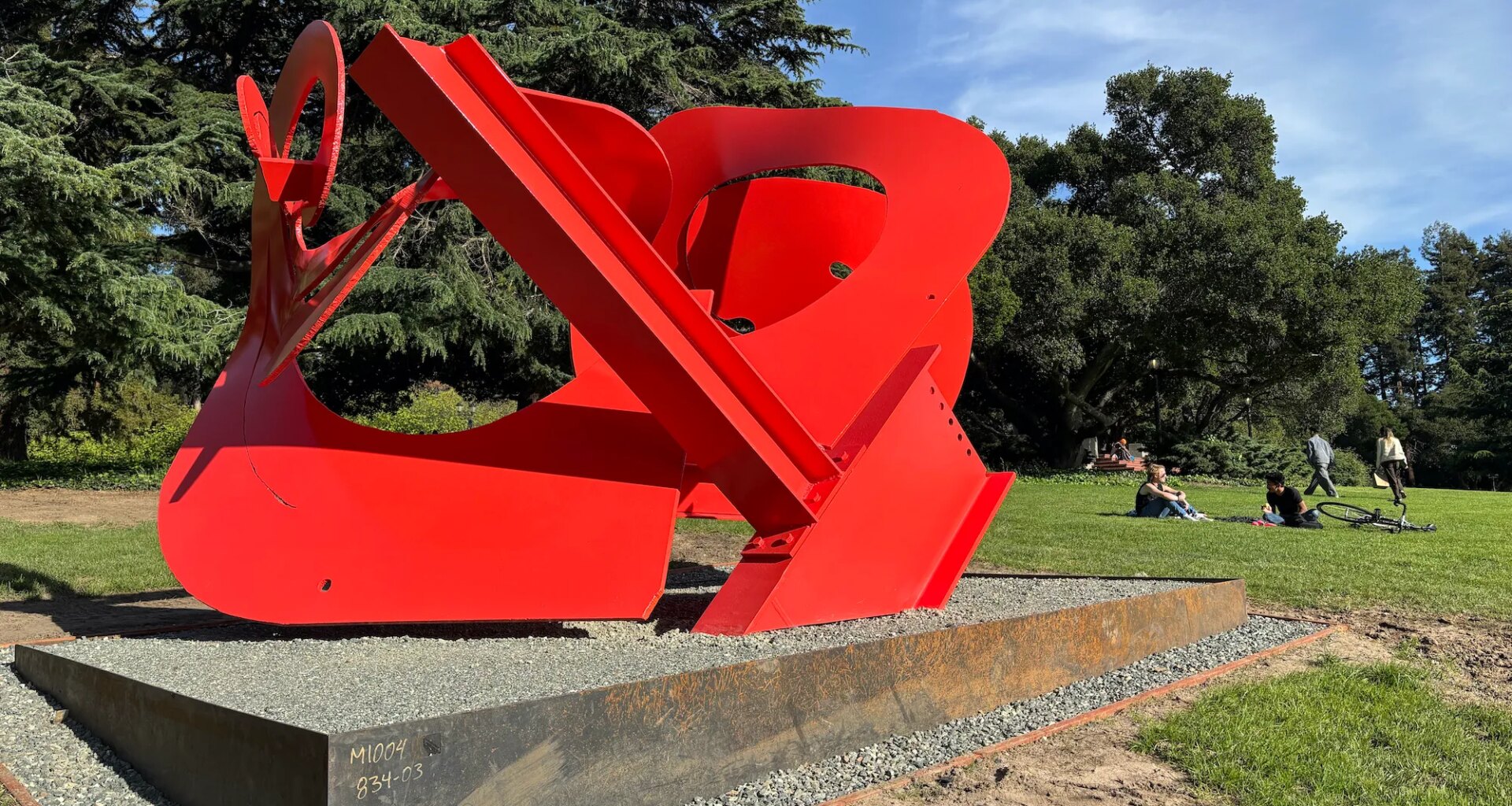
A bold burst of orange-red steel now rises from the Crescent Lawn at the west edge of the UC Berkeley campus along Oxford Street. This majestic new arrival is “Mamma Mobius,” a large-scale artwork by Mark di Suvero, one of the most celebrated American sculptors of the past half-century — and a UC Berkeley graduate whose artistic journey began on campus.
Recently acquired by the Berkeley Art Museum and Pacific Film Archive, “Mamma Mobius” is a permanent installation on Crescent Lawn. The work takes its inspiration from the Möbius strip, a mathematical form with only one side and one edge, which di Suvero translates into a looping composition of curved steel.
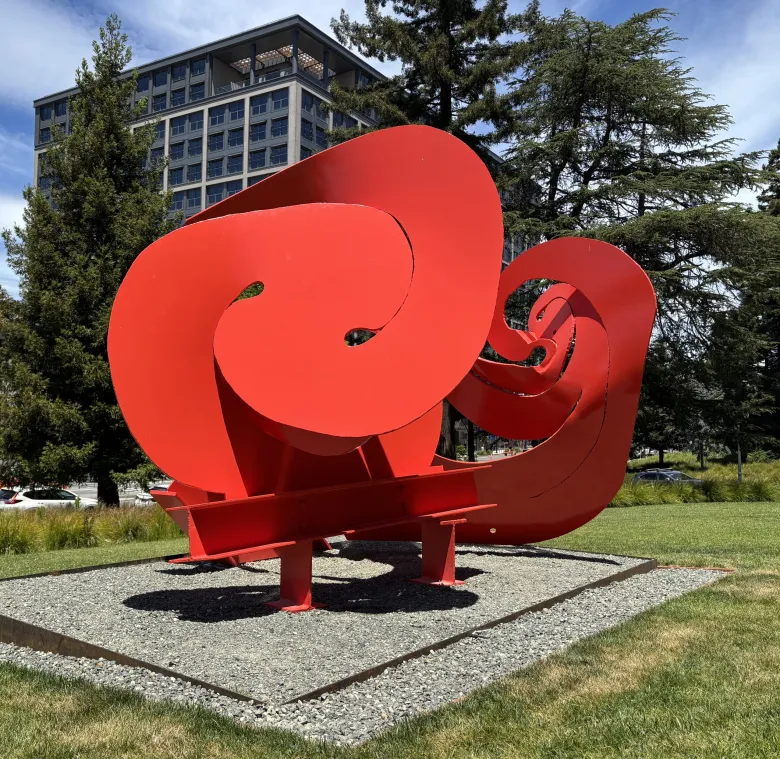 Mark di Suvero’s “Mamma Mobius” on UC Berkeley’s Crescent Lawn is part of the BAMPFA collection. Credit: Beverly Bradley
The 92-year-old di Suvero is known for monumental steel works that bring together art, engineering and public space, often on a scale that invites viewers to walk around and through them.
Di Suvero was born to an Italian diplomat and his wife in Shanghai in 1933. The family, learning during World War II that they were to be sent to a concentration camp, fled to San Francisco. Di Suvero studied philosophy at UC Berkeley in the 1950s and began sculpting during college. He went on to live and exhibit around Europe and the United States, eventually becoming one of the defining figures in postwar American sculpture, and one of the most noteworthy sculptors ever to study at Berkeley.
Berkeley’s open-air sculptures
The arrival of “Mamma Mobius” draws new attention to the rest of UC Berkeley’s open-air artworks that thousands of people pass every day without necessarily knowing anything about the artists or their work.
On the Crescent Lawn, di Suvero’s sculpture now joins two other major works from BAMPFA’s collection: Alexander Calder’s “The Hawk for Peace” and Arnaldo Pomodoro’s “Sphere Within a Sphere.” Together, the three sculptures give the western edge of campus a distinctive concentration of 20th- and 21st-century public art, a kind of informal sculpture garden where the university and the city meet.
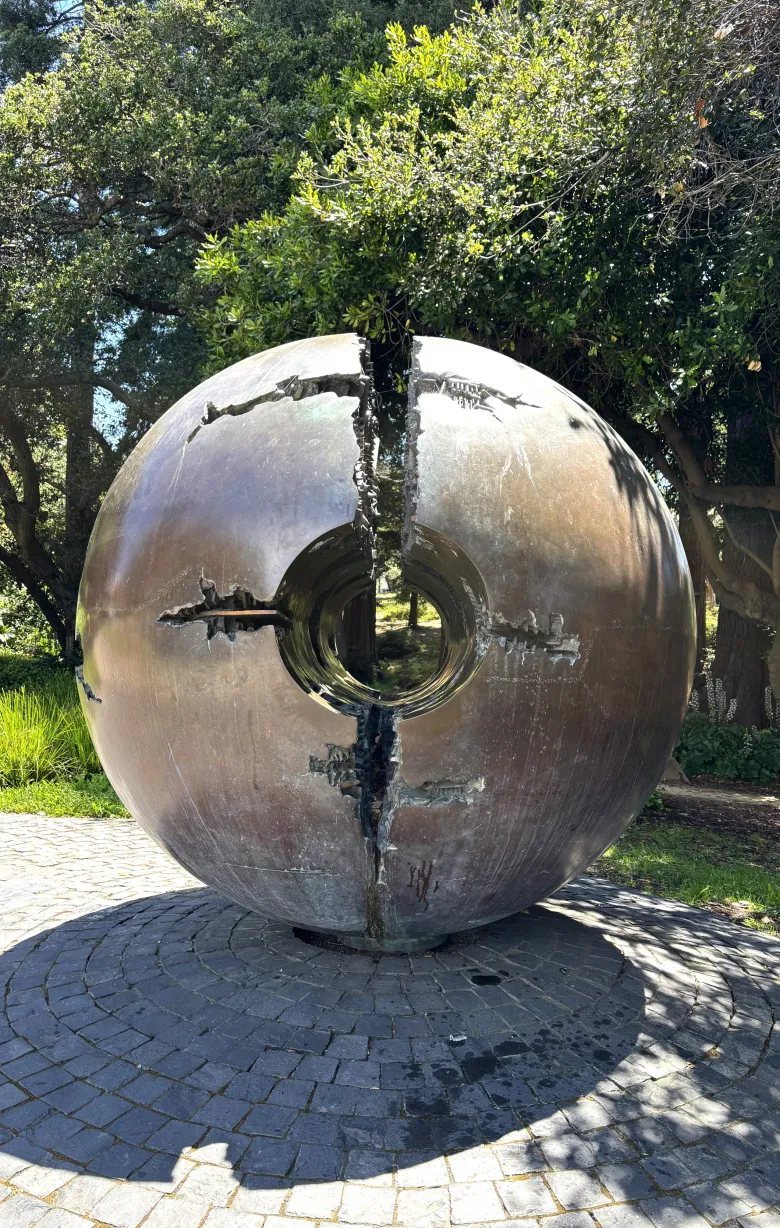 Arnaldo Pomodoro’s “Sphere Within a Sphere,” sitting near UC Berkeley’s Crescent Lawn, is part of the BAMPFA collection. Credit: Beverly Bradley
Pomodoro’s “Sphere Within a Sphere” (“Rotante dal Foro Centrale”) has long been one of the campus’s most recognizable landmarks. The bronze globe was created in 1969 as part of the Italian sculptor’s celebrated series of fractured spheres. Other versions can be found in public spaces and museum collections around the world.
Previously installed in the sculpture garden of BAMPFA’s former home on Bancroft Way, the Berkeley iteration of the work is now far more visible to pedestrians, sitting where thousands enter campus every day from Center Street downtown.
Nearby, Calder’s “The Hawk for Peace” offers a very different variation on modern sculpture. Completed in 1968, the monumental steel stabile was donated by Calder to BAMPFA in memory of his brother-in-law, Kenneth Aurand Hayes, a UC Berkeley alumnus from the class of 1916. At 13 feet high and 23 feet long, “The Hawk for Peace” is one of the most historically significant public sculptures in Berkeley. Calder, who had first trained in mechanical engineering before turning to art, became famous for his pioneering work with mobiles, but his later stationary sculptures — or stabiles — displayed the same attention to balance and movement in monumental public form.
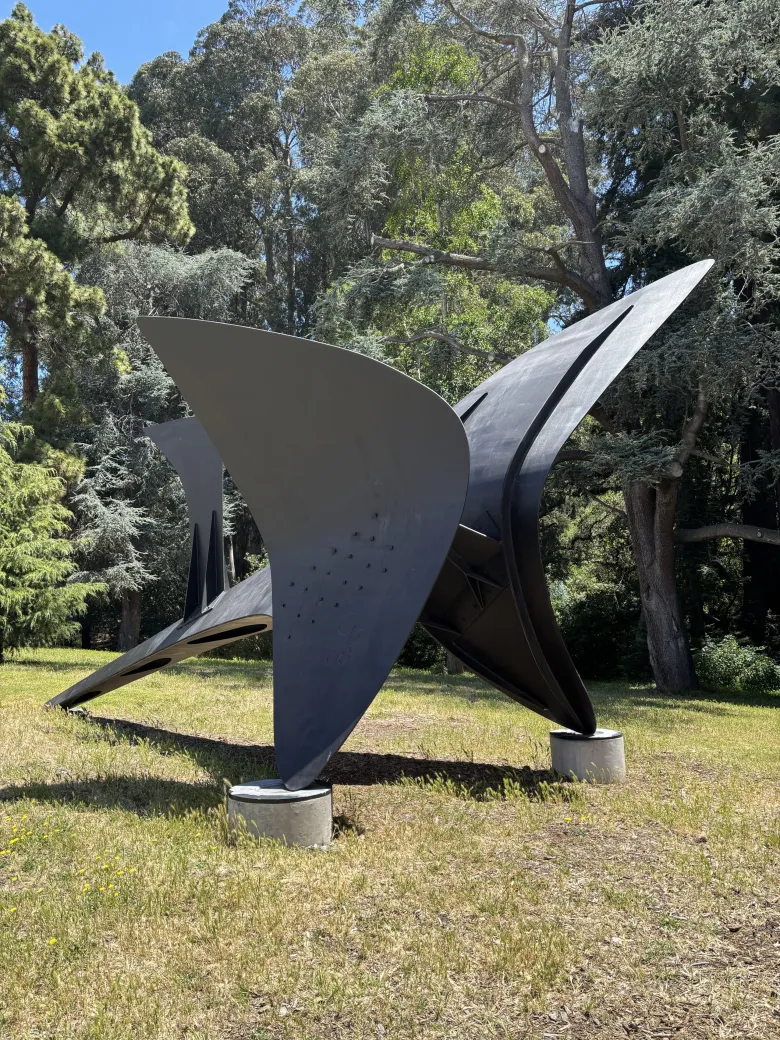 Alexander Calder’s “The Hawk for Peace,” placed near UC Berkeley’s Crescent Lawn, is part of the BAMPFA collection. Credit: Beverly Bradley
Like the Pomodoro sphere, Calder’s work spent decades outside BAMPFA’s former home on Bancroft before undergoing an extensive conservation process and returning to public view on Crescent Lawn in 2022. It now stands within view of both the di Suvero and the Pomodoro, linking three internationally significant sculptors in a single outdoor space.
Sculptures elsewhere on campus
Up the hill from Crescent Lawn, other parts of campus offer their own public art encounters. At the Hearst Mining Circle, in front of the Hearst Memorial Mining Building, Bruce Beasley’s “Rondo II” sits in a reflecting pool, its interlocking stainless-steel rings supported from below the water’s surface. The effect is unusually light for a sculpture made of heavy metal, and its setting connects the work to one of the campus’s historic centers of mining, materials and engineering.
Like di Suvero, Beasley has deep roots at UC Berkeley. As a member of the class of 1962, he studied on campus with the influential ceramicist Peter Voulkos and went on to become an internationally known sculptor in his own right.
“Rondo II” first appeared on campus in 2013 as part of a five-sculpture outdoor installation from Beasley’s “Rondo” series. Later that year, the work became a permanent part of the campus landscape, giving the Mining Circle one of its most visible contemporary artworks.
Near North Gate at Hearst and Euclid avenues, Richard Hunt’s “Outgrown Pyramid #1” adds another important American sculptor to UC Berkeley’s public art map. The 1973 welded Cor-Ten steel sculpture combines a pyramidal base with protruding forms that seem to push outward from within, suggesting the “outgrown” structure named in its title.
Hunt, who died in 2023, was one of the most important American sculptors of his generation, with a career that brought welded and cast metal into public spaces across the country. Born in Chicago in 1935, he began working with industrial materials early in his career and created his first public sculpture in 1967. “Outgrown Pyramid #1” belongs to that period when his practice was increasingly oriented toward large-scale public work, making the Berkeley sculpture an especially noteworthy example of the pivot toward public art that his career took during that time.
Taken together, works like these comprise an informal sculpture garden of sorts scattered across the UC Berkeley campus, one inflected by the sense of creative discovery and material innovation for which the university has long been known. Several make especially strong use of steel, bronze and other industrial materials, a fitting presence on a campus where world-changing breakthroughs in science and engineering happen in close proximity to vibrant artistic programming.
With the recent arrival of di Suvero’s “Mamma Mobius” on the Crescent Lawn — a sculpture that elegantly translates a mathematical concept into a work of art — it’s an ideal season for scholars and art appreciators alike to stroll through campus and rediscover its public art landscape.
“*” indicates required fields