
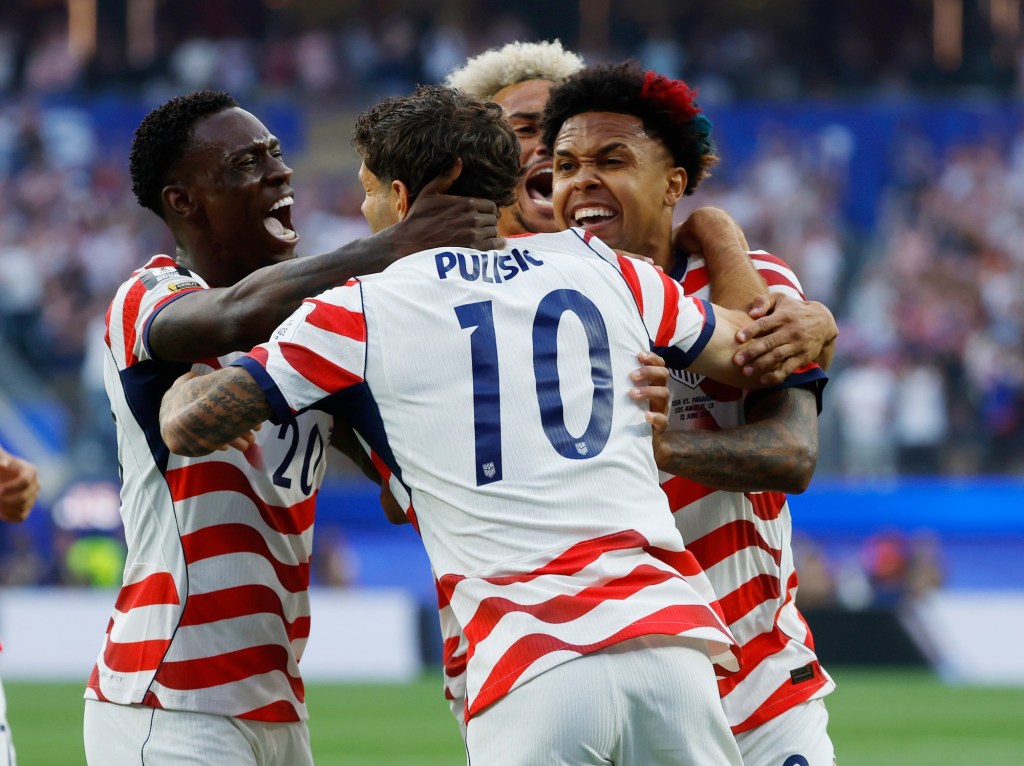
INGLEWOOD — Three thoughts on the U.S. men’s national team’s 4-1 win against Paraguay in its World Cup opener on Friday night at SoFi Stadium
1. The accidental citizen
It’s the kind of irony that the World Cup always seems capable of producing:
Folarin Balogun scores a pair of goals representing a country that, if the current administration’s policy toward birthright citizenship was in place, wouldn’t have allowed him to pull on the jersey.
Balogun wasn’t supposed to be born in the United States. His Nigerian parents were living in London and visiting Brooklyn in 2001, but the airline refused to allow his mother, then seven months pregnant, to board the flight home. Balogun was born in New York instead and, as such, received instant U.S. citizenship.
That the family returned to England a few months later didn’t matter under U.S. regulations, which President Donald J. Trump has tried to change to limit birthright citizenship. And in the eyes of international sport, a passport is a passport.
If he had his wish, Balogun presumably would be representing England in this World Cup. He played more than 20 times for the country’s under-17, U18, U20 and U21 national teams. But after English giant Arsenal gave up on him and shipped him to the French league, and then England’s senior team didn’t invite him to a training camp, he switched allegiances in 2023 to a country he barely knew. (He was also eligible to play for Nigeria.)
“I mean, yeah, he’s lethal right now in front of goal,” winger Christian Pulisic said after Balogun became the first U.S. player in 96 years to score twice in a World Cup game. “We’re really lucky to have him.”
Balogun would have had a first-half hat trick — in the span of 21 minutes — had a VAR review not negated another goal for offside.
“When I committed and throughout the whole cycle and the whole journey to me being at this point,” Balogun said afterward, “the fans gave me so much motivation, showed me so much support. For me, the most important thing has always been to be able to repay that.
“I feel like today’s a great opportunity. I just want to continue to show the fans I made the right decision. I’m completely proud, and I want to continue to make the fans proud as well. … It’s a dream, it’s a dreamy night.”
Some countries balk at adding players with tenuous nationality, fearful that a language or cultural barrier could undermine chemistry. The U.S. has never been one of them — partly in homage to its immigrant heritage, partly out of sheer necessity. (Nor has 2022 semifinalist Morocco, which has only seven players born in Morocco on its 26-man roster.)
Former U.S. national coach Jurgen Klinsmann, a German who lived in Orange County, actively recruited sons of American servicemen who married German women while stationed there — the most recent example being Malik Tillman, who started Friday in the midfield. Starting defender Antonee Robinson was born and raised in England to a father who was also born in England but lived in the United States for a spell and gained citizenship. Another starter, Sergiño Dest, was born and raised in the Netherlands.
“You look around our team,” said goalkeeper Matt Turner, who knows Balogun from their days at Arsenal together. “We’ve had many guys with mixed roots, guys who can relate with him in different ways.”
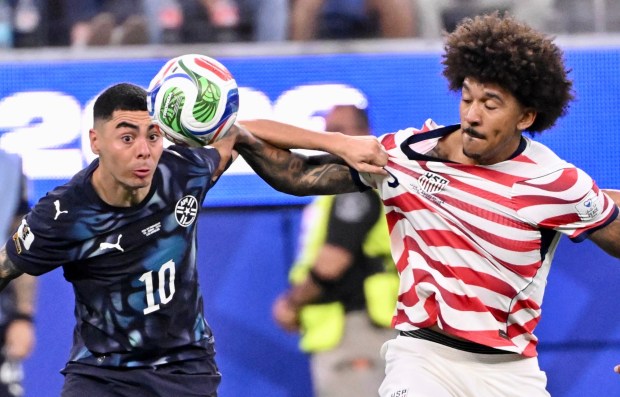 U.S. defender Chris Richards battles with Paraguay’s Miguel Almirón during the second half of their World Cup match on Friday night. (Photo by Keith Birmingham, SCNG)
2. Too perfect
Balogun and Pulisic got all the headlines Friday, but perhaps the most promising development came from a back line that was rarely troubled.
A back line that included Chris Richards.
Twenty-six days earlier, Richards hobbled off for England’s Crystal Palace with a sprained ankle that club staff later admitted involved two torn ligaments.
“When I did get the diagnosis after the game, my ankle was huge, and I came off in a boot with crutches,” Richards said earlier in the week. “Once we had the diagnosis, I was like, ‘Alright, cool, whatever it takes, I have to make it for this first game.’
“If there’s any time to sacrifice yourself, it’s now.”
It wasn’t just that he played, but how. He attempted 84 passes. He completed 84 passes.
That’s the most by any player with 100% accuracy in World Cup history since they began tracking the stat in 1966. The previous record, 71 of 71 by England defender John Stones, came in the 2022 quarterfinals.
“He was too perfect,” fellow center back Tim Ream said. “That’s Chris. He comes in, nothing phases him, gets stuck in, he’s a huge boost. Hopefully, he can continue that. … For everything he’s done to get himself in this position, that performance tonight says all you need to know.”
The stat is slightly deceiving because, as a center back against a bunkered defense, Richards was rarely under pressure and spent most of the night switching the point of attack. He attempted only one long ball. More than 80% of his passes were sideways or backwards.
Still, 84 of 84 …
“You’re playing it safe a lot of times,” Richards said, “but you’ve got to get in the stat book one way or another. Not a bad stat, though.”
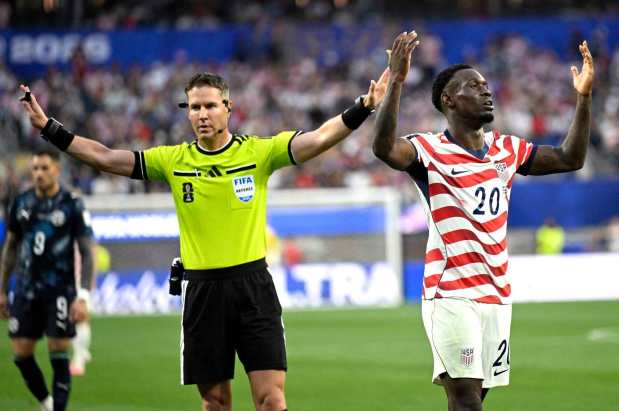 Dutch referee Danny Makkelei refutes a call for a foul by U.S. forward Folarin Balogun in their World Cup opener against Paraguay on Friday night. (Photo by Will Lester, Inland Valley Daily Bulletin/SCNG)
3. Hydration
Just 23½ minutes into the game, referee Danny Makkelie of the Netherlands blew his whistle for the first half’s hydration break. Or, as the Brits say, drinks break.
Many of the rule changes at this World Cup are intended to speed up the game. Players have five seconds to initiate a throw-in or goal kick at the risk of losing possession; they must wait a full minute to re-enter if they require on-field medical attention; and they have just 10 seconds to leave the field when substituted.
The three-minute hydration break, purportedly for player safety reasons, does the opposite, breaking the natural flow of the match and, in some cases, allowing coaching tweaks that change its tactical integrity.
Canada was trailing Bosnia and Herzegovina 1-0 on Friday when the second-half break came in Toronto with temperatures in the upper 70s. A few minutes later, the hosts scored to salvage a 1-1 tie.
The same thing in the first half Saturday, with Brazil trailing 1-0 and looking increasingly discombobulated. Coach Carlo Ancelotti gathered his players, moved some chess pieces around, and seven minutes later, Vinícius Júnior pulled his team even.
“I don’t like,” U.S. coach Mauricio Pochettino said. “Only like when the conditions are very extreme, but when the conditions are good, I think it’s not necessary. The opponent is going to try to take advantage of it to fix or to encourage, to do things that you cannot do when you are on the touch line and the game is running.
“But it’s part of the game (now), and I accept that. I am not agreeing, but I think it’s not a big issue.”
Added San Diego State alum and former U.S. national team defender Marcelo Balboa: “I’m a purist. I love the game for 45 minutes unless it’s 90-plus (degrees) and you hit the rule that you need hydration. I’m a firm believer in fluidity. It’s a fluid game. It swings back and forth. We have control, you have control. That’s the beauty of our game.”
In the past, FIFA and some pro leagues determined whether to allow hydration breaks using a wet-bulb thermometer that accounts for humidity, wind speed and the sun’s intensity. For FIFA, it was just under 90 degrees. For Major League Soccer, it is 84 degrees.
But FIFA scrapped that system in a World Cup played in indoor and outdoor stadiums across four time zones with kickoffs ranging from noon to 9 p.m., preferring a one-size-fits-all approach.
Why?
The answer becomes clear if you’re watching in the stadium, not on TV.
On Friday at SoFi, with temperatures in the mid-70s, both teams were back on the field after two minutes. But a FIFA staffer on the sideline — in American football, they call it the red hat — held up a hand to Makkelie to wait until his signal to restart the match.
To wait until the commercials were finished.