
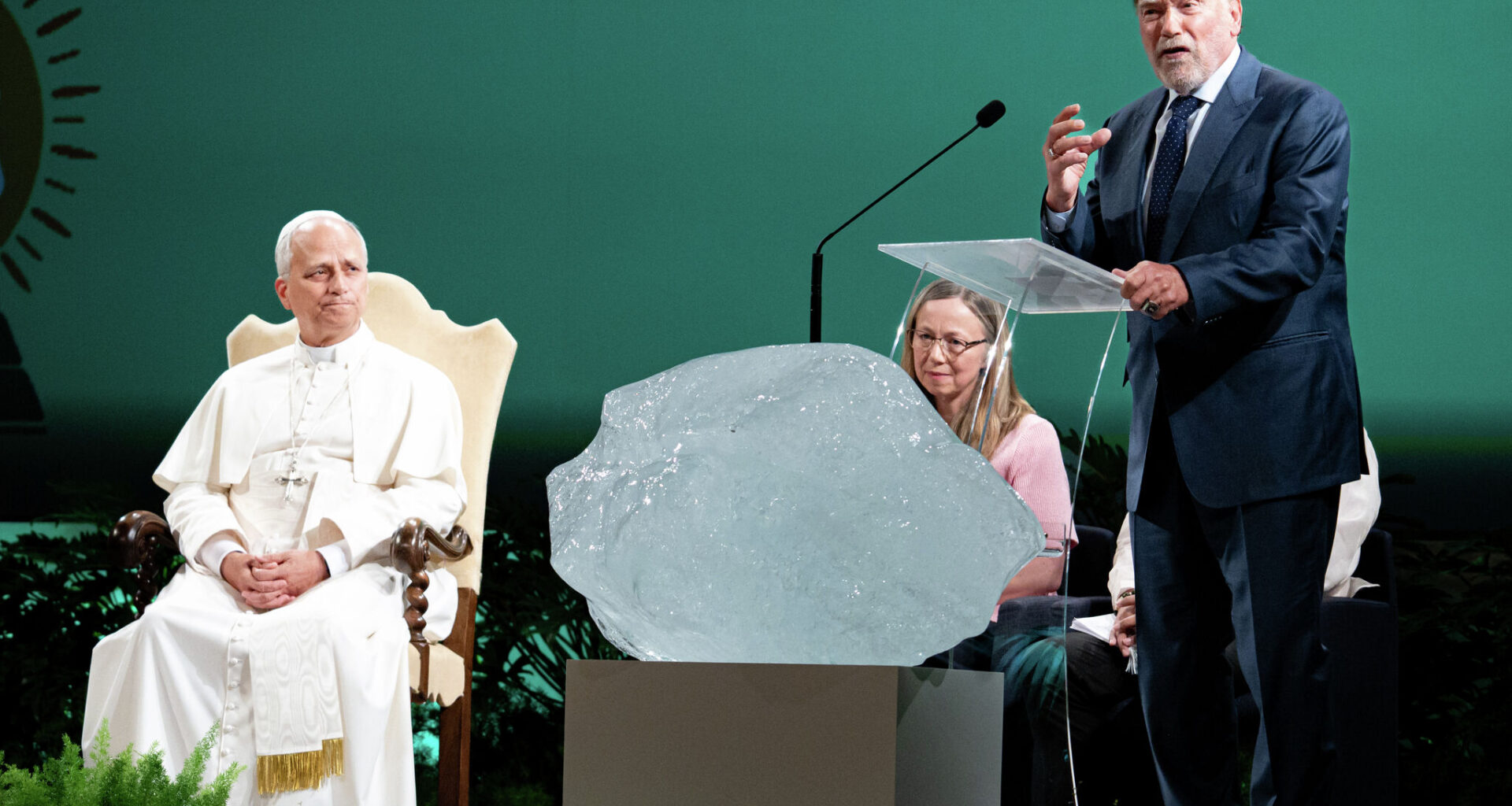
Pope Leo XIV and former California Gov. Arnold Schwarzenegger attend the international climate conference in Albano Laziale, Italy, in 2025. If Xavier Becerra is elected, he will be the state’s fifth-consecutive Catholic governor.
Massimo Valicchia/NurPhoto/Getty Images
Pro tip: If you are ever asked to predict a winner in a California gubernatorial race, be sure to bet on the Catholic.
Xavier Becerra’s rapid rise to one of the top-two spots in this month’s gubernatorial primary was a surprise, but it shouldn’t have been. If, as expected, Becerra wins the governorship in November’s runoff election, he’ll be the state’s fifth consecutive Catholic governor.
And that is no accident. While California is caricatured as crazy, uber-progressive, even godless, the truth is that we might be America’s most Catholic state.
Article continues below this ad
California has more Catholic residents than any other U.S. state — about 10 million. By percentage of Catholics among our population, we rank eighth, trailing mostly East Coast states with strong Irish and Italian heritage. And the Archdiocese of Los Angeles is the nation’s most populous Catholic diocese.
Catholicism also bonds together our people, particularly our diverse immigrant groups. Our large populations from Ireland, Italy, Mexico, Central America, Vietnam and the Philippines all have a religious tradition in common.
San Francisco Chronicle Logo
Make us a Preferred Source to get more of our news when you search.
Add Preferred Source
But our catholic mix also results in contradictions that can curdle into hypocrisy, in ways that feel familiarly Catholic. Our state and the Roman Catholic Church are known for large populations, for great beauty, for enormous wealth and for the highest of ideals. California and the church are also known for failing to live up to those ideals, for permitting indefensible abuses, for ugly histories.
Those histories intersect in California, via 21 Franciscan missions stretching from San Diego to Sonoma.
Article continues below this ad
These Catholic outposts shaped our architecture and named our cities for every saint in heaven. This is why — Father, hear my confession — your heretic-columnist can tell gullible children that the Silicon Valley capital is named in his honor. (“San Jose” is “Saint Joe,” and kids, that’s me.)
Former California Poet Laureate Dana Gioia, himself a Catholic, has argued that the “Catholic imagination” shaped California into something vastly different than the rest of the U.S.
“Our seasons, climate, landscape, natural life and history are alien to the worldviews of both England and New England,” wrote the former National Endowment for the Arts chair in his 2011 essay, “Being a California Poet.” “Our towns are named Sacramento and Santa Rosa, not Coventry or New Haven. There is no use listening for a nightingale in the scrub oaks and chaparral.”
Californians, Gioia wrote in 2013, see our landscape as “sacramental, shimmering with signs of sacred things.” Which explains our bipartisan environmentalism.
It also explains the fervor of our current fight with the Trump administration over immigration.
Article continues below this ad
Indeed, sanctuary policy is central to modern California-Catholic history. When the U.S. government refused political asylum to Central American refugees in the 1980s, Father Luis Olivares of Our Lady Queen of Angels in Los Angeles defied the feds by providing sanctuary for immigrants. The networks formed in that era are still leaders in today’s struggle against Trump’s mass deportations.
Ever since the anti-immigrant 1990s governorship of the Protestant Pete Wilson, our governors, all Catholic, have defended immigrants.
Gray Davis, who was raised Catholic and returned to the church at the urging of his wife, effectively killed off Wilson’s anti-immigrant measure, Proposition 187.
Arnold Schwarzenegger, a lifelong Catholic, also fought his party in service of the environment and public health. When he was less than pious, First Lady Maria Shriver, a daughter of America’s most famous Catholic family, provided faithful reassurance.
Jerry Brown left seminary before becoming a priest, but made his Jesuit education central to his political identity — especially his frugality, environmentalism and preference for rehabilitation over incarceration.
Article continues below this ad
Critics sometimes dismiss Gavin Newsom as a WASPY pretty boy, even though he’s Irish-Catholic. In office, Newsom has invoked his Catholicism on climate policy, his personal clean-ups of filthy roadsides (“good works!”) and his decision to halt the death penalty.
Becerra fits that mold. In the campaign, he has described himself as a practicing Catholic, and he has long credited his religion for his commitment to healthcare access and immigrant rights.
Five Catholic governors in a row is longer than our streak of Democratic governors. This Catholic continuity reflects our real differences with a country that has elected only two Catholic presidents: John F. Kennedy and Joe Biden.
According to a 2025 Pew Research study, American adults are more than twice as likely to be Protestant (40%) than Catholic (19%). In California, it’s more evenly split, with Protestants and Catholics each representing one-quarter or so of the adult population.
One California-based, Catholic scholar (who asked not to be named) compared California’s place in America to that of Samaria in Biblical Israel.
Article continues below this ad
Guest opinions in Open Forum and Insight are produced by writers with expertise, personal experience or original insights on a subject of interest to our readers. Their views do not necessarily reflect the opinion of The Chronicle editorial board, which is committed to providing a diversity of ideas to our readership.
Read more about our transparency and ethics policies
Samaritans worshiped the same God as the Jews, traced their lineage to Abraham and adhered to the Torah. But they rejected the Jerusalem temple establishment.
Instead, they built their own temple on Mount Gerizim and practiced the religion in their own peculiar way.
Joe Mathews writes the Connecting California column for Zócalo Public Square.