
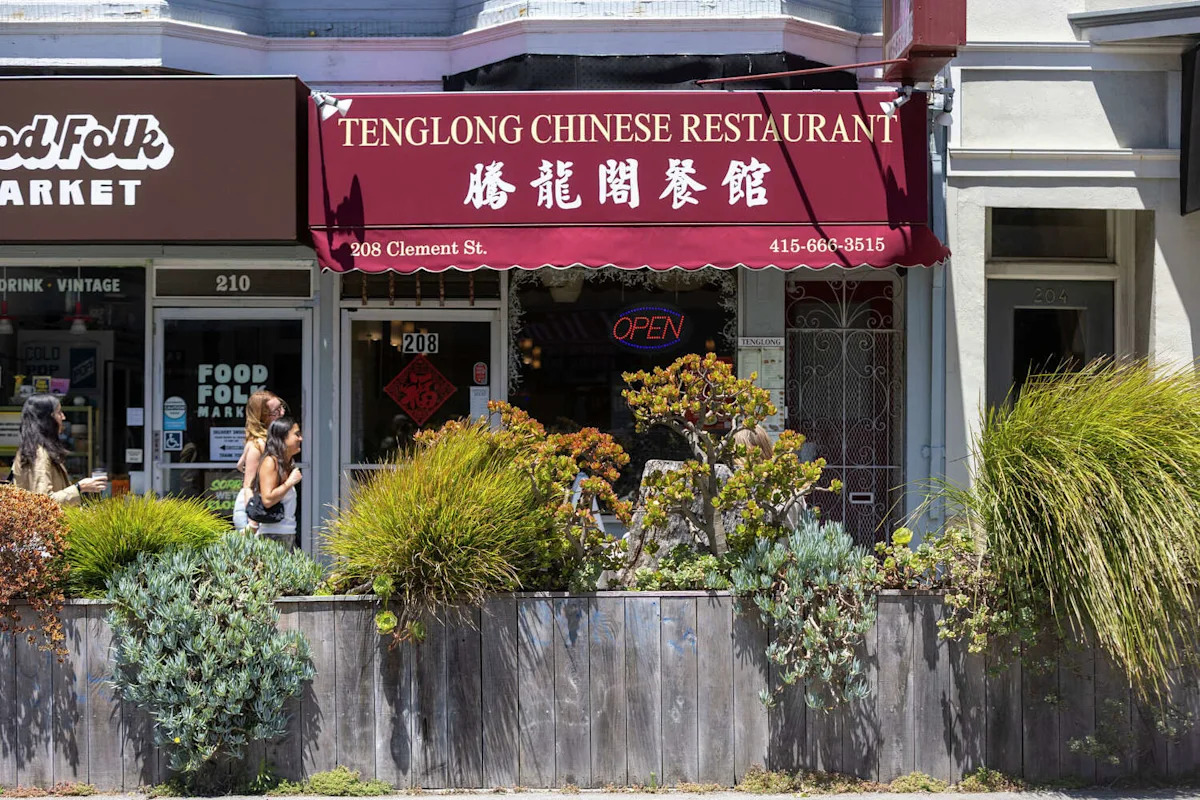
A ritual was happening along Clement Street, marked only by an anonymous note. “Dan, you’re a legend,” it read. The note was taped on the side of an overgrown parklet at Third Avenue, one that’s been there so long that it’s practically part of the sidewalk.
I passed by countless times before I realized that there was something peculiar about this space. It didn’t seem to be connected to any adjacent business, an anomaly in a time when so many parklets are de facto dining rooms. It’s big, the size of three parking spaces. Sturdy. But the most striking thing is the greenery. The plants that ring the edges are so healthy and well established that to sit there is to forget that traffic is only a few feet away. The space is curious for other reasons, too. There’s a long-standing bar, and big slabs of wood are stacked to make a seating area that’s something between a sculpture and a throne.
Dan Carlson is to thank for this space. For years, he was a mystery to me, but it’s time for him and his fellow caretakers to get their flowers. After all, they’re the ones planting them. You’d be surprised to learn how many of the city’s beloved green spaces are the product of loving neighbors rather than city workers. The word to describe these caretakers of the public realm is steward. Whenever you find a tiled stairway, hillside garden or parklet oasis, you’re in the realm of stewards. It’s an honorary title for an unusual bunch.

The public parklet on Clement Street near Third Avenue in San Francisco on June 3, 2026. (Douglas Zimmerman/SFGATE)

Some of the vegetation at the public parklet on Clement Street near Third Avenue in San Francisco on June 3, 2026. (Douglas Zimmerman/SFGATE)

People hang out at the public parklet on Clement Street near Third Avenue in San Francisco on June 3, 2026. (Douglas Zimmerman/SFGATE)
They’re diverse and quirky. Prolific yet often hidden. They seem to know the secret of happiness, or at least the secrets of the block. They’re earthbound in a society increasingly set in the cloud, which gives them an almost monk-like quality, though some are less monk, more maverick: dissidents determined to get s-t done. What prompts such an intense level of care? And what happens when it stops? Stewards hold the city together, and, in Dan’s case, they hang on by a thread.
San Francisco’s hidden stewards
“Every week, in the early evening, a man named Dan tends to this parklet garden. It is a ritual I am so appreciative of, and I am grateful for the space he cares for.” The anonymous note was my first clue about the identity of the mysterious gardener, and an indication that I wasn’t the only one to notice his handiwork.
Dan is what Elizabeth Barlow Rogers, credited with saving New York’s Central Park, would call a “zealous nut.” Zealous nuts are the type of people with an irrational sense of care for their place. But since zealous nut doesn’t sound as complimentary as its intent, we’ll stick with steward. I’ve grown to recognize stewardship as many things. It’s a sense of agency seemingly as powerful as therapy or drugs. An attachment to place in an increasingly placeless world. The unsung quality that we simultaneously depend on and take for granted. It’s a quiet revolution on a trash-strewn lot.

People hang out at the public parklet on Clement Street near Third Avenue in San Francisco on June 3, 2026. (Douglas Zimmerman/SFGATE)
I’ve wanted to write about stewardship for years now, but it wasn’t until I met Dan that I felt like I could capture its elusive magnitude and magic.
My first exposure to this city’s culture of stewardship was in the Portola. This tiny, proud neighborhood is sandwiched between 280, 101 and the ridgeline of McLaren Park. Perhaps it’s this isolated quality that allowed its stewards to shine so brightly. In the mid-2010s, I worked in the neighborhood. My office was a concrete bunker above a small coffee shop. Outside my window was Burrows Pocket Park, a tiny garden made of leftover land from the embankment that held up 101, which whisked commuters down to SFO and the Peninsula beyond on the other side of the retaining wall.
What had long been a neglected dead end was transformed by neighbors into an oasis. They ripped out a metal guardrail and started planting. They got permission from Caltrans to beautify the space and added benches and a mural. Then they started looking at the space beyond the fence.
When they first pointed to the fennel-strewn lot, I think I laughed. It was a dumping ground. Completely inaccessible. And at a 45-degree angle tilted toward the highway above. Yet the neighbors were undeterred. They cleared the fennel. Hand-built terraced walkways. They even used a crane to bring in an old junk car and stuffed it full of plants. A fitting metaphor for nature reclaiming what had been destroyed by the ravenous appetite of highway expansion.
Where 101 had severed the neighborhood, this greenway began to reconnect it.

The public parklet on Clement Street near Third Avenue in San Francisco on June 3, 2026. (Douglas Zimmerman/SFGATE)
There was a dedicated crew who showed up for the monthly gardening days. Even when it was slow, or rainy, the regulars were there. Alex, a high-end designer and amateur horticulturist, was often the leader. Shae, the owner of the nearby bar, was always picking weeds, even while casually waiting for her coffee at the shop next door. Maggie, the chain-smoking vice principal with a raspy voice strained by years on the playground, was a constant. She was in her late 50s, but it was easy to picture her as the young physical education teacher who would run the school decades later. Much of what I know about stewardship I learned from her, though it took me years to fully grasp what she was doing.
Things kicked into high gear once Raul showed up. During the pandemic, he saw people working on the overgrown lot behind his house. He got curious and joined them, eventually clearing enough brush to extend the pocket park through to the next block.
Proximity matters when it comes to stewardship. How will you care for a place from afar? This work is inherently local – a sense of place is built through a thousand small acts. Under the care of Raul and the regulars, the pocket park grew like a vine. It’s beautiful today, but if I could show it to you a decade ago, you’d be stunned to see what an accumulation of care can do.
We are living in a time when much of the world seems out of our control. Even the idea of agency has been co-opted, with “agentic” becoming the latest tech buzzword. That the machines would be gaining the ability to act independently while ours slips away is more than a bit dystopian! But the stewards of the Portola reveal a different path. They’ve found an analog answer to our dizzying digital age.

People hang out at the public parklet on Clement Street near Third Avenue in San Francisco on June 3, 2026. (Douglas Zimmerman/SFGATE)
Agentic is a good concept for artificial intelligence, but its truest form may be the practice of public space stewardship.
People need to believe they can shape their environment. In fact, they need to. Whether it’s home, work or the space outside your front door, studies show that having a sense of control over your world is as powerful as anything a doctor might prescribe you. When it comes to the public realm, agency manifests as an invitation. Seize your ability to improve the world around you, it whispers.
When we plant, paint or pick up trash, we’re activating all the senses. Civic agency is immersive: physical, psychological, social. You improve something, observe, discuss with the person walking by and then try again. This process cultivates a shared belief – no, an understanding – that change is possible. Here, now.
There’s something intoxicating about seeing and shaping such tangible improvements. Why else would people keep doing it? These tasks would be Sisyphean if they weren’t so enjoyable. And the act of caring for our communities becomes a gateway to understanding the local terroir: hidden fruits, hot gossip and good neighbors, all revealed in an afternoon out in the sun. Place connects us, and in the process, we find everything from bloody mary recipes to babysitters. Stewardship localizes care: Neighbors tend to a place, then to each other.

Some of the vegetation at the public parklet on Clement Street near Third Avenue in San Francisco on June 3, 2026. (Douglas Zimmerman/SFGATE)
What drives stewardship?
Back on Clement Street, I’d occasionally ask around about the parklet, and by proxy, Dan. When a new store moved in next to the little oasis, I took the chance to chat up the owners. I stood at the counter of Food Folk with Kevin Elmore, the co-owner, as we marveled at how lush the parklet looked outside his front door. I asked him if he knew anything about Dan, and he told me he heard Dan was retiring. Retiring? No. It couldn’t be. What would become of his garden?
I sent off a flurry of texts to the neighbors I knew, and they confirmed the rumor. Somehow, none knew how to contact Dan, but I hit a lucky break when I reached out to Eric, a fellow preschool parent who lived across the street. He’d seen Dan at work and had struck up conversation, eventually exchanging numbers. I asked him to connect me.
At long last, I’d found the mysterious gardener.
Like most stewards, Dan is not one to toot his own horn. He is gentle and soft-spoken, with the calm of someone deeply in tune with nature. When I asked if he wanted to meet me at the parklet, he declined. I was a bit surprised. He asked to chat by phone instead, and when we got on a call together, I began to understand why. Leaving the parklet was a bit like a breakup. He needed time away. “It became too much for me,” he said. I came to learn that he’d been caring for the parklet for more than 12 years.

People hang out at the public parklet on Clement Street near Third Avenue in San Francisco on June 3, 2026. (Douglas Zimmerman/SFGATE)
He described it as a “root-bound, water-hungry entity” meant to evoke “beach dunes and big grassiness.” Comparing it to a hard sponge, the space required an hour and a half of watering every third day, during which time Dan would clean the space as well. Originally the brainchild of two artists, Jonathan Anzalone and Joseph Ferriso, and their studio, Anzfer Farms, the parklet predated almost every business on the block, including the neighborhood’s beloved farmers market. I came to understand the space as a remnant of an earlier era, with the only constant being Dan himself.
Just as the digital world distorts our sense of agency, it distances care from presence. When a friend has a baby or a broken foot, it’s easier to DoorDash a meal rather than deliver a home-cooked one. We’ve become conditioned to posting our way toward a better world. Sign this petition, contribute to that GoFundMe, boost this story! Dare I say it’s not going too well. We’ve certainly seen the power of this approach, but a care bound by two thumbs and an algorithm is destined for diminishing returns. You can make waves in a sea of content, but it’s an ocean that consumes more than it contributes.
In this environment, stewardship is subversive. It’s full of untraceable acts, organic growth, real-world ripple effects. It compounds over time, creating the character of the places where we live.
BEST OF SFGATE
Travel | Disneyland’s likely 3rd theme park has been nearly 30 years in the making
Culture
| The 18-foot-high fence that turned Sonoma and Marin communities upside down
Food
| The SF tech worker whose unhinged order broke In-N-Out forever
Politics | Gen Z students are embracing the ‘Kirk doctrine’ on California campuses
Get SFGATE’s top stories sent to your inbox by signing up for The Daily newsletter here.
Yet stewardship often stands in contrast to the status quo, which the public realm tends to gravitate toward. People like their places to be predictable, and so a thicket of processes becomes the prerequisite for change. Forms, surveys and virtual hearings create a digital border around our physical world. And in these layers of abstraction and delay, most of us gradually lose the agency to improve the places we occupy. But not stewards. They have an itch to improve things, and they’re not likely to wait. For them, the world is more malleable.
Being about place predisposes one to this sense of doing. Dan and his fellow stewards embody this practice. And it really is a practice. You show up again and again when you’re caring for a place. It’s habit-forming. Maintenance. Part mundane, part muse. What compels someone to provide this level of continual care? I’d often ask myself this question when I saw the Portola stewards doing another thankless task in the shadows.

Some of the vegetation at the public parklet on Clement Street near Third Avenue in San Francisco on June 3, 2026. (Douglas Zimmerman/SFGATE)
The answer was that every new planting or project was a chance to reap the rewards of agency: connecting with nature, building community and realizing that the world is responsive to our touch. They’d found the “granularity of attention” that Jenny Odell praises, a wisdom formed from presence and place. By embracing the idea that the public realm is theirs to care for, stewards gain a sense of collective ownership. Making a place better creates more than just pleasure or pride; it changes how one sees the city. How one loves it.
“A lot of the left thinks social change has to look like Che Guevara, but maybe changing the world is more like caregiving than it is like war,” mused Rebecca Solnit, at a recent talk at the Internet Archive. She noted how so much change is the result of “nice little ladies,” an observation backed up by the fact that much of the Bay Area’s natural beauty is preserved thanks to such nice yet fierce women. Speaking on the theme of interconnection, she talked about how “there are no objects, only systems.” She drove her point home with a line that stuck with me: “We are verbs in drag as nouns.”
Don’t let the digital fence fool you. We are doing creatures. And at our best, we are stewards.

People hang out at the public parklet on Clement Street near Third Avenue in San Francisco on June 3, 2026. (Douglas Zimmerman/SFGATE)
Who maintains the maintainers?
Over the years, Dan’s care for the parklet took on a nocturnal quality. This was more practical than anything, he explained. He had a full-time landscaping business, and it was easier to tend to the parklet at night when there were less people to work around. But it began to wear on him. The work was largely unpaid, save for an occasional $200 stipend from a nearby property owner. And it was during these nocturnal waterings that he became “an anonymous entity,” as he put it. I realized he was right. It was how I had perceived him, and he was even more anonymous to the countless folks who’d enjoyed the fruits of his labor without a second thought to how such beauty blossomed.
Who maintains the maintainers? Like a Greek tragedy, Dan made me see that stewardship’s essential element is community. That’s what Maggie had been doing all along in the Portola, so simple and profound I’d missed it. Stewardship is collective care. And it’s not limited to gardening. It’s the shared experience of tending to any common space. Everything Maggie did, from asking me to join her school’s board, to inviting me to coach fifth grade basketball with her, to laughing her way through a Saturday workday, was in service of building this community of care for the Portola. And it continues to flourish.
Stewardship opened my eyes to how the city is built and who does the building. Show me the place you tend to, and I’ll know who you are. The lesson from Maggie and Dan went deeper: Care isn’t an independent act. It’s mutual.
There’s a temptation here to assume this story is about Dan, but he wouldn’t want that. Most stewards feel similarly. It’s as if they’re saying, “Look at what we’re creating. Look at its beauty, how it benefits the birds, how it brings people together – how could this be about me?” To them, the story isn’t about the steward; it’s about what’s being stewarded. And even if Dan was the only constant person over the years, the parklet itself was a continual presence on the block. The accumulation of care gave the space a life of its own. The parklet contributes to the community, just as Dan contributed to it.
This is the magic of well-loved places: They take on a life of their own.

Pedestrians walk by the public parklet on Clement Street near Third Avenue in San Francisco on June 3, 2026. (Douglas Zimmerman/SFGATE)

The public parklet on Clement Street near Third Avenue in San Francisco on June 3, 2026. (Douglas Zimmerman/SFGATE)

A pedestrian crosses the street near the public parklet on Clement Street near Third Avenue in San Francisco on June 3, 2026. (Douglas Zimmerman/SFGATE)
Seen in this way, this story isn’t a tragedy but a triumph. Dan left his post at the parklet in February once the winter rains had replenished his big, grassy sponge. And still the Clement Street parklet grows. A local merchant was entrusted with its care, though no one person can replace a legend like Dan. We’re all responsible for this place.
Jia Tolentino writes about the act of motherhood as “so crucial and difficult that it seems objectively holy,” and I think the same can be said of stewardship. “I can only care,” she says, “because I am being cared for.” It’s a symbiotic relationship. People and place. Solnit’s interconnection in its purest form. I see stewards in their acts of service, cleaning graffiti off a mural, calming tensions in the group chat, or carrying a folding table up a hill, and I’m reminded of Tolentino’s words: “We have to make of ourselves and our situations a soft place for others to land.”
The parklet eventually stopped being a soft place for Dan, but the neighborhood oasis he created remains. I’ve begun to recognize the parklet and all the places like it as monuments to maintenance. And when we care for them ourselves, we honor the maintainers and begin to enter into their secret society of stewards.
The problem with stewardship in a digital era – especially in a place like San Francisco – is that the best get burned out, and we’re often too distracted to notice. A culture that lives online misses the joy, satisfaction and community that’s found in caring for the city as a physical place. The screen works to separate us, and we miss the pliant, boundless, foggy world beyond it.
The silver lining is that our collective distraction has left many doors wide open. For the aspiring steward, San Francisco beckons. And once you start to see them, you’ll recognize stewards in all corners of the city, each with an outstretched arm. Stewards are the chair guiding the board of your favorite organization, asking you to join. They’re the muralist offering you a paintbrush, and inviting you to drinks afterward. They’re moms demanding safer streets, and sometimes taking action themselves. As stewards do.
So, what are you waiting for? The joy of stewardship awaits.
More Local
– Goodwill’s new ‘superstores’ could be the future of Bay Area thrifting
– BART exec unleashes fury on Clipper after learning unpaid bill caused outage
– Pacifica Pier closes, cafe likely to be demolished due to giant crack in concrete walkway
– One Bay Area housing trend is becoming impossible to miss
Get SFGATE’s top stories sent to your inbox by signing up for The Daily newsletter here.
This article originally published at The mystery behind one of San Francisco’s best parklets.