

The day after county supervisors took a straw vote in favor of giving one of their colleagues nearly $4 million in discretionary funds amid a budget deficit, Orange County Grand Jurors are questioning if supervisors have too much discretionary power.
The panel also took a hard look at the OC Board of Supervisors’ discretionary funds – money elected officials can dole out to nonprofits, programs and others in the districts they represent.
Jurors highlighted how each supervisor now receives $2.5 million a year to manage staff as large as a dozen people along with spending in their own district in their new report titled “Growing Political Appointees and Discretionary Spending within the OC Board of Supervisors.”
“Board-designated discretionary spending has continued to grow without clear alignment to countywide and citywide priorities,” jurors wrote in their report. “Without reform, administrative costs are likely to rise due to internal political considerations rather than operational necessity.”
The supervisors quietly increased their own salaries last year by 25% to overtake the governor’s pay even as the county had already implemented a hiring freeze, with executives warning department heads to tighten their belts wherever possible.
[Read: Orange County Supervisors Now Make More Than California’s Governor]
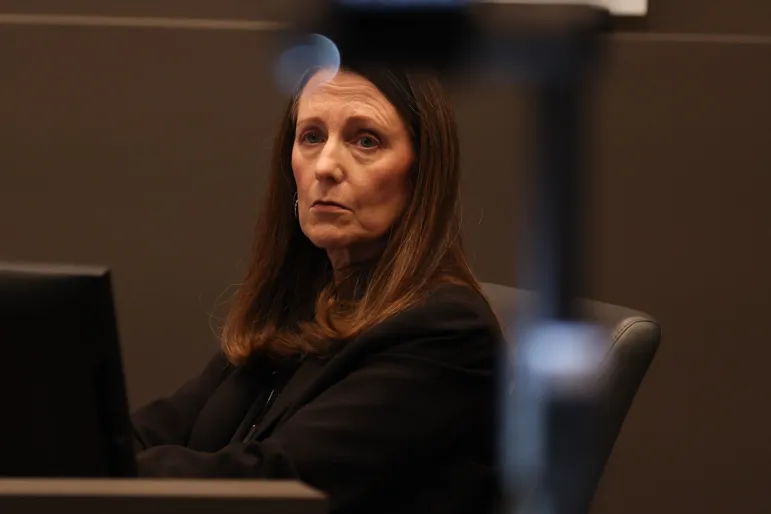 County of Orange’s Interim County Executive Officer Michelle Aguirre during the Jan. 28, 2025 Orange County Board of Supervisor meeting. Credit: JULIE LEOPO, Voice of OC
County CEO Michelle Aguirre announced on Tuesday that to balance the budget, staff had to pull roughly $75 million from one-time funds because their spending outpaced revenue.
“Simply put, we have exhausted all resources available to us,” Aguirre told supervisors. “You will see that we have no general fund requests for additional resources, because there are none to be given.”
But jurors found that the supervisors have continued to increase how much they spend every year without much justification.
“During the Orange County bankruptcy (December 6, 1994), for example, Board-appointed staff positions were reduced from eight to six, reflecting the need to prioritize limited resources,” jurors wrote. “The continued expansion of Board office staffing today contrasts with the 1994 approach and warrants renewed scrutiny of whether current staffing levels are aligned with the County’s operational priorities and fiscal realities.”
In a statement after publication of this article, Supervisor Vicente Sarmiento said the report indicates jurors have a limited understanding of the board’s responsibilities overseeing one of the largest counties in the state and staff played an important part in responding to residents.
He also said jurors should be spending their time on more challenging issues facing the county including campaign finance reform, the chemical tank incident in Garden Grove, and immigration enforcement.
“Additionally, the Grand Jury should periodically examine its own composition to ensure that its membership reflects the changing demographics and diverse communities of Orange County,” reads Sarmiento’s statement Wednesday.
“A jury that is representative of the county’s population is better positioned to understand the issues facing residents and to identify areas that warrant meaningful oversight and investigation.”
None of the remaining Orange County Supervisors returned messages seeking comment Wednesday.
Do Supervisors Need Discretionary Funds?
Jurors questioned the existence of supervisor’s discretionary funds, which were floated by one-time COVID-19 relief dollars, highlighting how the money could raise questions of impropriety.
“While many of these grants support worthwhile programs, the practice effectively allows Supervisors to allocate public funds to groups and constituencies outside the County’s direct governance responsibilities,” jurors wrote, noting that it could “create the appearance that discretionary spending and grantmaking are being used to cultivate goodwill or curry political favor with residents, organizations, and voters.”
There are currently no public plans to make the discretionary funds an ongoing program for supervisors.
On Tuesday, over a hundred people signed up to speak on the budget with a host of them, including many elected officials in the district represented by Supervisor Janet Nguyen, calling on Supervisors to return roughly $3.7 million to her discretionary accounts they say former Supervisor Andrew Do stole from them.
Do is currently in federal prison after he pleaded guilty to accepting bribes and rerouting over $10 million from the county to several nonprofits, including one that employed his daughter.
Much of the scandal was centered on his discretionary spending.
[Read: Former OC Supervisor Sentenced to 5 Years in Federal Prison in Bribery Scheme]
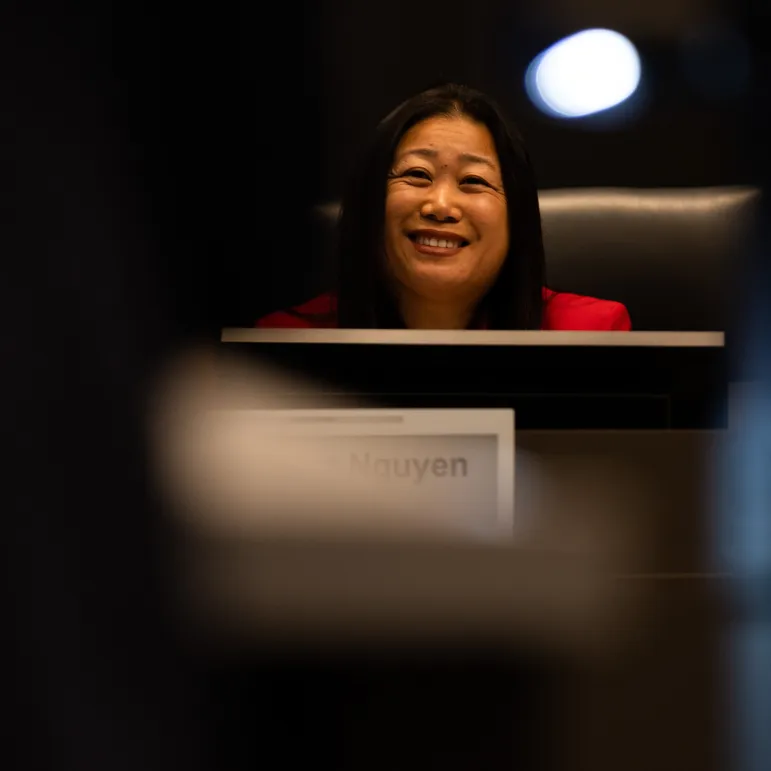 Orange County Board of Supervisors meeting on Jan. 13, 2026. Credit: JULIE LEOPO, Voice of OC
Nguyen successfully called on her colleagues to support returning $3.7 million to her discretionary budget to be used to fund community programs in her district
“If the situations were reversed, I know each of you would fight to the death for your district,” she said at Tuesday’s meeting.
“These funds were recovered in connection with the Andrew Do corruption matter, and it should be returned back to the benefit of the First District community that were deprived of the intended services.”
Supervisors Vicente Sarmiento and Katrina Foley agreed the money should be returned to the people it was supposed to help and that the area the First District covers changed near the end of Do’s tenure on the board.
Sarmiento said the money was meant to help people during the pandemic and staff should look back to ensure the money goes to help everyone impacted not only the residents still in the First District.
“Those funds, when they were diverted, they hurt and created true victims of residents who were denied the services, the assistance, the opportunities to recover quickly and to have their needs addressed at the time,” he said.
“I do believe that the money should go back to those that were harmed, but let’s figure out who was harmed.”
Foley, who represented some of the cities now in the First District, said she directed money to support meal programs to some of the cities that were impacted by Do that she used to represent.
She also added the corruption scandal has cost the county money.
“There was some support for those cities that are now part of district one, which were not part of district one at the time,” Foley said.
“So far, we’ve spent on outside contract services more than $1.7 million and that’s $1.7 million that has helped us to secure additional funding but at the same time it’s at a cost to our general fund so that includes our forensic audit, that includes all of our outside IT support services, and our civil litigation we are still presently pursuing.”
Jurors encouraged supervisors to implement more restrictions on how the money can be used, if it’s used at all.
“The Board should limit discretionary grants to County-related purposes within its direct service and governance responsibilities and adopt uniform eligibility and reporting standards to ensure transparency and eliminate the appearance of political favoritism.”
Do Supervisors Need a Dozen Staff?
 Attendees gather outside the board hearing room during the May 20, 2025 Orange County Board of Supervisors meeting on May 20, 2025. Credit: ERIKA TAYLOR, Voice of OC
Jurors also pointed to a column by Voice of OC’s Publisher and Editor in Chief highlighting that supervisors often have more power over the direction of the county than the county CEO, highlighting that the expanding staff also helps them make decisions independent of the county bureaucracy.
[Read: Santana: Orange County Supervisors Confront Themselves]
“Supervisors increasingly rely on their own policy aides, analysts, and communications staff rather than on the County Executive Officer and department heads, who are the subject‑matter experts responsible for managing County operations,” jurors wrote.
“Staff increases create a duplicative layer of analysis and decision‑support that mirrors work already performed by the County’s professional management teams,” they continued. “The result is not only higher administrative costs but also a governance model in which significant information flow, policy development, and operational guidance occur outside the County’s established executive channels.”
The Grand Jury report found the number of people directly managed by the supervisors has also dropped as more of the county incorporated in the late 90s and early 2000s, leaving just 4% of county residents who are governed directly by the supervisors and not city councils.
Moving forward, jurors recommended that the supervisors reexamine how many staff they actually need and review positions for “redundancy relative to the County Executive Office.”
Noah Biesiada is a Voice of OC reporter. Contact him at nbiesiada@voiceofoc.org.
Hosam Elattar is a Voice of OC reporter. Contact him at helattar@voiceofoc.org.
Related