
The roots of American stock car racing can be traced back to the moonshine business that once thrived in the hills of the Carolinas and Georgia.
To run their booze past authorities to clandestine markets, moonshiners worked with a network of daring drivers in souped up cars.
“Following World War II, there was no shortage of veterans back home building fast cars in their backyards,” moonshine and racing legend Junior Johnson recalled years ago. “They could build cars that were stronger and faster than the police had.”These cars and drivers soon formed a delivery network for moonshine operations.
“And that’s where stock car racing was born. As soon as two drivers with fast cars met, you had an argument and a race. When eight or 10 drivers got together on a Saturday night, you had an event.
“Back then, a landowner who had a bulldozer could make a circle and call it a track. There were no rules. If there was a purse offered, drivers often got stiffed by promoters who also had fast cars.”
Enter a garage owner from Daytona Beach, Fla., named Bill France Sr. On Dec. 14, 1947, France brought together a group of two dozen “race promoters” plus law enforcement leaders and several engineers at the Streamline Hotel down the street from his garage to see if he could form an organization to promote stock car racing.
An organization with the unwieldy name of the National Association for Stock Car Auto Racing — NASCAR — was born.
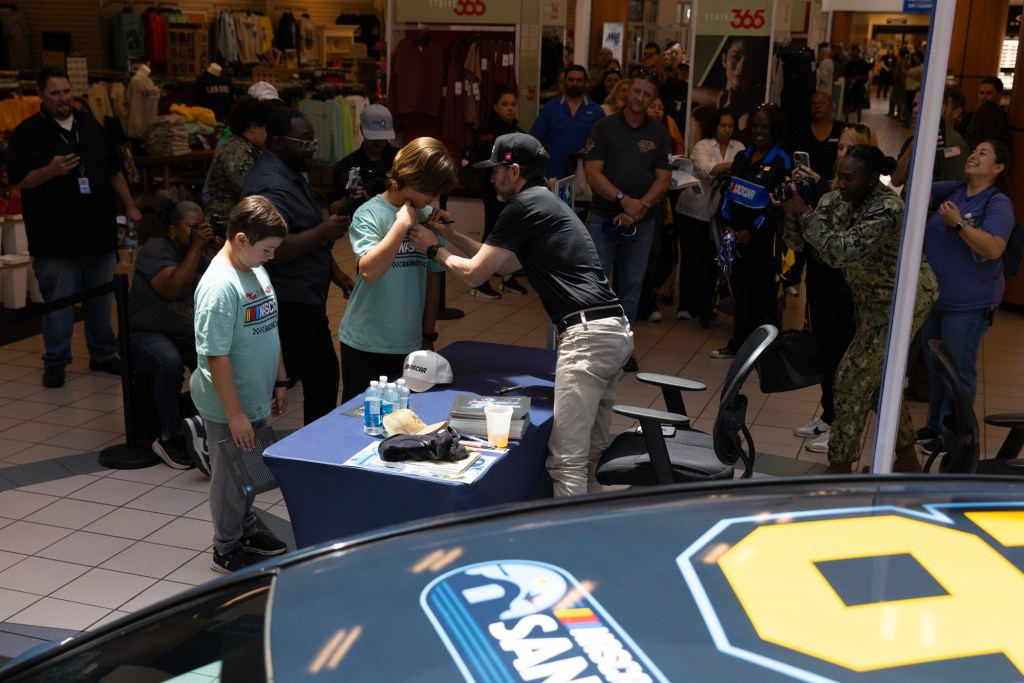
Actually, there was nothing truly national to NASCAR. At the time and for another 30 years, the open-wheel series anchored by the Indianapolis 500 dominated American motorsports. Although NASCAR expanded its schedule to include races at Riverside, it remained pretty much a southern niche sport. The San Diego Weekend, whuch begins Friday and culminates in the June 21 Anduril 250 Cup race at Naval Base Coronado, marks the circuit’s first major foray into San Diego
NASCAR had developed a cadre of popular drivers including Junior Johnson, Richard Petty, David Pearson, Glenn “Fireball” Roberts, Jeff Gordon, Cale Yarborough and Darrell Waltrip as well as off-the-cuff personalities. But the series was still fighting for recognition in an ever-expanding world of sports.
Then came Feb. 18, 1979.
On a day when the Northeast and Midwest were buried by a blizzard, CBS aired the first live, flag-to-flag coverage of a 500-mile NASCAR race — the Daytona 500. Not only was the audience captive, it was also intrigued as Yarborough and Donnie Allison battled for the lead entering the third turn for the final time. Then their cars came together and spun off the track as Richard Petty raced past to steal the win. As the cameras returned to the infield of the third turn, Yarborough and Donnie and Bobby Allison were fighting in the infield.
NASCAR had arrived. Five-and-a-half years later, there was another iconic photo moment as Richard Petty’s famed No. 43 was shown racing down the backstretch at Daytona headed for a record 200th win as Air Force One was landing in the background at the adjacent Daytona Beach airport.
During the 1990s, NASCAR became the fastest growing American sport in terms of attendance. And today it remains a weekend staple that has stood as the leading American motorsports series for more than four decades.
Over the years, NASCAR has evolved and diversified. Once a series of oval races run primarily in the south, NASCAR’s schedule now includes road and street course races and is truly national in scope.
And it has always been the drivers who fueled NASCAR’s growth and popularity — anchored by the three drivers who have won seven championships apiece: Petty, Dale Earnhardt and El Cajon native Jimmie Johnson, who will be making the penultimate appearance ever in a NASCAR race next weekend.