

On July 21 of last year, two longtime teammates each took their turn sitting down at a table adorned in Los Angeles Angels red, the team’s logo plastered on the wall behind them.
In Instagram photos posted from that day, they’re smiling. It was another joint milestone for Jakob Guardado and Alec Gomez — two Orange County kids living their baseball dream. They’d played together in high school and college. And now, they were making the leap together into professional baseball as undrafted free agents.
It’s the kind of story, however, that can be viewed in two different ways.
The signings can be seen as joyful low-stakes moment, the shared start of a journey that they hope ends in the major leagues.
They can also be seen as the byproduct, at least in part, of nepotism – the granting of a chance to certain players because of their connections, while others might never be afforded the same opportunity.
Once an extremely common practice in baseball, these types of signings are now drawing more scrutiny.
Jakob is the son of Angels executive Eddie Guardado, who was also a longtime closer for the Minnesota Twins, enshrined in that team’s Hall of Fame. Gomez is Jakob’s longtime teammate.
Players with big-league bloodlines do have a long history of performing well. Still, neither of these two were particularly productive college players. Gomez played in only five Division I games following a successful season at the Division II level. Guardado’s collegiate ERA was 6.22, his fastball averaged 88.8 miles per hour, and he struck out just 5.3 batters per nine innings.
One college head coach whose team faced Guardado said that he thought it was a stretch to sign him to a pro contract. The coach, along with most of the people The Athletic spoke to for this article, spoke on the condition of anonymity in order to provide a candid perspective and preserve relationships across the sport.
Both Guardado and Gomez declined comment through an Angels spokesperson, and the team declined to make Eddie Guardado available for comment.
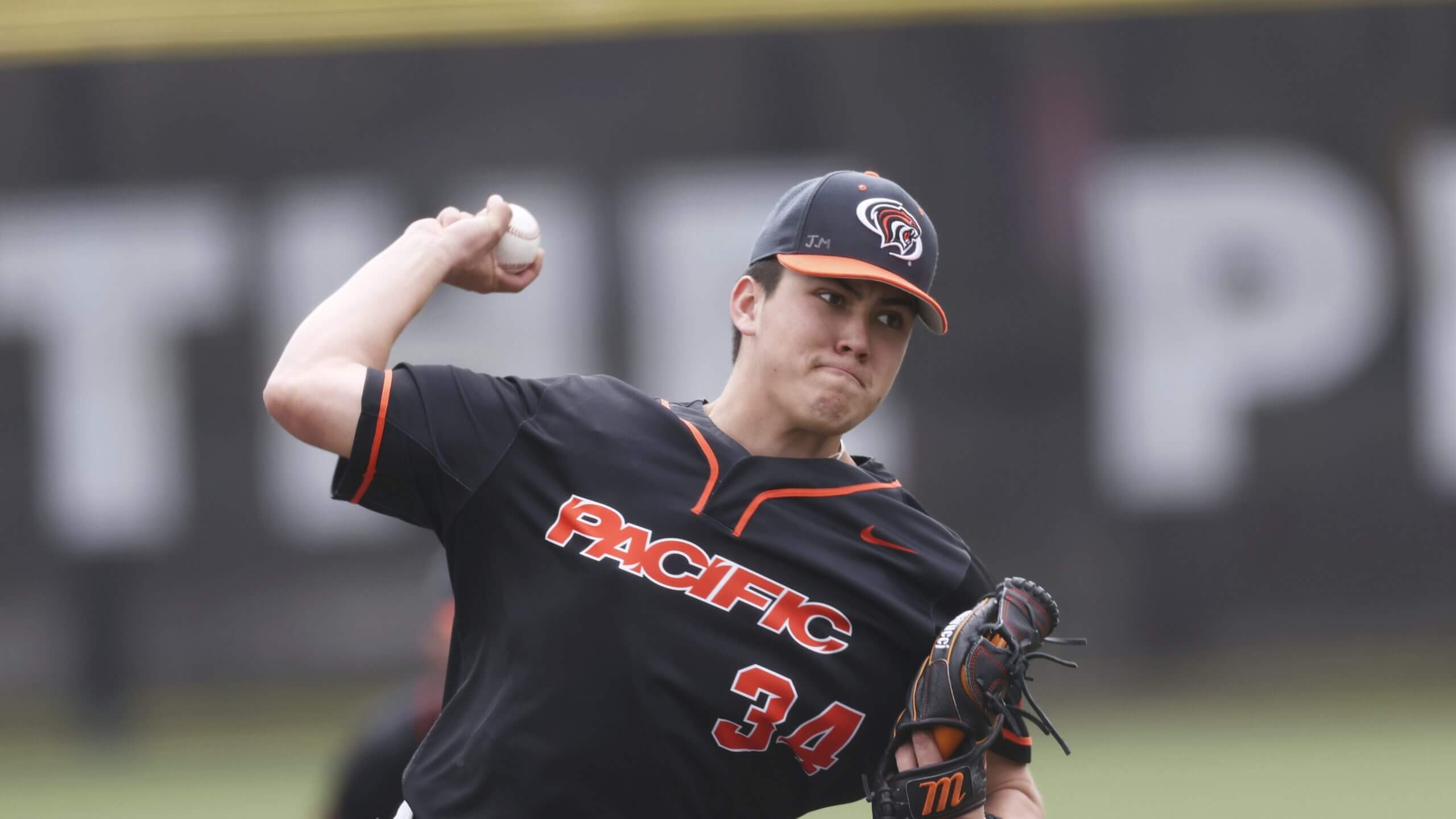
Jakob Guardado, shown pitching at University of the Pacific in 2024. (AP Photo/Amanda Loman)
Drafting family members or signing them to free agent contracts is as much a part of baseball history as sunflower seeds and the seventh inning stretch. For years, teams often used the later rounds of the draft for these selections, because the stakes were low and roster spots were considered plentiful.
In 2015, the Phillies drafted the sons of four organizational employees in the 35th round or later. The Padres drafted Rick Renteria’s son twice, in 2007 and 2012, while Rick was a coach in the organization. In 2005, the Mariners drafted Rufus Lumry III out of Princeton; his father owned part of the team.
All of those examples were in line with the norm at the time.
However, the elimination of 40 minor league teams in 2021, the subsequent elimination of 20 draft rounds, and the league’s institution of a hard 165-player domestic organizational cap in 2023 have changed the entire dynamic of minor league roster decisions.
There was a time when teams employed well over 200 minor leaguers. Now, clubs are far more judicious about every uniformed athlete, and signings that may smack of nepotism stand out for their rarity.
“It’s much different today,” said one current big league scouting director. “It’s almost non-existent because you can’t waste picks. Period. … You can’t afford to waste roster spots.”
Baseball has long accepted nepotism picks because the stakes were so low. Many of these picks never play in a professional game. Why would fans care?
Within the game, however, with roster spots now at a premium, every player and every signing is scrutinized.
“It’s just not fair anymore,” one baseball agent, who represents mostly minor league players, said of nepotism signings. “You’re going to have guys either not move up and get the development they need, or get cut. And it’s so easy to get cut now.”
That’s what makes Guardado and Gomez stand out in today’s game. Gomez’s entire D-I experience was going 1-of-14 at the plate while playing at University of Pacific in Stockton, California. Guardado, also at Pacific, posted a 1.660 WHIP and allowed 19 homers over his two seasons.
Director of player development Joey Prebynski, who has overseen an Angels system that annually ranks among the lowest in MLB, told The Athletic the signings were rooted in believing the players’ abilities and their specific fits for necessary roles in the organization.
While he declined to elaborate on the process of how the two were signed, he did note that, generally speaking, they rely “on recommendations from people that you trust.”
The Angels case might be among the more glaring examples. But even in an era where roster spots are scarce, other examples that raise eyebrows can be found.
Peyton Glavine, the son of Hall of Famer Tom Glavine, never rose above A-Ball in parts of four seasons in the Washington Nationals organization. After the Nationals released him this January at age 26, he was signed by his father’s longtime team, the Atlanta Braves in February. The Braves subsequently released him a month later.
A’s minor league hitting coordinator Todd Takoyashi oversees the development of his catcher son Tommy, who hit just three collegiate homers. Dodgers manager Dave Roberts’ son was signed by the Diamondbacks in 2023 after posting a .611 OPS over four college seasons. Brewers legend Prince Fielder’s son was signed by Milwaukee out of high school after going undrafted.
Not all these signings should be automatically cast as negative, of course. Take Jack O’Dowd, son of longtime Rockies GM Dan O’Dowd. Jack was a productive player at the University of Texas. But he was undrafted, unsigned, and only landed with his father’s former team this year after mashing in independent ball in 2025, with a .338 average and a 1.091 OPS. He’s the kind of player that teams might rightly take a chance on, and sometimes, a personal connection to a player means a chance to unearth a diamond in the rough; in 43 games in the Rockies organization so far, O’Dowd has a .358 average and a 1.100 OPS.
That is what makes these cases so complicated; they are rarely perfectly clear-cut.
“Everybody that I work with, they always speak highly of (my son),” said one high-ranking baseball organizational official who had a son in the minor leagues.
He spoke on condition of anonymity, concerned that his comments might upset his family. He said he wished his son was 10 years older, because back then it would have been easier to call in a favor from any number of other teams. Those days, he said, are done.
The official’s comments spoke to a self-awareness about the situation: A recognition that his own personal bias could be at play, and that his own authority in the organization could be a benefit to his son, fairly or not.
The positive reports he got were nice, he said, but he understood they could be inherently flawed.
“They’re also my friends,” he said. “If he was being a little turd, I’m not sure if they’d tell me.”
Not all roster spots are equal, of course. There has always been a need for so-called organizational players – “org guys,” – who are not likely to make the majors, but who are there to help fill out rosters, challenge the true prospects, and to be a quality presence in the clubhouse.
But those spots, too, are valuable, and the smaller minors have led to fierce competition for even those places. An org guy who might still have an outside chance to make the majors someday is a valuable thing, and if one is jettisoned in favor of a nepotism draftee, that can sting.
“You’re releasing guys that you know are good players,” said Phillies director of player development Luke Murton, “but that you know probably are not that guy.”
Beyond the current roster limits, executives noted that other issues often arise from employing players with family connections.
“The dismount is rarely clean,” said the AL executive. Rank and file player development coaches and executives sometimes got upset when an undeserving player was signed and given a chance. And parents got annoyed when their child was released.
“You think you’re doing the family a favor,” the executive said. “But it ends up being the opposite. It ends up being messy.”
Issues can also arise in team dynamics, the scouting director said. Often to the detriment of the actual player.
“His teammates are probably looking at him,” the scouting director said, “thinking, ‘We know why you’re here, and you shouldn’t be.’ Those situations, they create more issues than they’re worth.”
To avoid those situations in the past, sometimes teams would do each other favors: If you draft my scout’s son in the 38th round this year, we’ll do the same for you next year.
The executive said that he had a high-ranking assistant once specifically tell him not to call in any favors, and not to draft his son unless it was legitimately earned. There’s no way of knowing how common that story is, and how many favors were never called in.
“It’s supposed to be a meritocracy,” the executive said. “And it’s not always a perfect meritocracy. But you’re aiming for as close to that as you can get.”
Even purely symbolic moves can invite the perception of nepotism. The Chicago White Sox made baseball history in 1993 when they drafted Carey Schueler — the first woman to ever hear her name called by an MLB team.
The sport had just lifted its restrictions on drafting women. And in the 43rd round, the team made the symbolic move, and also a personal one: Schueler was the daughter of White Sox general manager Ron Schueler.
“I know, without a doubt, with who my dad was and the job that he had, it wouldn’t have been the same level of attention on me and opportunity,” Schueler told The Athletic. “That said, do I know that I earned it, and know that I was good enough? Yes.”
Schueler’s case shows just how nuanced these situations can be. It was undoubtedly an inspiration to have a woman drafted, particularly one who played baseball, and was good at it.
But it also raised the question of why this particular woman got the chance.
Is there a long-term, professional path for Jakob Guardado? A chance to prove that he’s not just here because he’s his father’s son?
It depends on who you ask.
The Angels argue that Guardado has an interesting fastball, one that’s special in how it moves. His 18.4-inch induced vertical break, they say, makes him a pitcher worth keeping around. They also believe in his upbringing and his competitive mindset.
“From a development standpoint, we felt like there were potentially some things we could do,” Prebynski, the Angels’ PD director said. “It was a combination of the characteristics of his fastball, and some development focus areas that we felt we could potentially improve.”
But the numbers don’t fully align with the club’s optimism. Guardado’s fastball averaged 91 miles per hour in the minors entering June, according to advanced data reviewed by The Athletic, and batters have a .400 batting average and .689 slugging percentage against the pitch. It generates whiffs just 20 percent of the time, and has led to Guardado posting a 7.50 ERA and 1.917 WHIP overall.
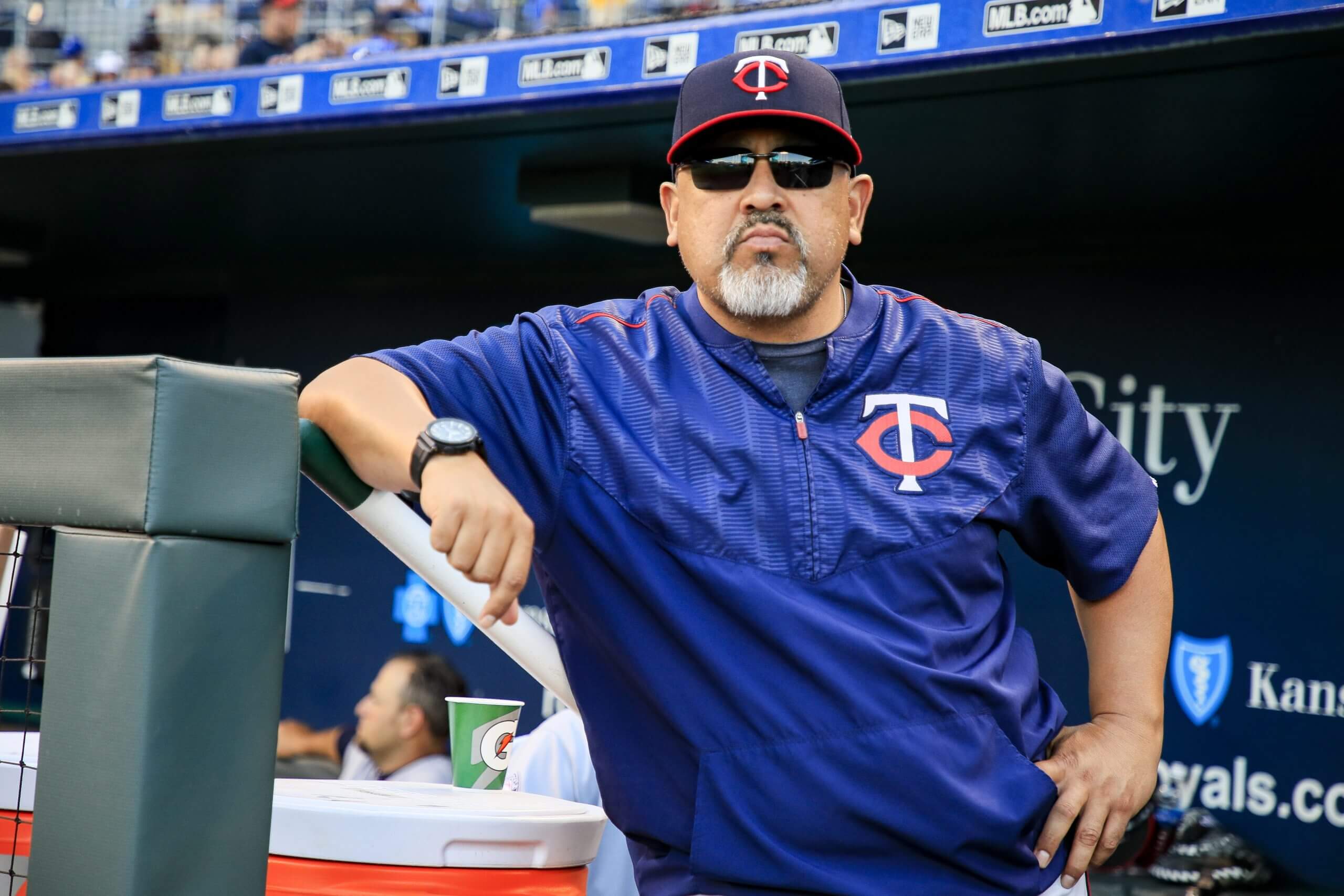
Eddie Guardado, shown when coaching for the Twins in 2017, had a long major league career. (Brian Davidson/Getty Images)
Still, the Angels gave Guardado multiple opportunities to pitch in big league spring training games. He was then rostered at an affiliate, and given a chance to save games early in the season. He ranks second on the team with 21 appearances.
Guardado’s performances have marginally improved as the season has gone on, and his strikeout rate is up to 11.3 per nine innings. Baseball’s history is littered with players overcoming the odds. Perhaps the already 24-year-old Guardado will follow that improbable path.
But future success or failure won’t erase the lingering question of why Guardado was given the chance to begin with over players with more accomplished or promising resumes — at a time in baseball where every roster spot has to be justified more than ever before.
And why was his friend Gomez, whose collegiate resume offers less justification for his current job, signed as well? Why is the 24-year-old playing in a complex league with players that, on average, are 4.5 years his junior?
“We’d watched some throughout the year at Pacific,” Prebynski said of Gomez’s five games played. “We felt like there was some baseball aptitude there.”
The Angels may not want to say that nepotism was a factor. Because 2026’s version of professional baseball no longer affords an obvious pathway for it.
For a long time, that was common for the fringiest draft picks or the cheapest of post-draft signings. But now, for better or worse, those players that used to slip under the radar are now far more likely to stick out.