
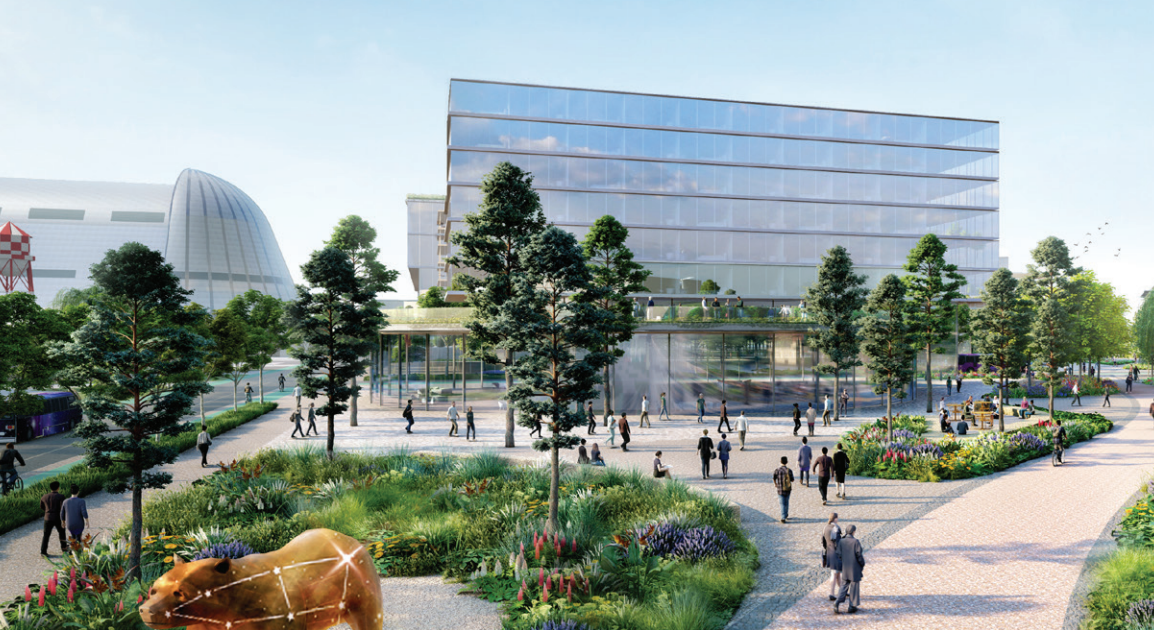
For the better part of a decade, NASA Ames and UC Berkeley have been planning to build a $2 billion space center at Moffett Field, but few details about the massive project on Mountain View’s border have been publicly known.
That changed recently with the April release of an environmental report laying out different scenarios for the project. The nearly 1,400-page analysis makes clear that the development, dubbed the Berkeley Air and Space Center, would include millions of square feet of research and office space, but little housing.
UC Berkeley is working with SKS Partners, a commercial real estate developer, to build the space center on a 39-acre portion of Moffett Field, a former military base that was closed and transferred to NASA in 1994. Now known as NASA Ames Research Center, the broader 2,000 acre site largely sits in unincorporated Santa Clara County, north of Mountain View and U.S. Highway 101.
Although Berkeley’s proposed development will impact Mountain View, the city has little say in it because Moffett is under federal jurisdiction.
According to city spokesperson Lenka Wright, the project is within Mountain View’s “sphere of influence” but outside its jurisdictional authority. Mountain View can advise UC Berkeley and NASA on local conditions and consider permit requests related to city utilities and public roads and sidewalks. However, Wright said the city does not have jurisdiction to decide on the underlying project.
The recent environmental report did give Mountain View an opportunity to chime in. State and federal law require agencies to review and disclose the environmental impacts of projects under the California Environmental Quality Act and National Environmental Policy Act. In April, UC Berkeley and NASA submitted a joint environmental impact report as part of fulfilling those requirements, which provided a public comment period for the project that closed Wednesday.
“Whether it’s about traffic or housing or air quality, those are all being studied under CEQA and NEPA right now,” UC Berkeley spokesperson Kyle Gibson said.
On June 9, Mountain View submitted a formal comment letter, which addressed concerns related to transportation, traffic, utilities and water supply — but not housing.
The information in the environmental report has sparked concern from some community members who said the project does not include enough homes, nor sufficient plans to mitigate traffic impacts.
At most, Berkeley is proposing building roughly 250 homes while the development is expected to generate up to nearly 6,000 new jobs, according to the report.
“People I work with aren’t opposed to having Berkeley do a science center at Moffett Field,” Lenny Siegel, a former Mountain View mayor and councilmember who has long been involved in Moffett Field advocacy efforts, said. “But this, in terms of the jobs-housing imbalance and transportation, is a real debacle.”
Wright said the city does not intend to urge UC Berkeley to provide additional housing beyond what it has planned for the project.
“Improving the jobs-housing imbalance is best addressed at the policy level on a regional scale rather than through individual development projects,” Wright said. She added that while the project’s impact on the ratio of jobs to housing is “potentially concerning,” the city believes it would “only modestly affect the existing imbalance” in the region.
Wright also said the space center would advance other city goals, like its economic vitality strategy, by generating spending and investment in Mountain View, which could lead to the creation of new businesses.
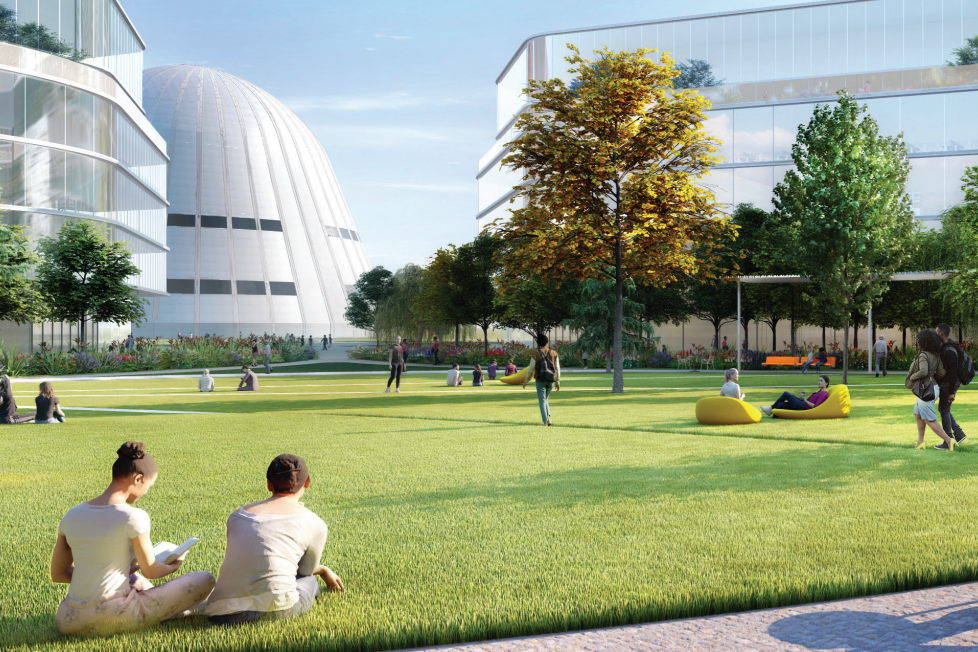 The project includes plans for research and office space, as well as a conference center. Rendering courtesy of NASA Ames.
The space center’s plans for housing
The project site currently consists of structures tied to the former naval air station, including office buildings, a gas station, a pool and a recreation area. Those buildings are now mostly vacant, according to the report.
In its place, UC Berkeley and SKS are proposing a mixed-use development with roughly 2 million square feet of research and office space, along with a conference center, retail stores and places to eat. Housing is also planned, but on a much smaller scale.
The project includes 145 homes for faculty and students, consisting of a mix of studios, one- and two-bedrooms, according to the report. Another 100 homes would be built as temporary lodging for staff, researchers and visiting families.
“We’re carefully looking at building the right amount of housing,” UC Berkeley’s Gibson said. “We don’t want to build housing that we then do not have students and faculty to fill, nor do we want to not build enough housing.”
The report also provides an alternative, lower-density scenario that reduces the research and office space to 1.1 million square feet while keeping the same amount of housing. This would result in about half as many employees on the site, the report said.
Additionally, the report describes a “variant” scenario that would not have any faculty or student housing, but would retain the temporary lodging. Instead, UC Berkeley and SKS would build more office and research space.
Gibson noted that proposing alternative and variant scenarios, with different components added and taken out, is standard for environmental reviews and part of evaluating a project’s impacts.
However, Siegel is concerned about the prospect of adding thousands of jobs without also adding a sufficient number of homes, particularly in a region that already is experiencing a massive housing shortage.
“Mountain View, and Sunnyvale actually, are truly trying to build housing to accommodate all the tech growth,” Siegel said. “This activity at NASA will undermine what we’ve been doing. We’re trying to catch up, at least not to have a worse housing imbalance.”
NASA had separately been planning to work with a private developer to construct approximately 2,000 homes at Moffett Field, but Siegel said that project had fallen by the wayside. When the Mountain View Voice asked NASA what happened to the project, a spokesperson did not provide details.
“NASA continues to consider possibilities for how the parcel could be used,” the spokesperson said.
According to Gibson, UC Berkeley did not consider the 2,000 homes that had been planned for the other project site when it submitted the environmental impact report.
“We are, as a university, in favor of housing around our sites, but we’re also not dependent upon those projects,” Gibson said. “We’re really looking at supplying what we need for our faculty and students through the housing that we develop.”
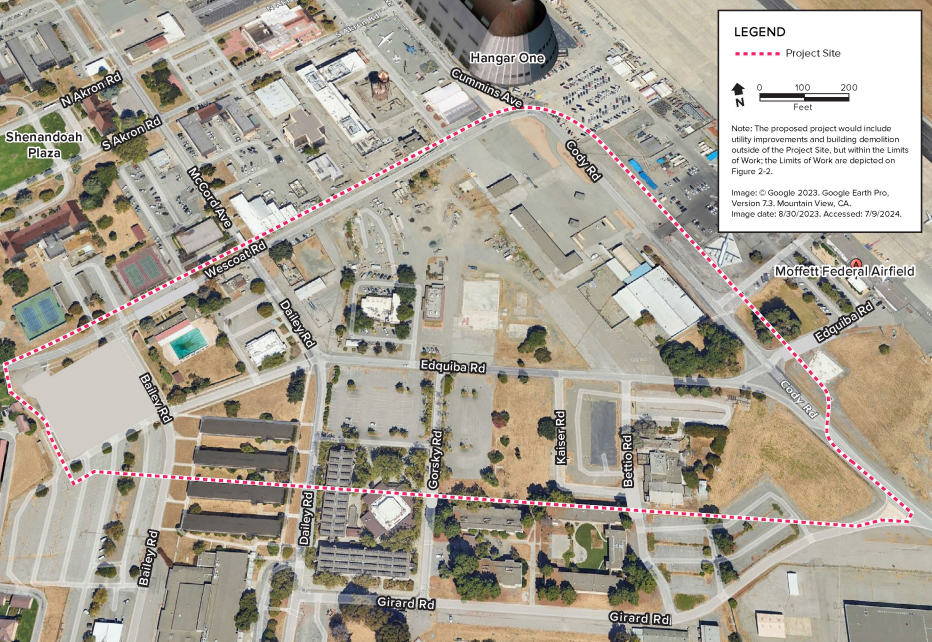 The project site is currently occupied by various, mostly vacant buildings. Image courtesy of NASA Ames.
Traffic and public safety
In addition to housing, Siegel raised concerns about increased traffic, arguing that space center commuters would jam freeways and local roads. Building more homes would lessen some of these impacts, he said.
The environmental report proposes other mitigations that could reduce traffic, such as encouraging public transit. The Bayshore NASA light rail station is within a half mile of the site.
Even so, the report notes that the project would substantially increase vehicle trips to and from the center, resulting in congestion during peak commute times at intersections like Ellis Street and Manila Avenue. The report proposes putting a traffic light at the intersection, which would require coordination with Mountain View.
Gibson noted that working with municipalities is a regular part of the development process.
“We’re going to make sure that we have the appropriate coordination with all local municipal services,” he said. “Whether it’s with the city (or) the county, we care very much about trying to minimize (the) impact of any project.”
Bill Berry, a retired NASA Ames deputy director, said the question of how public safety services will be handled at the site is not entirely clear. Berry is supportive of the space center, but noted that fire, police and emergency response services likely would need to be scaled up from what currently exists.
“Realistically, at some point, Mountain View is going to have to have some responsibility for what goes on out there,” he said.
A NASA Ames spokesperson said that “NASA plans to continue providing all fire protection, emergency medical response and police services.”
Wright said Mountain View has not made any decisions on the provision of fire protection or law enforcement services.
For Siegel, these kinds of discussions are critical for the project to move forward with community support.
“I’m hoping to see some public debate about this,” he said. “It’s not a project that I oppose, but in its current shape, it could be damaging to the community and no one seems to know about it.”
This story originally appeared in the Mountain View Voice. Emily Margaretten joined the Mountain View Voice in 2023 as a reporter covering City Hall.