
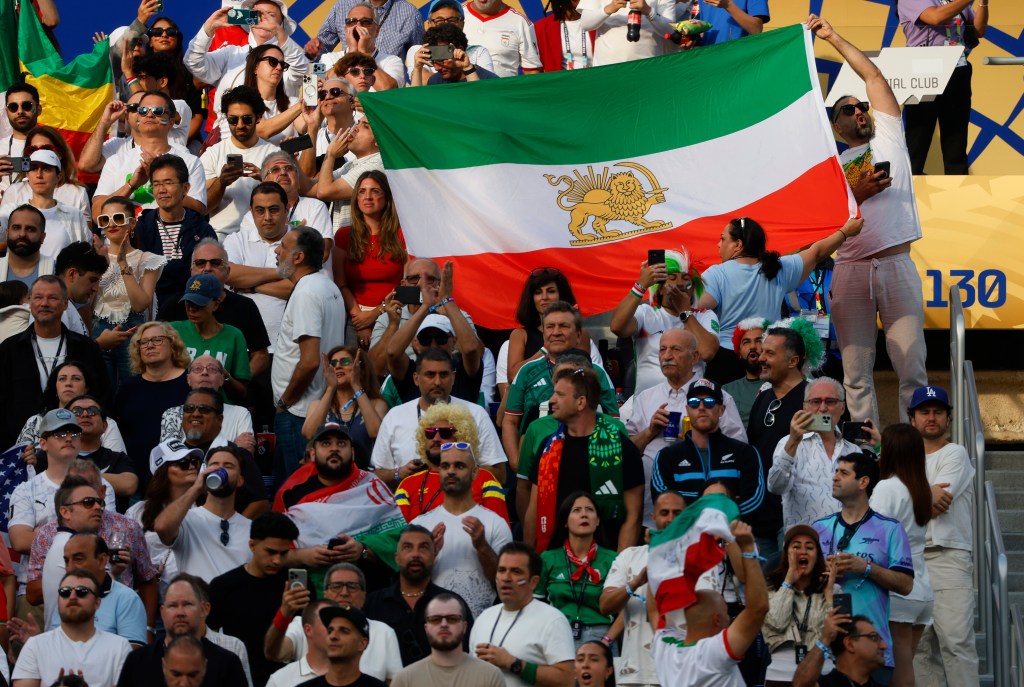
INGLEWOOD – Security working the entry gates Monday at SoFi Stadium were searching for two items to confiscate.
Water bottles.
And flags depicting a yellow lion holding a curved sword with a rising sun in the background.
One was in the name of Dasani, the other in the name of Melli.
Dasani is the bottled water company owned by FIFA World Cup sponsor Coca-Cola, and prohibiting fans from bringing in water — or even refillable containers — means they have to buy it inside on sweltering summer days. Melli is the nickname for Iran’s national soccer team, which threatened to halt matches if “Lion and Sun” flags, strictly banned back home, were displayed.
FIFA obliged on both counts, bowing at the altar of finance and politics. No bottles, no Lion and Sun flags.
Security was better at finding the former, judging by the contraband in trash cans outside the gates and by what happened inside when Iranian players took the field for pre-match warmups before their 2-2 tie against New Zealand in the Group D opener. Hundreds of fans stood … and waved Lion and Sun flags they had smuggled inside.
It was Iran’s flag 50 years ago, before the Islamic Revolution ousted the Shah (and millions of people), changed the government, changed the laws and changed the flag. It still has horizontal bands of green, white and red, but the yellow lion and sun were replaced by a red Islamic emblem.
The old flag has become a symbol of the opposition, which is strong among the estimated 250,000 in the “Tehrangeles” diaspora and was clearly representative inside SoFi and in a pre-match rally outside.
A local group sued FIFA last week to have the flag ban lifted, and hours before kickoff a Los Angeles Superior Court judge ruled in FIFA’s favor, reasoning: “Free speech is incredibly important, it is sacred, a bedrock of our society, but it is not without limitation, such as private actor, on private property, and as shown by previous cases, regulating in (a) reasonable way.”
So you weren’t supposed to bring in a flag. But you could wave it without reproach inside (it just meant you wouldn’t wind up in the FIFA-regulated fan shots on SoFi’s massive video board).
It was just the first contradiction in an evening full of them.
For the first time in World Cup history, the host nation was at war with one of the participants, yet most Iranian fans at SoFi Stadium not only support President Donald J. Trump’s attacks on Iran but wish he would have done more to promote regime change.
A cease-fire and peace agreement reportedly has been reached, yet several members of the Iranian delegation denied visas for the links to the Islamic Revolutionary Guard Corps, deemed a terrorist organization by the U.S. government, were forced to stay behind at the team’s training base in Tijuana.
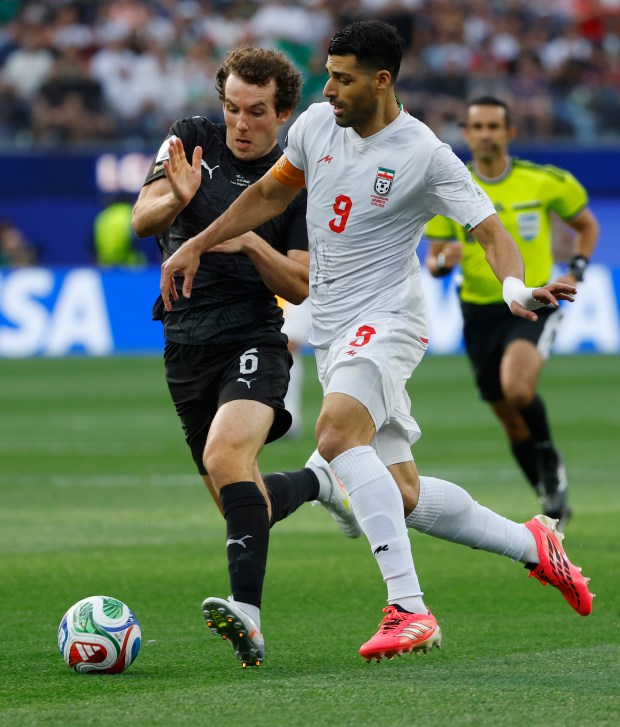
Fans booed the Iranian anthem so heartily you could barely hear it, then cheered wildly when Ramin Rezaeian provided an equalizer after an early New Zealand goal.
Then they waved the Lion and Sun flags when the Kiwis went ahead 2-1 early in the second half.
Then they waved them again nine minutes later when Mohammad Mohebi’s header glanced off the post into the net for a 64th-minute equalizer.
“It’s impossible, really, to describe how to feel,” Keyan said, “because it’s a situation I don’t know how many of us has ever been through. I’m conflicted.”
Keyan is a 34-year-old San Diegan who didn’t provide his last name for fear of repercussions against his family still in Iran. He was wearing a black T-shirt and a headband with the Lion and Sun crest, and wore a giant Lion and Sun flag like a cape. (The T-shirt and headband cleared security, while the cape did not.)
He bought tickets a year ago, and as the date neared he debated what to do, stay or go, cheer or boo, support or scold. He brought a more neutral change of clothes just in case.
“At the end of the day, this is the Islamic regime’s team,” he said. “I don’t know what they’ve put these players through to be here today. If I had to assume, their families are not safe at home and they may not have had a choice. Some may be pro-Islamic members of the team, I don’t know.
“But it’s hard to stand here and say, ‘Oh, we don’t support the team because we don’t know what’s going on,’ because I support Iran. The nation of Iran, our Persian heritage, it’s thousands of years old, and I support that wholeheartedly. I might not support this regime, but this regime is not Iran.”
The team’s preparations were not ideal, training in Turkey and initially planning to be based in Tucson, Ariz., before a late switch to Tijuana that had them arriving at 5 a.m. Star striker Sardar Azmoun wasn’t named to the roster, either because of an undisclosed injury (the official reason) or because of a social media post deemed disloyal to the regime (the widely accepted reason).
The team made the short flight to Los Angeles on Sunday and needed two attempts to land. The game followed a similar script, twice falling behind before salvaging a draw.
They’ll fly back to Tijuana until their June 21 date here against Belgium and June 26 against Egypt in Seattle.
“We are here to play football, and we are here to represent the respectful people of Iran, be it the Iranians inside of Iran or the diaspora,” coach Amir Ghalenoi told journalists Sunday in a FIFA-mandated news conference. “We are only thinking about our country. We’re not political people, and the slogan of FIFA is this: that football is separate from politics.
“We respect each and every one of the Iranians.”
Added captain Mehdi Taremi: “People have different opinions, but we are here as footballers to unite people and we will try to bring joy to all Iranians, irrespective of where they live. Everyone can have their own opinion. We are not here to get involved in politics, we are here to play football.”
Another contradiction.
At the 2022 World Cup in Qatar, Taremi and the Iranian players didn’t sing the anthem before their opening match against England. It was silent solidarity for protests back home following the death of Mahsa Amini, who was arrested for not wearing the hijab female head covering in accordance with Islamic law and died in custody after what witnesses reportedly claimed was a severe beating.
Taremi and his teammates sang the anthem Monday night. You just couldn’t hear it.
This time, the protest was in the stands.