
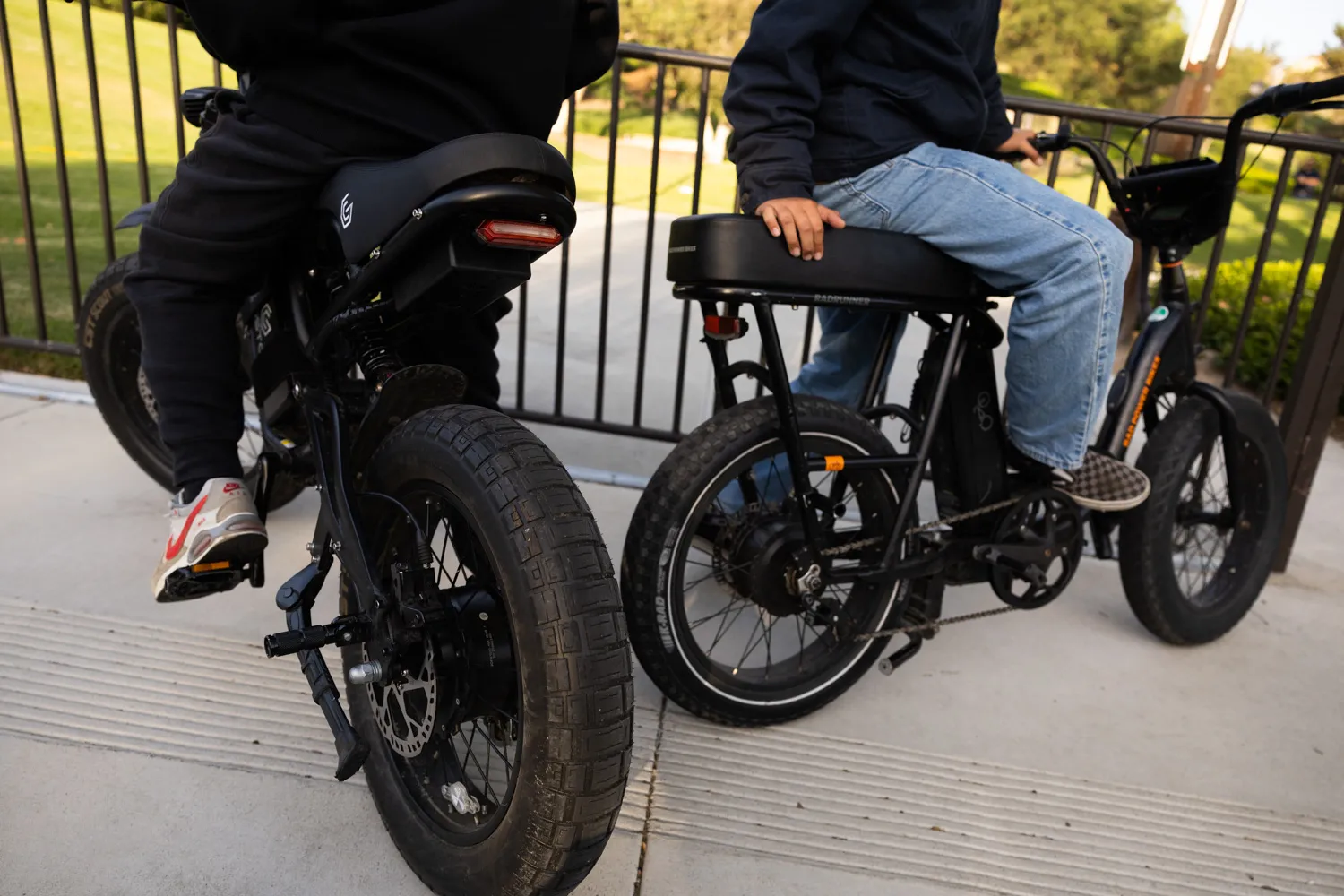
Electric bicycles, which have become a popular way for kids and adults to get around town, are resulting in deaths, injuries and arrests in Orange County as state and local leaders grapple with updated rules for the electric wheeled vehicles.
Many e-bike supporters point to the devices’ ability to curb negative environmental effects associated with cars and argue they offer residents a lower cost transportation option.
At the same time, evolving regulations and lacking infrastructure like bike lanes can result in crashes and arrests — all while community members and local officials grapple with how to keep people from getting seriously hurt or killed.
It’s especially relevant for children and teens, who are increasingly using e-bikes to get to and from school and other events every day.
While city leaders are cracking down on dangerous e-bike riding and adding policies that allow law enforcement to impound e-bikes, some school districts are looking to ban e-bikes altogether for certain grades while kids are on school grounds.
In the Newport-Mesa Unified School District, only high school students will be permitted to ride e-bikes to school starting next school year.
At the same time, Orange County District Attorney Todd Spitzer has announced the creation of an e-bike/e-motorcycle unit to review potential criminal charges against youth and adults, including parents who knowingly allow their children to ride illegal e-motorcycles.
“The death and devastation caused by e-Bikes and E-Motorcycles has reached epidemic levels, and we as elected officials must do everything we can to save lives,” Spitzer said in a statement. “If parents refuse to hold their children accountable, then I am going to hold parents accountable when they knowingly break the law.”
Not All E-bikes Are Equal
The definition of an e-bike has become muddled as different models are rolled onto the market and buyers make illegal modifications to their rides that allow them to go faster.
Standard e-bikes can be broken down into three classes.
Class 1 e-bikes can reach speeds of 20 mph and require the user to pedal to operate with an electric boost.
Class 2 e-bikes also go up to 20 mph and can be operated using a throttle and without pedaling.
Class 3 e-bikes can go as fast as 28 mph and also require the user to pedal to operate.
On the other hand, an electric motorcycle — commonly referred to as an e-moto — doesn’t have pedals. It has a motor with power greater than 750 watts to make it go faster than 28 mph, according to the Orange County Sheriff’s Department.
Legal e-bikes have a motor with power less than 750 watts.
The Orange County Sheriff’s Department also says that some e-bikes can be modified to become an illegal e-moto by removing the pedals and chain and tampering with the motor to allow it to reach greater power levels and go faster.
Injuries, Deaths & Arrests: A Dark Trend
Residents riding e-bikes and similar electric vehicles on busy streets has resulted in a growing number of crashes, injuries and deaths.
A 13-year-old boy died while riding an e-moto in Garden Grove last month after he hit a center median and was thrown off the vehicle.
Last year, a Cal State Fullerton soccer player died after she was riding an e-scooter and collided with a box truck in November 2025.
A new CHOC study from earlier this year examined e-bike injuries for youth and found the number of trauma activations associated with e-bike accidents has sharply increased over the past five years in their emergency room.
A trauma activation in the emergency room is when a specialized medical team assembles to treat a patient with severe, life-threatening injuries.
In 2021, CHOC’s emergency room saw only one trauma patient because of an e-bike-related injury. That number increased to 38 in 2022, 61 in 2023 and 125 in 2024.
In 2025, the emergency room saw 201 trauma patients with e-bike injuries.
“We basically have kids riding vehicles that are much more like motorcycles than bicycles, and many of them have not taken a class on how to ride them safely and don’t know the rules of the road,” study leader Laura Goodman said in a statement released with the data. “It’s a big problem.”
Orange County parents are also facing criminal charges when they knowingly allow their children to ride illegal e-bikes and e-motos.
An Aliso Viejo mom was charged with felony child endangerment and involuntary manslaughter after allegedly allowing her 14-year-old son to illegally operate an e-moto.
The teen was riding the vehicle and doing wheelies in the middle of the street when he struck an 81-year-old man in April before fleeing the scene, leaving the man with critical injuries, according to the Orange County District Attorney’s office. The man, a Vietnam veteran, died from his injuries two weeks later.
A Yorba Linda father was charged with felony child endangerment and abuse after allegedly helping his 12-year-old son illegally modify his e-moto to allow it to reach speeds up to 60 mph.
According to the DA’s office, the 12-year-old was critically injured with a fractured skull after he ran a red light and collided with a car while riding the illegal e-moto. Reports say the boy and his father had already attended an e-bike safety presentation after the child was previously cited for riding an illegal e-moto.
An Orange County School District Largely Bans E-bikes Next Fall
For families in the Newport-Mesa Unified School District, students in middle and elementary school will no longer be permitted to ride any kind of e-bike to school starting in the fall.
School district board members approved the e-bike ban, and it will go into effect for next school year.
High schoolers in the district are the only students that will be allowed to possess e-bikes on campus.
High school students will be able to ride any of the three classes of e-bikes to school, and they must complete an e-bike training program. E-motos are prohibited.
Students in grades below high school will still be permitted to ride a standard bike to school.
To read more about Newport-Mesa Unified School District’s new e-bike policy, click here.
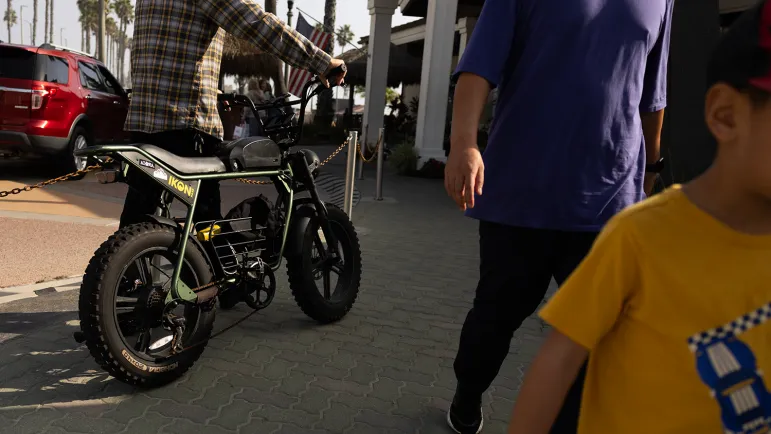 E-Bike Credit: JULIE LEOPO, Voice of OC
The changes were officially approved during the school board’s meeting on April 21 after multiple discussions over the course of several months. Board members approved the policy in a 6-1 vote with Trustee Ashley Anderson voting no.
“We’re not making these decisions without talking to schools and parents,” board member Krista Weigand said at the meeting. “We’re not taking it lightly.”
She said the board decided to permit e-bikes for high schoolers to allow them to get to things like jobs and after school activities.
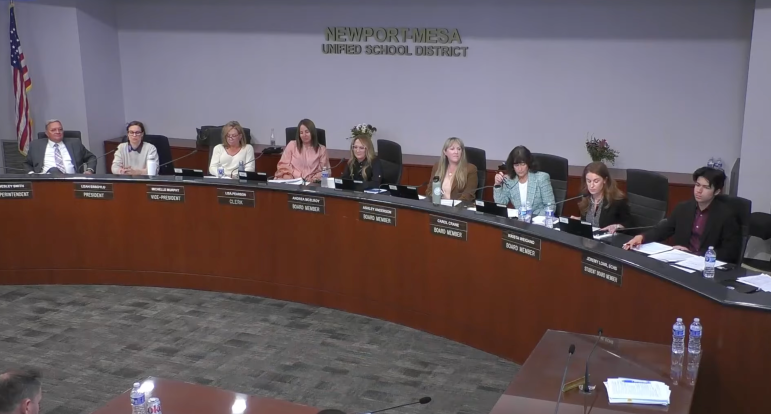 The Newport-Mesa Unified School board members during their meeting on April 21, 2026. Credit: Newport-Mesa Unified School District Youtube livestream screenshot
Anderson argued the board was voting prematurely on this policy because city leaders in Newport Beach and Costa Mesa haven’t aligned their local e-bike regulations.
“I’m concerned when we’re making plans about things that really are the city’s role,” Anderson said at the meeting, “and the cities are not aligned or on the same page or communicating well.”
Several parents spoke at that meeting saying their kids use e-bikes to get to school and they don’t have any other transportation options.
But board members said safety is more important.
“Our responsibility as a board is to keep our students safe,” board member Lisa Pearson said.
“I would rather be criticized here right now than sit here months from now wishing we would have done more to save a life.”
Orange County Cities Crack Down On E-bikes
Newport-Mesa’s action comes after several cities have grappled with e-bike rules and regulations — which often vary from town to town.
In Huntington Beach, police officers can issue civil or criminal citations to people riding e-bikes in an unsafe manner, depending on the severity of the situation, according to the city’s website.
Law enforcement can also hand out citations on private property, like shopping centers, and they can impound illegal e-bikes and e-motos operated by youth.
The Huntington Beach Police Department also hosts e-bike safety courses, which are required before students can ride their e-bikes to school.
Other jurisdictions, like Garden Grove, have eyed Huntington Beach’s regulations as a potential model.
[Read: Is Huntington Beach’s E-Bike Program a Model for Orange County?]
Leaders in Fullerton added rules that prohibit “unsafe” e-bike and e-scooter riding on public streets, paths, trails and parks after the Cal State Fullerton student died in a crash last year.
[Read: Another Orange County City Cracks Down on Reckless E-bike Riders]
In Irvine, officials also voted to tighten rules for e-bikes and scooters — including more responsibility for parents through citations and fines and updated speed limits on sidewalks and trails.
[Read: Irvine Cracks Down on Reckless E-bike Riding, Parents to be Held Accountable]
In 2024, an OC Grand Jury investigation found that all 34 Orange County cities had different rules for e-bikes, creating inconsistent enforcement and public confusion.
[Read: Orange County Grand Jury Blasts Uncoordinated Regulation of E-Bikes]
In that report, grand jurors recommended that every Orange County city should have specific policies that define rules for e-bikes.
They also recommended that every city should have a system to report e-bike accidents, injuries and deaths, and they recommended that every city should also develop outreach and education programs regarding e-bikes.
Angelina Hicks is the Voice of OC Collegiate News Service Editor. Contact her at ahicks@voiceofoc.org or on Twitter @angelinahicks13.
Related