
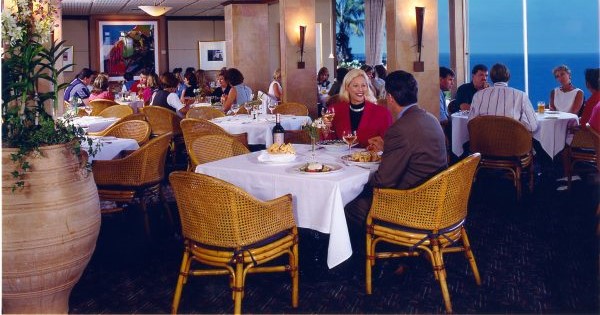
This is the third installment in a series of stories on the history of dining out in La Jolla, how it’s changed and how it continues to evolve.
In the later decades of the 20th century, restaurants started opening in La Jolla that now are familiar names — some because they are mainstays to this day, others because they represent national chains.
In this installment of the month-long series “Dining Out,” the La Jolla Light looks at the major chain restaurants that opened in La Jolla in the 1970s, ’80s and ’90s, along with favorites that remain today.
Leading the way for fast-food chains was Jack in the Box, which opened in the ’70s on Pearl Street in a building designed by architect Russell Forester.
“When I lived on Eads [Avenue] and Genter [Street], I would go there occasionally,” recalled La Jolla Historical Society historian Carol Olten. She noted that several “community icons,” such as former Cove Theater manager Spence Wilson, would eat there.
“It was a regular little gathering spot for people that liked hamburgers,” Olten said.
Jack in the Box closed when the site was acquired by the neighboring Bishop’s School in 2021. El Pueblo Mexican restaurant opened there this year.
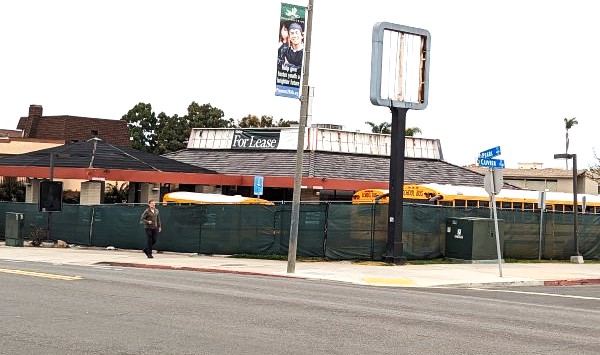 The former Jack in the Box on Pearl Street in La Jolla is pictured after it closed upon being acquired by The Bishop’s School in 2021. It is now occupied by El Pueblo Mexican restaurant. (Ashley Mackin-Solomon)
Chains such as Taco Bell and McDonald’s followed Jack in the Box onto prominent La Jolla streets.
“There was a really big stink when McDonald’s opened a location on Prospect Street,” Olten said. “We already had a Jack in the Box, so people were acquainted with fast food and chain restaurants. But … we did not want a national chain on Prospect Street. People stood up at meetings and talked about [the possibility of] trash and paper napkins being all over the place.”
When the McDonald’s eventually opened in the 1980s, it was in a location on Prospect Street where water and trash would collect in a dip in the asphalt.
“I think they made an attempt to keep everything very clean when they opened, but when they would hose the street off, the water would collect there outside in the gutter, and you would not believe the literal stink that was caused,” Olten said. “People pointed to that and talked about the stagnant water and napkins floating in it.”
Eventually, the McDonald’s restaurant moved out of La Jolla. Olten doesn’t recall when, but there are reports of the McDonald’s still operating in the early 1990s.
In addition to the chains, restaurants started to open that have become household names in the La Jolla culinary scene.
One of the earliest that remains is Harry’s Coffee Shop, which opened in 1960 at 7545 Girard Ave. The restaurant, which is open daily for breakfast and lunch and has been owned by the same family since its inception, is widely considered a slice of Americana.
Another longtime La Jolla eating establishment, George’s at the Cove, opened in 1984 at 1250 Prospect St. as a California-style restaurant inspired by other popular places of the time, such as Wolfgang Puck’s restaurants.
When it opened, George’s restaurant was located on the lower level and the bar level. The rooftop Ocean Terrace opened in 1991.
George’s chef and owner Trey Foshee, who joined in 1999, recalled that that was a busy time for restaurants.
“I had worked in San Francisco, Los Angeles and Hawaii prior to [George’s] … so I had been exposed to what was going on on the national scale, but La Jolla had its own little vibe. There was a lot of social activity in the restaurants. La Jolla felt like a hub for that kind of stuff.”
For example, he said, there was a time when George’s bar needed a bouncer to regulate crowds.
Culinarily speaking, however, Foshee said La Jolla “was a little behind the times” and was “very Maine lobster, veal chop and martini.” So upon his arrival, George’s menu started to change.
“La Jolla didn’t have its own culinary legs at that time,” Foshee said. “It felt like we needed to bring things up a couple of notches,” including using new techniques and local ingredients.
“San Diego back then had all this great stuff, but people weren’t using it,” he said. “I remember when we put local yellowtail on the menu and the response was ‘Really?’ Nowadays it would be odd to fly something in rather than use local ingredients, but it used to be the opposite. It was all about East Coast black cod and snapper from Florida.”
Sami Ladeki, owner of Sammy’s Woodfired Pizza, said that in the 1980s, “La Jolla’s dining scene was largely made up of fine-dining French and Italian restaurants, so there was an opportunity to create something different. … People were looking for fresh, healthy food in a more relaxed setting.”
So he opened one of La Jolla’s first pizzerias in 1989 at 702 Pearl St.
“Sammy’s brought a new California-style cuisine and a more casual dining experience to La Jolla,” Ladeki said.
Nearly a decade later, Ladeki had the opportunity to travel to Tokyo and “completely fell in love with the city, its culture and its cuisine.”
So in 1998, he opened Roppongi at 875 Prospect St.
“At the time, Roppongi was the first modern Asian cuisine restaurant in San Diego,” Ladeki said. “We combined influences from Japan, China and Thailand in a way that wasn’t being done anywhere else locally. There was no sushi in La Jolla at the time, and diners were becoming more adventurous and eager to explore new flavors. Roppongi introduced many guests to a completely different style of dining and helped broaden the culinary landscape of the community.”
Roppongi closed in 2015 but reopened late last year in its original home.
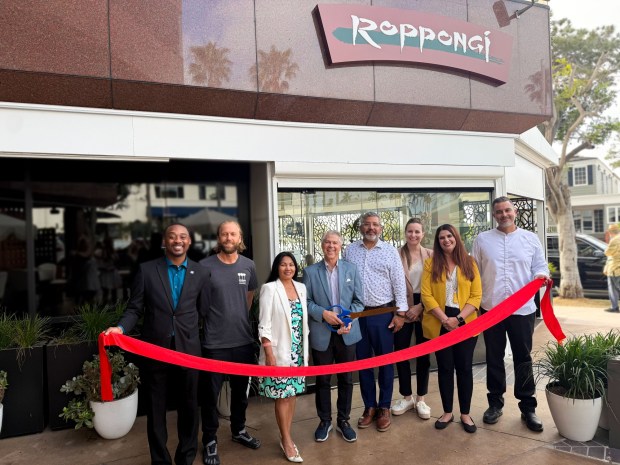 La Jolla leaders and Roppongi officials gather for a ribbon-cutting to celebrate the restaurant’s reopening last year. (Roppongi Restaurant & Lounge)
Local chef Guiseppe Ciuffa calls the changing restaurant scene of the 1990s “the golden years” of La Jolla dining.
“I arrived in La Jolla and a friend asked me to partner with him on opening a restaurant,” Ciuffa said. “So we bought a sandwich place located where Parakeet Cafe is now on Fay Avenue. It was called La Taverna. We were young and would try to keep up with the La Jolla scene. We wanted it to be romantic and playful with our lunch and dinner menu, and we were packed.”
“La Jolla had a bad reputation that it was older and boring,” he added. “But there were a lot of new chefs coming up and also a lot of knowledge from chefs that had been in it.”
After some time in downtown San Diego, Ciuffa returned to La Jolla in 1998 to take over the Come On In Cafe on Torrey Pines Road. Soon after, he opened a cafe in the Museum of Contemporary Art San Diego, along with Come On In catering.
Through those enterprises, he got to know the community.
“I would see the people wanting something before work, then the moms that would come in after drop-off [of their children at school], and then the people getting off work,” he said. “So I got to know everyone and got a sense for what they wanted [to eat].”
After 17 years, he decided to focus on his catering.
Then in 2019, Ciuffa returned to the Come On In location on Torrey Pines Road to open Candor by Guiseppe.
Reflecting on the evolution that took place in the 1980s and beyond, Ladeki said “one of the biggest changes has been how much more adventurous diners [had] become. When Sammy’s opened, introducing woodfired pizza was considered innovative. By the time Roppongi opened, guests were beginning to explore global flavors, but Asian cuisine was still relatively unfamiliar to many people in the area.”
Today, he said, “diners are incredibly knowledgeable. They travel more, they follow food trends and they have access to cuisines from around the world. What was once considered unique has become part of everyday dining.”
Also, he said, dining out has gone from being primarily about food to being a fuller experience.
“Guests want great cuisine, but they also want beautiful design, engaging service, creative cocktails and a memorable atmosphere,” Ladeki said. “Restaurants have become gathering places where people celebrate, connect and create experiences. The restaurant community in La Jolla has also become much more diverse … which has helped establish La Jolla as one of Southern California’s premier dining destinations.”
The next part of the series will look at La Jolla’s restaurants at the turn of the 21st century, through the COVID-19 pandemic and what lies ahead. ♦