

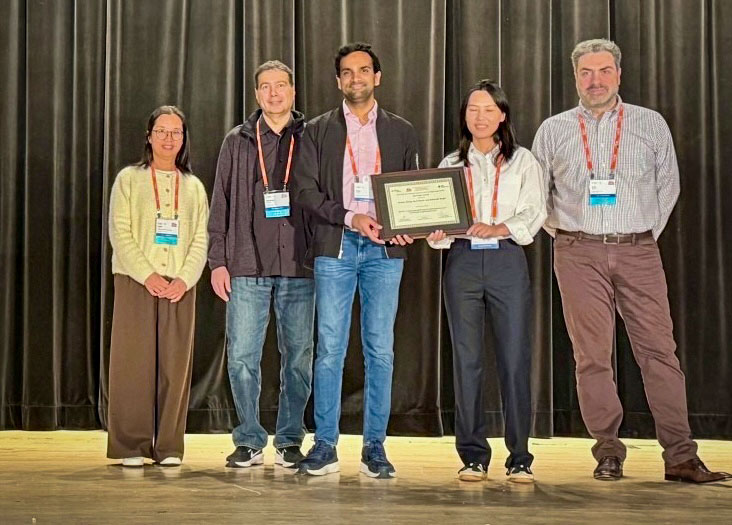
Xiuwen Zheng started her research at the San Diego Supercomputer Center (SDSC) as a CSE M.S. student and then continued into the Ph.D. program at CSE. She was co-advised by Amarnath Gupta of SDSC and Arun Kumar of CSE and Halıcıoğlu Data Science Institute (HDSI), which is part of the Halıcıoğlu School of Data Science and Computing.
“Instead of forcing all data into a single platform, MICRO intelligently coordinates how queries run across multiple systems,” Zheng said. “The middleware analyzes workloads, determines where operations should execute and optimizes how data moves between graph and relational stores.”
The result is faster, more efficient analytics across increasingly complex data environments — an advance with significant implications for high performance computing, AI and data-intensive scientific research.
Modern scientific workflows routinely combine diverse forms of information, including simulation outputs, sensor streams, metadata catalogs and relationship-based knowledge graphs. Fields such as fusion energy research and drug discovery all depend on connecting structured datasets with complex networks of relationships.
AI systems face similar challenges. Large language models, recommendation engines and autonomous agents increasingly rely on interconnected data ecosystems rather than isolated databases. As data volumes continue to grow, efficiently linking these specialized systems has become a major bottleneck.
Rather than replacing existing databases, MICRO is designed to improve interoperability across heterogeneous and distributed data systems. The approach reflects a broader shift in modern computing, where organizations increasingly rely on specialized tools working together instead of one-size-fits-all platforms.
“By reducing the complexity of cross-system analytics, our goal is for systems like MICRO to help scientists and organizations spend less time managing infrastructure and more time extracting insights from data,” Zheng said.
MICRO is part of a longer research arc at UC San Diego known as Project AWESOME to help domain scientists analyze large multi-model social media datasets and later extended to applications in cybersecurity and beyond. The path to ICDE 2026 was not a straight line: the broader line of work faced multiple close rejections at major database venues before this paper was recognized.
“Xiuwen soldiered on, resolutely believing in the project vision, demonstrating technical creativity, and delivering on its potential,” said CSE and HDSI Associate Professor Arun Kumar about the work’s trajectory. “Her tale of perseverance is one I hope is helpful to students and researchers everywhere. This work also exemplifies the interdisciplinary research ethos across SDSC, HDSI and CSE. I am excited to see more such fruitful interdisciplinary collaborations across campus spanning engineering, the sciences, and the new Halıcıoğlu School of Data Science and Computing.”
SDSC Research Scientist Amarnath Gupta, who leads Project AWESOME, added that collaborations with domain scientists — including Professor Molly Roberts in Political Science and HDSI, whose group works with large-scale social media data — were instrumental in surfacing the cross-store, cross-model challenges that MICRO ultimately addresses. The project is supported by the National Science Foundation.
Xiuwen Zheng received her Ph.D. and M.S. from UC San Diego Jacobs School of Engineering CSE Department in 2025 and 2019, respectively. Her Ph.D. work was co-advised by her publication co-authors Amarnath Gupta of SDSC and Arun Kumar of CSE and HDSI.
Learn more about research and education at UC San Diego in: