
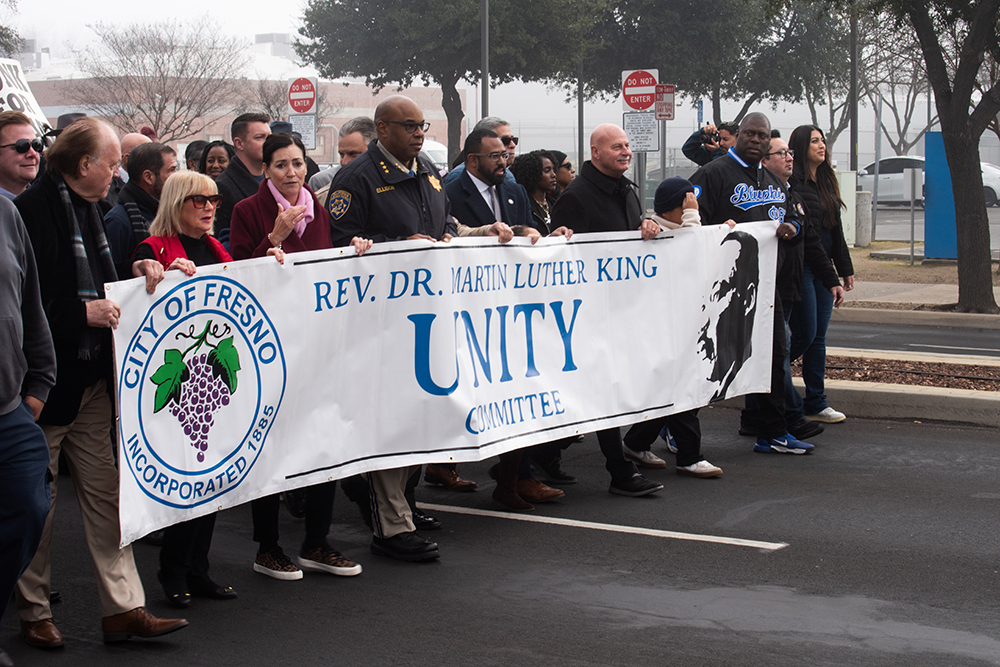
 A march honoring Dr. Martin Luther King Jr. in Fresno on Jan. 19, 2025. Photo by Peter Maiden
The September 2025 issue of Vanity Fair magazine features Bernice King’s essay entitled “The Fight to Protect MLK’s Legacy.” She begins her essay with these words: “…on March 28, 1968, I celebrated my fifth birthday…with Daddy and seven days later on April 4, he was assassinated.”
King then shares her father’s dream as expressed at the March for Jobs and Freedom (Aug. 28, 1963) and his speech “Beyond Vietnam: A Time to Break Silence” (April 4, 1967).
MLK believed in democratic socialism, which calls for “a better distribution of wealth” and a more equitable society. However, King, quoting her father, states that “we have got some difficult days ahead” as this “world house” continues to address and hopefully resolve the great issues of militarism, poverty and inequality.
She encourages “a collective focus on reviving the revolutionary, love-centered movement that my parents and other courageous, hopeful people cultivated.”
In conclusion, she calls for activists to use Kingian nonviolence against what her father called “the triple evils of racism, militarism and poverty.”
She ended with a reference to an observation from her father’s book, Where Do We Go from Here: Chaos or Community?, “We must learn to live together as brothers or will all perish together as fools.”
With the assassination of the right-wing podcaster Charlie Kirk and the voluminous commentary on that tragic event, not one writer, to this author’s knowledge, quoted Dr. King’s foreboding, which is the purpose of the annual celebration of Martin Luther King Day.
As a Black, southern, Baptist minister, King gave us iconic words of wisdom as guide lights so we can all find our way out of the darkness of the secular world and its conflicts. King’s sermons were soulful jeremiads birthed from the Black experience and its resistance to racism and racial oppression. King calls her father’s words the philosophy of Kingian wisdom.
Dr. King came to Fresno in 1964 and used his nonviolent approach to address housing discrimination in the city. He led a march of more than 1,000 from Fresno High School to Fresno City College’s Ratcliffe Stadium. Dr. King spoke before a mass of 3,000 concerned citizens. The City of Fresno has replicated this historic event for dozens of years.
In 2024 and 2025, the West Fresno Ministerial Alliance (WFMA), composed of Black ministers such as Reverend B. T. Lewis, Reverend Bruce McCalister and others, has organized a supportive MLK celebration parade with the emphasis on Kingian philosophy. The WFMA has always reminded me of King’s Southern Christian Leadership Conference, composed of Black Baptist ministers, which was King’s civil rights activist organization. Pastor Jim Franklin has co-coordinated this event. Reverend Edward Jones IV also coordinated a march in 2025 at Fresno City College.
This brings us to the renowned Fresno City Council Member Lester Kimber and Dr. Sudarshan Kapoor, both of whom served on the board of the MLK March. The march has also been supported by the City of Fresno and several mayors including the present mayor, Jerry Dyer.
Dr. Kapoor has served on the Dr. Martin Luther King Jr. Unity Committee and co-coordinated the “Stop the Hate, Build the Culture of Peace Week” in Fresno. He has promoted nonviolence as advocated by Mahatma Gandhi’s idea of Satyagraha or love force which, in a mass movement of civil disobedience, led to the end of British colonialism in India.
Les Kimber and now his son, Mark Kimber, have been the editors of the major Black newspaper, the California Advocate, that is the straw that stirs the drink concerning all news fit to print about the life and times of Black folk in Fresno and the Valley.
Current editor Mark Kimber has partnered with Fresno State to cover Black academic achievements and has an annual interview with Fresno State President Saúl Jiménez-Sandoval on his strategies in recruitment and retention of Black students.
At Fresno State, all students are required to take a critical-thinking course. Dr. King, while an undergraduate at Morehouse College, wrote a paper entitled “The Purpose of Education.”
King argued two points: 1) education should make one a critical thinker, and 2) it should build moral character. King wrote that the most “dangerous criminal may be the man gifted with reason, but no morals.” That warning is relatable to many American politicians today.
These separate celebrations are organized by sincere individuals who want to continue Dr. King’s legacy and champion the idea of “unity without uniformity.”
Facebook
Twitter
Email
Print