
At dawn on Saturday morning, the fog had not yet burned off in the Berkeley Hills and the security lights at UC Berkeley’s stadium gave off an ominous glow.
The city was asleep as 155 runners made their way up the steps to the sounds of energetic pop music and the hills’ morning birds.
Some embraced loved ones. Others looked intensely focused, mentally preparing themselves for the journey ahead.
Everyone was awaiting the start of the inaugural Bay Area 100 ultramarathon, an exhausting 100-mile foot race over trails and fire roads and through the nature preserves and public lands of the East Bay.
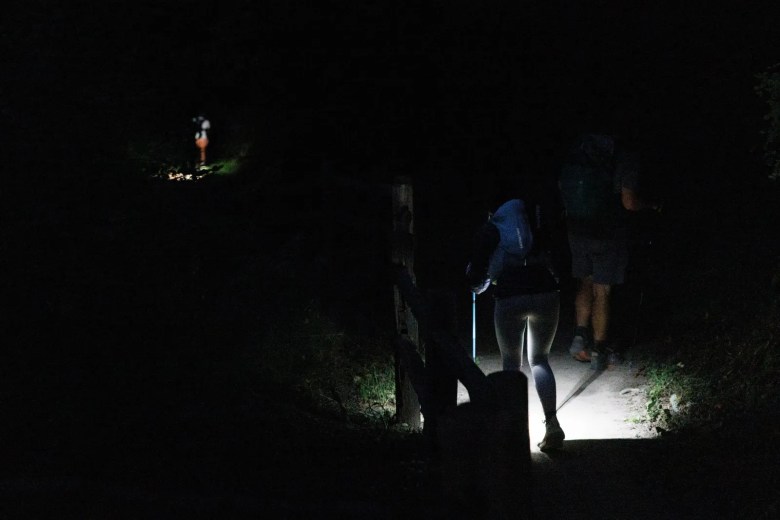 Hanna Swernoff leaves the Big Bear Staging Area, in Lake Chabot Regional Park, while it’s still dark. She’d been running since 5 a.m. the previous day. Credit: Miles Cull for The Oaklandside
The race would take these hardened runners through the woodlands of Tilden Regional Park, over the rolling hills of Las Trampas Wilderness Regional Preserve, around the quiet waters of Lake Chabot, and through the deep shade of the redwoods in Redwood Regional Park. By the end, the participants would cover 100 miles and 18,000 total feet of elevation gain, before finishing, after 17 or 24 or 33 grueling hours, on the track at Skyline High School in the Oakland Hills.
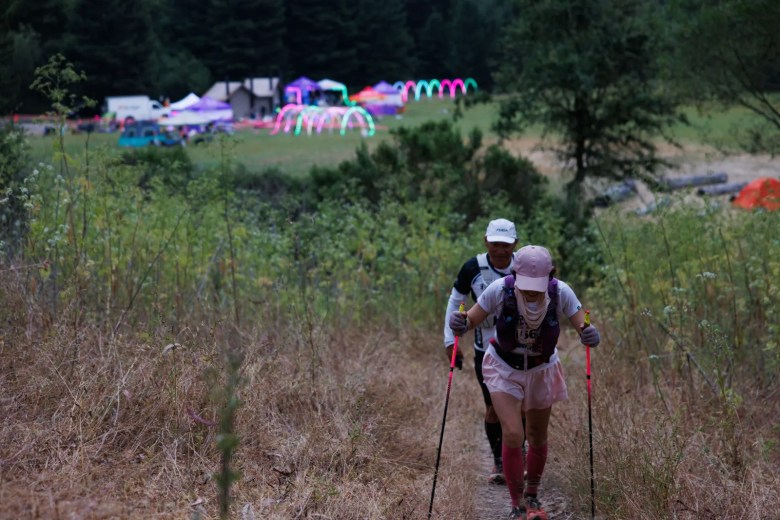 Qi Song and her pacer leave Bort Meadow station, in Chabot regional park, just after dawn. Credit: Miles Cull for The Oaklandside
The race, like most ultramarathons, was set up to allow runners to eat, rest, and get care along the way, with 23 designated aid stations spaced three to six miles apart, offering runners water, fruit, salty snacks, or the electrolyte drinks and sugary gels designed specifically for endurance events.
Runners had the option to arrange for a support crew, usually composed of family members or friends, to meet them at one of eight aid stations, where they could offer an outfit change, a fresh pair of shoes, and emotional support.
The race kicked off at 5 a.m. on Saturday, June 13, and was scheduled to officially end at 2 p.m. on Sunday, meaning the runners would have to run through the night to finish before the cutoff.
As the start time approached on Saturday, many were shaking out pre-race nerves and trying to stay warm.
One of those runners was Samuel Cooper, a dean at Montera Middle School who also coaches the school’s cross country and track and field teams. Cooper was one of three educators selected for the Dapper Don Award, which provides free entry to the race in honor of Don James, the late Piedmont teacher and ultrarunner who died in 2022.
This race is Cooper’s sixth 100-mile race since last June, and he has three more 100-mile ultramarathons planned before the end of the year. He often travels far for these races, to places like Montana, Wyoming, Idaho, and Utah. Running the race at home, he said, would be like a grand tour of his favorite trails.
Despite his experience at this distance, he said he always has trouble sleeping the night before a big race. With this race on his home turf, his excitement was even more intense. He’s a member of Bay Area run clubs including the Bay Bandits and Beer Bucket Runners, and he said he expected to see a lot of friends out on the course.
“It’s going to be a party,” Cooper said.
An East Bay trail-running culture
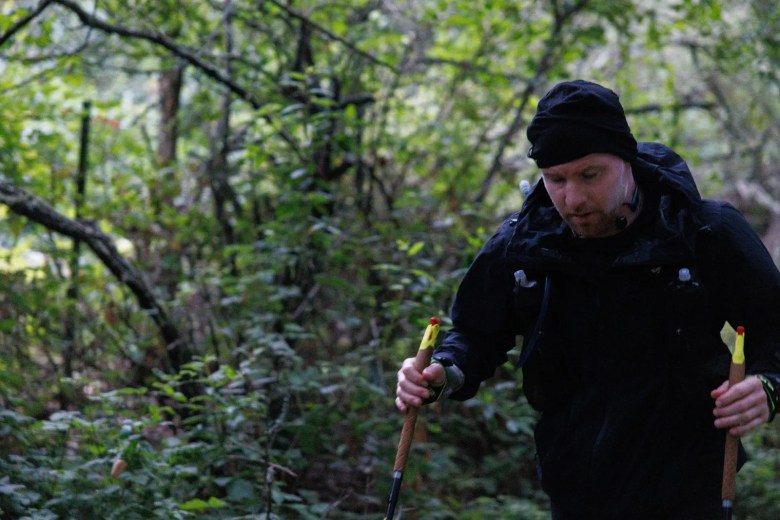 Brendan Rodgers in the final hours of his run. Credit: Miles Cull for The Oaklandside
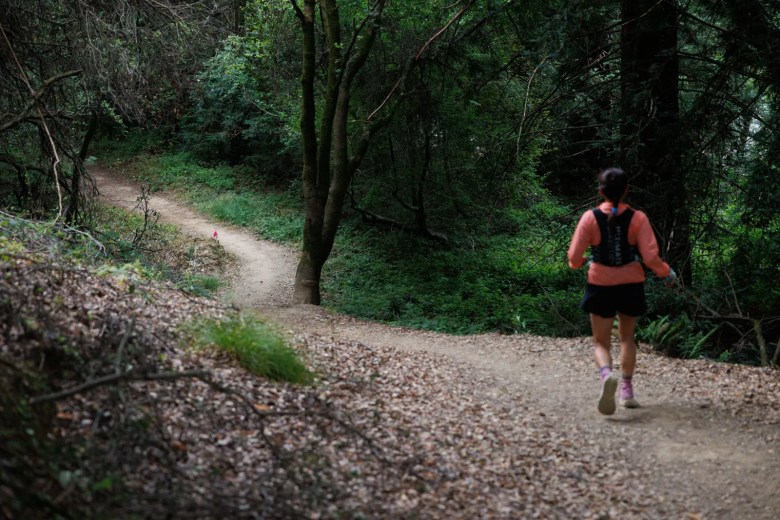 A pacer makes her way down a trail in Chabot park. Credit: Miles Cull for The Oaklandside
The Bay Area is home to many historic races, such as the 7.4-mile Dipsea Race held in Marin County, first run in 1905.
The East Bay hills are host to two ultramarathons — the Dick Collins Firetrails, a 50-mile race, and the Skyline 50K Endurance Run, one of the oldest 50-kilometer (31-mile) races in the United States. (Any race longer than a traditional 26.2-mile marathon is considered an ultramarathon.)
The oldest 100-mile ultramarathon in North America, the Western States Endurance Run, was first run in 1974. Runners start in Olympic Valley and finish in Auburn, a suburb of Sacramento. That year, there was only one finisher. Over the past 50 years, the sport has steadily grown.
Seth LaReau, who writes about the business of trail and ultrarunning on his popular Substack, Trail Waves, said the Bay Area has long been a hub for the sport of ultrarunning, on par with cities like Boulder, Salt Lake City, and Flagstaff, Ariz., and deserves its own signature 100-mile race to meet demand as the sport has expanded, thanks in part to coverage from major outlets like ESPN. Runsignup, a widely used platform for race registration, reported a 9.5% increase in signups for 100-mile races last year.
But the region had never had a “point-to-point” 100-mile ultramarathon before, where runners finish in a different place than they started.
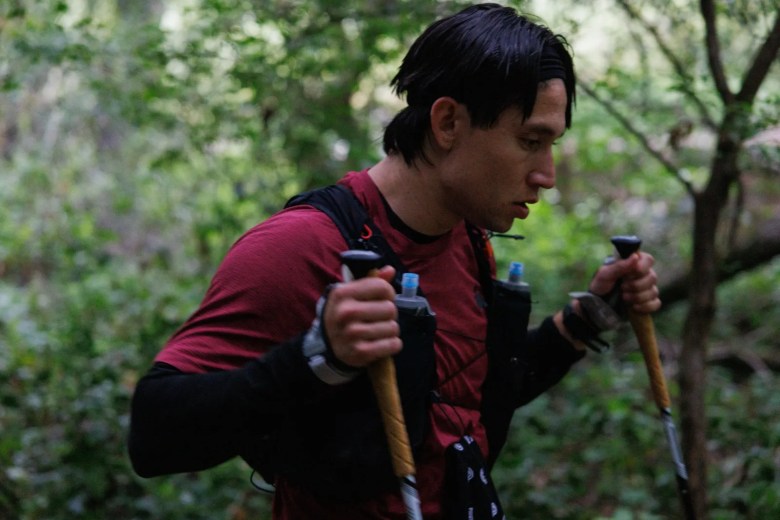 Christopher Finlez reaches the final 20-mile stretch of the Bay Area 100 on Sunday morning. Credit: Miles Cull for The Oaklandside
Adam Ray, owner of Scena Performance, the organization that puts on the Dick Collins and Skyline 50K races, said that he saw an opportunity.
Ray is an ultrarunner himself who has trained on the very trails that the race would pass through.
A longtime resident of the East Bay, Ray wanted to create a race that would showcase how culturally and geographically distinct the East Bay is.
LaReau said the Bay Area 100 could also help create a healthy ecosystem for the sport — and provide access for runners who don’t have the means to travel and pay the costly entrance fees for races run by larger organizations.
Knowing when to push through
On Saturday, the runners had to contend with the Bay Area’s dramatic temperature swings.
After a foggy morning run through Tilden Regional Park and Wildcat Canyon Regional Park where temperatures were just above 50 degrees, they passed the steam trains, crossed into Sibley Volcanic Regional Preserve, and headed east toward Las Trampas Wilderness Regional Preserve under the midday sun. By that point in the race, the runners had already covered 40 miles, far longer than a standard marathon, and it was getting hot.
Las Trampas was the most exposed part of the course, with little to no shade or tree cover; some runners passed through just as temperatures were peaking at 92 degrees. Careful pacing, and careful management of fluid intake, would be key aspects of their race strategy.
Ray said he was looking forward to the runners getting to experience this part of the course, as it’s an area few explore due to its remoteness. Some sections are two miles from the nearest road.
For many, this would prove to be the most challenging segment.
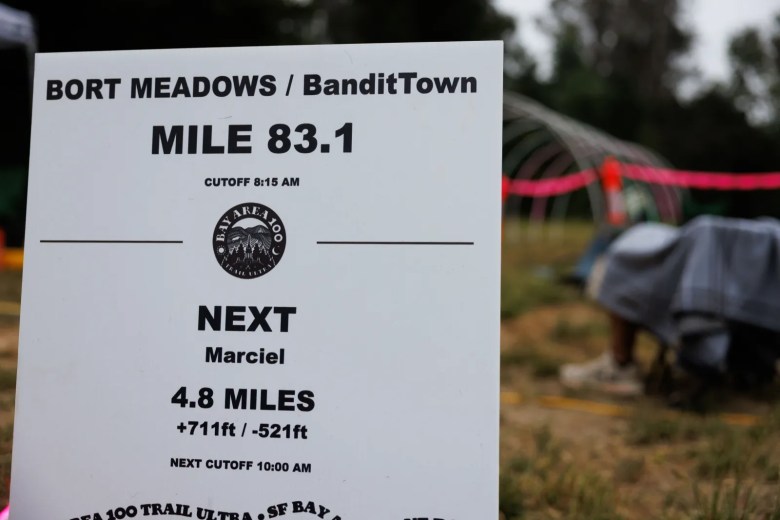 A sign points runners to the next care station at Bort Meadows. Credit: Miles Cull for The Oaklandside
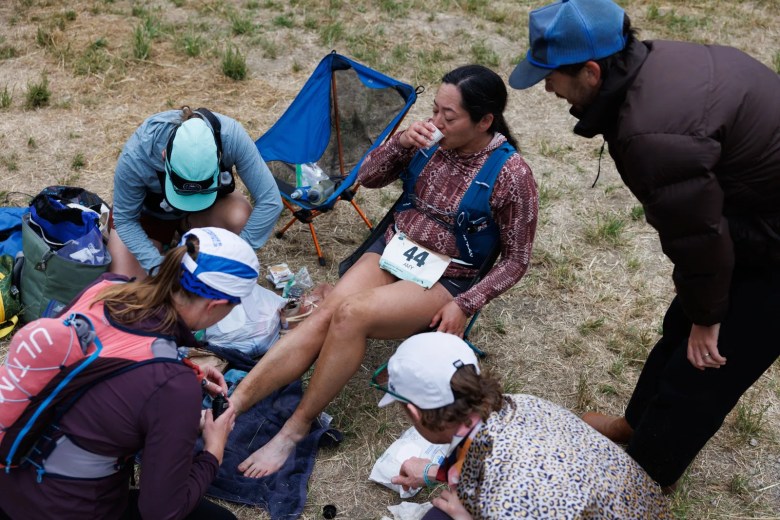 Crewmembers assist Chinn as she recovers at Bort Meadows. Credit: Miles Cull for The Oaklandside
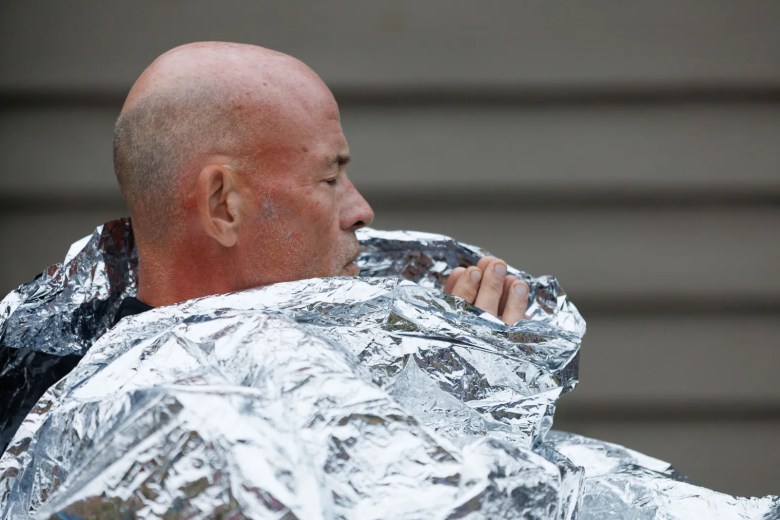 A runner recovers at the Bort Meadows Staging Area in Oakland, 83 miles into the race. Credit: Miles Cull for The Oaklandside
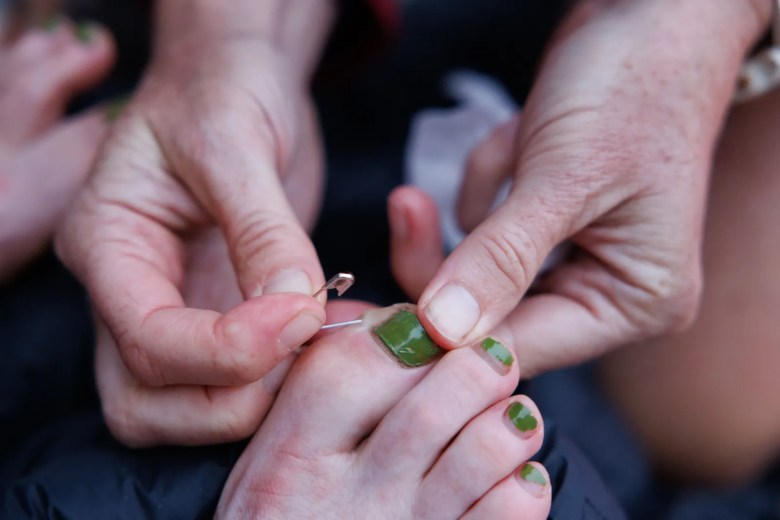 Liz Warner, a member of runner Emily Gable’s support crew, lances a blister for Gable during the run. Credit: Miles Cull for The Oaklandside
Amy Chinn was one of them. Chinn is an education specialist at Montera and another recipient of the Dapper Don Award. When she spoke to us on the course, she said the heat in this section was compromising her ability to intake food. She managed to settle her stomach by nibbling on saltine crackers, though she said it wasn’t easy to swallow them in the dry heat.
Chinn, who picked up running during the COVID-19 lockdown, told us before the start of the race that it was Cooper, her colleague, who encouraged her to start running ultramarathons. Before this weekend, she’d completed multiple 50-mile and 100-kilometer (around 63-mile) races, but this was her first time attempting a race of this distance. She assembled a support crew of experienced endurance athletes who helped her plan her gear and craft spreadsheets to track her caloric intake over the course of the race.
She said that she actually felt overprepared.
She has to be, she told us, since she has lupus, which means she lives with a weakened immune system. During the pandemic, she was afraid to go anywhere, but all that inactivity ended up causing her more pain.
“I might as well just do something,” Chinn told herself. “It’s gonna hurt either way.” That’s when she started heading out on trails.
Chinn said she has to pay close attention to her body on a long run; she’s had to learn when to push through pain and when to slow down.
“I have to know what’s an injury versus just pain from inflammation,” she said.
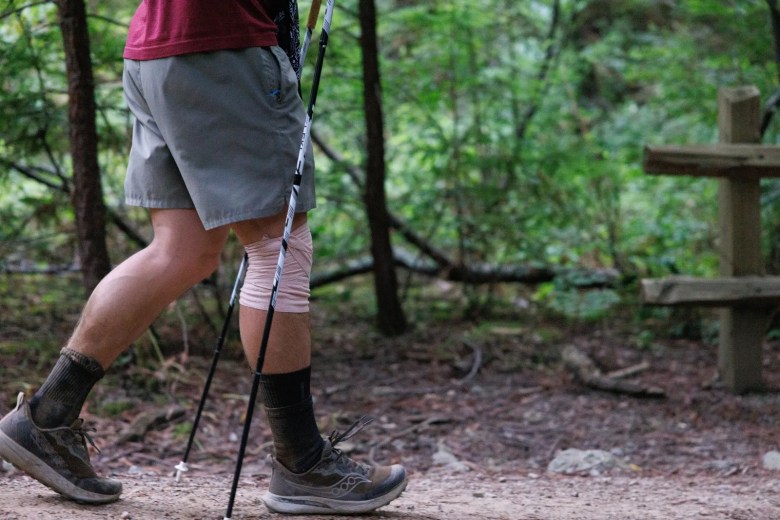 Finlez soldiers through an injured leg on the approach to the Big Bear Staging Area. Credit: Miles Cull for The Oaklandside
Running by the light of headlamps
The midday heat caused the field of runners to stretch out dramatically, with some more than 20 minutes apart. Runners sought shade where they could and doused themselves with water at each aid station. The more experienced runners placed ice cubes in their garments that cooled them off as they ran.
After passing through the dry grasslands of Las Trampas, the runners made their way around Lake Chabot and past the marina, where picnicking families looked on.
Nighttime approached by the time any runners made it into Reinhardt Redwood Regional Park. Underneath the redwood trees, runners pulled out headlamps — one of the many pieces of kit that the race organizers required — which illuminated the trail just a few yards ahead of them.
At around this point in the race, at mile 68, runners passed through a critical aid station at Bort Meadow. The route would take them back by the station again at miles 82 and 97.5.
Dubbed “Bandit Town” because it was staffed by members of one of the East Bay’s largest trail running clubs, the Bay Bandits, it felt less like a medical unit than a mini rave, with competing sound systems set up across the meadow. String lights illuminated the nearby trail for runners and inflatable decorations hung from the canopies.
Some runners passed through swiftly, offering a wave or smile to the volunteers and continuing on their way. Others entered wearily and took a seat in one of camp chairs scattered about for a quick rest. Crew members and volunteers would quickly attend to their needs, serving up bowls of soup, massaging tired feet, or applying Vaseline to chafed areas. An EMT was on standby to provide simple medical care, such as icing a sprained ankle or lancing a blister.
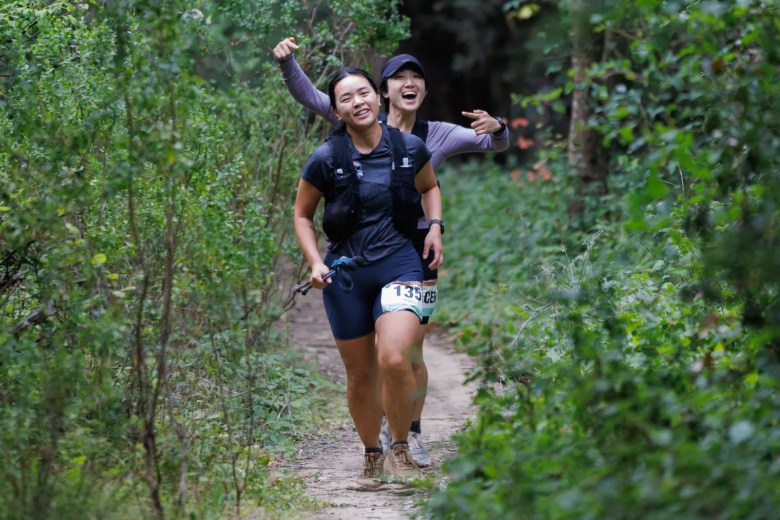 Trami Pham gets cheered on by her pacer as she heads to the Bort Meadow Staging Area more than 24 hours into her run. Credit: Miles Cull for The Oaklandside
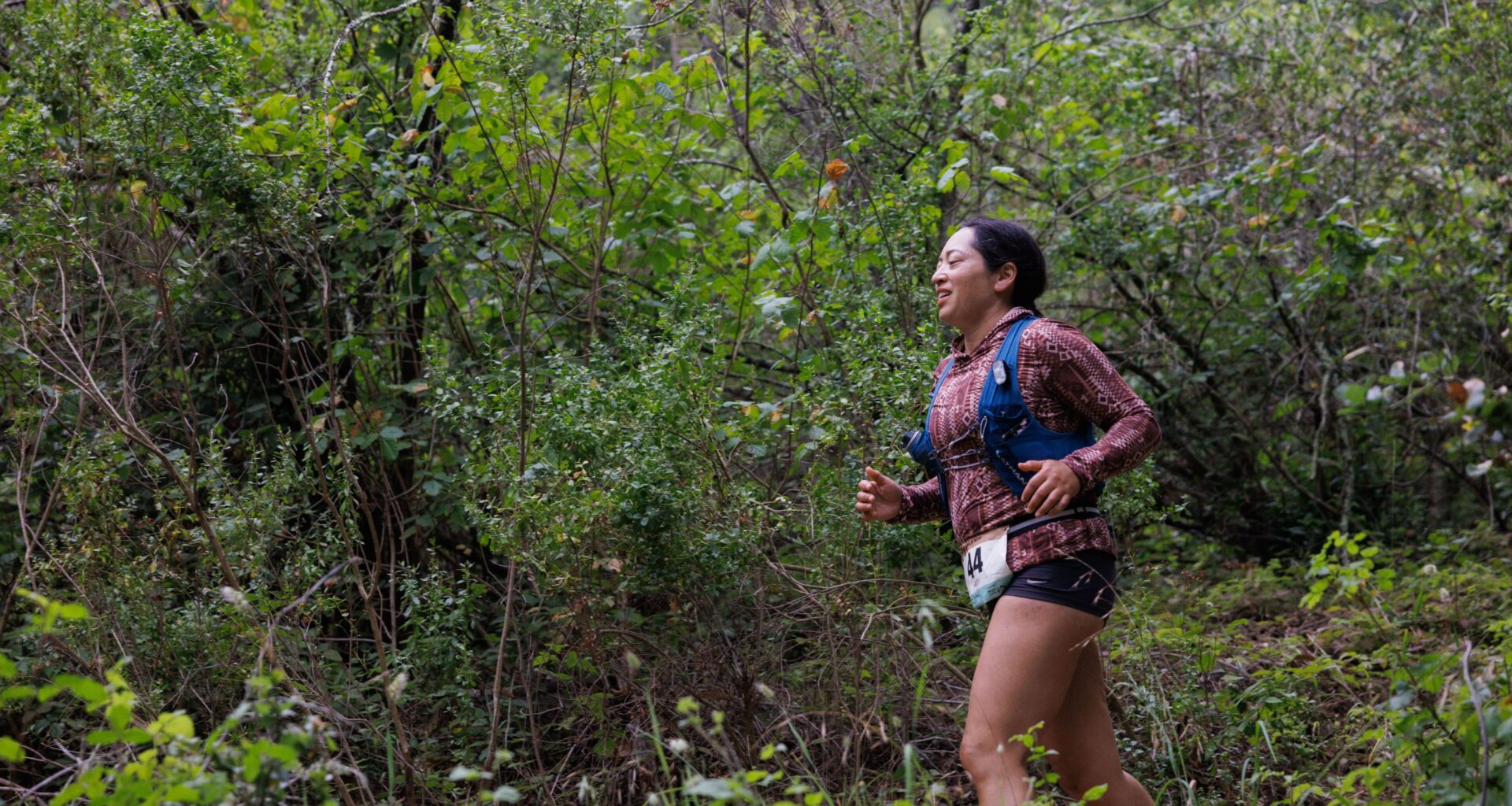
One of the runners who passed through Bort Meadow, hardly taking a moment to pause, was Hannah Swernoff. She’s a fifth grade teacher in Piedmont and the third recipient of the Dapper Don award. This was her first 100-mile race.
Three miles before Bort Meadow, at an earlier aid station located at Big Bear Staging Area, Swernoff stopped for a moment to cry. She sat on a wooden railing eating white rice out of a paper cup as a volunteer checked in with her. After getting a quick pep talk, she slowly stood up and resolved to go on. She’d take a few steps, then pause to lean on her hiking poles. But eventually she got moving again, and by the time she made it to the meadow at mile 82, she looked strong and was running with determination. Turnarounds like Swernoff’s are not uncommon during endurance events, athletes told us, which can be marked by extreme ups and downs.
The inaugural race was not without its hiccups.
Despite wireless timing mats placed throughout the course, tracking runners was difficult and the race website was often providing inaccurate information. The race’s livestream on YouTube, which allowed fans to watch the race from home, also had frequent technical issues.
Ray said he’s confident those issues will be sorted for next year’s edition of the race, when he hopes to double the number of entrants.
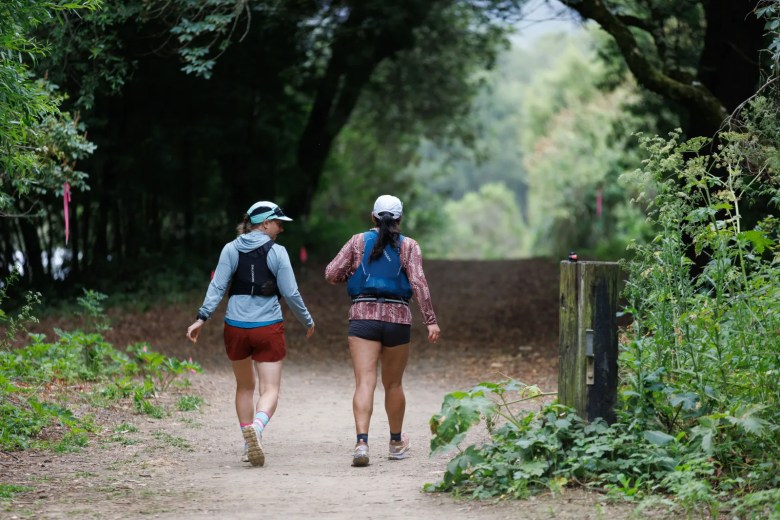 Chinn, right, leaves the Bort Meadows station early on Sunday morning for her last 17 miles. Credit: Miles Cull for The Oaklandside
The ‘golden hour’ arrives
The top runners finished the race in the dark of night. Patrick Rabuzzi of Oakland was the first man to finish, at around 10 p.m., at 16 hours, 54 minutes, and 56 seconds. Caitlin Boldt of Pleasanton was the first woman across the line, at around 3 a.m., with a finishing time of 21 hours, 52 minutes, and 12 seconds.
Cooper reached Skyline High in under 24 hours, his goal, arriving before dawn, in 22 hours, 8 minutes, and 6 seconds. After crossing the finish line, he embraced his support crew before wrapping himself in a space blanket and sitting down to recover. He would go home, get a shower, and return to the track after sunrise to cheer on the rest of the field.
Swernoff entered the Skyline track just after noon on Sunday in a near sprint. She jumped across the finish line, hardly displaying a sign that she had just covered a tough 100 miles.
As the race’s final cutoff time of 2 p.m. approached, Chinn was still out on the course. By then, a crowd had gathered at Skyline’s track to welcome in the runners during what’s called the “golden hour” — the final hour of an endurance race, when the athletes’ grit and determination is celebrated.
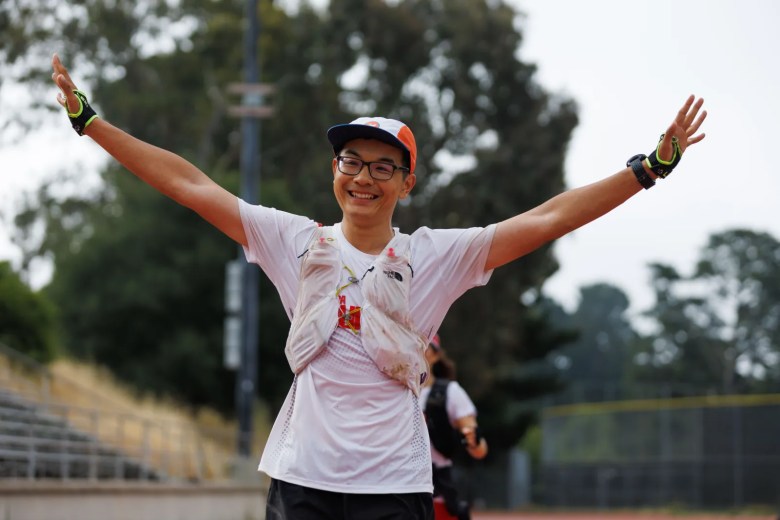 Xintao Zhao arrives at the Skyline High School finish line after more than 27 hours. Credit: Miles Cull for The Oaklandside
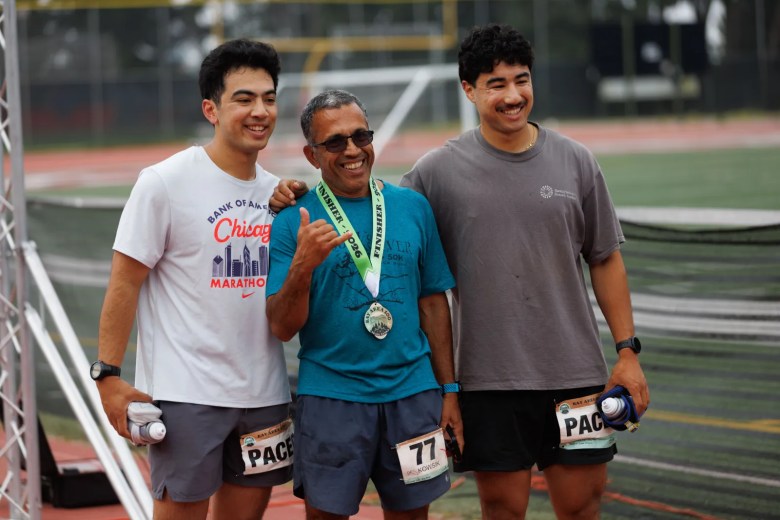 Kowsik Guruswamy with his sons, who paced him during the final stretch, after reaching the Oakland finish line in the Bay Area 100 ultramarathon, June 14, 2026. Credit: Miles Cull for The Oaklandside
A spotter out on Skyline Boulevard delivered a message to the announcer that a runner wearing bib No. 44 was approaching.
“Amy Chinn” blasted out of the stadium’s PA as she made her way onto the track, her four crew members cheering her on.
Chinn made it across the finish line with 15 minutes to spare, in a final time of 32 hours, 44 minutes, and 23 seconds, making her one of 101 runners to finish the race.
As the finishers medal was draped around her neck, she let out a laugh, and then a sigh of relief.
We know that most readers don’t get to the end of the article. But you did! To support our in-depth, rock-solid reporting, please consider making a donation to our nonprofit newsroom today. We rely on our readers — particularly the ones who read the whole story!
“*” indicates required fields