

The San Francisco Giants, according to The Athletic’s Ken Rosenthal, are likely to sell at the trade deadline. They are reportedly willing to listen to offers for any of their core players on long-term contracts, like Willy Adames, Matt Chapman and Rafael Devers.
You were not surprised by this announcement. It was like someone holding a press conference to announce that they’re selling their very expensive iPod dock at a garage sale. They paid a lot for it — Sharper Image, even — but they simply don’t have the use for it anymore. They will not be charging full price, of course. But it’s not going to come cheap.
It would be an informative announcement, but not an especially useful one, and the expensive, used iPod dock would still be there Sunday afternoon.
Those old iPod docks still have value, though. Kids are modding their parents’ iPods these days and having a lot of fun with it. So even though you’re not going to get full price for your iPod HiFi Speaker (MSRP: $349) on eBay, they’re still fetching $100 to $200. There are still people who can use what that outdated tech has to offer, by gum.
The Giants aren’t trying to sell a tube TV, in other words. There are teams that might want a discounted Adames, Devers or Chapman. There might be teams that want one of them so badly that they’ll take on more of the contract than you would expect. Teams are, uh, you know, modding their Deverses and Adameses these days. You wouldn’t understand.
In order to process any of this, we should probably figure out just how overpaid these three players are relative to the open market. As in, if Devers, Adames and Chapman were free agents, what would their contracts look like? They wouldn’t get the same contract that they’re signed to with the Giants, that’s for sure. But they would still get many millions, almost certainly for multiple years.
Instead of just guessing at the numbers, I called in an expert. Tim Britton covers the Mets for us, but he’s also a utility player around here who gets called on often to pinch nerd. His specialty is contracts — predicting them, analyzing them, et cetera — and he does a great job for us every year when it comes to our free-agent projections.
So how far away are the Giants’ biggest contracts from the current market value? Britton has something much better than a guess for us. He begins ominously, writing, “I just want to start by saying I disliked all these deals the minute they were signed.”
Now’s a good time to take a sip of water and make a comical glunk sound as you swallow.
Willy Adames
It’s tricky to get a truly accurate projection for Adames (and Devers) because if Adames stays on the same zero-WAR-or-worse pace that FanGraphs has him on, the projection systems will rightfully panic. If he has have some sort of second-half renaissance, the projection would be far more optimistic.
So let’s split the difference and assume that Adames finishes this season with positive value, but not the typical 3- or 4-WAR-plus seasons we’re used to. With a two-win season, he’s hitting the market as a 31-year-old shortstop of moderate offensive value and solid defense. That’s a valuable player, but it’s not a nine-figure franchise cornerstone, which is what the Giants were hoping for when they gave him the contract.
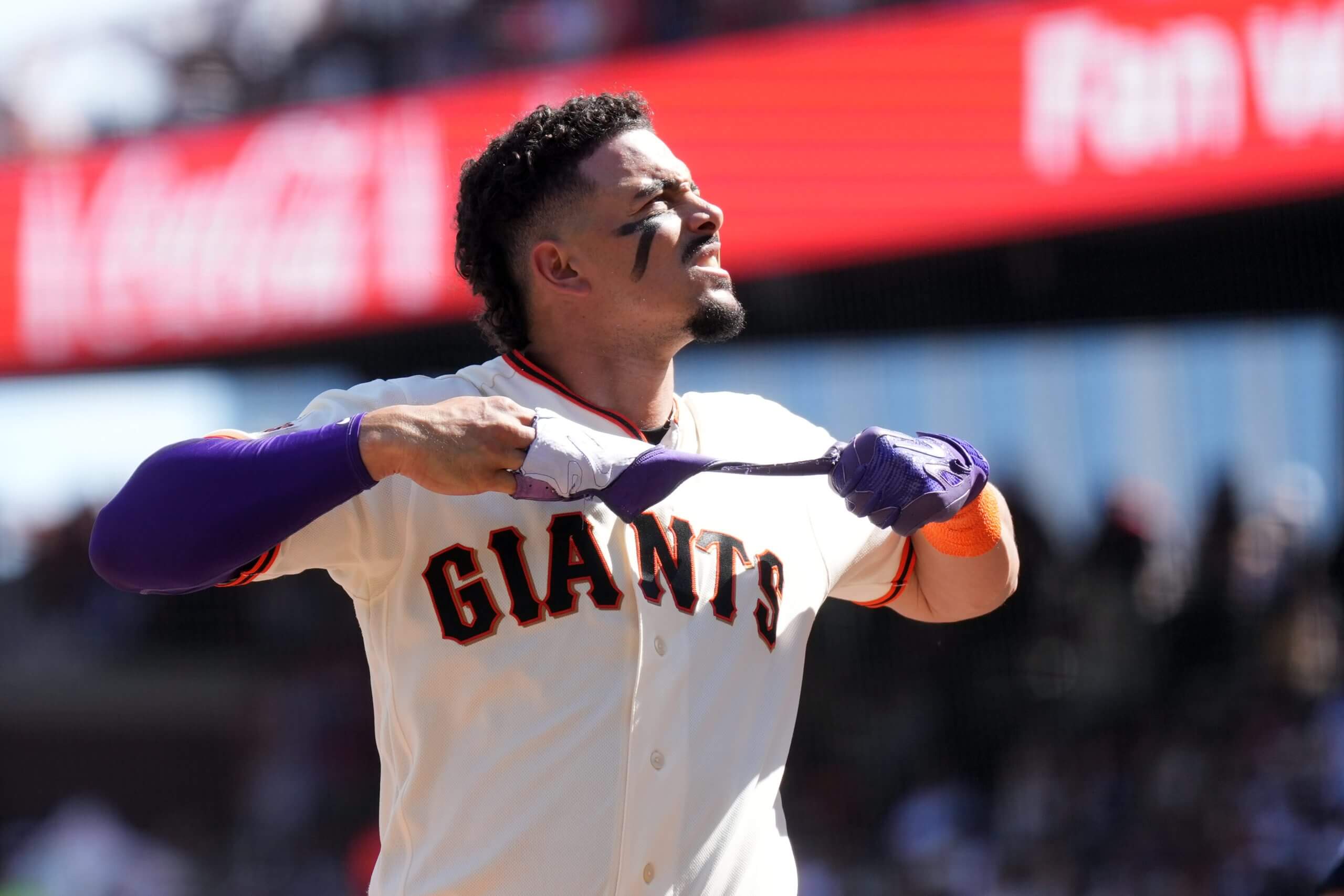
Willy Adames isn’t performing like the franchise shortstop the Giants thought they were signing, but he still has value for the right team. (Darren Yamashita / Imagn Images)
The best comparison would have been Ha-Seong Kim, but he suffered a serious injury right before his free agency. Britton settles on Jhonny Peralta, who had a long string of helpful seasons for the Guardians and Tigers before hitting the open market as a 31-year-old. It isn’t a perfect comp, as Peralta had 12.5 WAR over the previous five seasons, and Adames is closer to 18, but it’s a pretty good one.
Peralta signed with the Cardinals for four years, $53 million in 2014, which would be the equivalent of $74 million today. Give Adames a little bump for being slightly better for slightly longer, and you have something like four years, $80 million instead of the five years, $130 million he actually has left.
That’s a $50 million gap between actual and projected value, which is a hefty one. It’s not one that’s easy to pay down with prospects, and it’s not easy to match with another underwater contract.
But … you can see how teams might consider the idea. If one of them would pay for four years at $80 million after the season (and they probably would), then Adames just might be a team’s preferred fit, especially if it can get the Giants to absorb some of the contract.
It’s not likely. But it’s not science fiction, either.
Rafael Devers
Closer to science fiction. Britton writes, “If we stick Devers with 0.0 WAR for the year, the comp is late-career Justin Smoak,” which is absolutely chilling. What Britton couldn’t have known is that Smoak was on the Giants at the end of his career. He couldn’t have known that because nobody knows that. You certainly didn’t remember it. If Justin Smoak is reading this, he just stopped to look up his Wikipedia page. “Huh, well, I’ll be. Six at-bats in 2020.”
But this comparison is actually before Smoak became a solid hitter for a couple years on the Blue Jays. It’s just looking at the yuck of Devers’ current age-29 season and looking for another first baseman who kept getting that many at-bats without any production to show for it, so Smoak in his pre-breakout seasons was the best fit. It’s not looking at the years and years of strong (and positionally appropriate!) production that Devers offered before that.
That production is a problem for these comparisons, because it’s not common for above-average players to suddenly become below-average players before turning 30, especially at an “old skills” position like first base. This uncertainty would almost certainly affect Devers’ chances to get a long-term contract like the one he’s currently on.
The best comp, then, might be Pete Alonso, who signed a five-year, $155 million contract this offseason. Except that’s not the contract we’re comparing Devers’ current contract to. We’d have to compare Devers to the short-term deal Alonso signed with the Mets the first time he was a free agent — a two-year, $54 million contract that included an opt-out in the event that he had a rebound season. He had that rebound season, opted out and then signed a five-year contract, this time with the Orioles. He bet on himself and won, and that’s what Devers would likely have to do.
So if we’re talking about what teams would give Devers right now if he were magically a free agent, Britton thinks two years, $60 million or three years, $75 million would be a decent analogue, and there would definitely be an opt-out for all of the seasons after the first one. The team would secretly hope the player exercises the opt-out. They always do.
Devers currently has seven years, $225 million on his contract, and while that’s a vast difference, remember the Alonso example. He got the short-term deal with an opt-out, then translated it into a longer deal that very much resembles what Devers is still owed. He just had to prove himself in the interim.
The Giants do not have a time machine, so they cannot prove to other teams that Devers will have an Alonso-like rebound. Also, if they had a time machine, they would have better things to do. I have a list that goes all the way back to Rusty the Mechanical Man if they need suggestions.
The gap is too big to overcome. Teams would like to take a chance on Devers whomping for them down the stretch. Teams would not like to take a $150 million to $200 million chance, even if that’s eventually what he might have made as an Alonso-like free agent in an alternate universe.
Matt Chapman
Chapman is the most valuable player on the Giants, according to Baseball-Reference (by more than a full win), but his FanGraphs value isn’t as rosy (he’s 48th in baseball with 1.8 fWAR). Either way, he’s back in positive territory, where he generally is every season. He posts, as they say. He posts every season, and he’ll finish this year with roughly the same numbers that he does every season.
That written, there are complications, too. Britton points out that teams will pay more for offense than defense if the WAR totals are the same, so not all 5-WAR guys are created equal. It’s also not a minor point that Chapman is the oldest of the trio, turning 33 in April.
There’s a much better comparison available. Check out how closely Chapman’s last few seasons match up with another third baseman who was just on the market.
Player
1Y
3Y
5Y
3.5
12.1
19.6
3.7
12.9
19.8
Alex Bregman is a year younger, though, so you can’t just use the contract he got from the Cubs this offseason (five years, $140 million) as a template. But it’s pretty close. Except there’s another third baseman with a similar WAR history who didn’t do so well in the offseason.
Player
1Y
3Y
5Y
3.8
11.1
15.4
3.7
12.9
19.8
Eugenio Suárez signed a one-year, $15 million deal. The defensive gap between them explains a lot, and Suárez also had a .298 OBP last season, even if he hit 49 home runs. They’re very different players, even if they’ve had similar value at the same position.
The best comparisons might be a little bit in the past, with Justin Turner (after his 2017 season) and Chase Headley (after 2015). Here they are with the WAR they had entering free agency, along with their three-year and five-year WAR totals before that.
Player
1Y
3Y
5Y
4.4
11.7
12.5
3.4
14
20.6
3.7
12.9
19.8
Turner got close to $21 million average annual value, and Headley’s contract was close to $18 million AAV, but they were also younger. So Britton suggests Chapman might get a three-year, $60 million contract, which would put his contract $40 million in the red. I’ll disagree, though, and go back to the Bregman comp. It’s too good to ignore, and even after adjusting for age, I think Chapman gets something close to his current salary obligations of four years, $113 million.
That doesn’t mean that a team wouldn’t try to get the Giants to eat money, or that it wouldn’t give up anything better than a C-prospect or a PTBNL for the privilege of absorbing Chapman’s contract. It also doesn’t mean that teams are especially interested in making these sort of franchise-altering commitments in the middle of a season, rather than the offseason, when they can take more time to research these decisions.
When you consider all of that, maybe Britton’s estimate is a better example of how other teams might see Chapman on Aug. 1. They might like the player, but there has to be some sort of discount if they’re going to take the plunge in the middle of a season.
If there’s a player of the three who’s likeliest to be traded, it’s Chapman by a mile. There’s an off chance that another team is desperate enough for a shortstop to consider Adames (the Braves, perhaps, with Kim helping to partially offset the salary for this season, at least), especially if his offensive numbers return to his career norms, but it’s unlikely.
The likeliest scenario is that all three stay, end the season with solid-to-pretty-OK offensive numbers and are in the starting lineup on Opening Day next season. That’s not the worst outcome, and while I say that through gritted teeth, the Giants’ biggest problem isn’t that they employ these three players or pay their current salaries, it’s that they can’t build a better roster around them, especially on the pitching side. If the Giants aren’t winning in 2027, it won’t be because Devers is making too much money to have a .750 OPS or whatever. That wouldn’t help much, mind you, but it also wouldn’t be the main reason things aren’t working out.
If you’re wondering just how much money the Giants might have to eat, though … about that much. Which is why they probably won’t be eating any money at all. The Giants will be selling, alright, but they won’t be giving. And that’s going to make it hard to trade some of their best players.
Thanks upon thanks to my colleague Tim Britton, who took the time to run these comparisons, even though his day job is watching the Mets.