

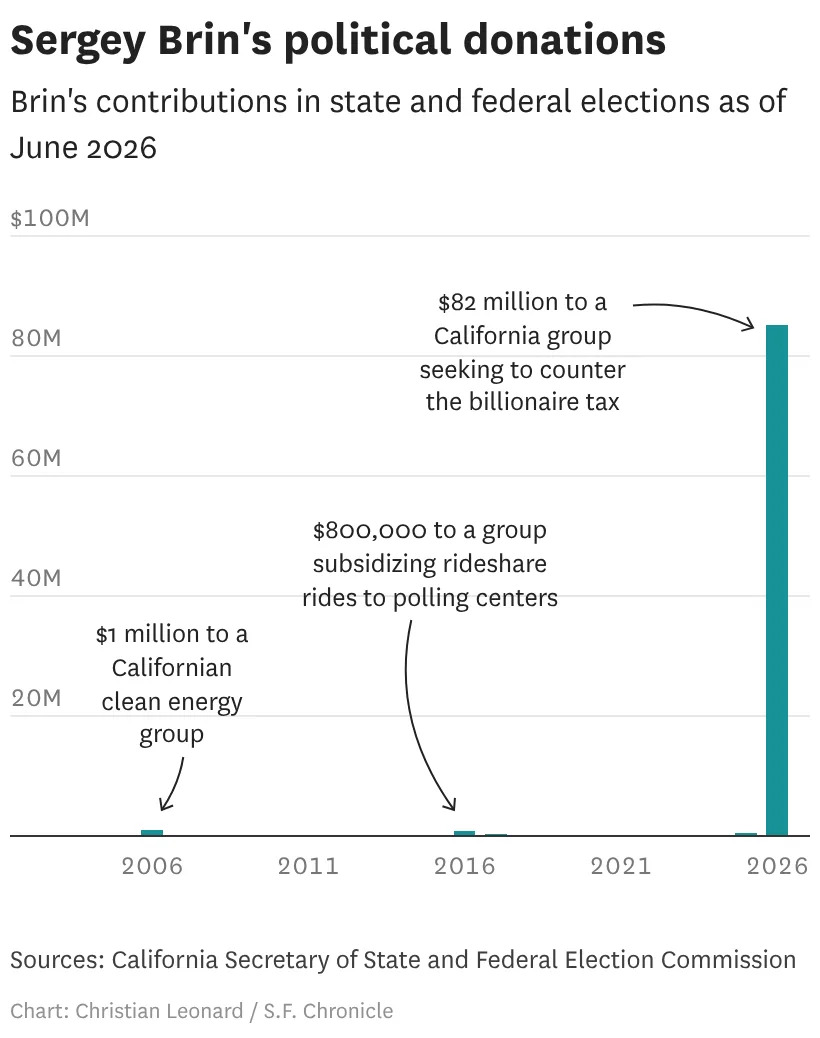
For most of the past two decades, Google co-founder Sergey Brin kept his billions away from the ballot box.
He floated a bit of pocket change to a couple of causes, usually left-oriented: $1 million to a California clean energy group in 2006, $100,000 to oppose California’s gay marriage ban in 2008 and $36,000 to support President Barack Obama’s reelection campaign. But after helping subsidize rideshare rides to polling centers in 2017, the donations stopped. It seemed that Brin had closed his pocketbook to politics.
So why, after decades of political aloofness, has the world’s third-wealthiest person dropped more than $85 million on California elections this year – instantly becoming one of the state’s biggest political donors of the past quarter-century?
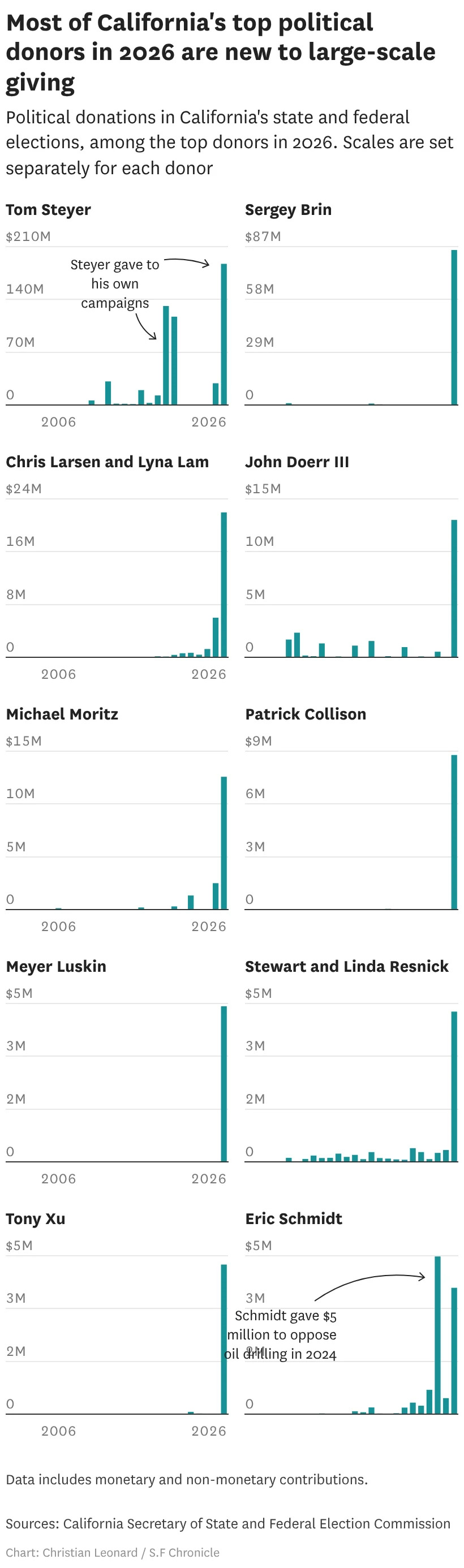
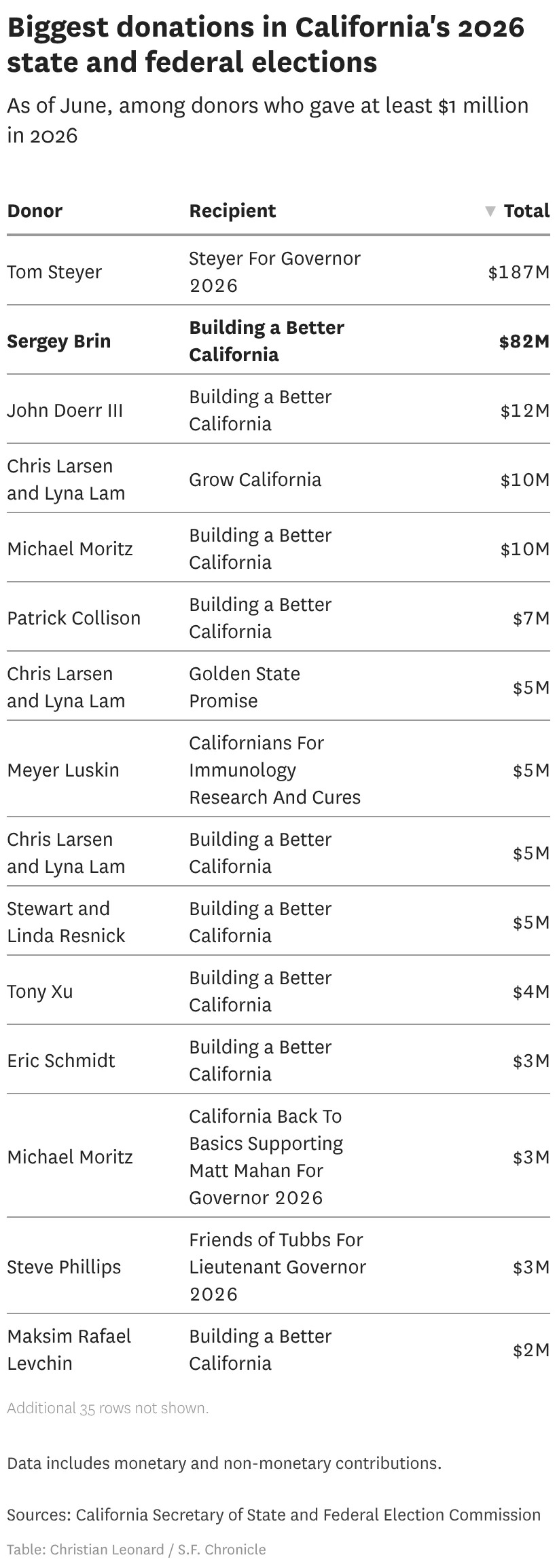
The answer involves more plutocrats than just Brin. Out of the 30 donors who donated at least $1 million to state- or federal-level political causes in California this year, 21 gave more in 2026 than in any of the prior 25 years. That includes Tom Steyer, who spent nearly $190 million of his own money on his failed campaign for California governor, by far the most of any individual.
For some donors, this year was the first they made a major donation to influence California politics.
The deluge of money from billionaires and other elites into California elections is part of a national trend of mega-donors throwing their weight around, said Richard Hasen, a professor of political science at UCLA who studies campaign donations and lobbying.
As Steyer’s failed campaign illustrates, money doesn’t guarantee victory. But it can help.
“It’s kind of like a lottery,” Hasen said. “The more money you spend, the more likely it is you will have a chance to influence both who is elected to office as well as what people are going to do when they’re in office.”
Hasen said concerns about federal regulation – especially for emerging technologies like artificial intelligence or cryptocurrency – led much of Silicon Valley to back Donald Trump for president in 2024. Now that regulation is now largely up to the states, and newly awakened to the importance of political advocacy, tech leaders have focused their political weight further down the ballot.
Almost all of the money Brin donated this year went to Building a Better California, a political action committee formed in February. The New York Times reported in April that Brin has helped fundraise for the group, which has also received seven- or eight-figure donations from Silicon Valley venture capitalists John Doerr and Michael Moritz.
On its website, Building a Better California describes itself as a nonpartisan group advocating for more housing, better education and good-paying jobs. But by far the bulk of its spending – roughly $100 million – has gone to support potential measures that would counteract a “billionaire tax” that a healthcare union is aiming to put on the November ballot. One counter-measure, for example, would ban new taxes on retirement savings – and investment accounts.
The proposal, which would levy a one-time 5% wealth tax on Californians worth more than $1 billion to pay for healthcare funding, sparked immediate outcry from tech moguls, business leaders and moderate Democrats. Brin and his Google co-founder Larry Page reportedly moved out of the state entirely in an attempt to avoid the tax.
But tech leaders still have an incentive to keep the tax from becoming law, because many fear it will reduce the values of the startups they back, said lawyer and tax adviser David Lesperance. He described the wealth tax as a fire – billionaires can run from it, or they can fight it. Brin, and those like him, have done both.
“It’s an unwanted outcome, but it’s a completely predictable outcome,” Lesperance said.
Supporters of the wealth tax argue that the massive amount of money spent to fight it proves its necessity.
“The billionaire tax will save lives and protect patients,” said Debru Carthan, vice president of healthcare workers union SEIU-UHW, which pitched the tax. “We know that California voters are ready to ask billionaires to pay their fair share, and we’re confident that the billionaire tax will win in November.” Backers turned in what they said was more than enough signatures, but the secretary of state has not yet confirmed whether it has qualified for the November ballot.
The tax may have been a galvanizing force for tech billionaires, but it wasn’t the only one. A 2019 Stanford study found that unlike other “economic elites,” wealthy tech founders tend to support socially liberal policies, including some forms of wealth distribution. Where they tend to lean right is when it comes to regulation of their industry.
That may help explain why Brin, who told Google employees in 2016 that he was “deeply offended” by Trump’s election and protested his immigration ban, donated $443,000 to the Republican National Committee in 2025 and has praised Trump’s support of AI.
Silicon Valley’s desire for a business-friendly environment still palatable to the bulk of California’s liberal voter base also materialized as support for San Jose Matt Mahan, whose campaign for governor was fueled by millions of dollars from billionaires.
While Mahan’s campaign ended in a bust, other billionaires’ bets were more successful. Grow California, a committee funded heavily by crypto billionaire Chris Larsen and his philanthropist wife Lyna Lam, saw almost all of its favored candidates for the state Legislature headed to the general election.
Shaudi Fulp, who leads Grow California and serves as a political strategist for Fortune 100 companies, said that the group has pursued policies and candidates that Californians already support, such as affordability and public safety.
“Many of the new voices engaging in California’s civic life are not responding to a single policy proposal,” Fulp said in a statement. “They’re responding to a broader desire to ensure California remains the best place in the world to build, innovate, and create opportunity.”
Lesperance, the tax adviser, says billionaires are simply starting to see politics as a good investment.
“So if the ultimate motivation is, ‘I have a significant risk to my capital, I’m going to use some of that capital to fight the fire.’ … That’s a good ROI,” Lesperance said.
Subscribe
There’s more to San Francisco with the Chronicle. Subscribe today for just 25¢.
This article originally published at Why billionaires are finally waking up to California politics.