
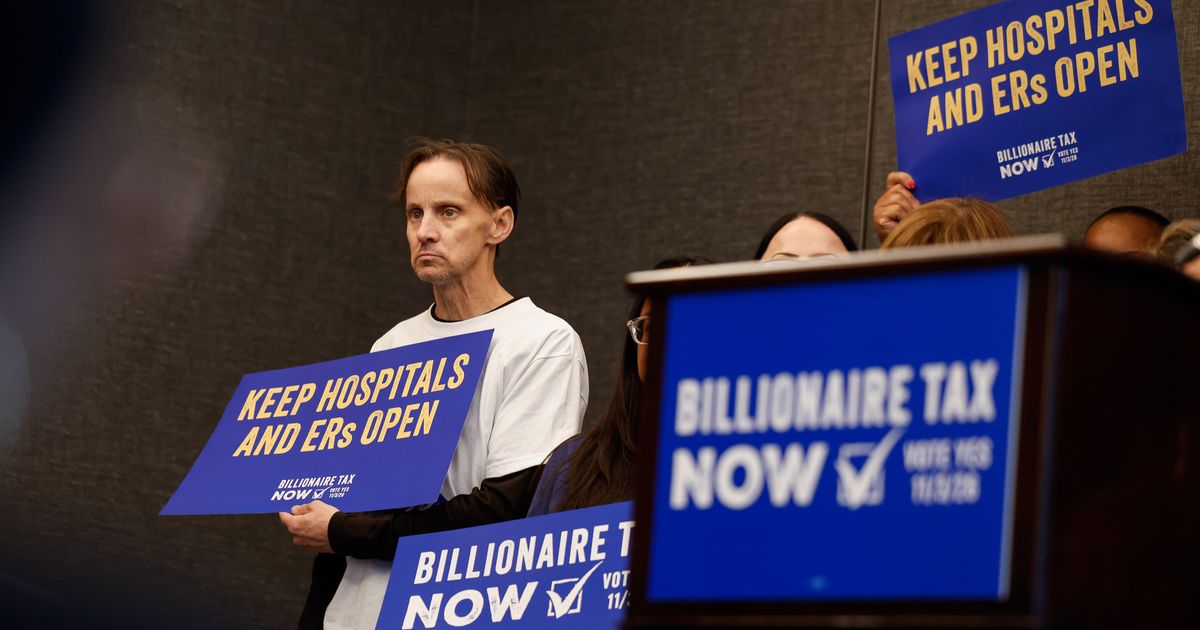
Photo: Caroline Brehman/Bloomberg/Getty Images
Wealth taxes aimed at the very rich are a perennial favorite on the progressive end of the ideological spectrum. A really big one that carries immense political implications has just been certified for the November ballot in California, a state famous for its left-leaning electorate but also its sizable class of billionaires.
The proposed measure comes via a citizens petition and is mainly sponsored by SEIU-UHW, the union representing about 120,000 California health-care workers. It would impose a onetime 5 percent tax on the worldwide net worth of individuals with over a billion dollars in wealth as of January 1 of this year — about 200 people. The proceeds (an estimated $100 billion) would be earmarked for health-care benefits facing steep budget cuts thanks to last year’s One Big Beautiful Bill Act and associated Trump administration measures to reduce or shift costs in federal-state programs. Though it’s not explicit, a big part of the appeal for the billionaire tax is to force those benefiting most from Trump’s tax and budget policies (plus the Silicon Valley magnates who have shifted in his direction politically) to compensate those whom the same policies have damaged. In a deep-blue state like this one, you’d think this might be a proposition that wins along predictable party-affiliation lines.
And it may attract a lot of Democratic voters, but Democratic interest and advocacy groups aren’t so sure. Indeed, SEIU-UHW — with top cover from Bernie Sanders, potential 2028 presidential candidate Ro Khanna, and defeated gubernatorial candidate Tom Steyer (the billionaire who famously wanted to tax himself) — is more or less alone on this one. Other unions worry that the proposal would preempt alternative, more permanent soak-the-rich schemes. The health-care earmarking, moreover, means other urgent needs like education or housing would be left out of the buffet line. Meanwhile, the big kahuna of California Democratic politics, Governor Gavin Newsom, has come out against the proposal on grounds that it might kill the golden goose of wealth creation by chasing off potential targets of the tax. Newsom probably also doesn’t want to complicate his likely presidential bid by presiding over the decline of Silicon Valley or becoming associated with a big tax increase. But he certainly has plenty of company among California Democrats who oppose the tax for one reason or another. That’s true of 2026 Democratic gubernatorial candidate Xavier Becerra, who shares Newsom’s “capital flight” concerns.
So for progressives anxious to push the billionaire tax, it’s more than a little inconvenient that their Democratic governor and his designated Democratic successor, along with powerful constituency groups they work with regularly, oppose them on this measure. But there’s a potential escape hatch: Ballot initiatives aren’t finalized for the general election until June 25, and in the past, sponsors have often been willing and able to cut deals to withdraw them. As the New York Times reports, negotiations involving proponents and opponents of the billionaire tax are very much underway:
Any deal to quash the billionaire tax would likely include an agreement to raise taxes in other ways for health care. On Monday, the State Assembly passed two bills that could become part of a deal. One would raise $1.4 billion next year by limiting corporate tax credits and extending a software tax. The other would change how California taxes managed-care health plans.
Newsom could also offer to reduce or delay some of the health-care budget cuts that billionaire-tax sponsors are worried about, as legislators are already proposing. So a lot of gears are turning.
If there is no deal, it all gets very complicated. Silicon Valley interests (especially former Google co-founder Sergey Brin) have mostly pursued a strategy of promoting an additional ballot initiative that would undercut or even neutralize a billionaire tax (in the case of conflicting initiatives, the one that earns the most votes takes effect). But the rich folks could switch to full-on opposition to the original measure. In any event, there is a very real risk that the whole subject will overshadow a pivotal election campaign in the nation’s largest state, where, for example, control of the U.S. House of Representatives could be determined. The cost of pro- and anti-billionaire tax ads could become astronomical, affecting not just cash-starved California pols but candidates — especially Democrats — from around the country who treat the Golden State’s donors as a campaign ATM.
So a lot of people ostensibly on both sides of the billionaire-tax debate are probably hoping for a deal that makes it go away. If it doesn’t, you will hear an awful lot about it across the country.
Sign Up for the Intelligencer Newsletter
Daily news about the politics, business, and technology shaping our world.
Vox Media, LLC Terms and Privacy Notice