
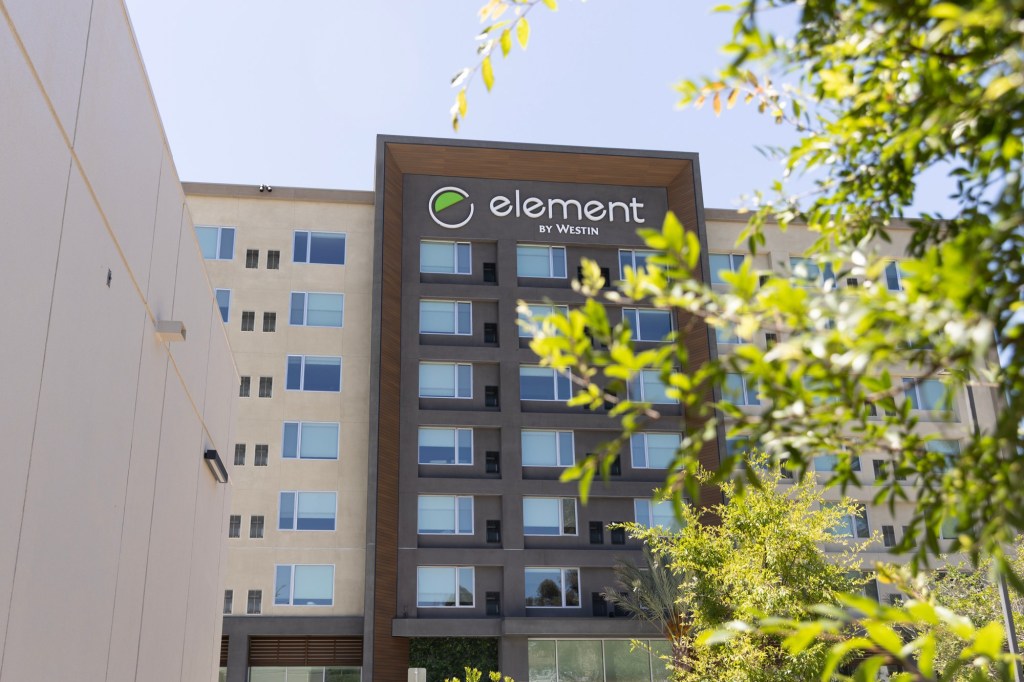
A new seven-story Marriott-branded hotel that focuses on extended stays and includes spacious suites with full kitchens has opened in Mission Valley, marking the first new lodging there in more than six years.
The $72 million project, bordering the San Diego River, also is the first hotel in the county to carry the Element name, an extended-stay hotel brand by Marriott known for its eco-conscious focus that embraces guest wellness and a contemporary, nature-inspired design.
The 148-room Element by Marriott on Qualcomm Way, which was developed by by Miami-based Driftwood Capital, capitalizes on its next-door neighbor, an older, full-service Marriott also owned by Driftwood. While it is not technically a dual-branded complex, guests at the new Element will be able to take advantage of the Marriott’s pool, meeting space and restaurant.
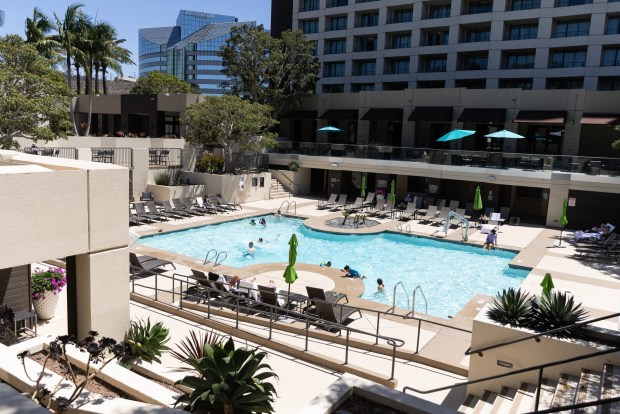 The pool at the neighboring Marriott is available for use by Element guests. (Luke Johnson / The San Diego Union-Tribune)
“The brand itself was originally created as an extended stay Westin property built for the eco-conscious traveler who’s not just staying one or two nights,” explained Josef Eberhardt, general manager of the Element-Marriott hotel complex. “So they incorporated green building materials, eco-efficient LED lights, and water-saving fixtures with recycling and filtered water systems throughout the building, electric charging stations and complimentary bikes for the guests to use.”
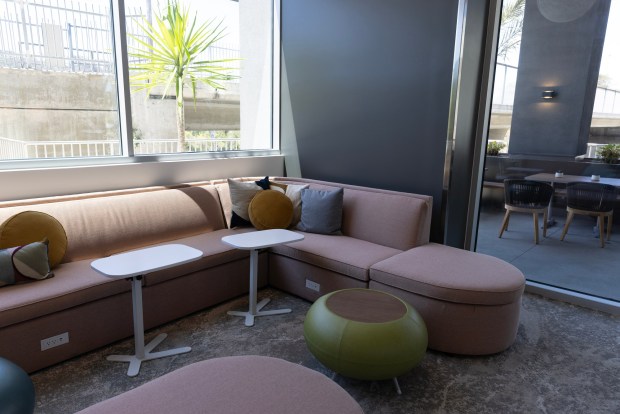 The Element’s lobby area. (Luke Johnson / The San Diego Union-Tribune)
A second Element hotel is expected to open this year in Chula Vista near the Otay Ranch Town Center.
Located just north of the San Diego River, the Mission Valley Element includes 5,000 square feet of ballroom and meeting space enclosed by glass that looks out onto an outdoor plaza that provides still more meeting space. The lobby, which is wrapped in glass on three sides and offers views of the San Diego Trolley passing by, has plenty of lounge seating to accommodate a breakfast buffet in the morning and coffee service throughout the day.
The hotel’s facade is notable for its seven-story-tall wood arch that frames the entry, complemented by a tall “green wall” that is covered with an ivy-like plant.
There is a mix of room types, including king and double queen rooms, although the majority are suites. One guest room feature unique to the Element hotels is a concept known as “studio commons,” where guests can rent a spacious living area and fully equipped kitchen anchored by four private guest rooms.
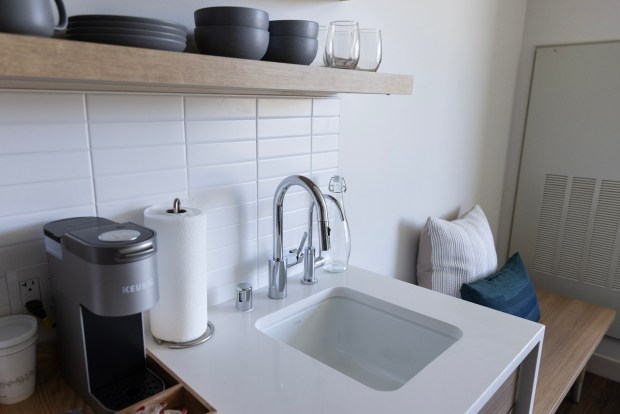 A lot of the larger rooms include small kitchens. (Luke Johnson / The San Diego Union-Tribune)
The opening of the new Mission Valley property comes at a time when hotel development has lagged because of high construction costs, an uncertain economy and dampened enthusiasm by lenders for such projects. The last new hotel in the area was the Legacy International Center religious resort, which opened in early 2020, just before the start of the pandemic.
While it has a 126-room hotel, much of the $190 million Bible-themed resort’s focus was to be on in-person training related to the late evangelist Morris Cerullo’s global ministering operation. There were also several religious attractions, plus a domed theater, but those were never opened to the public. The property is currently up for sale, with an asking price of $150 million, down considerably from its original price of $215 million.
Driftwood Capital’s project had the advantage of property it already owned, pointed out Daniel Katz, the firm’s vice president of asset management. The Element sits on a space that previously accommodated surface parking and a permanent 5,000-square-foot tent structure for the Marriott.
“Generally speaking, I think financing for construction is absolutely harder now, but I think for us, we’re pretty heavy on development right now, having just opened this hotel in San Diego, and we have another 500-room resort under development in Cocoa Beach, Fla., and another large project in Miami being built,” Katz said.
“So I think what it really comes down to is your relationships in the capital side of the business. And in terms of executing on these projects, Driftwood has 30 years of experience doing this, and we have a very strong balance sheet. And lenders are ultimately looking at who is the guarantor in doing these projects.”
On the operating side, Katz points out that there are economies of scale when managing two neighboring hotels, especially when it comes to booking group business.
“We’ve already booked our first campus-wide sellout, where we’re able to go out and sell 501 rooms to the market (between the two hotels),” Katz added. “We had a group come in and book a meeting for 2027 where they’re going to be utilizing the whole campus.”
Of the 148 rooms, 111 have full kitchens, and because of that, it’s expected that 35% to 40% of the Element’s bookings will be for business travelers, plus a substantial amount of rooms booked for government-related contract work, Eberhardt said.
“It’s very common to see that kind of contract work that comes through for the military bases and shipbuilders,” he said. “For example, the shipbuilders work on 45-night shifts, where they come in from other places, work here for 45 days, and then go home for 45 days and then return.”
Katz said that the occupancy rate at limited-service hotels in Mission Valley and other north San Diego communities tends to be in the mid-80% range and out-performs full-service lodging in that area.
He expects nightly room rates to be slightly above $200.