
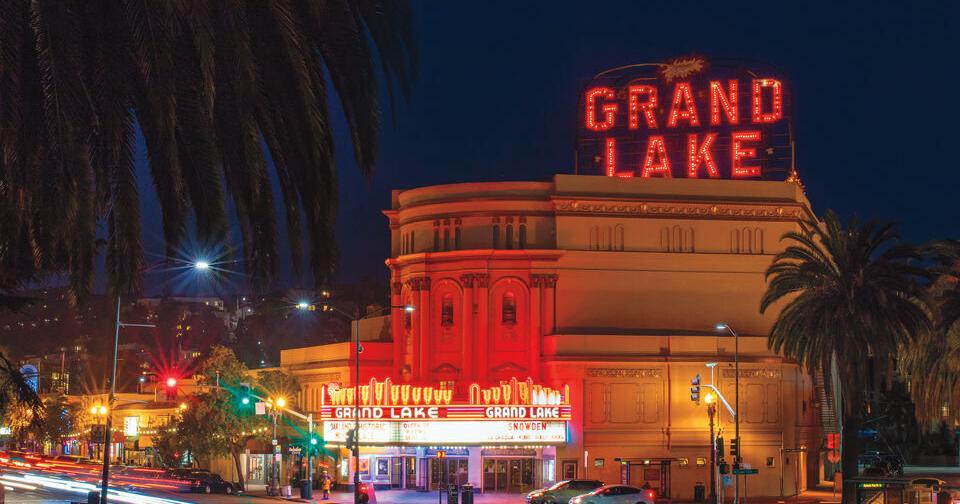

The Grand Lake’s rooftop sign continues to shine.
Shutterstock
Ask anyone who grew up in Oakland about the Grand Lake Theater, and they may sigh in nostalgic appreciation. Fond memories are exactly what Allen Michaan, owner of the historic movie palace, has spent 46 years working to create.
Michaan was in his late 20s when he first walked through the theater and instantly recognized its charisma. It was 1979, and the building at the corner of Grand Avenue and Lake Park Avenue had been sitting largely untouched since it opened in 1926. It was somewhat neglected but still intact. Mann Theatres, the chain that inherited the theater, had invested little in the property.
“What I got was original to the 1926 construction,” Michaan recalls. “Really, nothing had been changed. It was wonderful that they had left it alone, because so many theaters got so-called modernized, and it ruined the whole magic.”
Designed by the San Francisco firm Reid Brothers and built for a reported $1 million (roughly $18 million today), the Grand Lake opened March 6, 1926, as a vaudeville and silent film house. Its exterior wraps a rounded corner in ornate Neoclassical dress. Above the roofline, nearly 3,000 incandescent bulbs fire together on what Michaan says is the world’s largest rotary-contact sign. Inside, frescoed walls, gem-colored carpets, and crystal chandeliers further the transportive experience. The ceiling over the main auditorium, with its Mighty Wurlitzer organ, features a painted female figure in a pink gown that you’ll only see if you lean back and look up. Audrey Marr, who has worked at the Grand Lake since the 1980s and is its longest-tenured employee, grew up coming to the theater. The woman on the ceiling, she says, “haunted” her as a child. “She is indelible.”
To understand what the Grand Lake represents, though, you have to remember the moment in which it was born: the Roaring Twenties. “Theater construction throughout the country was at a fever pitch,” Michaan explains. “Thousands of theaters were being built every year, transitioning from little nickelodeons with short films to feature films. It became the national passion.”
The Great Depression helped end that era, and by the time television arrived in the 1950s, Oakland’s dozens of houses had dwindled to a handful. The Grand Lake, however, survived.
In the 1980s, Michaan converted the auditorium’s balcony into a second screen. When the neighboring storefronts became available, he built two new theaters inside the building—one Egyptian Revival, one Moorish style. “No one built any movie palaces like that since the late ’20s, early ‘30s,” he says. “The Grand Lake had become a special destination theater. Anything I was going to add on to it had to have that same magic.”
With no commercials before the film, no video games in the lobby, and real butter on the popcorn, the theater operates as Michaan intends: an authentic movie-going experience. renaissancerialto.com.