
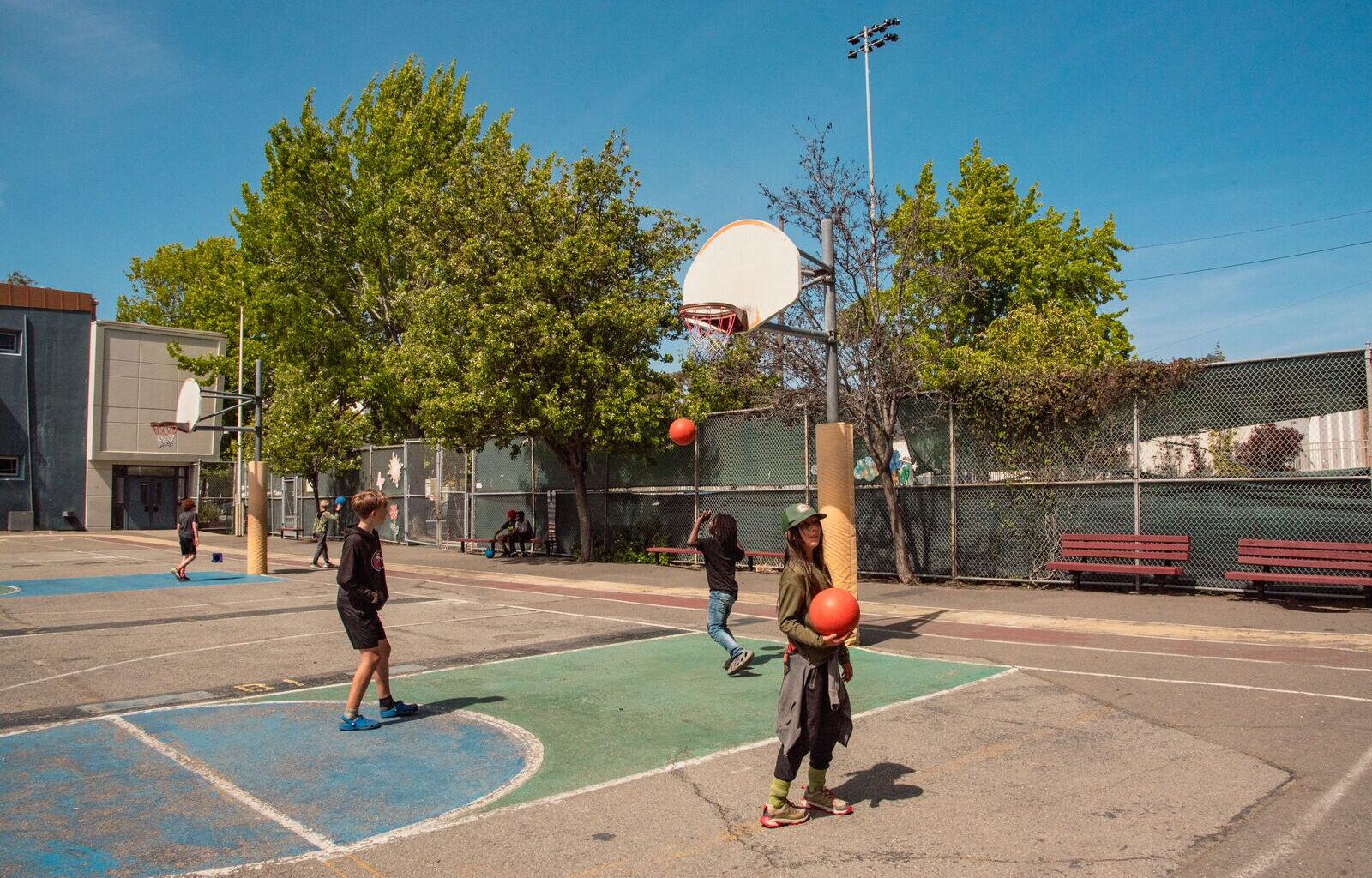
 Students play basketball afterschool at Washington Elementary School on May 15, 2025. Credit: Berkeleyside/CatchLight Local
The Berkeley Unified School District (BUSD) is overhauling its after‑school program, including reorganizing some staff and shifting enrollment priorities, in an effort to expand its capacity by the start of next school year.
Long waitlists for BUSD’s afterschool program, LEARNS, have frustrated parents for years. There are currently 348 students on waitlists across the district’s 11 elementary schools. All of the waitlisted students are in grades 1 through 5, according to district officials, since transitional kindergarten (TK) and kindergarten students received priority enrollment under California’s universal TK mandate.
Waitlisted BUSD families received their notices within two weeks of the school year ending on June 4. The news frustrated many parents, but BUSD’s new aftercare manager Joya Balk said the notices were sent out earlier this year than in previous years to make things easier for families.
“That was a direct response to parents saying they wait all summer, and they get uncertain. So we moved the timeline up and made clear what we can support, so that parents can access City of Berkeley programs,” she said. BUSD partners with the city to ensure families have access to municipal after‑school programs, noted Balk, when LEARNS cannot accommodate all students.
Chronic waitlists are one of several challenges Balk has taken on since stepping into the aftercare manager role in November. Others, she said, have included staffing shortages, operational inefficiencies, and the need to accommodate more transitional kindergarten students who require lower teacher-to-student ratios.
Balk is now leading on restructuring the program in hopes of addressing these issues. That process began in March, when Berkeley Unified notified all nine of its afterschool coordinators that their positions would be eliminated by June 30. The decision was met with strong pushback from some families, including Latino parents advocating to retain bilingual staff who they say are essential to their school communities. It’s unclear how many of the eliminated positions were held by bilingual staff. Berkeleyside requested this information from BUSD but hadn’t received an answer at the time of publication.
Under the aftercare program’s new structure, three cohort auditors (also called program leaders) will supervise 12 specialists and 80 instructional technicians across all elementary schools at an estimated staffing cost of $4.3 million, slightly below the previous coordinator-based model cost of $4.5 million. The new model is expected to increase program capacity by 10%, or between 60 and 120 additional students.
But some families said at recent school board meetings that the changes haven’t increased access, and that in some cases the situation has worsened. At Emerson Elementary, a nearly 50-student waitlist includes children who had been enrolled in the program for years. Parents at the school said the sudden loss of those seats has left working families scrambling for alternatives.
Balk and other BUSD leaders have asked families for patience as the new model falls into place.
“Restructuring takes time in any organization,” Balk said. “You’re not going to be able to see change overnight, and especially in a school district that has a lot of layers of governance.”
As LEARNS increases spots for younger children, district leaders have also been working to increase enrollment among low-income and high-needs students to meet state funding requirements, potentially reducing spots for other families, Balk added.
Some relief may come this summer, she said, once the district has a better sense of available grant money that could enable it to hire more instructors, increase program capacity and reduce waitlists at the schools that need it most.
How will LEARNS be different next school year?
Balk’s expanded learning plan for next year, approved by board members in June, outlines changes to BUSD’s before-school, after-school and summer programs.
Starting in the fall, all BUSD elementary schools will have a dedicated specialist on-campus to handle staffing, communications, attendance, and program fees. The new auditor positions will support record-keeping systems for BUSD’s in-house aftercare model, which differs from many other school districts that outsource services to organizations like the Boys and Girls Club.
Families enrolled in LEARNS will see some changes in program costs, which are calculated on a sliding scale based on income. BUSD increased aftercare fees, particularly for TK and kindergarten, because younger students require longer hours and lower staff-to-child ratios. At the high end of the scale, fees for full-time afterschool care (5 days per week) will increase from $475 to $650 per month for TK and kindergarten, $450 to $570 for grades 1–5, and $200 to $270 for before‑school programs.
BUSD also reduced sibling discounts to a flat 20%, whereas the discounts were previously 30% or 50%, depending on income. The employee discount will remain at 20%.
The school board also recently voted to charge families $1 per day for bus transportation to non‑district afterschool programs.
Balk said academic support will also increase in LEARNS. BUSD will pilot a literacy curriculum during summer school, with the goal of training afterschool staff over the next three years. LEARNS staff working with TK and kindergarten cohorts will also receive professional development in the fall to better meet those students’ needs.
Balk hopes to expand enrichment opportunities in LEARNS to include activities like gardening and cooking classes, once the program becomes financially stable and is fully meeting families’ needs.
“It’s expanded learning, not just daycare,” said Dianna Mullins, a parent and Cragmont Elementary PTA board member. “I’m excited about the future of the program for (marginalized) kids, for kids that are doing full tuition — it’s for everybody.”
Mullins said the prior aftercare model left families with widely varying experiences across schools because of different staffing availability at various sites.
“There was no consistency at all. Some schools were having a great experience, and some were having a nightmare experience,” she said. “Realistically, a structure needed to be put in place. There may have been some ugly things, but it had to happen.”
BUSD families have long voiced aftercare concerns
For years, Berkeley Unified families have contended with unstable aftercare options.
Anna Gazdowicz is the parent of an incoming 4th-grade student and 4-year-old twins at Malcolm X Elementary. She said her family spent four years on the LEARNS waitlist with “zero movement” since she enrolled her son in BUSD.
After failing to secure a spot at their assigned school, she placed him in a city-run program across town, where the family remained until transferring to the newly opened and much closer Willard Clubhouse Afterschool program, which is also run by the city.
When Gazdowicz was notified of available spots in BUSD’s program for next year, she declined.
“We can’t really plan our school and work lives around (LEARNS), so we’ve had to make strategic decisions,” Gazdowicz said. “We already engineered something that worked, and we weren’t going to dismantle it for a system that we’ve learned not to count on.”
She said she enjoys the city’s afterschool programs, which are run by full-time municipal employees who also oversee other local children’s programming like summer camps. Although her family has never been a part of LEARNS, she has noticed earlier notifications and clearer communications from BUSD, especially regarding transportation availability to outside afterschool programs.
As in years prior, families recently spoke about their aftercare concerns at school board meetings, asking district leaders to increase capacity, with some supporting the use of contractors if needed.
The community group Latinos Unidos de Berkeley and parents advocated during the May 27 board meeting for a bilingual staffer in the afterschool program at Sylvia Mendez Elementary to accommodate its dual-language curriculum and support its large Spanish-speaking community. More than 500 advocates signed petitions urging the district to adopt a language requirement for that role.
“This goes beyond a line item. It’s a time when Latinx families are fearful and feel under attack,” said Anayansi Diaz-Cortes, a Latinos Unidos representative and parent to fourth and sixth-grade students in BUSD. “The deep trust that Sylvia Mendez after‑school staff have built with families is not replaceable.”
Balk said BUSD is trying to be more responsive to community concerns and feedback as the expanded learning program evolves.
“We’ve been through a lot of changes as a community, and we’re hoping that by listening to everybody involved, we can better meet the needs of students throughout their whole academic career in Berkeley, not just one year at a time,” she said.
“*” indicates required fields