
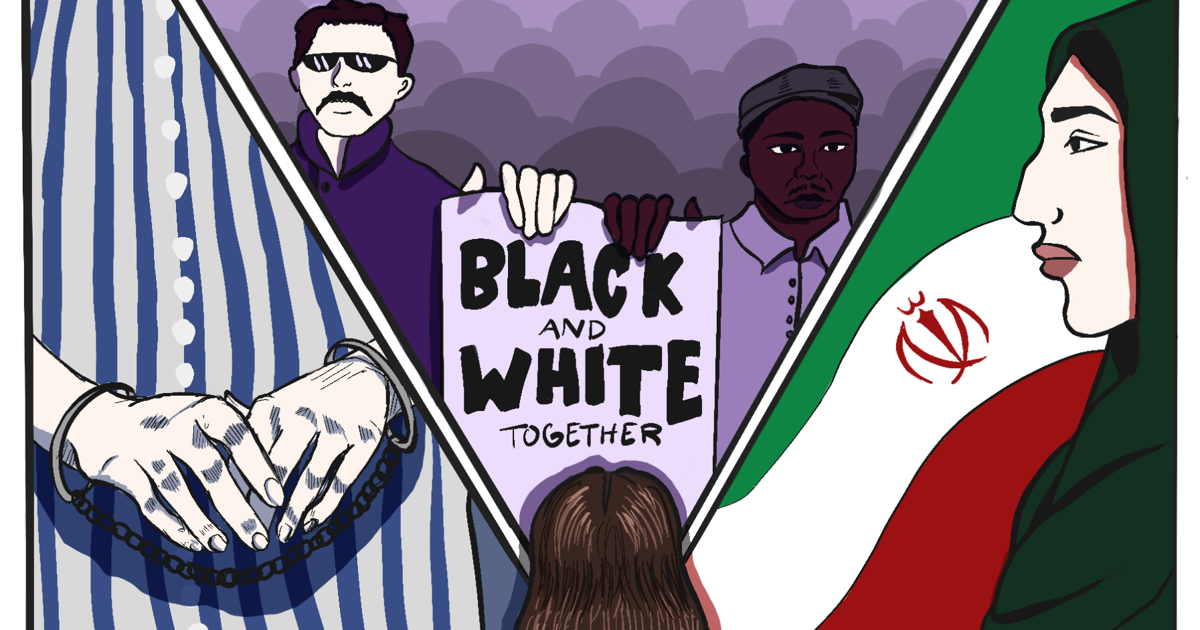
World-renowned Iranian French artist and author Marjane Satrapi passed away June 4.
In the wake of her death, it is difficult to contest the sheer impact of her most famous work, “Persepolis.” The graphic novel illustrates Satrapi’s coming-of-age experience as a rebellious, outspoken and skeptical young girl living in Tehran on the heels of the 1979 Iranian Revolution. Despite being consistently targeted in book-banning crusades, “Persepolis” has sold more than 2 million copies worldwide, been translated into 24 languages and landed on The New York Times’ list of the best books of the 21st century.
The success of “Persepolis” signals a greater pedagogical undercurrent worth paying attention to: The graphic novel is a powerful medium for relaying historical narratives. The combination of illustration and the written word allows graphic novels to artistically embed an experiential view of history. Its written element relies heavily upon dialogue to convey the sequence of events, orienting history through conversation and personal mental processing of such trauma. The visual element provides support through graphic illustration, allowing for a deeper, more robust connection between author and audience and opening a new channel of perception from the readers, separate from the editorial and factual elements of traditional academic and creative historical writing.
Using graphic novels to depict history facilitates active consumption of these essential stories, challenging the predominance of dry, passive facts and figures. Active consumption of media is based on making reading an interactive experience. In textbooks or academic research, this interaction is facilitated by crafting questions that use the text to seek the answers. With graphic novels, interaction with the text comes from the visual component, which uniquely composes a more visceral connection to and a deeper understanding of the issues the narrative describes.
This phenomenon can most clearly be explained by the picture-superiority effect, which finds that when all else is equal, people recall images much better than words. This process is at the foundation of learning, retention and understanding. The editorial characteristics of graphic novels also inherently inculcate an interactive relationship between reader and text. These texts are primarily dialogic, orienting the narrative within the characters’ interpretation of history and allowing readers to more easily retain the information communicated through the text, as it is presented in a digestible manner: a social interaction between two people.
The illustrative and narrative components of graphic novels complement one another, creating an inveterate connection between the reader and the characters they are getting to know. In turn, this may produce a more sympathetic, educated outlook on real people who have personally experienced or carry the generational trauma of atrocities. The graphic novel represents an embrace of historical subjecthood: Its protagonists are complicated and active rather than simply statistics or stock characters.
In “Persepolis,” when 12-year-old Marji reflects on her uncle’s execution by the newly instated Islamic regime, the comic strip shows little Marji floating in an endless sea of black space. There are no words on the strip; Marji’s incommunicable grief lives within the blank space — a grief that extends beyond the written word, beyond the dry regurgitation of factual history. The emotional weight of tragedy and catastrophe manifests through the author’s creative liberty, emerging through a narrative that only the author, who has personally experienced the history, can see.
The graphic novel’s function as a historical device, then, is to lend its characters a fundamental humanity. Today, the same humanity is in short supply.
With the integration of AI skyrocketing, UC Berkeley has positioned itself as a major launchpad for ongoing developments in AI, often at the expense of investing in artists and storytellers. The increasing prevalence of AI only exacerbates the trajectory within historical narratives toward the dry recitation of facts and figures.
AI is reliant upon the synthesis of statistics and averages, and it does not possess the ability to chronicle catastrophic events through the vantage point of human beings. AI does not know the pain of a mother who lost her son in battle. It cannot fathom the reality of a child seeing their school blown to pieces. The graphic novel inherently resists this sanitization of history by providing both a more immediate human connection to the narrative through the visual and a somatic understanding of history.
The implementation of AI, an inherently inhuman mechanism, to tell these stories is an attack on the human condition as a whole. AI has the potential to transform the ways in which we consume information — relentlessly, and in a way that demands the eradication of a personal perspective in absolute terms. This, in turn, risks rupturing the social fabric human beings have created with one another by transforming how we consume information.
The graphic novel ultimately resists this shift through its dependency on lived experience and creative expression. As students, and as people, it is our duty to support the work of graphic novelists and amplify the voices of those who have lived through the historical events we learn about in our lecture halls. If you really want to learn about history, read it through pictures.