
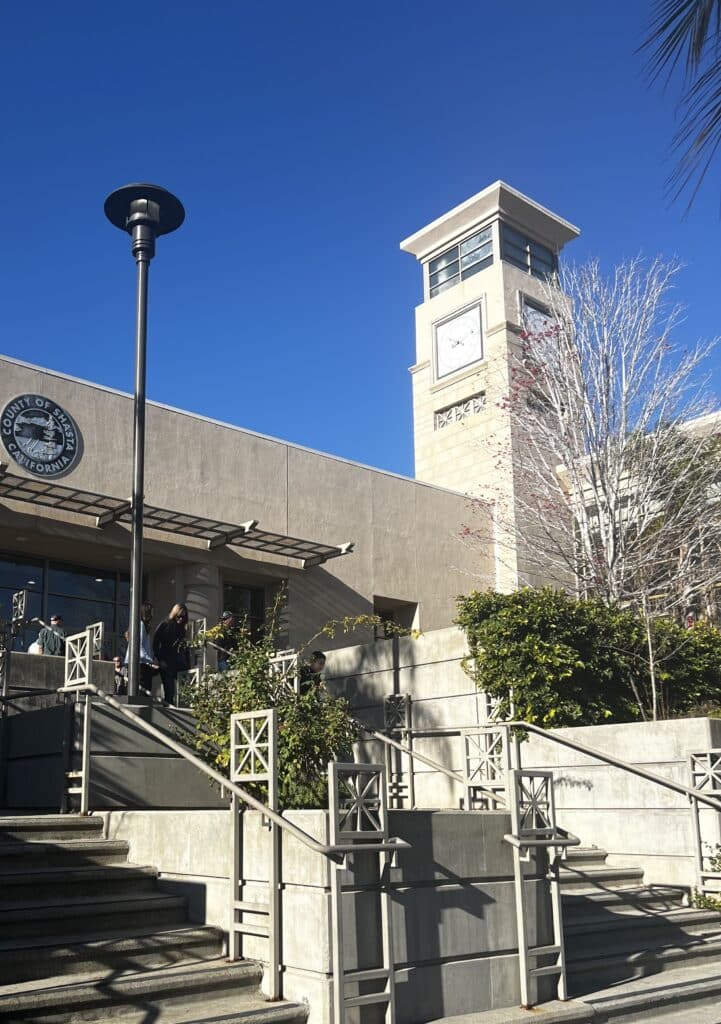
 Shasta County’s administrative building. Photo by Annelise Pierce
A free speech group is raising alarm over a bill working its way through the California Legislature.
As currently written, Assembly Bill 1821 — which would amend California’s 1968 Public Records Act — allows government agencies to delay responding to certain requests and to charge for the time spent searching for and providing public records deemed to be for “commercial use”.
It also authorizes local agencies to petition the courts if they believe a public requester has made a request with “malicious intent.”
According to CalMatters reporting, the bill’s proponent — LA-based Assembly Member Blanca Pacheco — says she hopes it will reduce “frivolous” requests, especially those that might be generated by AI. In an interview with the statewide media agency, she called the bill’s changes to CPRA law, “minor amendments or minor tweaks.”
The nonprofit First Amendment Coalition disagrees. Earlier this week, the organization sent out a press release noting recent changes to the bill and calling it “bad for government transparency, for accountability and for our democracy.”
FAC Executive Director David Snyder wrote that an aspect of the bill that allows agencies to petition the courts over so-called malicious intent, “would be easily weaponized by agencies seeking to thwart transparency and accountability.”
He also cited decades-old California law making it clear that state and local agencies cannot sue records requesters. Allowing such suits, he wrote, would put an “intolerable chill” on the public’s exercise of its right to access.
In Shasta County, access to public records is already under scrutiny by local government officials hoping to reduce costs associated with the process. Over recent months county CEO David Rickert has made multiple public mentions of his concerns about the county’s costs associated with an rising number of public records requests — a total of 1,316 last calendar year.
Each request, Rickert said during an April 7 public meeting, takes a minimum of two hours to respond to, with a total of 2,632 hours spent in 2025, the equivalent of more than one full-time position.
During the same meeting he even called out public records requesters by name. Shasta Scout was named as the top user of the county’s record request portal in calendar year 2025 with 54 requests, followed by activist and elections staffer Laura Hobbs — with 42 requests.
Asked why he chose to name top records requestors publicly, Rickert wrote by email that his comments were meant to “inform the Board and the public of the activity.”
“On a side note,” Rickert continued, “I am interested in ways we can streamline the PRA process and improve transparency.”
The county has already implemented significant efforts to streamline and improve the process over recent years, implementing a records request portal in August 2024 that has made asking for public documents relatively simple. A public benefit of the portal is that it distributes transparency across a wider audience by allowing the public at large to view all responsive documents alongside the associated requests on a searchable county portal.
The switch to that process may be one reason requests have increased by at least 30% since the last fiscal year, a stat shared by deputy CEO Erin Bertain during recent budget hearings.
But Susanne Baremore, a Shasta community member who worked for the county’s legal department decades ago, says there’s another reason the county is having to shell out more cash to deal with increased public records requests.
“I believe that the volume of PRA [requests] is symptomatic of some deficits in leadership and knowledge base for key positions within the county,” Baremore said by phone yesterday.
A helpful first step in reducing the need for records requests would be ensuring more county officials actually answer the questions they’re asked, she said. With 37 requests in the last calendar year, Baremore was among the top requesters called out by Rickert in April.
Last week, during county budget hearings, the issue of records requests was raised publicly again, both by deputy CEO Bertain and by Shasta County Sheriff Michael Johnson, who, like Pacheco, called some public records requests “frivolous.” He also said the need to comply with California Public Records Act law, especially when it comes to body camera footage, will be “problematic moving forward.”
“It’s costing us a lot of time, money and effort and staffing just to keep up with those,” Johnson said, “and some of those are as frivolous as some college student doing some study.”
Last summer, a Shasta Scout intern — who had just graduated from university — used the records process to reveal a Redding ICE facility that had not been publicly acknowledged by local law enforcement officials. Since being hired as a full-time reporter last fall, her CPRA requests of the Shasta County Sheriff’s Office — used along with other data sources — have revealed ongoing detentions at that facility as well as Sheriff Johnson’s unsuccessful attempt to collaborate with ICE officials last year.
Yesterday, Shasta County spokesperson Miranda Angel responded to a request for comment by writing that the county is aware of AB 1821 and has been monitoring amendments. She said staff plan to bring a position letter on the bill to the board for consideration at an upcoming meeting, but did not elaborate about what position staff may suggest.
“At that time, more information will be available,” Angel wrote. “The letter will ultimately be up to the Board to approve.”
Disclosure: The nonprofit First Amendment Coalition has previously represented Shasta Scout pro bono in several successful legal demands against both Shasta County and the City of Redding. Those legal demands resulted in a change to local records law, the return of press rights, and access to body camera footage — all in service of the public’s good.
Do you have a correction to share? Email us: editor@shastascout.org.