
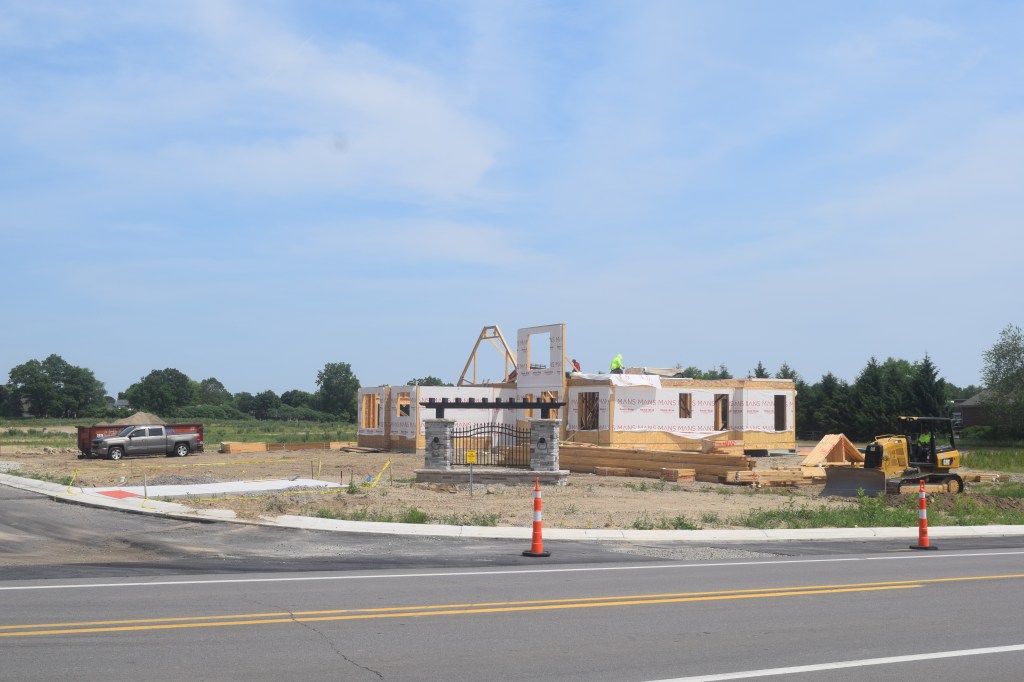
Oakland County townships are driving population growth as new residents seek larger homes, open space and suburban amenities within commuting distance to other county hubs.
According to recent U.S. Census data and estimates from the Southeast Michigan Council of Goverments, six townships are among the top 10 growth communities in the county from 2020 to 2025.
Lyon Township sits atop the list with 3,609 new residents. Other townships include Commerce, third (+1,922); Highland, seventh (+1,158); Milford, eighth (+960); Orion, ninth (+712), and Independence, tenth (+710).
Four cities are also among the top 10, including Auburn Hills in second with 2,043 new residents; Troy, fourth (+1,473); Novi, fifth (+1,443); and Rochester Hills, sixth (+1,411).
Lyon and Commerce townships also ranked first and second in the county for new housing units added between 2020 and 2025, according to SEMCOG. Lyon Township added 1,333 housing units during that period, while Commerce Township added 816.
“Lyon Township has actually grown by almost 16%, about 15.5%, and that’s the largest rate for any community in the state above 20,000 people,” said Dan Riley, research coordinator for Oakland County’s economic development organization.
Riley said both Lyon and Commerce townships benefit from a combination of available land, transportation access and lifestyle appeal.
“They’ve got land. People still like to build new single-family homes,” Riley said. “Lyon Township is easily accessible to I-96, I-275 and in Commerce Township’s case, M-5 and I-696. People also look at school systems and remote work and see both of them as attractive places to live.”
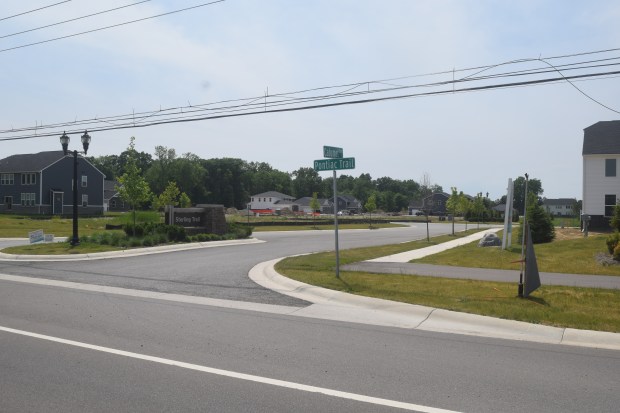 New developments such as Sterling Trail are popping up throughout Lyon Township as their population continues to grow.
Photo by Matt Fahr
By the numbers
Population estimates showed 57 of 83 counties in Michigan grew between 2020 and 2025. Michigan’s reached 10,127,884 residents in 2025, an increase of 50,553 from 2020 and continuing four years of growth.
In Oakland County, 37 of 62 communities experienced growth during the same period, including 16 townships.
Of the 25 communities that lost population, only five were townships. According to Census data and SEMCOG estimates, Oakland County’s population reached 1,332,764 in 2025, an increase of 19,109 from 2020.
Among the highlights:
— Pontiac added 475 new residents between 2020 and 2025, outpacing the growing communities of Ferndale (+246), Farmington Hills (+171), Walled Lake (+167), Birmingham (+158), Wixom (+120) and Royal Oak (+48).
— Townships also landed at the bottom of the growth list with Bloomfield losing 353 residents between 2020 and 2025 followed by Waterford losing 325.
— Based upon estimates, the village of Leonard added 2 residents between 2020 and 2025, the smallest increase in the county.
Countywide, Oakland’s continued growth has been fueled in part by migration. The American Community Survey estimates show in 2025, 62,494 county residents lived outside Oakland County one year earlier. Of those newcomers, 37,578 moved from elsewhere in Michigan, 14,708 arrived from another state and 10,208 immigrated from abroad.
To compile the chart below, the Oakland Press analyzed databases from the Census Bureau, including American Community Survey estimates, and synchronized with SEMCOG’s regional database.
The Census Bureau relies on county-level administrative data to determine the balance of births and deaths, then uses municipal-level information on housing changes and other federal sources to distribute those population changes between cities, townships and villages to form their estimates. But comparing the totals year over year — especially among the many small communities in Oakland County — can be problematic. That’s why we used the 2020 decennial census count as the base and then layered in yearly estimates to find population changes between 2020 and 2025. But the smaller the community, the larger the margin for error.
How to build a community
For many homebuyers, affordability remains a major draw.
Joe Muck, owner of J Muck Realty and a Lyon Township resident for the past 13 years, said many potential buyers begin their searches in Novi or Northville before looking farther west.
“There are definitely some people that want to be in the South Lyon area, but honestly, a lot … start in Northville or Novi,” Muck said. “Whatever the price point is, whether you’re at $300,000 or $900,000, you just feel like you get more bang for your buck in both communities (Lyon and Commerce).”
Even at higher prices, buyers often find larger homes and properties than they would in more established neighboring communities, he said.
“The reality is, even today, I could take someone to a $600,000 house, and it’s still a much different house than if I take someone to a $600,000 house in some neighboring towns,” Muck said.
Land is a key to Lyon Township’s expansion. Once known primarily as an equestrian community, the township still has undeveloped acreage.
“South Lyon used to be an equestrian town, so there’s tons of farmland,” Muck said. “I think the biggest reason for the explosion is availability.”
Riley, the county researcher, agrees.
“It seems spatially, the availability is there and people are taking advantage of it,” he said. “People also look at school systems (South Lyon schools) and remote work and things along those lines and see both of them (Lyon and Commerce) as attractive places to live.”
While housing construction has surged, Muck said commercial development has lagged behind residential growth.
“My assumption was also that businesses would be developed, and there’s a lot less of that than there are houses being developed,” he said. “The demographics don’t make sense for some businesses. If you look at Whole Foods’ requirements, we don’t even come close to the population they need, let alone some of the larger chains you see in other areas of the county.”
Despite the growth, community leaders say Lyon Township has maintained much of its small-town character.
Paula Ruffin, owner of New Hudson Chiropractic and Wellness Center and a member of the Lyon Township Downtown Development Authority, said residents continue to appreciate the area’s balance between rural charm and suburban convenience.
“You still have this country feel,” Ruffin said. “It’s got a great school system, and people can feel like they’re moving to the country, but then in 10 minutes they’re in Novi and can get their shopping done.”
The township’s DDA has worked to strengthen community identity. Ruffin said the DDA sponsored only two annual events for more than two decades before significantly increasing its offerings after 2021.
“We now have over 17 to 19 events a year, and we’re adding more,” she said.
Those include weekly summer concerts, the “Lighting Up the Grand” walkable holiday light display, the “Scarecrows on the Grand” Halloween attraction and a mid-December holiday market featuring dozens of vendors.
“We’ve had so many people thank us because it’s great to drive a mile down the road and go to a concert or an event and not have to leave our community,” Ruffin said.
She said once the commitment was made to build from within, it has paid dividends.
“I’ve been there 25 years, and yet I still didn’t really start this ball rolling until 2021 … when we were like, ‘Let’s just pull the trigger and do all this,’ and the numbers bear it out, so it works,” said Ruffin. “It’s a win-win.”
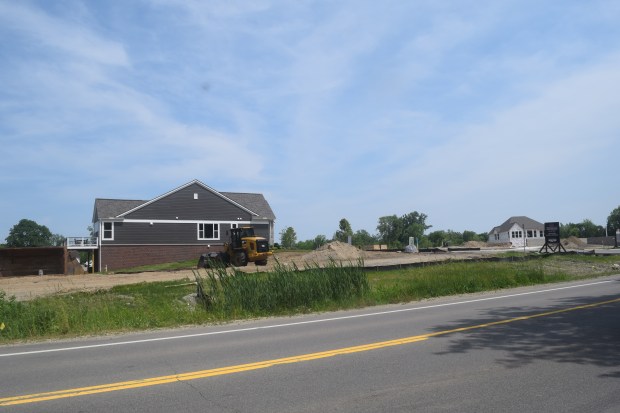 Land is a key to Lyon Township’s expansion. Once known primarily as an equestrian community, the township still has undeveloped acreage.
Photo by Matt Fahr
Commerce filling up
In Commerce Township, things are slowing.
Township Supervisor Larry Gray said the area has filled up over the past decade as space is becoming limited.
“Commerce has been growing for years, to the point we have less than 20% of developable land left,” Gray said.
The township continues to attract residents with its recreational opportunities, relatively low tax burden and proximity to regional transportation networks.
“We offer plenty of outdoor activities for our residents, whether it’s hiking, biking, boating or just about any outdoor activity,” Gray said. “We have one of the lowest tax bases in Oakland County.”
Gray noted that one-third of Commerce Township is covered by lakes or parks, while residents also benefit from access to both the Walled Lake Consolidated and Huron Valley school districts.
But growth has created challenges, particularly traffic congestion and increased demand for public services.
“The main factor we see with the addition of residents is traffic,” Gray said. “We’ve also seen growth in need for our internal departments, mostly emergency services.”
To meet those demands, the township has added personnel to both its fire department and the county sheriff’s substation.
Commerce officials expect residential growth to continue, though at a slower pace.
Building permits have increased by 20 from 2025 to 2026, but township leaders do not anticipate an increase in residential permitting this year. Several housing developments currently under review could contribute to additional growth beginning in 2027.