
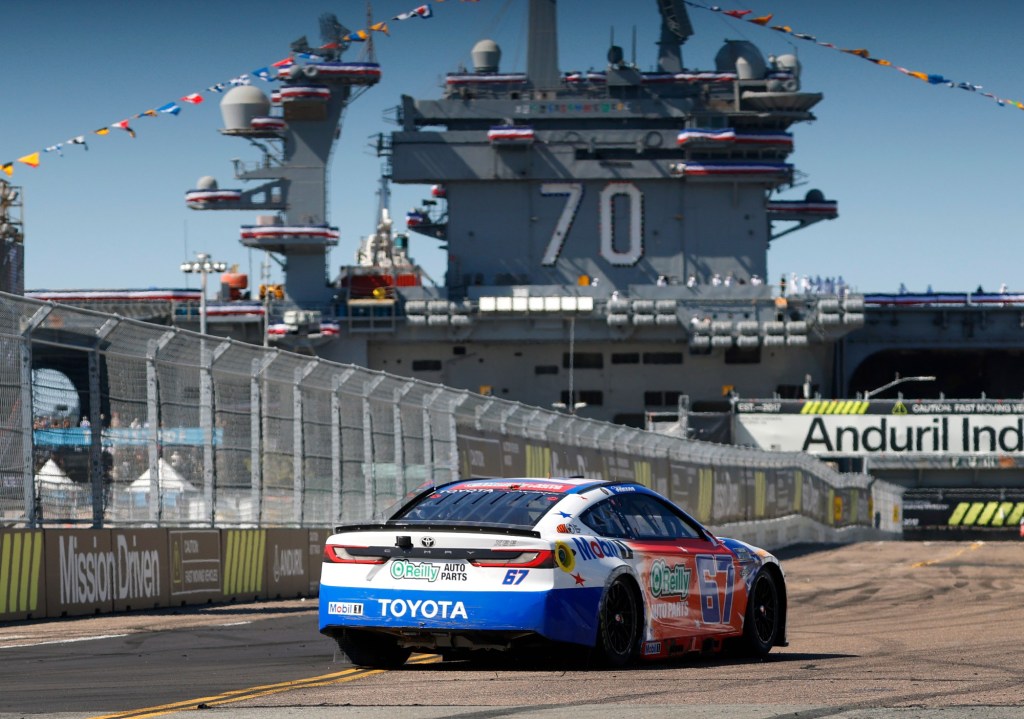
Coronado was put on the map in the late 1880s when the Hotel del Coronado was built.
The hotel, in turn, gained fame as the setting for a 1959 comedy starring Marilyn Monroe, Tony Curtis and Jack Lemmon called “Some Like It Hot.”
NASCAR’s historic appearance here at Naval Base Coronado offered an alternative: “Others Like It Fast.”
Sunday’s Anduril 250 highlighted a weekend that culminated with a memorable afternoon of chills, thrills and spills. A 16-turn course across five different surfaces will do that. When he took the checkered flag, Corey Heim was as much a survivor as a winner.
Electronic signage along Interstate 5 began warning drivers around Del Mar of “Coronado Bridge Delays,” some 25 miles before getting to the blue bridge.
The delay wasn’t bad four hours before the green flag, with 15 minutes needed to cross the 2-mile span.
A bridge sign welcoming folks to Coronado lists the population as 26,600. There were 50,000 spectators expected for Sunday’s race.
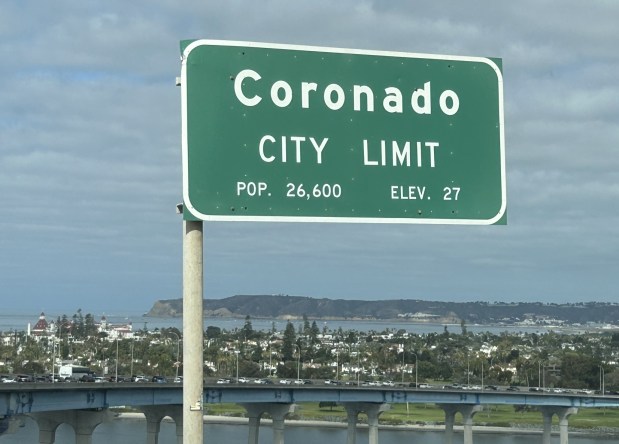 The Coronado population swelled over the weekend with an estimated 50,000 race fans each day. (Kirk Kenney / San Diego Union-Tribune)
Traffic backed up on Third Street as cars got off the bridge and pointed toward the base.
Interestingly enough, if you took a left down Orange Avenue and made your way the 10 blocks down to the Hotel del, it immediately seemed like any other Sunday.
Traffic, including golf carts favored by many of the locals, was light. Tourists walked leisurely down the street among the shops and what in two weeks will serve as the parade route for one of the city’s favored Fourth of the July events.
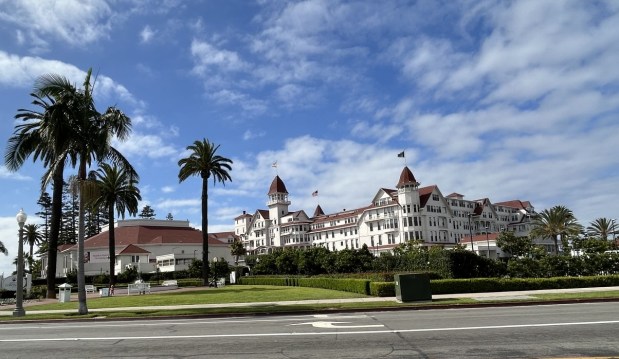 It seemed like anything other weekend on Sunday outside the Hotel del Coronado. (Kirk Kenney / San Diego Union-Tribune)
Approaching the base along Ocean Boulevard, one noticed an electronic sign emphasizing the 25 mph speed limit.
There was no such signage on the base, where drivers averaged 90 mph during qualifying. It’s no wonder there four cautions before the race was half over.
NASCAR Fan experience
• Fans were given a light-hearted warning moments before driver and VIP introductions on the main stage in the NASCAR fan experience, when a guy on the microphone said, “we’ve got a lot of cameras out here. Be aware, if you’re with someone you shouldn’t be with. We don’t want a Coldplay moment.”
El Cajon’s Jimmie Johnson gets a big hand from the crowd during driver introductions moments ago for NASCAR’s Anduril 250 on Naval Base Coronado. pic.twitter.com/FnwevhEwam
— Kirk D Kenney (@sdutkirKDKenney) June 21, 2026
• Driver introductions came on the stage with the same fanfare as a WWE match. El Cajon’s Jimmie Johnson received the biggest hand from the crowd. Before driver introductions, honorary race officials included Chargers safety Tony Jefferson, an Eastlake High School graduate, and former NFL running back Marshawn “Beast Mode” Lynch. U.S. Secretary of War Pete Hegseth was loudly cheered, with chants of “USA! USA! USA!” as he waved to the crowd. That was in contrast to a banner draped above a southbound freeway overpass an exit before the Coronado Bridge that read, in part, “Drunk, bigoted, war criminal Pete.”
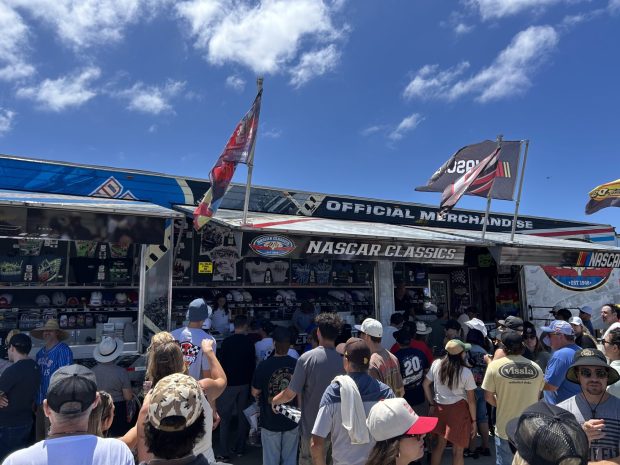 Dale Earnhardt merchandise remains popular 25 years after the driver’s death. (Kirk Kenney / San Diego Union-Tribune)
• There were more than a dozen trailers down one straightaway in the fan experience, each selling official drivers gear. The biggest gathering was outside the Toyota trailer, where fans could get apparel to represent Tyler Reddick, Bubba Wallace, Riley Herbst and Heim. The fans also favored merchandise for Kyle Busch, who died tragically exactly one month ago.
• The NASCAR Classics trailer offered shirts, hats, toy cars and other items for great drivers from the past like Dale Earnhardt, Dale Jr., Bill Elliott, Jeff Gordon, Bobby Labonte, Richard Petty and Rusty Wallace. Earnhardt’s No. 3 apparel remains the most popular, even though “The Intimidator” died 25 years ago.
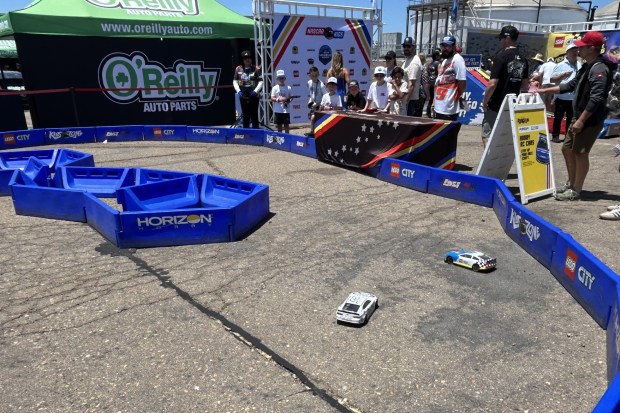 Youngsters had an opportunity to race cars in the Kids Zone. (Kirk Kenney / San Diego Union-Tribune)
• Those race fans who only come for the crashes should have gone to the Kids Zone, where a pair of remote-controlled cars ended up against the wall and upside down at every turn. The 8- and 10-year-olds behind the controllers got a kick out of it each time. The woman working the booth who had to put the cars back on four wheels every few seconds, not so much.
• Among those in the Kids Zone were Laura Herstad, her brother Ned Personius and their families. The setting brought back childhood memories. They had the run the base back in the 1990s when their father, Capt. William Personius, was stationed here.
“My father is a retired Navy pilot,” Laura said. “I grew up almost every weekend of my childhood was on this base, so we had to come check this out. It’s amazing. It’s Americana at its finest.”
William Personius, as president of the Naval Helicopter Association, was responsible for getting the H-60 helicopter that is part of a memorial at the base’s entrance.
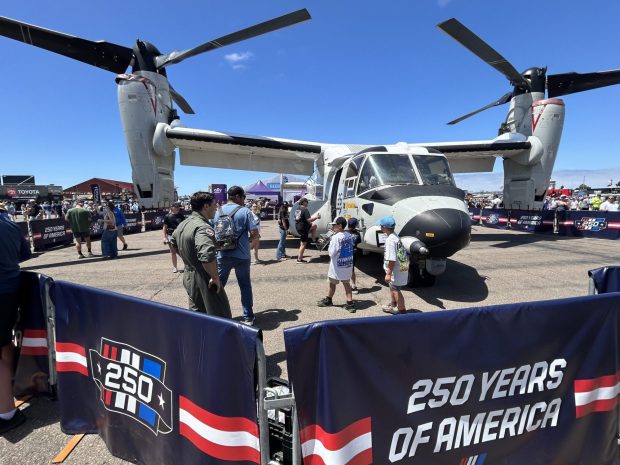
Pilot candidates?
The race location was noted several times this week as presenting a great recruiting opportunity for the Navy.
The NASCAR fan experience area included various aircraft as well as an amphibious vehicle and a submarine.
Lt. Justin Price (call sign: Download) was standing next to a CMV-22B Osprey. Fans lined up to get an inside glimpse of the military and cargo transport aircraft, most notable for a tiltrotor that allows for vertical takeoff and landing.
“This is a great forward-facing way the Navy has for showing the public how we operate, how confident we are, how professional we can be and just share our enthusiasm for something we truly love,” said Price, a Philadelphia native who has been flying for eight years.”
Price said the Osprey draws people to it because “this particular aircraft is such a weird, dynamic, interesting engineering feat that human beings have come up with. People are interested in how it works and how it flies.”
After waving three young boys ahead to inspect the aircraft, Price was asked if he had seen any good pilot candidates.
“I hate to use a Pixar reference,” he said, “but a good chef can come from anywhere. I can’t see a great pilot, but there might be a great pilot in this line. A 3-year-old who doesn’t have any interest in it right now, but it just sits in the back of his head and one day he wants to fly it. … This group is going to remember this aircraft, and there’s probably a kid of two in this line that one day will fly it.”
Honored guests
Two Medal of Honor winners, Command Master Chief Britt Slabinski and Captain Royce Williams, were recognized before the race.
“I’m absolutely in awe that the Navy is allowing these race cars to go at high speeds around a nuclear-powered and nuclear-armed aircraft carrier,” Slabinski said. “I’m just amazed by that, so, to the drivers out there, please don’t crash into the carrier.”
Slabinski is a retired Navy SEAL who was honored for his actions in Afghanistan in 2002. He said this is “classic America.”
“I think (General George) Patton said it best, America loves a winner. We hate a loser. We’ve been having that attitude for 250 years. I hope we keep it up for another 250 years, leading the way in the world.”
The 101-year-old Williams, an Escondido resident, received his medal earlier this year during President Donald J. Trump’s State of the Union speech for heroics in 1952 during the Korean War.
Williams estimated that he flew some two dozen different aircraft, fueled by the need for speed, during his career. He said the Grumman F8F Bearcat, with a top speed of 455 mph, was his favorite.
Why?
“Power,” he said simply.
The final question for the men was if they had the opportunity would like to ride in a race car.
“Yes, once upon a time,” Williams said.
Said Slabinski: “I don’t want to ride in it, I want to drive it.”
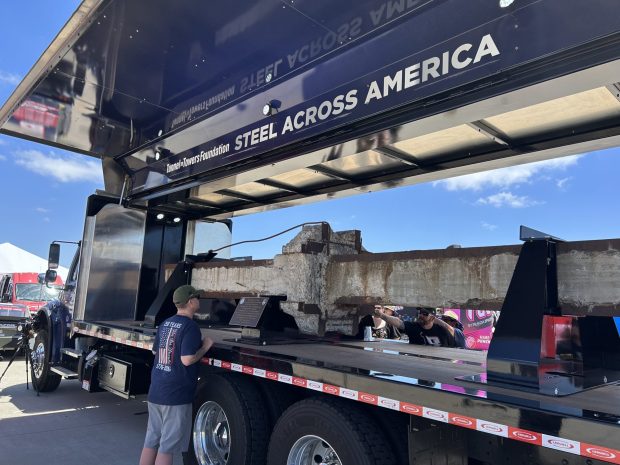 The Tunnel to Towers Foundation is touring the country with a steel beam from the South Tower at the World Trade Center. (Kirk Kenney / San Diego Union-Tribune)
Tunnel to Towers
The Tunnel to Towers Foundation was represented at the fan experience as part of its “Steel Across America” tour of 35 cities across 30 states as it brings attention ahead of the 25th anniversary of 9/11.
Sitting on a flatbed semi is a 21-foot, 16,900-pound steel beam recovered from the South Tower after the attack on Sept. 11, 2001. It provides an emotional connection for those with vivid memories of that day and a visual representation of the 2,977 lives lost for those too young to remember.
Among those who died was New York fireman Stephen Siller.
“He was off duty that morning after working an overnight shift,” said Stephen Siller Jr., who was nine months old when his father died. “He was obsessed with the job. He loved being a fireman, so he always carried a scanner with him. When he heard over the scanner that the towers had been struck by a plane, he called my mother to say he had to get to work.
“He drove to his firehouse, Squad 1 in Brooklyn, but his unit had already responded. So he grabbed his gear, threw it in his truck and started to drive to the World Trade Center. He was stopped at the Brooklyn Battery Tunnel. You could not get into Manhattan … So my dad parked his car outside of the tunnel, grabbed about 80 pounds of gear and ran about two miles to the South Tower, where he lost his life while saving others.”
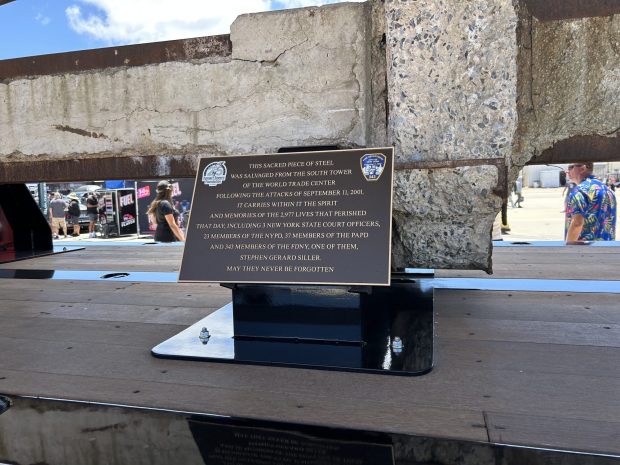 Sign explaining the significance of steel beam from South Tower. (Kirk Kenney / San Diego Union-Tribune)
“It’s overwhelming,” Siller said. “You look at it and feel the gravity of what happened that day. There’s been some really special reactions. One of those came in New York at one of our earlier stops. There was a fireman whose whole unit was killed on Sept. 11. The truck isn’t even here. He walked up to the steel and was crying and praying. He was hugging it like he was hugging his friends.
“My father’s body was never recovered. A lot of those men in that firehouse, they were never recovered. Who they are is ingrained in that steel. This is sacred.”
The purpose of the tour is to ensure no one ever forgets what happened on 9/11.
The Tunnel to Towers Foundation began with a mission to raise money to build special houses to fit the needs of wounded veterans and first responders. The organization has provided hundreds of mortgage-free smart homes as well as paying off the mortgages for the families of fallen first responders. More recently, it has created veterans villages for homeless vets.
More information is available at t2t.org.
On Board
The USS Carl Vinson featured prominently throughout the day, with the Navy Band Southwest Ceremonial Band performing the national anthem on its deck and the aircraft carrier visible throughout the race as drivers made their way between turns 5 and 6.
It wasn’t the first time the Carl Vinson was involved in a national sporting event.
In November 2011, a college basketball game dubbed the Carrier Classic was played on the deck of the Carl Vinson.
President Barack Obama was among the crowd of 8,111 for North Carolina’s 67-55 victory over Michigan State.
Organizers had planned to build two courts, one below deck in the hangar bay in case inclement weather made the one on deck unplayable. In midweek, with a 50/50 forecast of rain, they rolled the dice and built only the on-deck court. Rain began to fall an hour after the final buzzer.
Pot shot
Race aficionados noted an unprecedented five different surfaces that had some drivers going through tires about every 10 laps. If race officials really wanted the course to represent San Diego, they would have included several potholes.
Parting thought
Being in Coronado for Father’s Day brought back a memory of my father, who worked for Sunbeam Bread Company over four decades before he retired. At one point, his bread route included some stops in Coronado. This was in the late 1960s, before the bridge was completed, so my father drove his bread truck from the bakery on 16th Street through downtown to the ferry landing for the 15-minute ride across San Diego Bay.
Car ferries went away in 1969 when the bridge opened. It would have been a good option after Sunday’s race, when the Coronado Bridge was choked with cars returning to the mainland.