

When Los Angeles decides who will lead the city in the coming years, the winner will take the reins as the clock ticks down to the 2028 Olympics—which take place just months before the nation elects its next president.
L.A. voters will choose between two Democrats—embattled incumbent mayor Karen Bass and her progressive opponent, City Councilmember Nithya Raman—in a November mayoral runoff after no candidate won a majority in June’s primary.
Whether Bass or Raman emerges triumphant, the winner will have little time to enjoy a victory lap. The scrutiny is sure to be immediate, as the next mayor will be under pressure to deliver on promises to tackle the city’s problems before millions of visitors descend on the City of Angels for its third time hosting the Olympics.
Under the glare of the global spotlight, a successful Games could offer Democrats the opportunity to showcase effective governance in one of the party’s prominent strongholds.

But a failure of the host city to show meaningful progress could make it a symbol of dysfunction in a city governed by Democrats. That could make it fodder for President Donald Trump and Republicans to attack Democrats as incompetent leaders in the months before the 2028 presidential election, when Americans will have to choose between Trump’s successor and a Democratic opponent as the nation’s next commander-in-chief.
Newsweek reached out to Raman and the LA28 Organizing Committee for comment. A spokesperson for Bass referred Newsweek to details of the Games’ preparations on the mayor’s website.
A Transit-First Games
For a city notorious for its gridlocked traffic, the ease with which visitors are able to traverse the city during the Games will be one of the clearest tests of whether the Games are a success.
Bass had initially pledged a vision of a “no-car” Olympics at a press conference in 2024, saying public transportation would be the only way to access Olympics venues.
That has since been walked back somewhat—although both Bass’ office and the LA28 Organizing Committee are touting the Games as “transit-first,” pointing to the expansion of the city’s public transportation system in recent years.
“The worst thing the city can do is plan the bulk of events downtown with the idea that people will all take rail or buses to the events,” Daniel Durbin, a professor of communication and the director of the Institute of Sports, Media and Society at the USC Annenberg, told Newsweek.
The Games “are an opportunity not only to move millions of spectators efficiently via transit, but also to accelerate lasting improvements that will make mobility in Los Angeles safer, faster and more reliable,” Bass’ office said last year.
The plan to address traffic during the Games involves leasing up to 3,000 buses from across the country, but there have been issues in securing the funding to pay for it. LA Metro has sought $2 billion in federal funding for the planned transit service for the Games, including leasing buses, hiring drivers and building temporary depots.
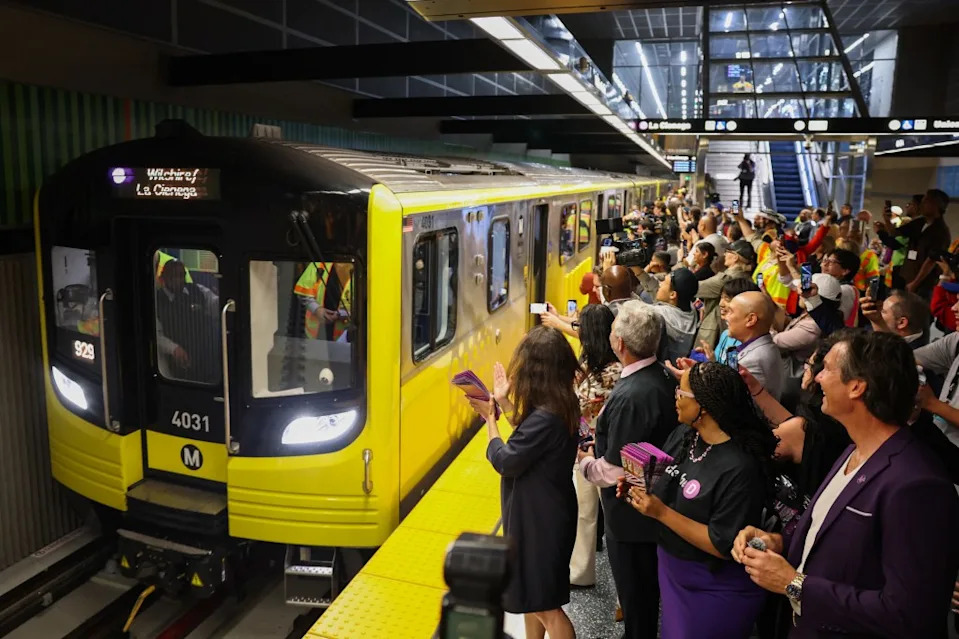
One of the first trains open to the public arrives to the Wilshire/Fairfax station on May 8, 2026, at the opening of the Metro D Line subway extension in Los Angeles.
Recently, the House Appropriations Committee approved $875 million for Olympic transit funding after such funding was excluded from Trump’s 2027 fiscal year budget request in the spring, the Los Angeles Times reported.
And while the city has made progress on an ambitious set of 28 bus and rail projects that sought to transform public transit in the city by 2028, including an extension of a metro line to Los Angeles International Airport, it’s not clear if most will be ready in time for the Olympics. Even if they are, the city’s public transportation network still lags far behind the systems in prior host cities, including London, Paris and Tokyo.
Paris was able to run “a model green games because they already had a fulsome rail infrastructure,” Durbin said, but Los Angeles won’t be able to match it. “This is a freeway culture, has a freeway infrastructure second to none, and a successful Los Angeles Olympics will employ those freeways well by spreading events across the region,” he said.
Brian Taylor, a professor of urban planning and public policy at University of California, Los Angeles, said temporary transportation measures will be more crucial for the smooth running of the Olympics than major infrastructure projects.
Completing rail projects “is not going to be critical to the success of the Olympics,” he told Newsweek. “Instead, having sort of a temporary event management system together to deal with security and manage the crowds is going to be more important.”
Both Durbin and Taylor pointed to the success of the city’s 1984 Olympics, when it did not have a subway or light rail, to note that fears about intense traffic, or a “carmageddon,” during the 2028 Games may be overblown.
Taylor said the use of buses and park-and-ride lots were crucial back then. He said research also showed behavioral shifts meant the city avoided gridlock during the 1984 Games.
“There was just civic pride,” he said, with people voluntarily shifted their working hours so they would not be on the roads at peak times.
The City’s Homelessness Crisis
Olympic hosts have a history of moving homeless people out of the city before the games begin. The last time Los Angeles hosted, the city deployed mounted police patrols to move homeless people from the Skid Row area into less visible areas of the city. Bass has vowed not to employ similar tactics.
But city leaders will likely take some action to make such problems “less visible” before the Games,” Christian Grose, professor of political science and public policy at the University of Southern California, told Newsweek. “Ideally, these problems will be addressed so more people are moved off of the street, and [so] that it is not just an image change but actual policy changes that will improve the lives of Angelenos and Californians, as well as those visiting for the Olympics or watching from afar.”
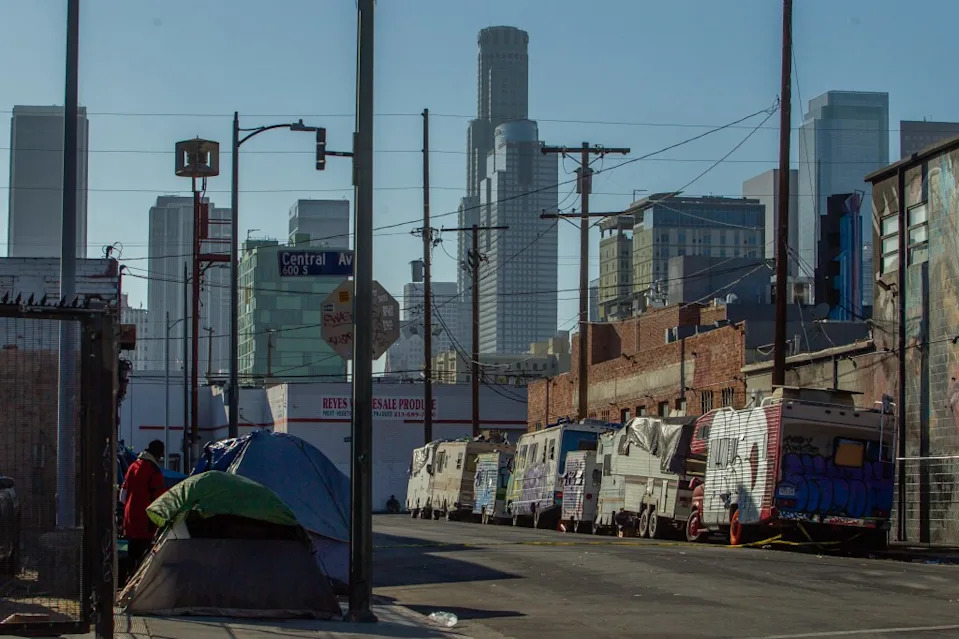
A street lined with tents and motorhomes in the Skid Row area of downtown Los Angeles pictured on June 11, 2026.
Benjamin Henwood, professor at USC Suzanne Dworak-Peck School of Social Work and director of the Homeless Policy Research Institute, told Newsweek that the crisis is “fundamentally a failure of affordable housing policy at the federal level.”
Decades of disinvestment has left local governments “to manage a crisis they didn’t create and can’t solve alone,” Henwood said, and that gap “cannot be closed by 2028.”
But he said that meaningful progress would involve a “humane, public-health-oriented” model that “moves beyond enforcement to answer a harder question: not just where people can’t sleep, but where they can.”
Bass has faced criticism for not making enough progress on the issue, though she has pointed to reductions in homelessness during her tenure. Estimates suggest some 44,000 people remain unhoused within the city limits.
Raman said the city’s primary strategy for homelessness “has been to move encampments from one block to another, from your block to your neighbor’s block and back again… It’s political theater.”
She has pledged to reduce the numbers of people sleeping in tents and encampments by at least 50 percent by the 2028 Games. Her plan involves “a strategic, sequenced approach” that will prioritize schools, parks and other sensitive locations.
For Henwood, the approach should involve providing sanctioned spaces, access to bathrooms, cooling centers, water and basic services.
The city’s unsheltered residents should be treated “as constituents with rights, not problems to be relocated for the cameras,” he said. “The bar for the Games isn’t solving homelessness. It’s whether L.A. can govern with dignity while the world watches, and whether Democrats can demonstrate they’ve learned something from the last decade of failure.”
‘No-Build’ Olympics
The city’s affordability crisis continues to define life for many Angelenos, and is likely to be a major issue nationwide in the 2028 election.
Grose noted it is top of mind for voters, with 20 percent of likely California voters listing the cost of living as the state’s most important issue in a recent poll, while 15 percent said it was housing.
Bass has pointed to two consecutive years of declining street homelessness and efforts to fast-track affordable housing approvals as signs of progress. But the rebuilding of homes destroyed in devastating wildfires last year has been criticized for moving too slowly.
“The continuing challenges in bureaucratic red tape for rebuilding have exposed the city’s lack of foresight, planning, infrastructure, leaving many to question if the current administration has the ability to house a successful Olympics,” Durbin said.
The 2028 Games are unlikely to create a housing legacy, as Los Angeles secured its Olympic bid by pledging to use existing facilities rather than constructing new ones.
While that keeps costs down and avoids purpose-built venues being abandoned after the Games, it also means the city is not leveraging the preparations to create permanent, affordable housing.
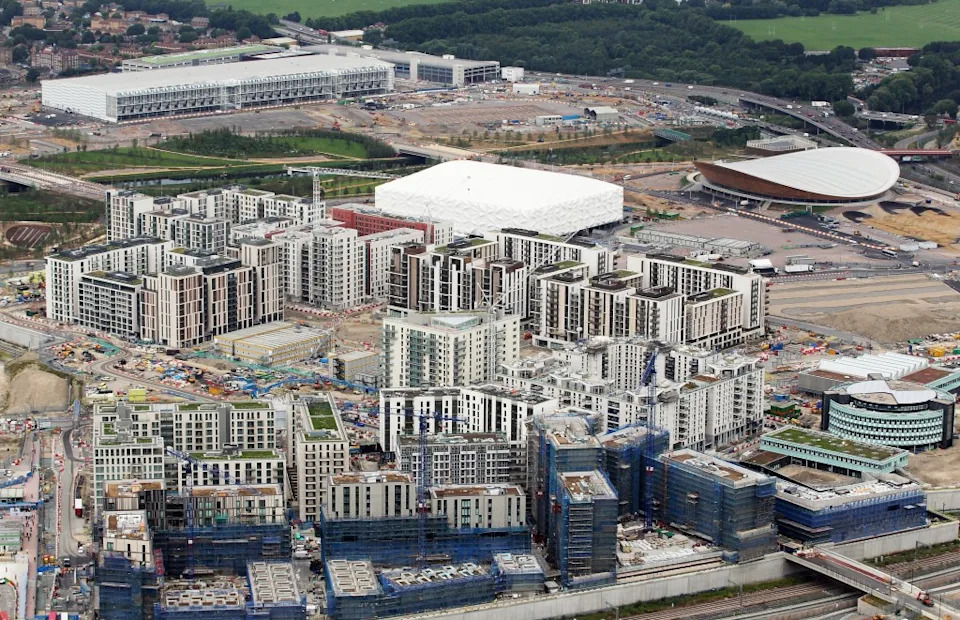
An aerial view of the athletes village and main press center under construction on July 26, 2011, for the 2012 Olympic Games in London, England.
Taylor noted other host cities have done exactly that: the Olympic Village for the 2012 Games in London was later repurposed for public housing.
“Significant steps toward cleaning up tent cities and creating housing” could be taken before 2028, Grose said. “But this has been such a long and ongoing problem, I would be surprised to see a systematic program in place for housing within the next two years,” he said.
A Referendum on Democrats?
The 2028 Games could be seen as a referendum on Democratic governance just months before voters choose the nation’s next president. Several California Democrats have been touted as contenders for their party’s nomination, including Governor Gavin Newsom and former Vice President Kamala Harris, a former state attorney general and U.S. senator.
The Olympics presents “a reset opportunity on California Democrats’ national image,” Grose said.
Democrats “are the influential power brokers and govern Los Angeles and California; the upcoming Olympics—if run well—can show off the state to a huge audience.”
But Durbin said that the 2028 election will be a referendum on Trump’s second term, and the economy and cost of living will be bigger issues.
“The outcome of the Olympics isn’t likely to move the needle all that much,” he said.
Gar Culbert, a professor of political science at California State University, Los Angeles, agreed that any failures would be unlikely to stick to the Democratic nominee in 2028.
“Voters care about national issues, and not ones that are specific to the city of Los Angeles,” Culbert said. “Depending on who the Democratic candidate is, it is unlikely to rub off on them.”
Los Angeles City Councilmember Monica Rodriguez made it clear that the Games are not being planned with national implications in mind.
“I’m focused on ensuring the Games are successful so Angelenos aren’t left on the hook financially—not so Democrats can win elections,” she said in a statement to Newsweek.
The Trump Factor
Trump has long maligned Los Angeles and other Democrat-run cities.
Last year, he defended the decision to deploy National Guard troops to quash protests that erupted after his administration stepped up immigration raids in the city by saying Los Angeles had been “invaded and occupied by illegal aliens and criminals.”
But the president sees the 2028 Olympics as one of the marquee events of his second term.
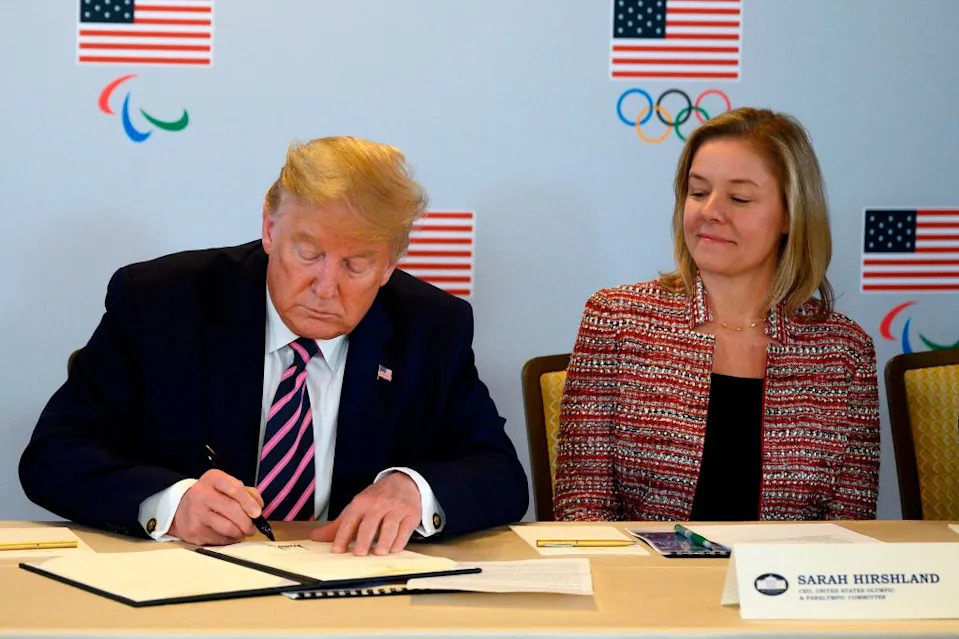
U.S. President Donald Trump signs a document pledging federal support to the Olympics beside U.S. Olympic & Paralympic Committee CEO Sarah Hirshland, on February 18, 2020, in Beverly Hills, California.
“This will be the last major public event of Trump’s presidency, and it seems unlikely that he’ll want to go out on the sour note of a failed Olympics,” Durbin said.
Trump has demonstrated as much—he established a task force last year to ensure the event is “safe, seamless and historically successful.”
“The L.A. Olympics is shaping up to be a wonderful moment for America. It’s going to be incredible. It’s so exciting,” Trump said as he signed an executive order establishing the task force.
Durbin said there is concern that if it appears Los Angeles is unprepared for the Games, Trump could step in at the last minute.
“If Trump does offer support and the Olympics turn out well, the Republicans can claim that Democrats can’t run anything and they (the Republican Party) were needed to sweep in and save the day,” he said.
“Hence, it’s important for the Democratic Party and its public image that one of the most left-leaning cities in the country can run a successful Olympics with no Trump involved.”
Related Articles