

When three men in apparent mental crisis were killed by Los Angeles police within a 48-hour span in January 2023, city leaders vowed to take a hard look at how such tragedies could happen. Nearly three years later, a new city audit concludes that little has changed: The LAPD still relies heavily on armed patrol officers to lead responses to mental health calls, often sidelining clinicians trained in crisis intervention.
An assessment released last week by City Controller Kenneth Mejia’s office found that the LAPD’s Mental Evaluation Unit (MEU) – a specialized division created to defuse volatile encounters – continues to operate under a “patrol-first, armed-response” model that relegates mental health professionals to a supporting role, even in non-violent incidents.
Despite MEU’s stated mission to reduce the potential for violence and connect people in crisis with care, the report found that the department measures the program’s performance by how quickly its teams free up patrol officers at the scene, not by whether force was avoided or help was provided.
“Most concerning is that while LAPD’s directive requires SMART (Systemwide Mental Assessment Response Teams) to be deployed to mental health calls involving people who may be violent or armed, or are high-risk LAPD doesn’t allow SMART units’ officers or mental health clinicians to be primary responders in these or lower risk or non-violent situations,” Mejia said in a statement. “In fact, LAPD requires armed patrol units to be primary responders.”
A police-first model for crisis response
LAPD’s SMART units, a program under the MEU, pair one armed officer with one clinician from the Los Angeles County Department of Mental Health.
They respond to 911 calls involving potential mental health issues, as well as requests from patrol officers who encounter individuals in distress. The teams are designed to assess behavioral health needs while ensuring scene safety — a bridge between policing and care.
But in practice, the Controller’s Office found, it’s often the patrol officers — some of whom may lack formal mental health training — who determine whether clinicians can intervene.
In 2022, patrol units were the first responders in 96% of MEU-tracked incidents and made the final decision in 76% of cases. Roughly 78% of these calls ended in either an arrest or an involuntary 72-hour mental health detention, known as a 5150 hold.
Auditors also reviewed a sample of MEU incident reports and found that only 6% described attempts to de-escalate the situation. Sixty-one percent made no mention of de-escalation, and 33% involved incidents that did not require it.
MEU officers, the audit noted, do not receive additional training beyond LAPD’s one-time department-wide Mental Health Intervention Training, and the current program doesn’t align with best practices.
The unit’s $12.8 million annual budget — which covers roughly 79 sworn officers — includes only personnel costs. It omits data on equipment, fleet, contracting, and training.
“It seems like a lot of information and data that would be helpful to policy makers, to the LAPD, to the community, for thinking how to evolve the program, how to make it better, is left with no data,” said Dinah Manning, the Controller’s chief of strategic initiatives and lead author of the audit, in an Oct. 30 interview.
The Controller’s Office recommended that LAPD revise its policies to allow SMART teams to take the lead on non-violent mental health calls, update how the department tracks outcomes like de-escalation and use of force, and require ongoing training for MEU officers.
It also called for clearer protocols for officer interactions with people in crisis — noting, for example, that MEU’s current guidebook still requires nearly all subjects to be handcuffed before evaluation, a tactic experts say can escalate tension.
The audit further urged the City Council and Mayor’s Office to continue supporting and funding the city’s Unarmed Model of Crisis Response (UMCR) pilot through its multi-year plan — and to consider expanding it, if proven effective, as an alternative to armed police response. Launched in March 2024, the UMCR program dispatches trained, unarmed civilian teams to handle nonviolent emergencies.
LAPD defends its system as necessary for safety
LAPD’s Deputy Chief Alan Hamilton defended the department’s current “patrol first” model as a matter of officer and clinician safety. He maintained that the department’s Mental Evaluation Unit (MEU) is “just one of many tools” patrol officers may use in the field
“You couldn’t send a lone officer and a DMH (Department of Mental Health) clinician to the scene of a person with a specific mental health issue,” Hamilton said in an Oct. 30 interview.
“If it goes sideways, or in other words, if there is an attack or something like that, by a suspect, now you have a lone officer that’s trying to protect the clinician and also trying to protect the subject of the call.”
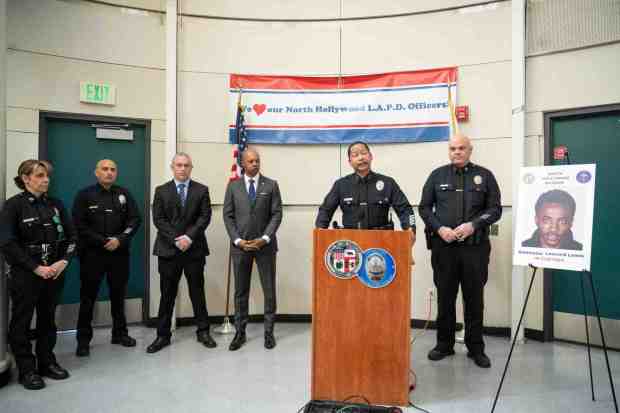 LAPD Deputy Chief Alan Hamilton holds a press conference with his team at LAPD’s North Hollywood Division on Monday, February 6, 2023 announcing that Sammeiso Leonard Lewis, a resident of Las Vegas, was arrested in the December robbery of two French Bulldogs from a nine-month pregnant woman in Studio City. (Photo by Sarah Reingewirtz, Los Angeles Daily News/SCNG)
Hamilton also cited limited resources. Depending on the night, the LAPD deploys only three to six SMART units citywide, even though the program runs 24 hours a day, seven days a week.
“ It’s a city of 4.1 million people. It’s very difficult to show up,” he said. “The MEU does not quote, take over … the officers retain the responsibility for the outcome of the radio call that we show up to, or the incident that we show up to.”
He added that LAPD would “gladly” expand mental-health training if more funding were available, but said pulling officers out of the field for multi-day courses would reduce already stretched patrol coverage.
“It sounds like the Controller has identified a resource issue within the Mental Evaluation Unit where we need more staffing in order to send people to better, more high quality training, which we will gladly send our people to if the city is willing to provide money for it,” Hamilton said. “But don’t forget if they’re off training, they’re not in the field.”
He also questioned the Controller’s call for unarmed response teams to take more calls, citing the unpredictability of 911 emergencies.
“They’re recommending that we send unarmed people to places where armed responses are not necessary. How do they know that ahead of time?” Hamilton said. “I don’t know if the Controller’s aware, but most of your mental health people will not respond without law enforcement assistance or without having them very close by.”
Beyond firearms, Hamilton noted that people in crisis may have access to other kinds of weapons — and can act unpredictably out of anger or confusion. He said a stronger law enforcement presence can help deter violence.
“If you have three LAPD officers and a DMA clinician show up, it’s probably a lot less likely that someone’s going to attempt to harm someone with that kind of a presence,” he said. “Why are we rolling the dice? Why are we taking unnecessary risks?”
Still, Hamilton said he agreed with parts of the audit, including the need for better training and more resources for the department’s mental health response.
“I don’t dismiss any of these studies offhand. I read them to see if there’s different nuggets that we can use to approve our stuff,” Hamilton said. “I agree 100% that we should get more training.”
He questioned how expanded training would be funded and staffed without pulling officers off daily patrols. Hamilton also defended the current response model as flexible and comprehensive, saying it gives officers a range of tools to respond to mental health calls — from de-escalation to, in rare cases, lethal force.
“There’s a full spectrum in between,” he said. “We have to have someone there and we have to have adequate resources to bring that to bear if necessary, which is not necessary 99 out of 100 times.”
The Los Angeles County Department of Mental Health did not immediately respond to a request for comment Monday.
Some city officials call for broader unarmed crisis response
Councilmember Eunisses Hernandez, who co-chairs the City Council’s Ad Hoc Committee on Unarmed Crisis Prevention, Intervention, and Community Services, said the audit “comes at a perfect time.”
“The report shows that LAPD often in many of these cases are still the first responders to mental health calls,” she said Oct. 31. “There’s often time in situations where they don’t need to be the first responders, but their policies and their systems still put them in that role, which then puts people in danger, puts police in danger.”
She added that when officers respond to people experiencing severe mental-health crises or suicidal thoughts, their presence can sometimes escalate the situation.
Hernandez said Los Angeles’ Unarmed Model of Crisis Response (UMCR) program—piloted last year—offers a safer and more cost-effective alternative. Since launching, civilian teams of clinicians and social workers have handled more than 6,000 calls, resolving 96% without LAPD backup.
“Which means that we’re saving LAPD time, we’re saving LAPD money and the city money, she said, “because it costs $35 for an unarmed crisis response team to answer a call versus $85 for LAPD to answer the same call.”
Councilmember Nithya Raman echoed that view, saying the report “underscores that we urgently need a true city-wide unarmed crisis response program, one that allows for many more mental health calls to be handled by trained clinicians and social workers.”
Mayor Karen Bass thanked Controller Mejia for the assessment and said she would work with LAPD Chief Jim McDonnell to review its recommendations. “These units have a vital role to play,” Bass said.
She added that she’ll review training and policy updates “to ensure that SMART units are fully maximized to assist Angelenos in mental health crises and to help prevent excessive use of force,” and that her administration is also focused on expanding the region’s clinician workforce and investing in Crisis and Incident Response Through Community-Led Engagement, and UMCR.
Advocates urge shift toward care-first model
The audit’s findings echo long-standing concerns from mental health advocates, who say families often face a grim choice: call 911 and risk an armed police response, or wait hours for a clinical team that may never arrive.
“It’s how fast do you need assistance. Say somebody you love is in your home, they’re in a back bedroom, they’re in a crisis. You know they’re in crisis. There’s no immediate fret to anybody’s safety,” said Mark Gale, criminal justice chair of the National Alliance on Mental Illness (NAMI) Greater Los Angeles County.
“Then you don’t call 911, you call 988 and you ask for PMRT,” he added, referring to the Psychiatric Mobile Response Team, which consists of clinicians from the L.A. County Department of Mental Health who conduct in-person psychiatric evaluations.
Gale said PMRT now offers 24/7 coverage across Los Angeles County, but response times can still range from 30 minutes to two hours.
“If your son is putting holes in the wall and screaming and yelling at his parents and he’s got a baseball bat in his hand,” he said, “you dial 911.”
Having worked with thousands of families navigating similar crises, Gale said outcomes often hinge on which officers respond.
“Families are always worried that the wrong LAPD officer will show up,” he said. “The NAMI families’ experience with law enforcement ranges from high praise when they de-escalate and nobody got hurt, and no force was used. I also have friends where law enforcement has shot and killed their loved one, more than one. So we run the gamut.”
Not all LAPD officers have undergone Mental Health Intervention Training, Gale noted, and in an emergency, it’s usually the nearest unit that responds.
At Dignity & Power Now, which advocates for people impacted by incarceration, communications manager Janet Asante said the audit aligns with what many families already know.
“Bullets are not how we cure people,” she said. “That is not the prescription for any of these mental illnesses, and that’s what you get when you have officers handling clinical means.”
She described one case involving a father, Afael Roblero, who called police for help when his son, Jessie, in crisis was vandalizing their home. The son was arrested and later spent over a year in Men’s Central Jail despite a judge ordering him to a treatment program.
“This report is not surprising to me,” she said. “Every time that we are successful in winning policies to move away from the very harmful systems of policing and incarceration, somehow those investments for care and treatment and the appropriate medical response get co-opted. There’s a misimplementation of resources towards the LAPD, LAFD, and the carceral system in general.”
That tension between intent and implementation is what the Controller’s Office sought to examine.
Ultimately, the Controller’s Office said the audit was meant not to criticize but to clarify — to help Los Angeles understand how its crisis-response system actually works and where it can improve.
“ What we wanted to do is to shed light and bring transparency to a very complicated mental health response system that’s in place through the city,” said Dinah Manning, the Controller’s chief of strategic initiatives. “ Obviously, the LAPD is a city department that we invest a lot of money into, and so we wanted to be able to understand, what is that response system.”
She added: “Through everything, we just really want to ensure that the public is informed, that policy makers are informed, that the process is a little bit demystified so that we can hopefully evolve our system of mental health response and do our best to avoid tragic outcomes that we can’t come back from.”