
From government emails to records showing how taxpayer dollars are spent, public documents can offer a window of transparency.
But a bill moving through the California Legislature could change how Californians access that information.
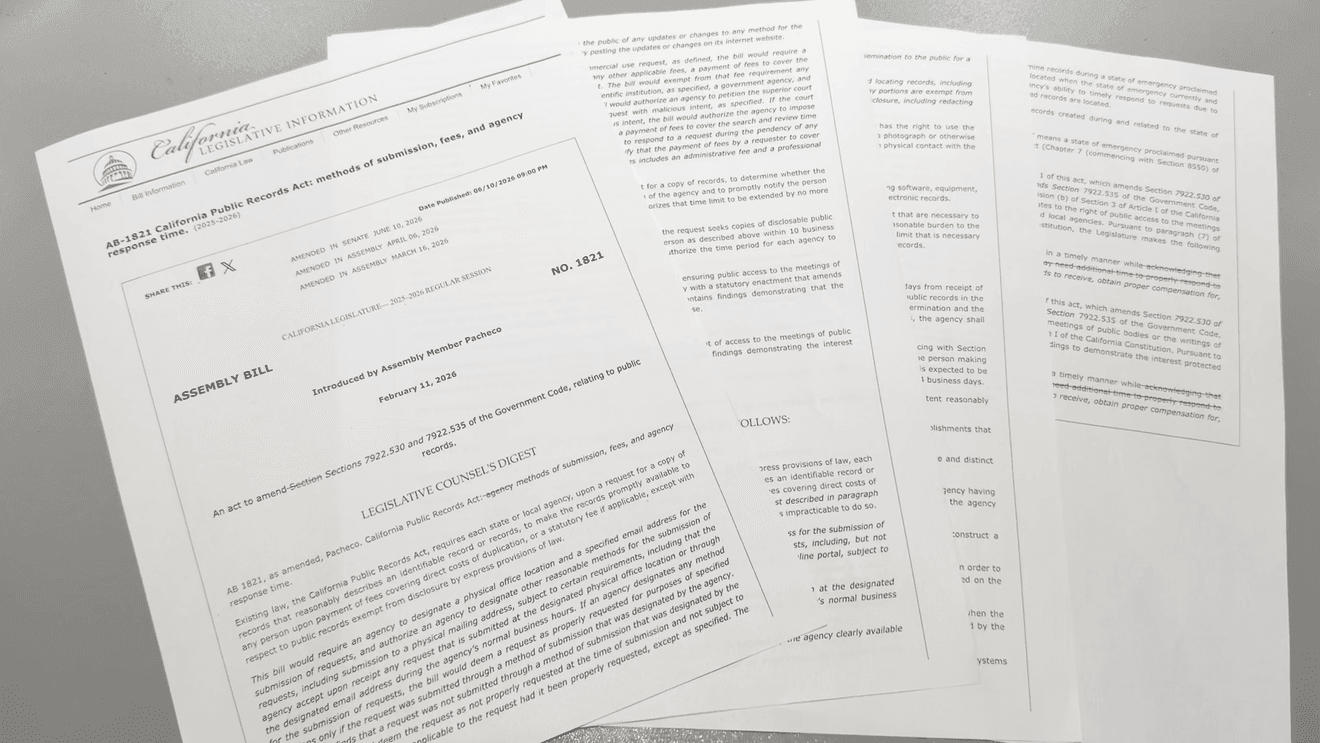
Assembly Bill 1821, introduced by Assemblymember Blanca Pacheco, aims to address what supporters describe as a growing strain on local agencies caused by increasingly complex public records requests.
Especially those, she says, that are made with malicious intent or commercial use.
“These kinds of requests slow down responses for everyone else, including journalists and community members using the system in good faith,” Pacheco said.
Under the proposal, agencies would have additional time to respond to California Public Records Act requests, up to two weeks.
The bill would also allow agencies to charge hourly fees ranging from $22 to $66 for staff time spent searching for and reviewing records that are determined to be for commercial use.
Critics argue the changes could make it harder and more expensive for the public to obtain government records.
Tracy Rosenberg, executive director of Oakland Privacy, said organizations that rely on public records requests could be significantly affected.
“We have broken news stories that have appeared in the headlines all over the country. In the current version of Assembly Bill 1821, we would simply not be able to do that work,” Rosenberg said.
The bill would also allow agencies to seek court intervention if they believe requests are being submitted with malicious intent.
David Snyder, executive director of the First Amendment Coalition, said that provision raises concerns.
“This bill would entitle the government to bring you into court for doing nothing more than submitting a Public Records Act request. I think that will have a tremendous chilling effect on the public’s willingness to submit Public Records Act requests,” Snyder said.
Opponents say existing law already gives agencies tools to address overly burdensome requests.
David Cuillier, director of the Joseph L. Brechner Freedom of Information Project at the University of Florida, said additional restrictions are unnecessary.
“There’s already a fix for that. I don’t understand it, other than to allow governments to even be a little more vicious toward people who are just asking questions,” Cuillier said.
Supporters argue the measure is needed to help agencies keep up with a growing volume of requests.
Donald A. Larkin, speaking on behalf of the League of California Cities, said the bill would create a more manageable timeline for agencies.
“Cal Cities supports this bill because it will create a consistent and reasonable time frame for agencies to respond to requests that are getting longer and more complicated,” Larkin said.
Eric Lawyer, speaking on behalf of the California State Association of Counties, says the proposal is a balanced approach much needed.
“We believe it is possible to achieve a better balance in the public’s essential rights to information and ensure public agencies can function efficiently and effectively. AB 1821 is a measured and important step towards that balance,” Lawyer said.
The bill next heads to the Assembly Appropriations Committee. If approved there, it would move to a vote before the full Assembly.
Cuillier also noted that California already ranks 39th nationally in government transparency based on an index of studies he has compiled over the past two decades.
He argues that if AB 1821 becomes law, the state’s transparency ranking could fall even lower.