
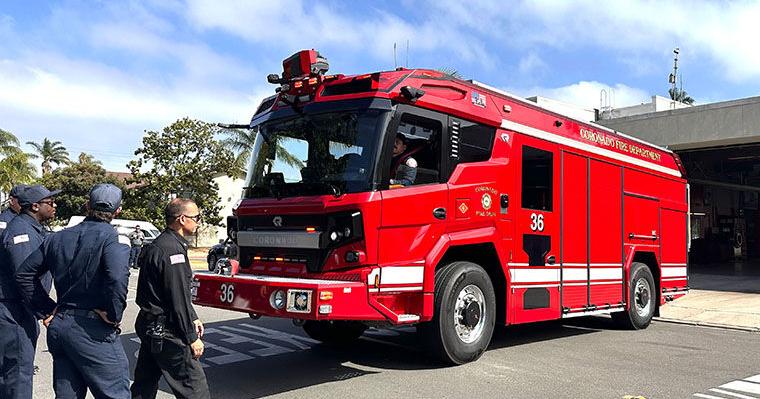
In November of 2024, under the recommendation of Coronado’s Fire Services department and Fire Chief Jayson Summers, the Coronado City Council approved funding for the acquisition of a new, electric fire engine. Earlier this month, the City hosted a commissioning ceremony celebrating the arrival of the new Rosenbauer RTX service vehicle and its official debut within the City’s fleet.
Prior to the acquisition of the Rosenbauer RTX, the City had two Type 1 fire engines (the most common fire truck, designed to respond to structural fires) and one aerial fire engine (a “ladder truck,” equipped with an extendable ladder or platform). Each vehicle had an eight-year warranty and a 16-year service life. The City had already planned to replace one of the existing Type 1 engines in 2026, with the purchase to be made in the 2024-25 fiscal year.
As trucks were being considered, Summers and his team researched the benefits of different models and found that electric trucks offer improved health and safety benefits for both the firefighters and the community compared to a diesel engine truck. The RTX will also provide improved vehicle longevity, visibility, stability, and maneuverability, and technological capacity to support their operations and aid in their work. As an electric vehicle, the new truck also offers environmental benefits and noise reduction compared to the city’s older models.
In previous conversations, Summers has noted the health risks that come with what have been the typical conditions firefighters work in, including being surrounded by diesel exhaust from what have been traditional engines, and a desire to improve conditions for these teams. “Diesel exhaust is a Group 1 carcinogen and a known cancer-causing product for humans,” he said while discussing the new electric apparatus. “These firefighters operate in and around that exhaust 24 hours a day, in addition to the [health risks from] the fire gear equipment that we know very well.
“Now, we’re trying to fix that, and this [truck] is a game changer in terms of all of that,” he said. “We have to do everything we can and, unfortunately, fires cause smoke, and we can’t remove that. But if we can remove the diesel exhaust from around them, we’re doing something.”
Because the Rosenbauer RTX is electric, it doesn’t have the large engine that diesel firetrucks have, either, leaving more space in the vehicle for the firefighters and equipment. “It’s much larger inside,” Summers explained of the new vehicle. “The firefighters can walk around inside, and they can stand up. We have tragically lost several firefighters in traffic accidents from stepping off of the rig on the freeway or roads. On this apparatus, they can pivot their seats, walk backward, and get out on the opposite side [as opposed to one way in the past]. It also has almost twice the storage space of a traditional fire engine.”
The new truck also has the capability to lower itself to the ground, removing the dangerous step on/off the vehicle. While discussing the benefit of this seemingly simple feature, Summers also noted, “I’ve also known firefighters who have had career-ending injuries because of their knees blowing out from stepping off of fire engines.” He added that a lot of thought was put into the design of this apparatus to address these types of features that have resulted in injuries in the past.
Additionally, unlike other Type 1 fire engines, the RTX can pump water while the vehicle is being driven, which is typically a feature included only in Wildland brush fire engines.
The RTX is outfitted with two electric motors and an energy backup system for zero carbon emission operation, but it does include a diesel generator that provides a hybrid capability that can extend the operational range of the vehicle by an additional 375 miles should the team need to utilize that for an extended-use call. Otherwise, the vehicle only requires a 25-minute timeframe from which to fully recharge.
Summers and his team look forward to having the new truck in their toolbox and to continuing to provide the best possible service for the community, in a vehicle they have previously noted has the potential to surpass the capabilities and level of service of the diesel apparatus the RTX has replaced.
VOL. 116, NO. 24 – June 17, 2026