
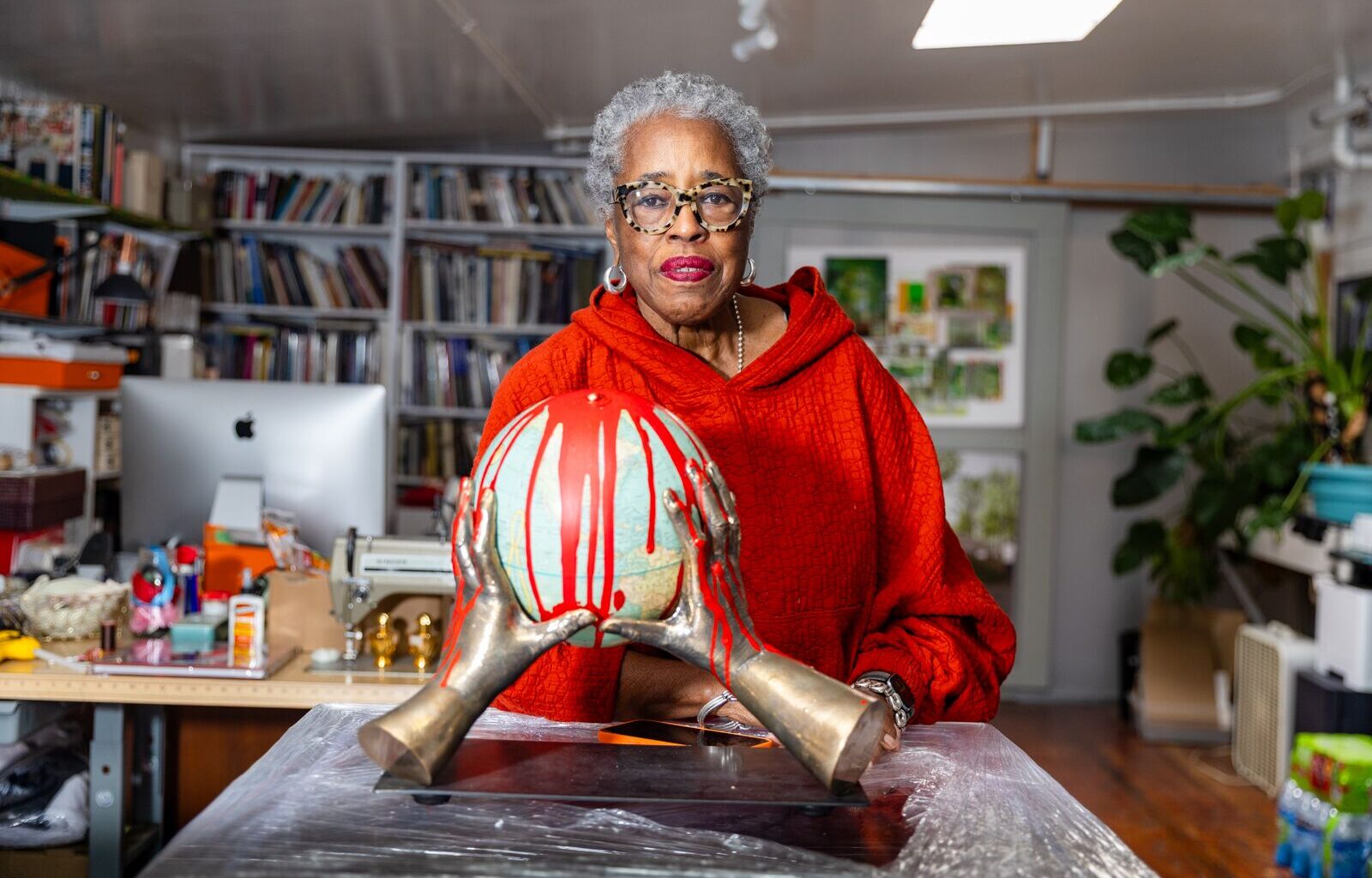
When Mildred Howard was a little girl in the late 1940s and early ’50s, her mother would take her and some of her nine older siblings from their home in South Berkeley to visit the natural history collection at the Snow Museum, near Lake Merritt — a forerunner of today’s Oakland Museum of California.
“Mildred Howard: The Poetics of Memory,” Oakland Museum of California, 1000 Oak St., Oakland, through Oct. 18, $25
Now, her first major museum survey, “Mildred Howard: Poetics of Memory,” is on view at the Oakland Museum (OMCA). It’s a knock-your-socks-off roundup of her life’s work exploring identity and memory and documenting the African American experience: collages, mixed media pieces, immersive installations, sculptures, videos of her outdoor public art and personal memorabilia.
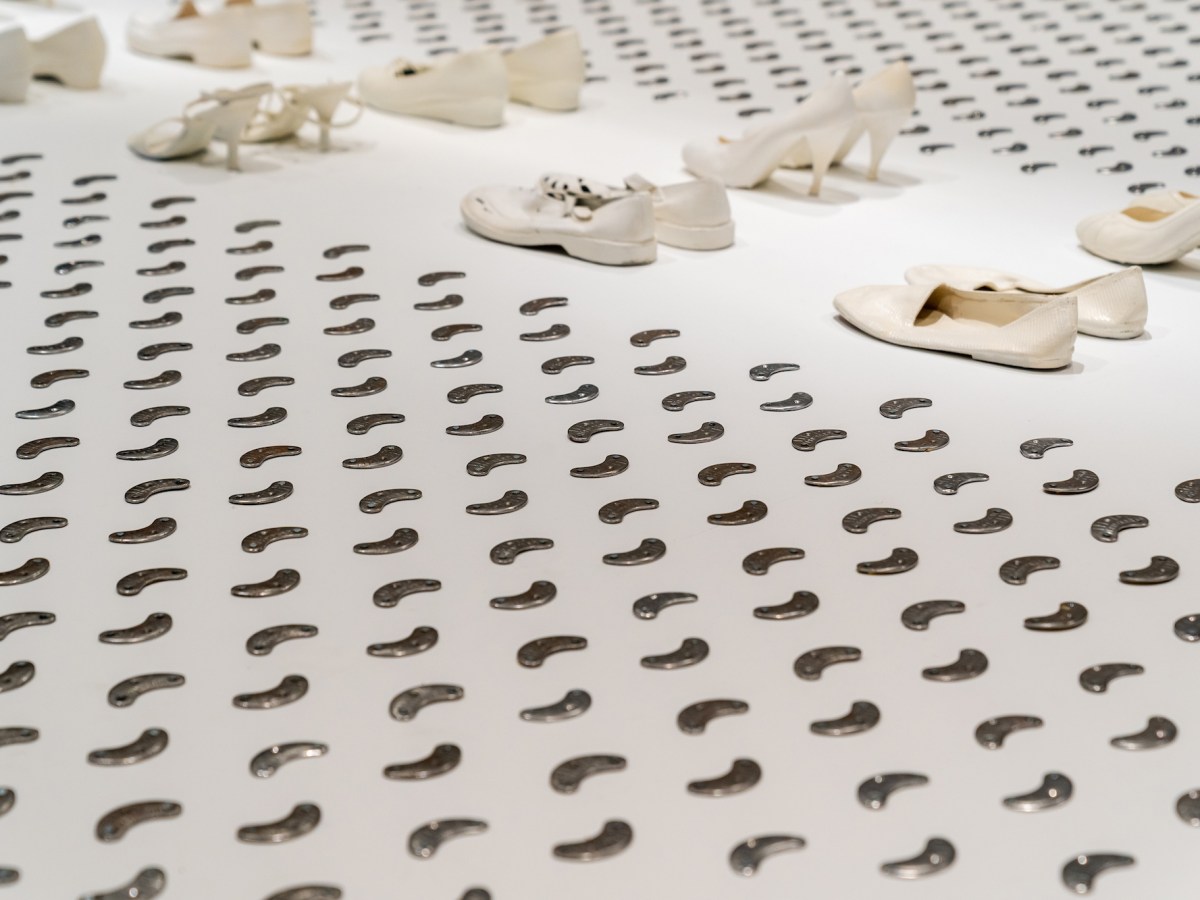
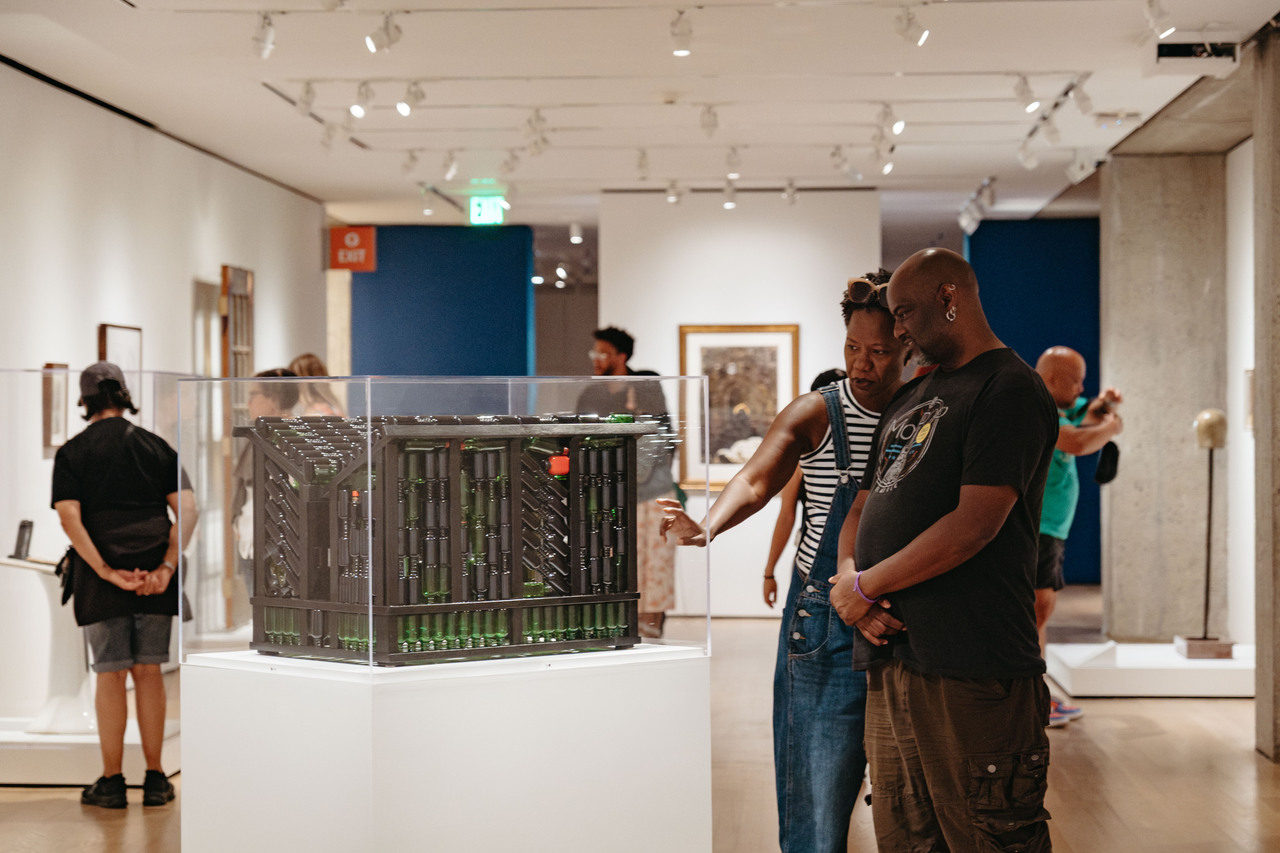 Mildred Howard, “Black Has Always Been a Color,” 2024, at OMCA. Glass bottles, wood, glue, high heels. Photo: Christine Cueto. Courtesy: Oakland Museum of California
In addition to the exhibition, Howard’s archive was acquired last year by UC Berkeley’s Bancroft Library, where it will be preserved alongside the archives of artists like Ansel Adams, Dorothea Lange and David Lance Goines. And last year, Howard won a prestigious Guggenheim Fellowship — to file next to her two Rockefellers and two NEA grants — after applying for the honor, wait for it, 16 times. The thread of resilience and determination runs through her life like a vein of gold.
Howard was born in 1945 in San Francisco. Her parents moved to the Bay from Texas in the 1940s as part of the Great Migration, eventually settling in South Berkeley where her father, Rolly, worked as a longshoreman in the shipyards of Hunters Point and her mother, Mable, opened an antiques business in their home. Recycling and giving new uses to old things would also become a lifelong hallmark of her youngest daughter’s artistic vision.
From early days, Mildred was inspired by her mother’s dedication to social justice. Mable “Mama” Howard was a well-known and admired community organizer who led the fight to underground the BART line through South Berkeley, preventing the predominantly Black neighborhood from being permanently divided. Mildred Howard would incorporate her mother’s activist spirit into her own art practice. “Art is one of the last forms of freedom of speech,” she’s said. “And we don’t want to lose it.”
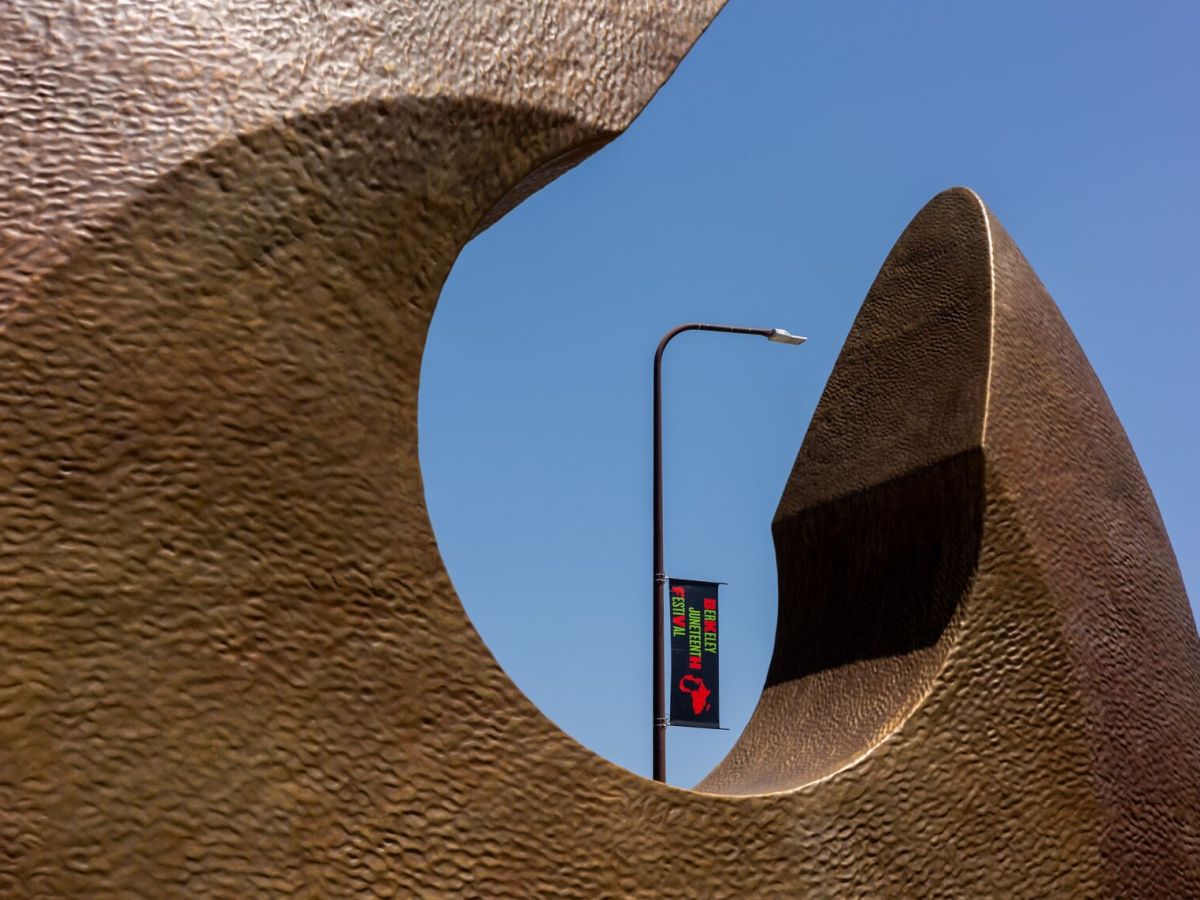
An example of her many protest pieces is the stunning work of public art “Delivered, Mable’s Promissory Note” that Howard erected in 2024 near the Ashby BART station, making good on the community’s debt of gratitude and commemorating her mother’s David-vs.-Goliath victory in the 1960s. The swirling, semi-circular bronze sculpture draws inspiration from traditional West African metalwork, which served as currency and jewelry, and makes a statement in the sun.
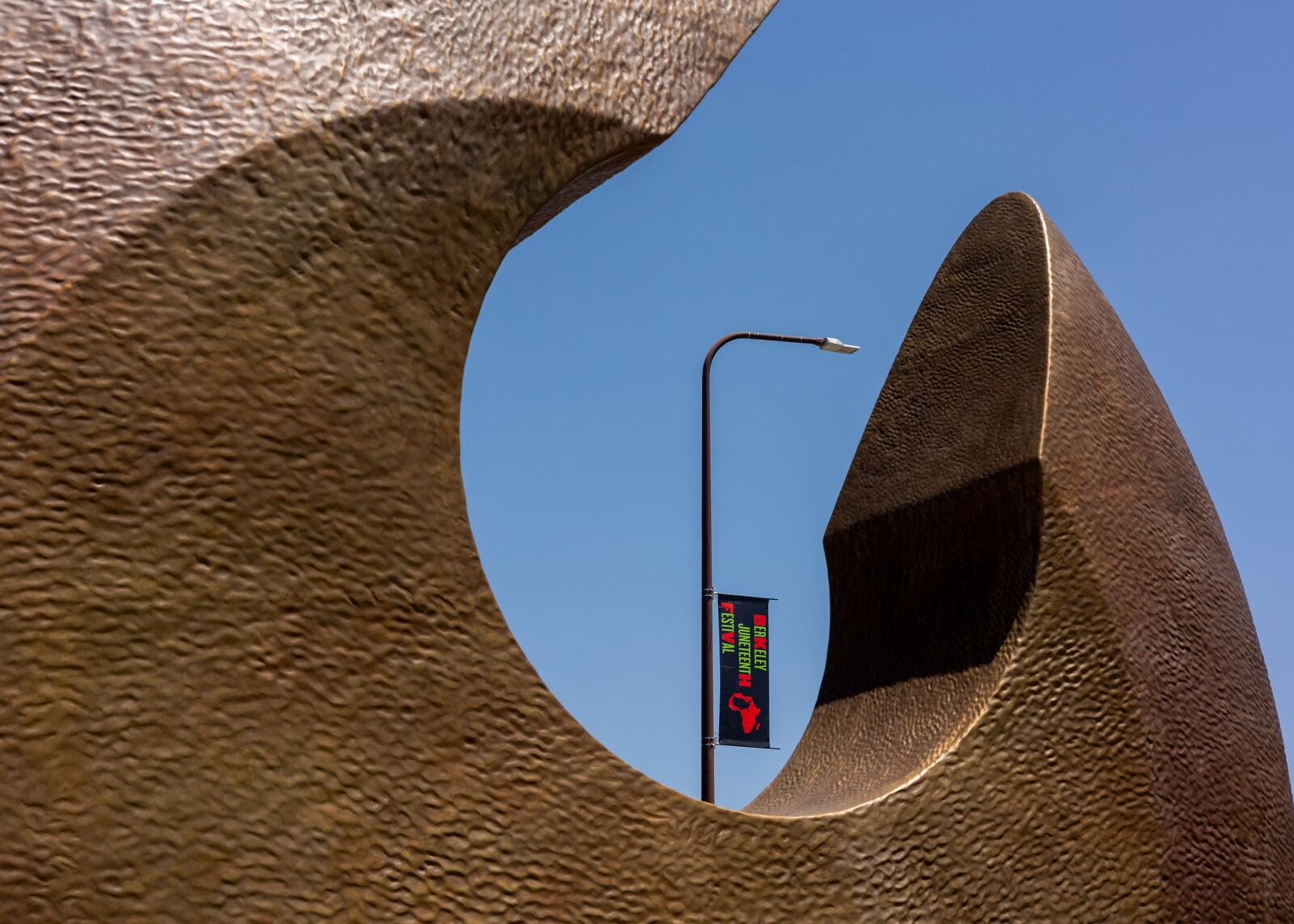 “Delivered, Mable’s Promissory Note” (2024) is outside the Ashby BART station and commemorates her mother Mable’s fight to underground the BART line through South Berkeley. Credit: Ximena Natera, Berkeleyside/CatchLight Local
Howard started out as a ballet dancer, where she learned “discipline and dedication,” and she experimented with fashion design, eventually finding her most powerful voice in the visual arts. She came up in a grassroots artistic circle, working with neighborhood art organizations like the Berkeley Art Center and Fiberworks Center for the Textile Arts, where she was part of their first exhibition. To help pay the rent as a single mother of twins, she became an arts educator at places like the East Oakland Youth Development Center, the San Francisco Art Institute the California College of the Arts, and the Exploratorium, where she developed school curricula.
Thinking deeply about the physics of light, color, and structure transformed her art and led to some of her first installations. Carin Adams, the curator of the OMCA show, called Howard “a pioneer in helping establish what we think of as installations” — immersive, artistic experiences — alongside artists like Yayoi Kusama, Christo, David Ireland and Judy Chicago.
Inside Howard’s sunlit Oakland studio
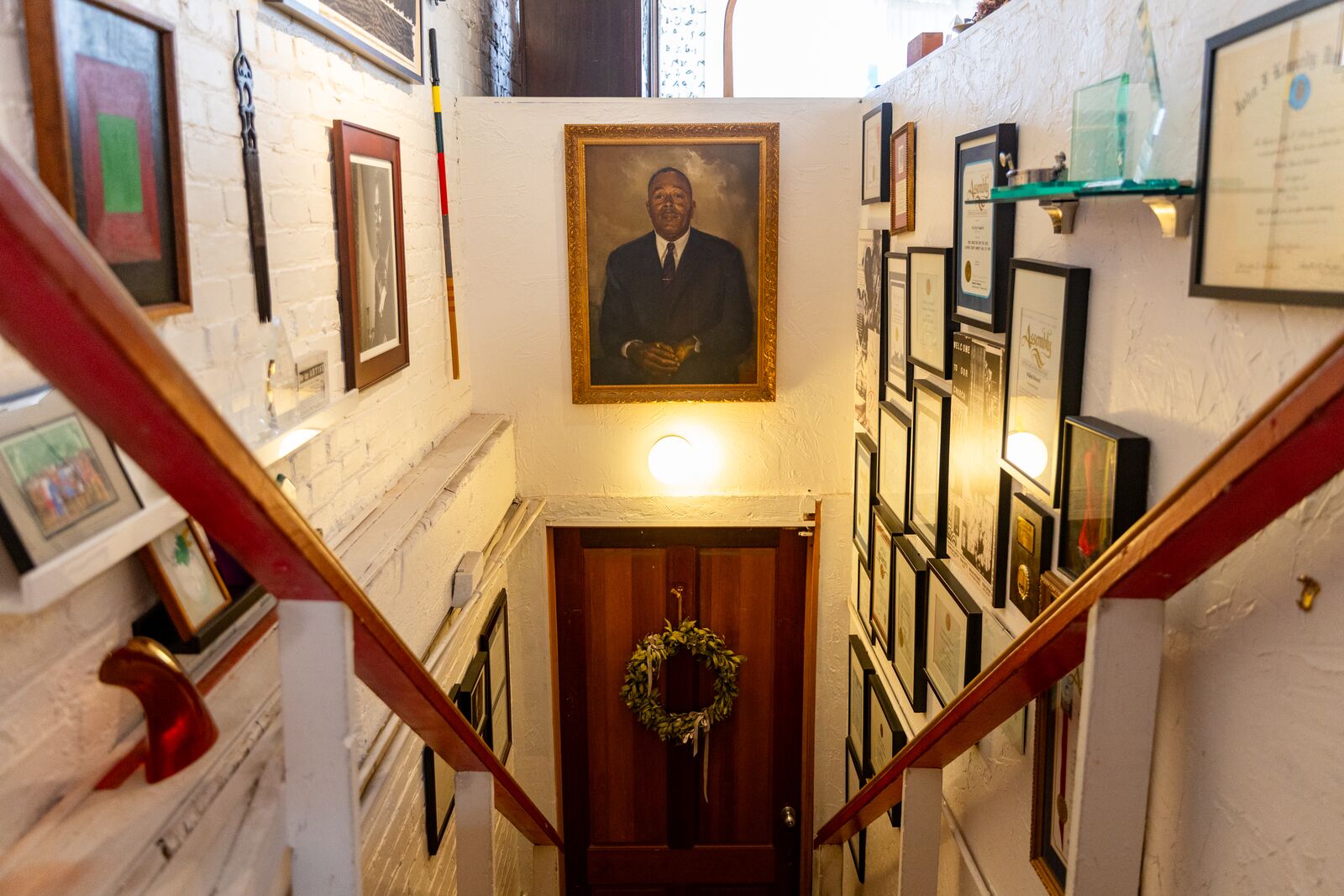 Awards and photographs hang in the entryway of Howard’s studio in Oakland. Credit: Estefany Gonzalez for Berkeleyside
In 2011, Berkeley’s mayor declared March 29 as “Mildred Howard Day.” But six years later a doubling of her rent forced her out of her home in the city. She left during a decade when the Black population fell in South Berkeley by 30%, and moved into a more affordable home-studio in West Oakland, converted from a former factory.
When a reporter and photographer from Berkeleyside visited her at her studio earlier this month, we were greeted by her grandson, Lamar “MYL3Z” Brown, who doubles as her assistant. He’s an artist himself and the co-creator of a new documentary about Howard, “Memories in Motion.” He led us through the pink-and-blue front door, past a dark basement and garage, up a narrow staircase, and into a loft space with skylights letting in the sunshine.
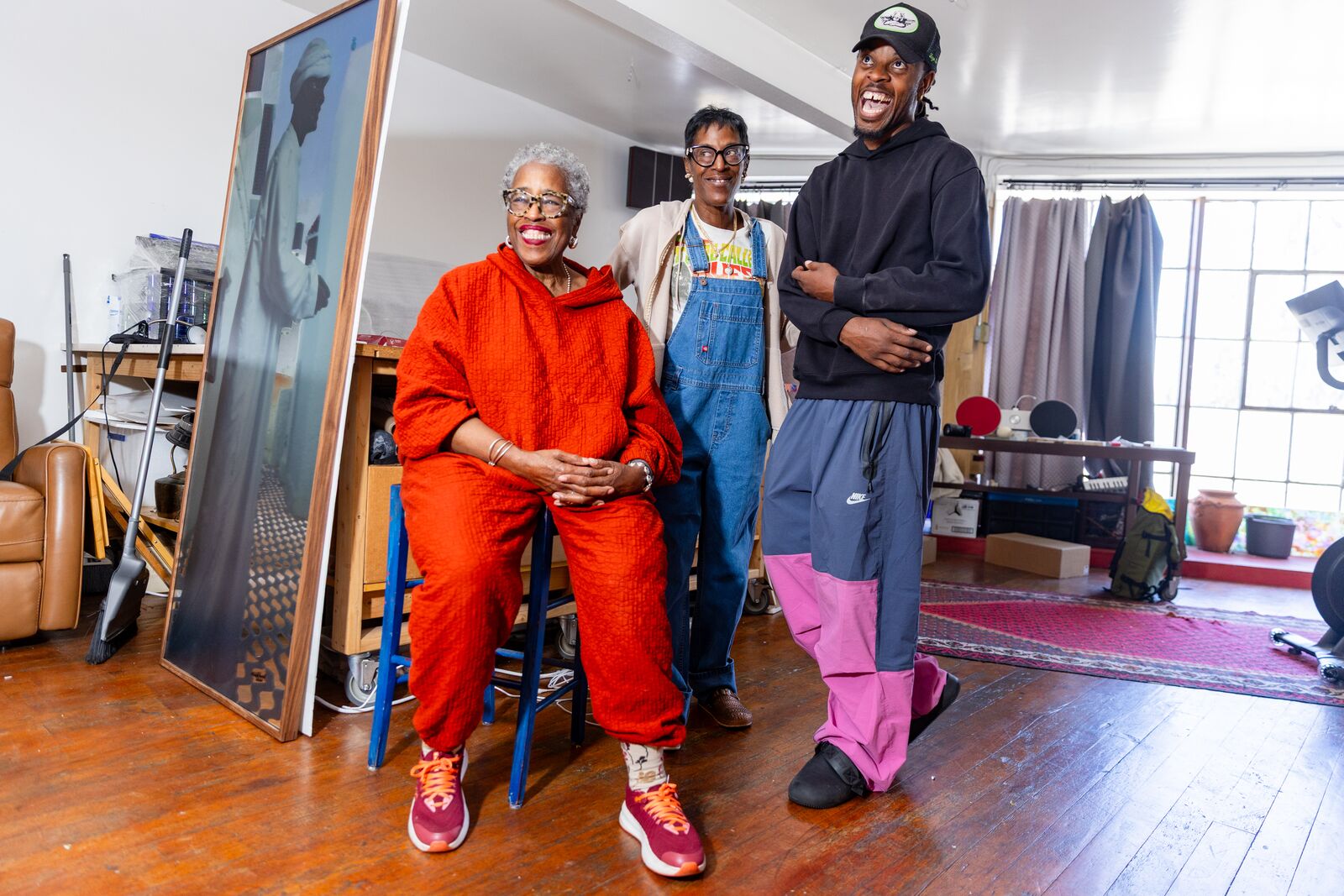 Howard with her daughter Timiza Joseph and grandson Lamar “MYL3Z” Brown in her Oakland studio on June 4. Credit: Estefany Gonzalez for Berkeleyside
Dressed with an artist’s eye, Howard wore a nubby, tangerine-hued sweatsuit, magenta sneakers, tortoise shell glasses, silver jewelry, close-cropped gray hair and bright red lipstick. Though just a month out from shoulder surgery, she was full of energy, giving a tour of the art-filled space.
Everywhere, there were bright pops of color: brick-red walls; a lollipop-colored leather chair; turquoise-blue dining room seats. And works from friends like Betye Saar, Raymond Saunders and Romare Bearden, a foundational collage artist whose work inspired hers (and the city of Berkeley’s logo), as well as a collection of African masks and an oil painting of her grandfather.
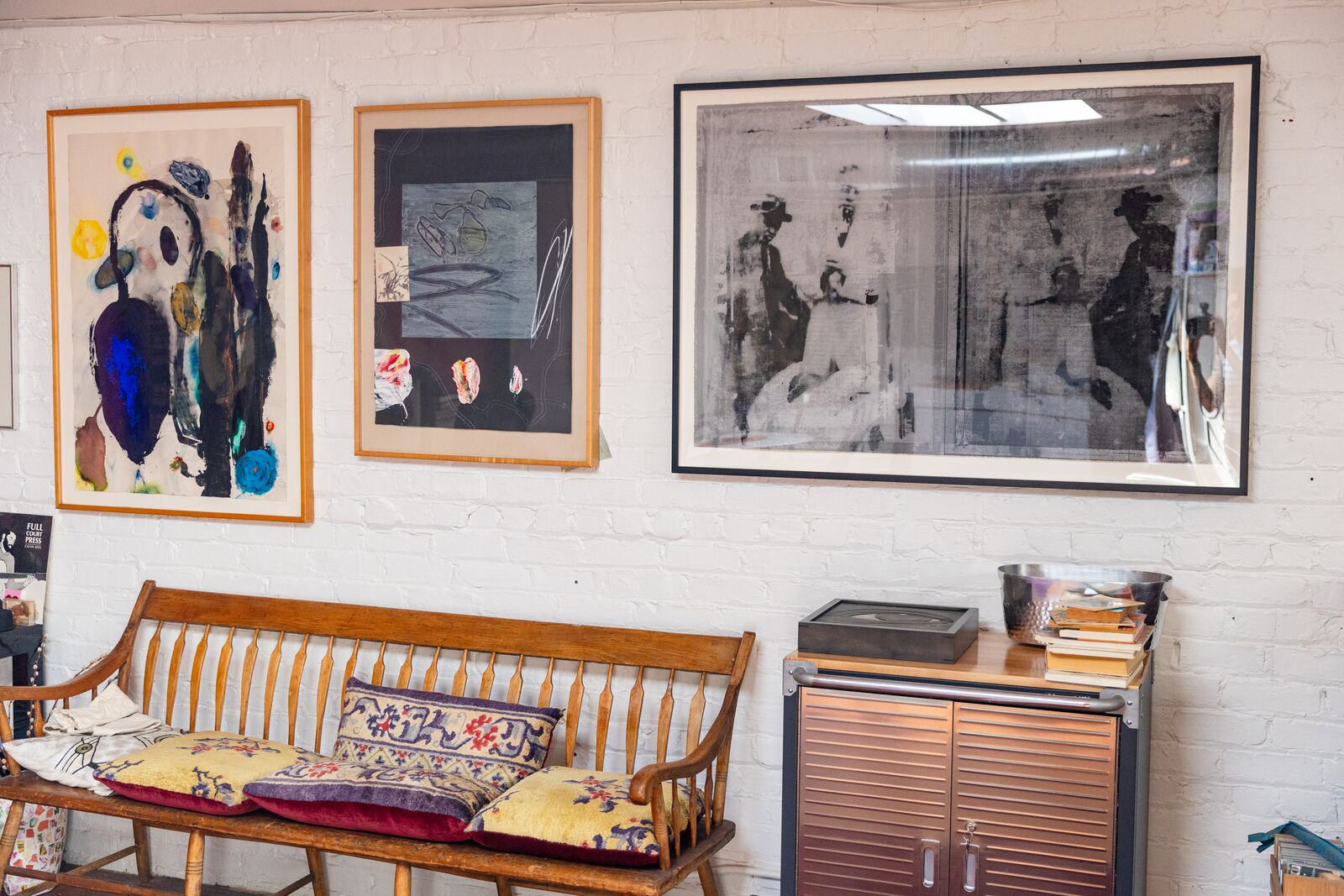
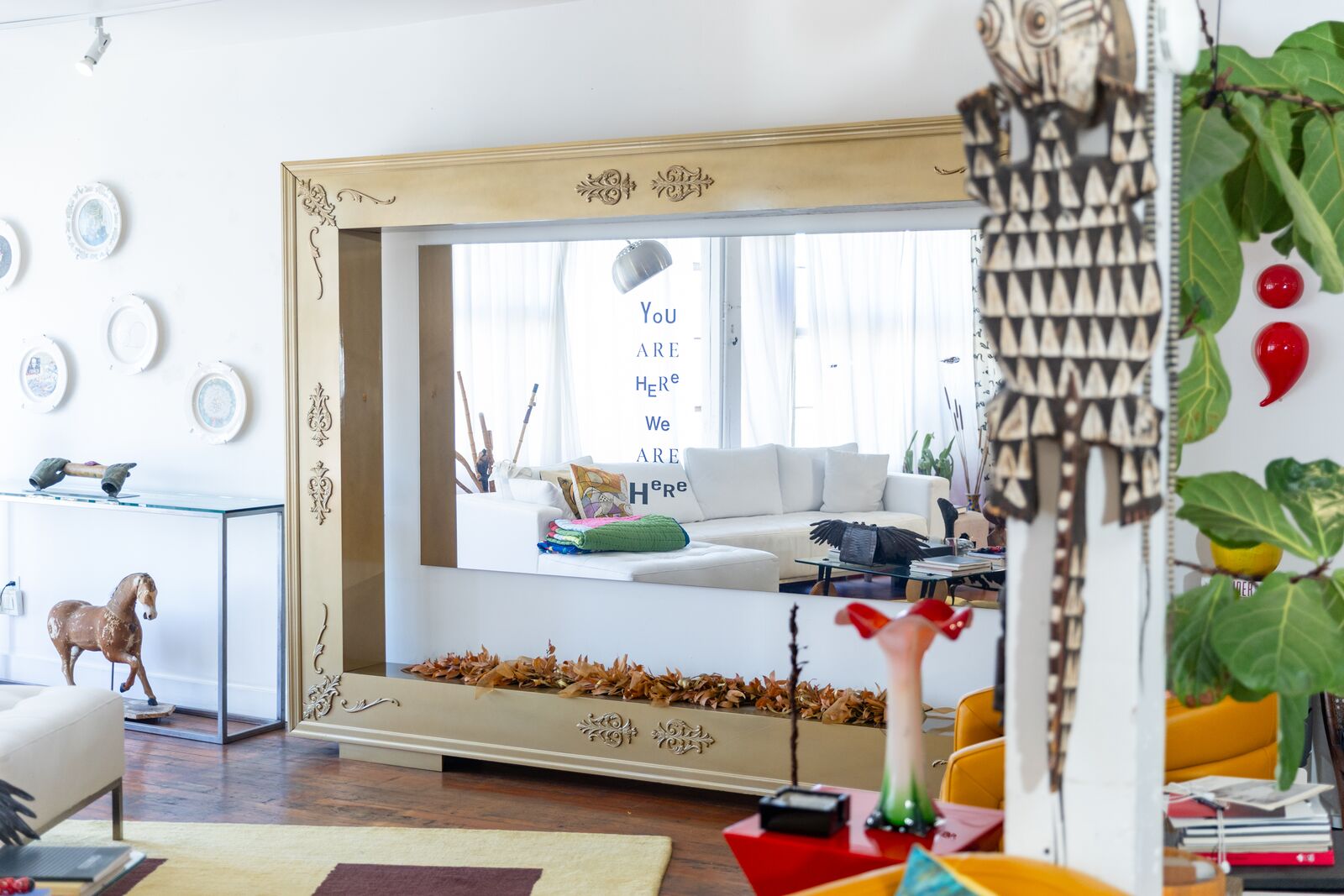
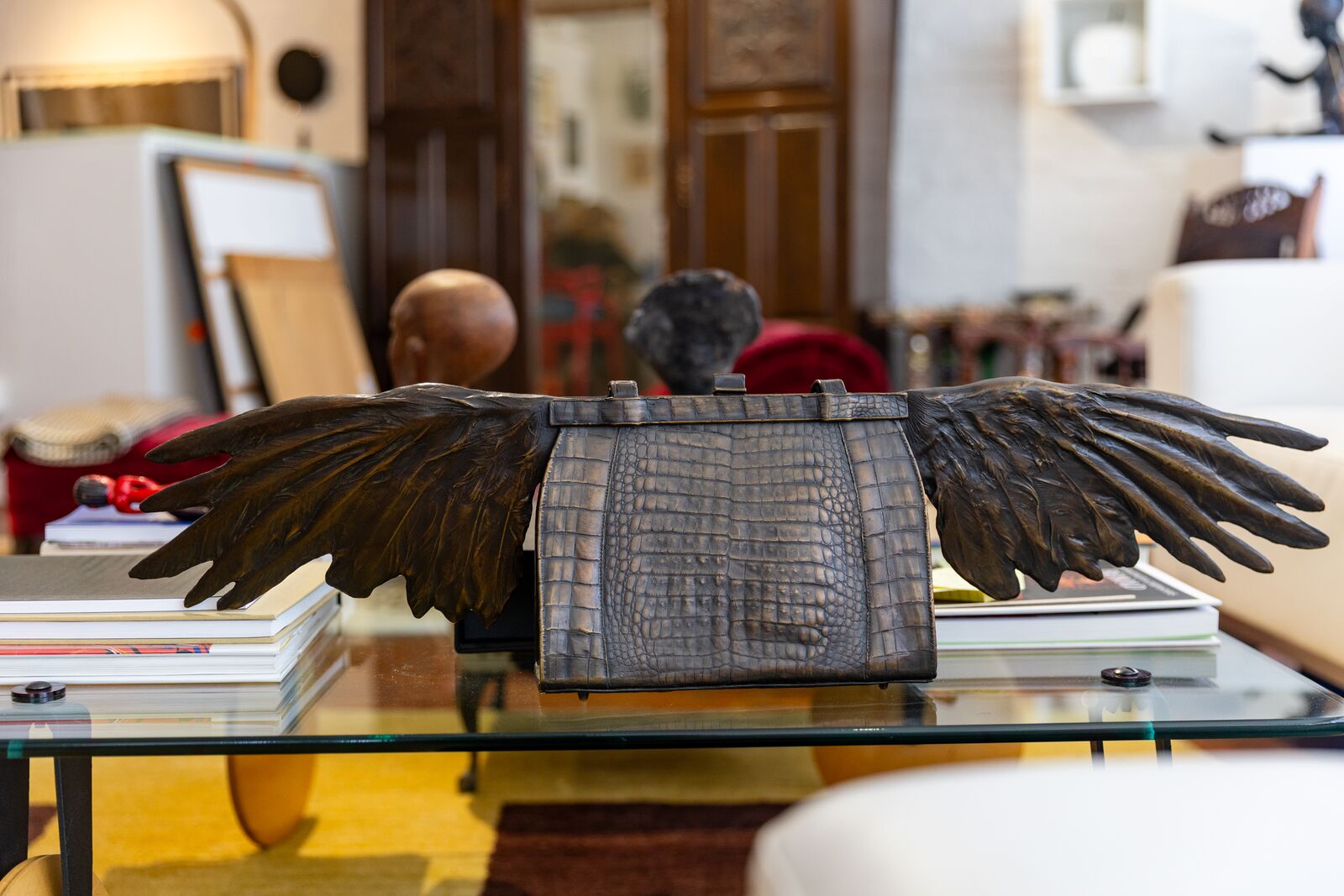
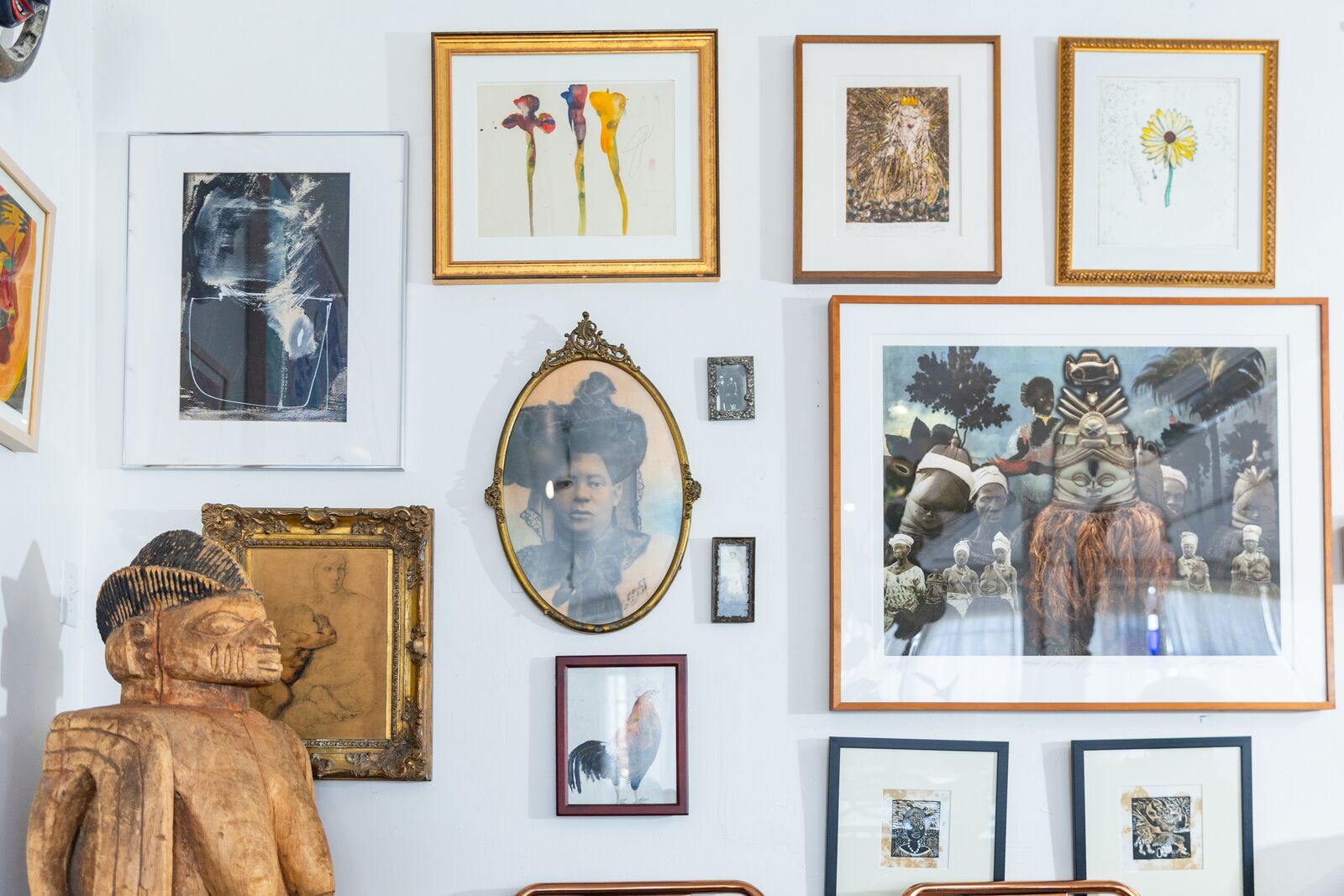
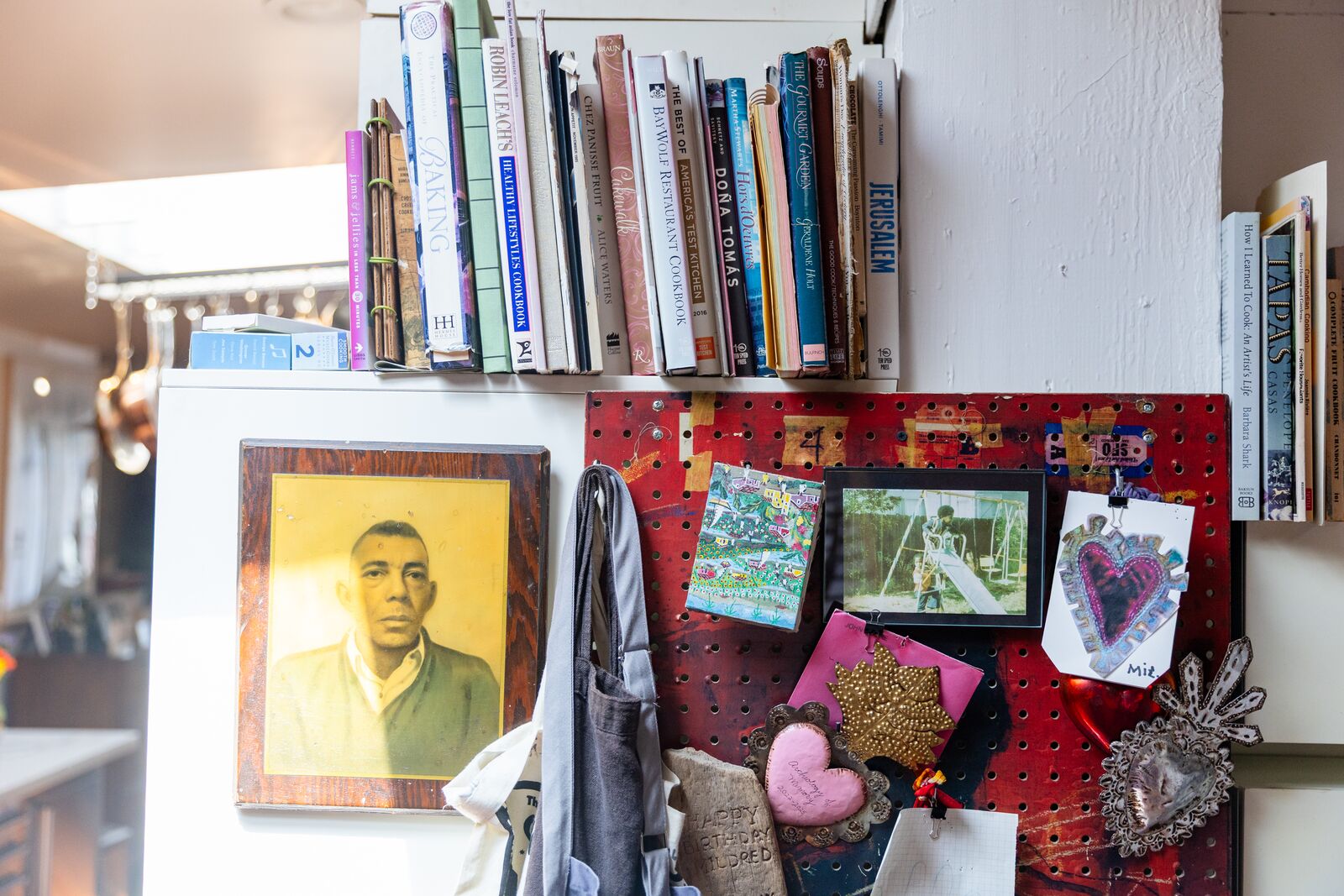 Scenes from inside Howard’s studio. Credit: Estefany Gonzalez for Berkeleyside
Her own pieces were mixed in, sparkling with wit: a wall-size mirror in a gilt frame (mirrors are a favorite motif because they reflect the viewer as well as everything in a room); her mother’s old purse, now bronzed and sprouting angel wings; and down a short corridor into her home-studio, a somber, mixed-media piece called “We’ve Got Blood on Our Hands” — a globe splattered with bold red paint and a pair of brass hands holding it up, a pointed example of her creative re-use and a searing indictment of warmongering that she says is not meant specifically in protest of President Trump because “I don’t want to give him the privilege of thinking he’s even worthy of my art.”
Offering guests homemade banana bread, she said amid all the commotion of the museum show, she was ready to get back to making. Art is the source of her resilience, and it helped get her through the most profound loss of her life, the death in a car accident of her son, Ameer, at 22, in 1970. After she howled with grief in the middle of Adeline Street, she dug deep, creating 18 shows in 13 months. “Making art saved my life,” she said.
Howard’s work explores layered meanings of home
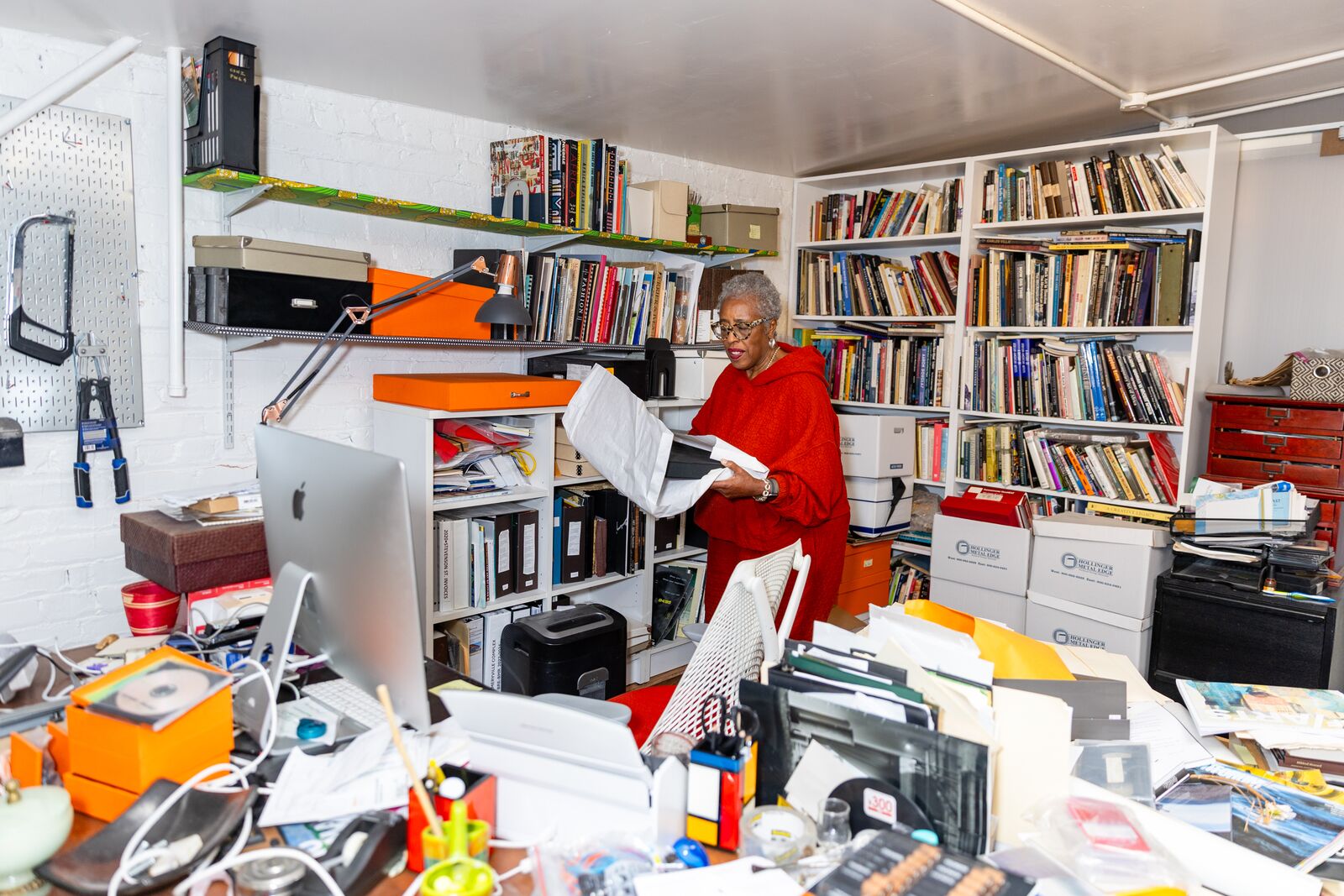 Howard looks through her archives. Credit: Estefany Gonzalez for Berkeleyside
At the show’s preview earlier this month, the huge turnout attests to the great interest in this beloved East Bay artist’s work. And the atmosphere of her home carries over: the brilliant pops of color, especially her signature red; the importance of family and memories, both sweet and bitter; her deep seriousness alongside her humor and puns; and the re-purposing of random, found materials to express both poetry and political outrage.
Case in point: The powerful, satirical assemblage, “Volume I and II: History of the United States with a Few Missing Parts” (2007), in which two hefty U.S. history books are displayed on pedestals, side by side, with holes, perhaps bullet holes, punched through their pages, gesturing at all that is omitted from the textbooks taught in classrooms. “Looking at everyday things, I’m challenged by the myriad possibilities for metaphor as a way of accessing cultural expressions of race and gender,” Howard said.
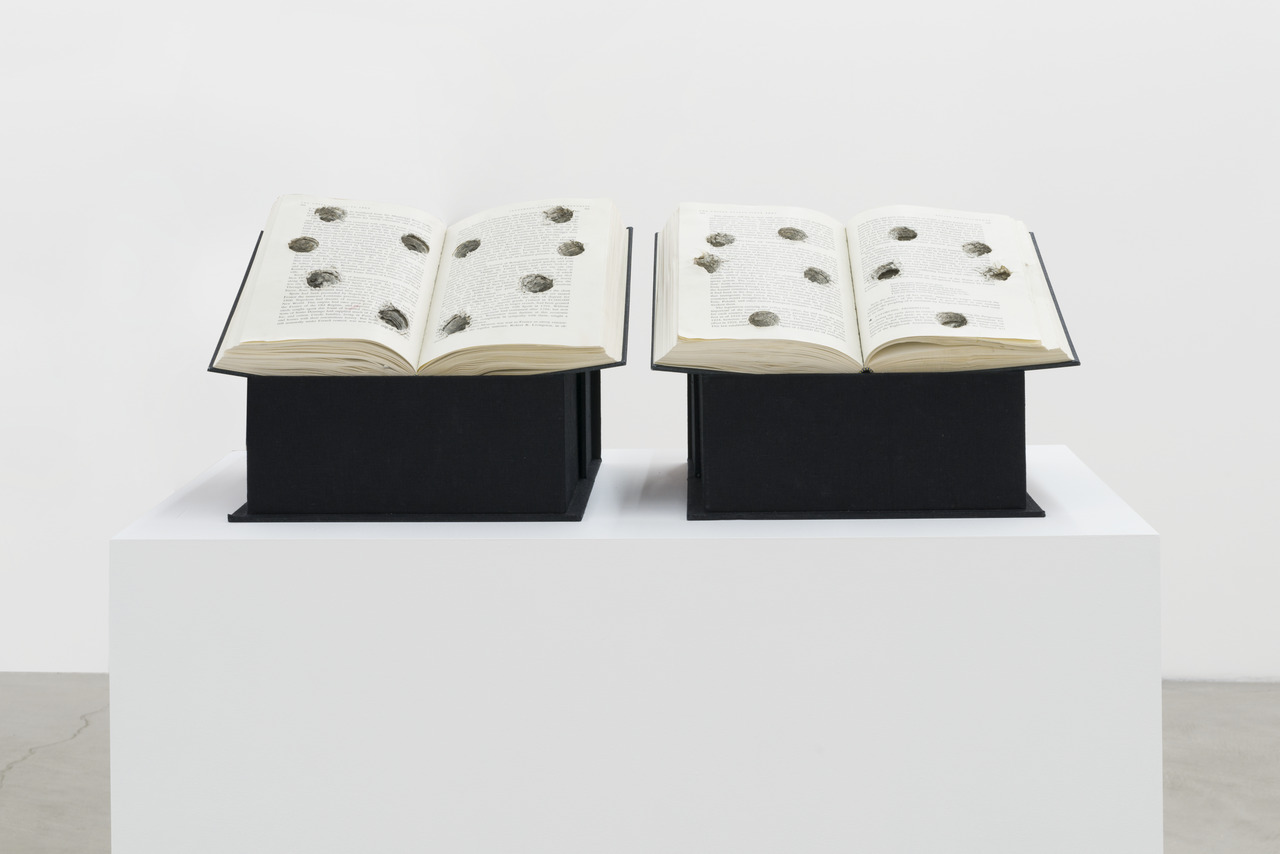 Mildred Howard, “The History of the United States with a few Parts Missing,” 2007. Altered books, metal stands. Courtesy: parrasch heijnen, Los Angeles
One throughline of the carefully curated works is Howard’s constant questioning of the many layered meanings of home.
Is home a safe place to protect family and produce art as evidenced by the exhibit’s re-creation of Howard’s home-studio, its red walls and decades of preserved memorabilia, like her Berkeley High School yearbook and decorative postcards from artist friends?
Or is home a place to scare away lurking demons as in one of her iconic “bottle houses”? The mixed-media piece “Black Has Always Been a Color” (2024) is a small, black, wooden, open house-like structure, filled with glowing green and black bottles, inspired by the centuries-old African American folk tradition of building “bottle trees” or “sticking bottles neckdown in the front yard to ward off bad spirits,” Howard explained.
Or can home sometimes be a threatening place as in “Blackbird in a Red Sky (a.k.a. Fall of the Blood House)” (2002), one of the show’s stand-out installations that nestles a red, almost life-size, glass house next to a small pond filled with crimson glass apples. It’s beautiful — with a subtext of menace.
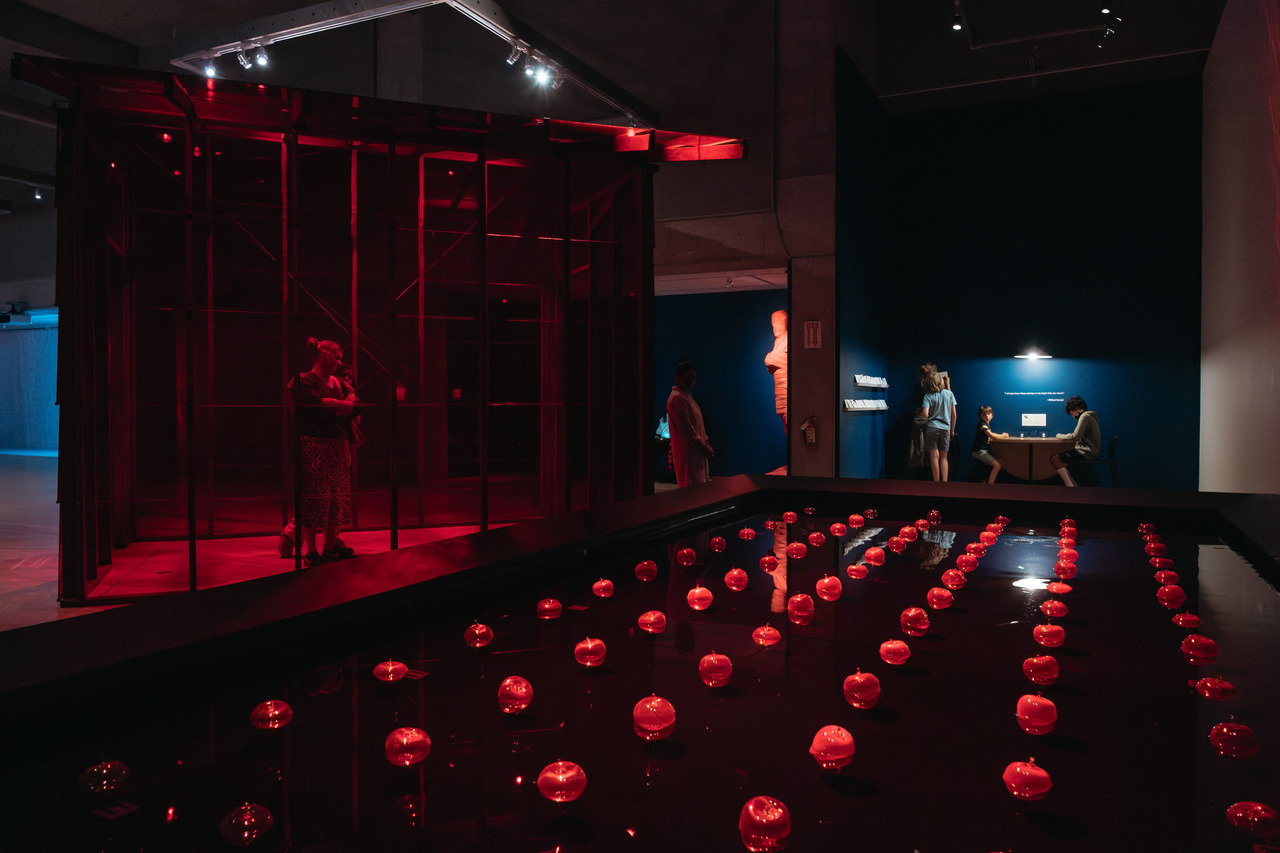 Howard’s “Blackbird in a Red Sky (a.k.a Fall of the Blood House),” at OMCA. Plate glass, blown elements, stainless steel flashing, and wood. Photo: Christine Cueto. Courtesy: Oakland Museum of California
“A house is supposed to be a safe place, but it’s not always that way,” Howard said. “Great things happen at home and so do bad things. A house can be a place that holds secrets and some of the worst crimes have taken place at home.”
Glancing at those delicate floating apples, she added, “If Eve had known that we women would have such a hard time, that we would still be fighting for our rights, she probably would not have bitten an apple.” She sighed. “And the piece is still relevant today.”
Howard is always bringing disparate elements together, both ideas and materials.
“The fragility of life and the sustenance of life,” are showcased together, Howard said, in her work “Crossings” (1997, 2026). A huge trapezoid form is filled with hundreds of ceramic eggs glowing in ambient rose-colored light. A gilt-edge mirror sits off to a corner reflecting the viewer, the piece and “Blackbird” across the room.
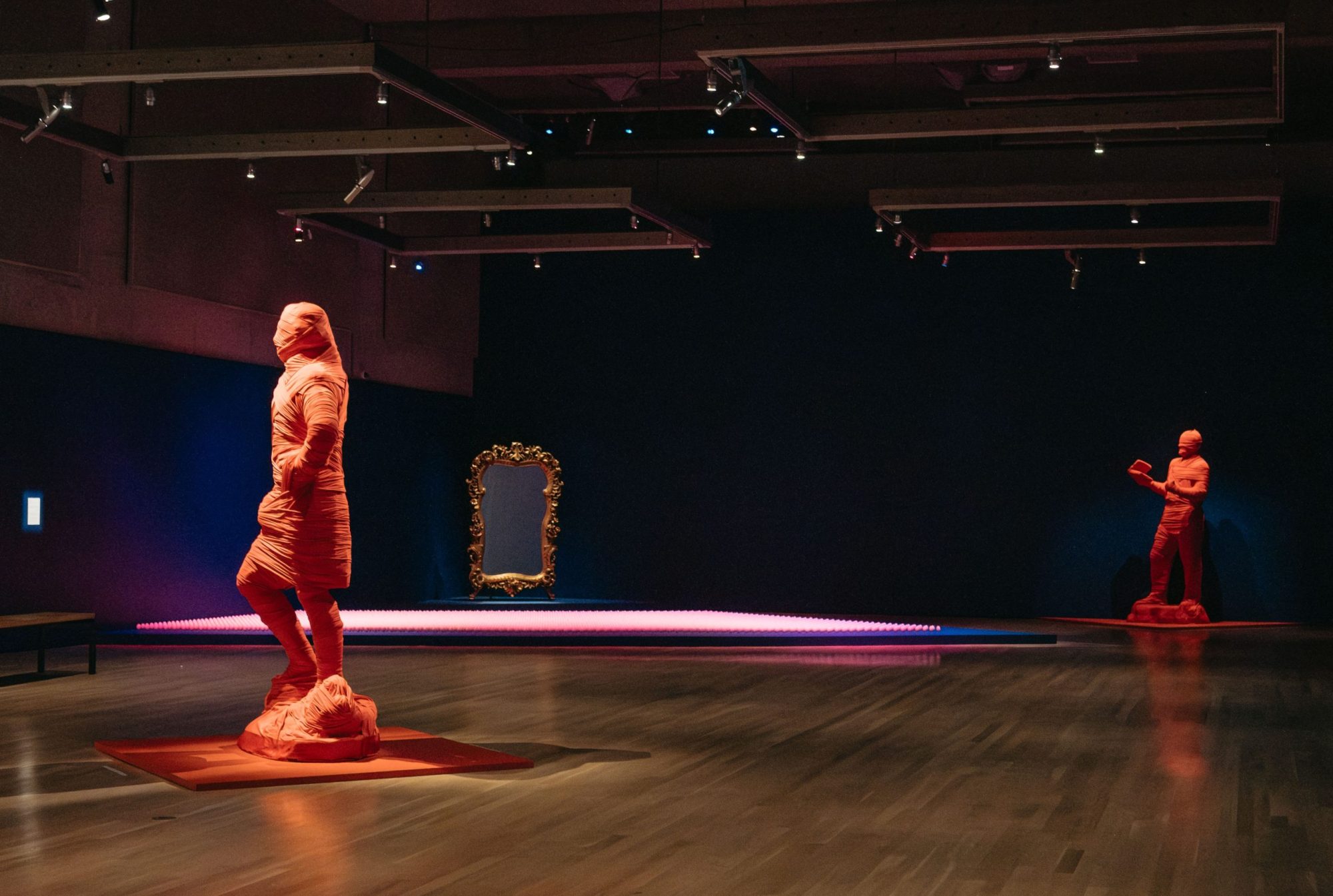 Howard’s “Crossings,” on view at OMCA. Plate glass, blown elements, stainless steel flashing, and wood. Photo: Christine Cueto. Courtesy: Oakland Museum of California
The installation was inspired by a trip Howard made to South Carolina, and it evokes the tragedy of the Middle Passage, in which 14-16 million enslaved people lost their lives. “Those millions of people lost their lives so I could sit here and make art,” said Howard. “That’s a real gift.”
Howard never forgets all the people it took to get her here — her ancestors, her parents, her family, fellow artists. But also, at 81, she keeps focused on her next work. At the end of our interview, she quoted a line from the poet Quincy Troupe, her sometime collaborator: “And at the end, there is space to begin again, always space at the end to begin again.”
It sounded like her life philosophy.
Related stories
Mildred Howard sculpture honors her mother, who stopped BART from dividing South Berkeley
June 14, 2024June 14, 2024, 3:39 p.m.
Striking artwork by long-time Berkeley resident, artist Mildred Howard installed at OMCA
March 1, 2019Oct. 4, 2022, 1:46 a.m.
Redlining: The history of Berkeley’s segregated neighborhoods
September 20, 2018Feb. 27, 2023, 3:00 p.m.
We know that most readers don’t get to the end of the article. But you did! To support our in-depth, rock-solid reporting, please consider making a donation to our nonprofit newsroom today. We rely on our readers — particularly the ones who read the whole story!
“*” indicates required fields