
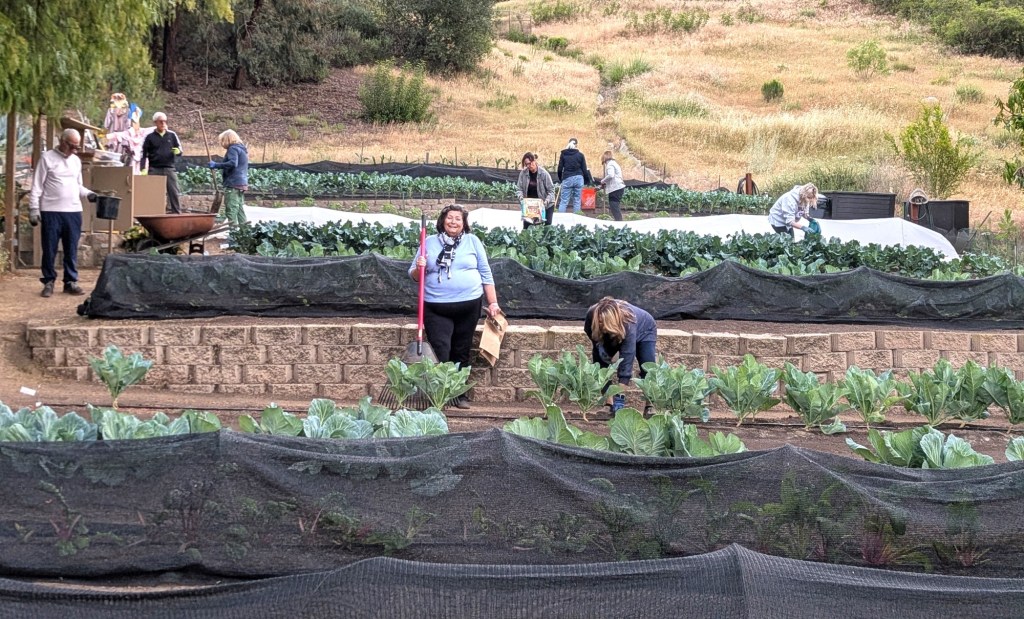
The Backyard Produce Project, which has provided over 400 tons of fruits and vegetables free to locals in need over the past 16 years, is in need of physical and financial help.
On June 1, Backyard Produce Project leaders were notified that Poway Gardens Senior Living on Monte Vista Road had been sold, and the large garden that project volunteers were allowed to develop on the property will have to go.
Originally, the project was given 30 days to vacate, but later allowed to stay until the end of July so volunteers can harvest produce from plants already growing, said project co-founder Jane Radatz.
Sherryl Hernandez, executive director of Poway Gardens, confirmed on June 22 that the new owner of the two main residential buildings is Tharon Group and said it will continue to operate as a memory care facility.
However, Hernandez said she had no details on who purchased the portion of the 32-acre property that included the five smaller ranch-style residential buildings and the gardens tended to by memory care residents and staff along with the Backyard Produce Project’s garden.
On May 30, Poway Gardens Senior Living held a fundraiser for the Alzheimer’s Association on the property. The event included tours of the expansive gardens and officials explaining how beneficial they were as a horticulture therapy activity for the memory care residents.
Online descriptions of the property say there are five organic gardens and a greenhouse on the site.
Backyard Produce Project needs volunteers to provide physical help to rejuvenate a garden in Poway that has not been in use for several years, getting donations of gardening supplies and money to support the work, and finding a space where two plastic 8-foot by 14-foot sheds that contain fruit picking equipment can be located long-term, Radatz said.
The garden rejuvenation will be happening throughout this summer. Relocating the sheds needs to happen by late July.
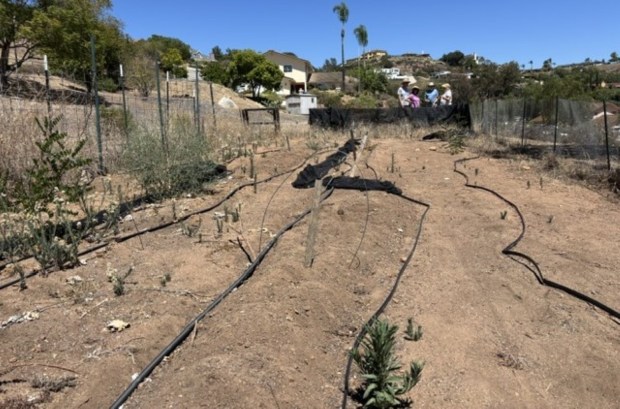 The new site being loaned by a Poway resident for the Backyard Produce Project’s use. Since it has not been used as a garden for several years, it needs extensive rejuvenation this summer so volunteers can plant this fall. (Courtesy of Backyard Produce Project)
“What it provides is really valuable and this is a loss for us,” Mary Cushing-Inman, a coordinator with 4 Community Care, said about the Backyard Produce Project garden that was part of the senior living center.
Her group is a nonprofit partner of the San Diego Food Bank, which distributes fruits and vegetables grown in the project’s garden and fruit picked by project volunteers from area yards to those living in four apartment complexes in Poway Unified School District’s boundaries.
The recipients are low-income families and seniors. The nonprofit also rescues near-expiration food from area grocery stores and obtains other needed food items from the San Diego Food Bank.
Cushing-Inman said unlike the limited fruits and vegetables 4 Community Care can get from the San Diego Food Bank, the Backyard Produce Project’s contributions are organically grown. There is also more variety and the quality is like that found at a farmers market, which the recipients cannot afford to buy.
“What we get has the look of coming straight from the farm to market,” she said. “The volunteers arrange it in a respectful way to help people who have less. What they give is so beautiful.”
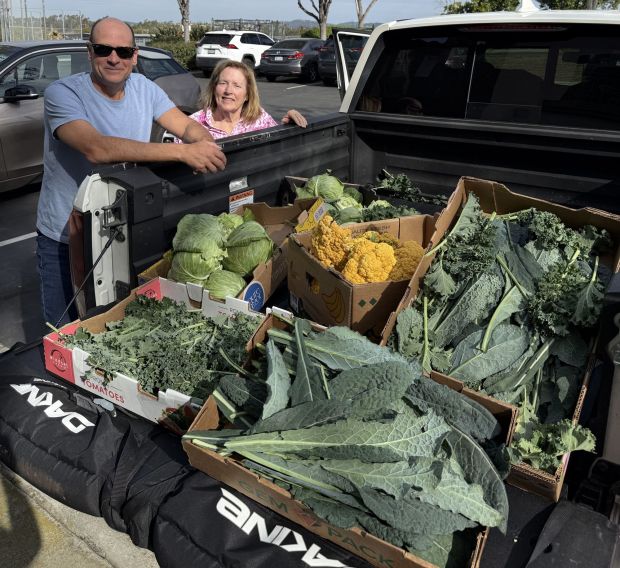 Matt Sanseverino and Mary Cushing-Inman delivering items grown in the Backyard Produce Project garden to a 4 Community Care distribution site. (Courtesy of Christie Moran)
She said her volunteers carefully go through produce they get from the food bank before distributing it. For example, sometimes there will be a spoiled orange in a bag so they have to remove it. The produce has also also been washed and the wetness can speed up the spoiling process, she said.
None of that is necessary with the fruits and vegetables grown through the Backyard Produce Project, she said, because it is all high quality and presorted.
“Those volunteers do an amazing job,” Cushing-Inman said.
The project’s garden team has found a smaller private garden in Poway to relocate to, but since the space has not been used as a garden for many years it will need extensive work before fall crops can be planted, Radatz said. Their goal is to get the ground ready for planting by September.
“It has seven 60-foot rows while our current garden has 17 40-foot rows,” Radatz said. “It is smaller, but there is room on the property to expand.”
Radatz said the garden is owned by a neighbor of a Backyard Produce Project garden lead. The owner would like to remain anonymous, but said “she just wants to see the garden put to good use.”
According to Radatz, the space was used as a neighborhood garden many years ago, and then became a Customer Supported Agricultural garden for a couple years. When that ended, the garden was no longer tended, so it now needs extensive rejuvenation, a new irrigation system and a new flow meter installed since the project will have to reimburse the property owner for water.
At Poway Gardens the project did not have to pay for water, Radatz said.
“We are hoping to receive donations to cover our water use,” she said.
Pre-pandemic the project held an annual fundraiser to cover supply expenses and there has been enough in the reserve to continue for the last several years. Other groups, such as the Poway Valley Garden Club, have also been “generous with donations,” Radatz said.
“We have been coasting on reserves, but will now have to do some fundraising,” she said.
The project also had about a dozen trees at the Poway Gardens site that provided apples and other fruits not typically found in area yards, which are overwhelmingly citrus. Radatz said they were advised that transplanting mature fruit trees is rarely successful and there are no plans at this time to plant new trees.
The plan is to have project volunteers continue to tend the current garden through July while simultaneously rejuvenating the new garden.
Meeting a September planting timeline means the project needs additional volunteers this summer who are able to do heavy gardening tasks that are required to prep the ground, such as tilling. It also needs financial support to purchase the supplies needed, such as mulch and soil amendments.
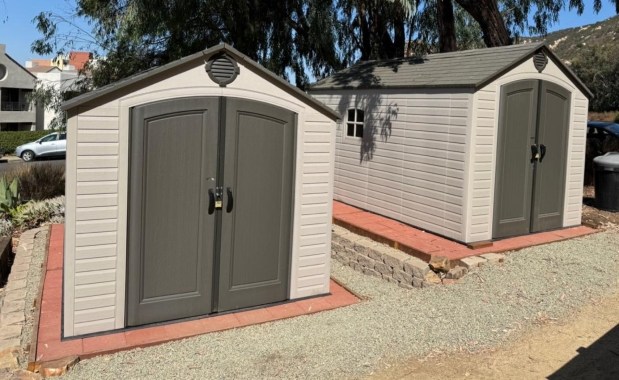 The two 8-foot by 14-foot sheds that house the Backyard Produce Project’s tree picking team equipment. They need to be relocated by late July. (Courtesy of Backyard Produce Project)
The project also needs a site where it can relocate its two 8-foot by 14-foot sheds used to store the equipment used by the project’s tree-picking volunteers. When contacted, that team goes to homes throughout Poway, Rancho Bernardo and nearby communities to harvest ripe fruit from trees.
Their owners donate the fruit — most often citrus — because their trees produce more than they can use. The two sheds need to be removed from the Poway Gardens property by the end of July.
Losing the Poway Gardens site at this time is especially hard for the 4 Community Care organization, Cushing-Inman said. Summer is a peak growing season, especially for tomatoes and zucchini, and there will be a several months gap before the Backyard Produce Project will have its new garden ready for harvest.
Cushing-Inman said she anticipates the project will not be able to contribute produce its volunteers have grown until at least November or December.
She said demand is also higher at this time of year because children are out of school and not obtaining meals on campus. Her volunteers not only rescue near-expiration food from grocery stores, but also pick up meals not served at PUSD campuses during the school year.
With school being out, they have already lost that resource until at least mid-August.
In addition, San Diego Food Bank officials have told them that they are expecting a higher need in response to changes in the federal Supplemental Nutrition Assistance Program (SNAP) that were implemented on June 1. This impacted the CalFresh program.
The new rule requires those ages 18 to 64 who do not live with a child under 14 to fulfill 20 hours per week (80 per month) at a job, in job training, community service or school unless given an exemption due to a physical or mental health condition.
The San Diego Union-Tribune reported in late May that nearly 100,000 people across San Diego County were at risk of losing their CalFresh benefits and more would be turning to local organizations for food help.
Anyone who would like to provide volunteer labor, gardening supplies or money to help with the garden rejuvenation can contact Radatz by emailing jradatz@att.net or calling 858-485-5449.
Cushing-Inman said if anyone wants to donate excess fruits and vegetables from their home gardens this summer, they can email 4communitycare@gmail.com to make arrangements.