
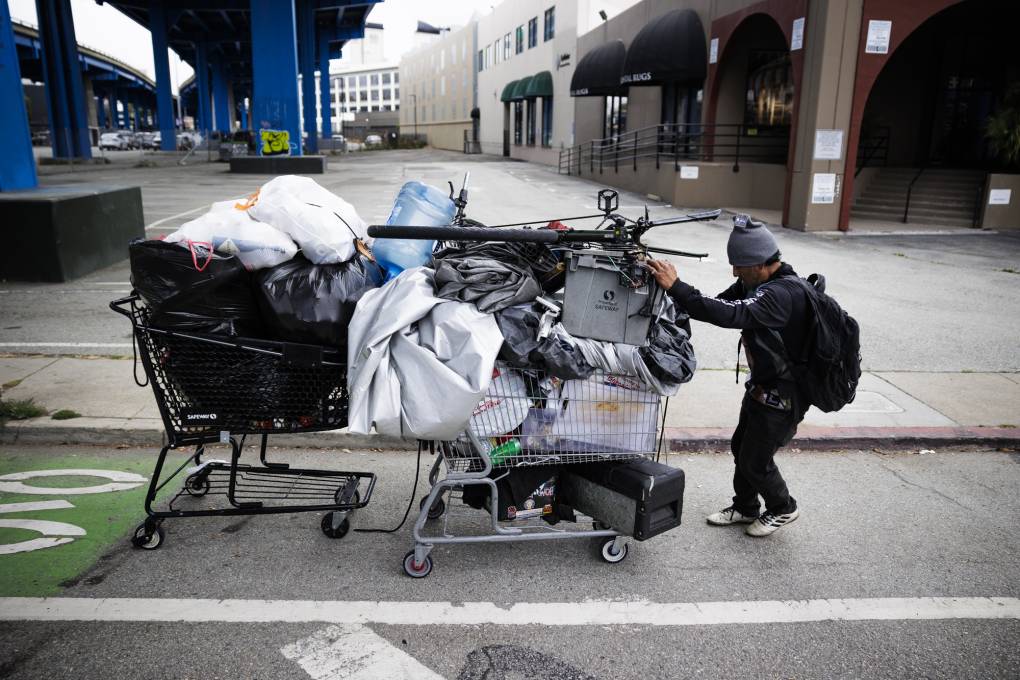
The number of people exiting homelessness to stable housing has declined 14.3% year-over-year, according to the report.
Jun 23, 2026
Updated 3:47 pm PT
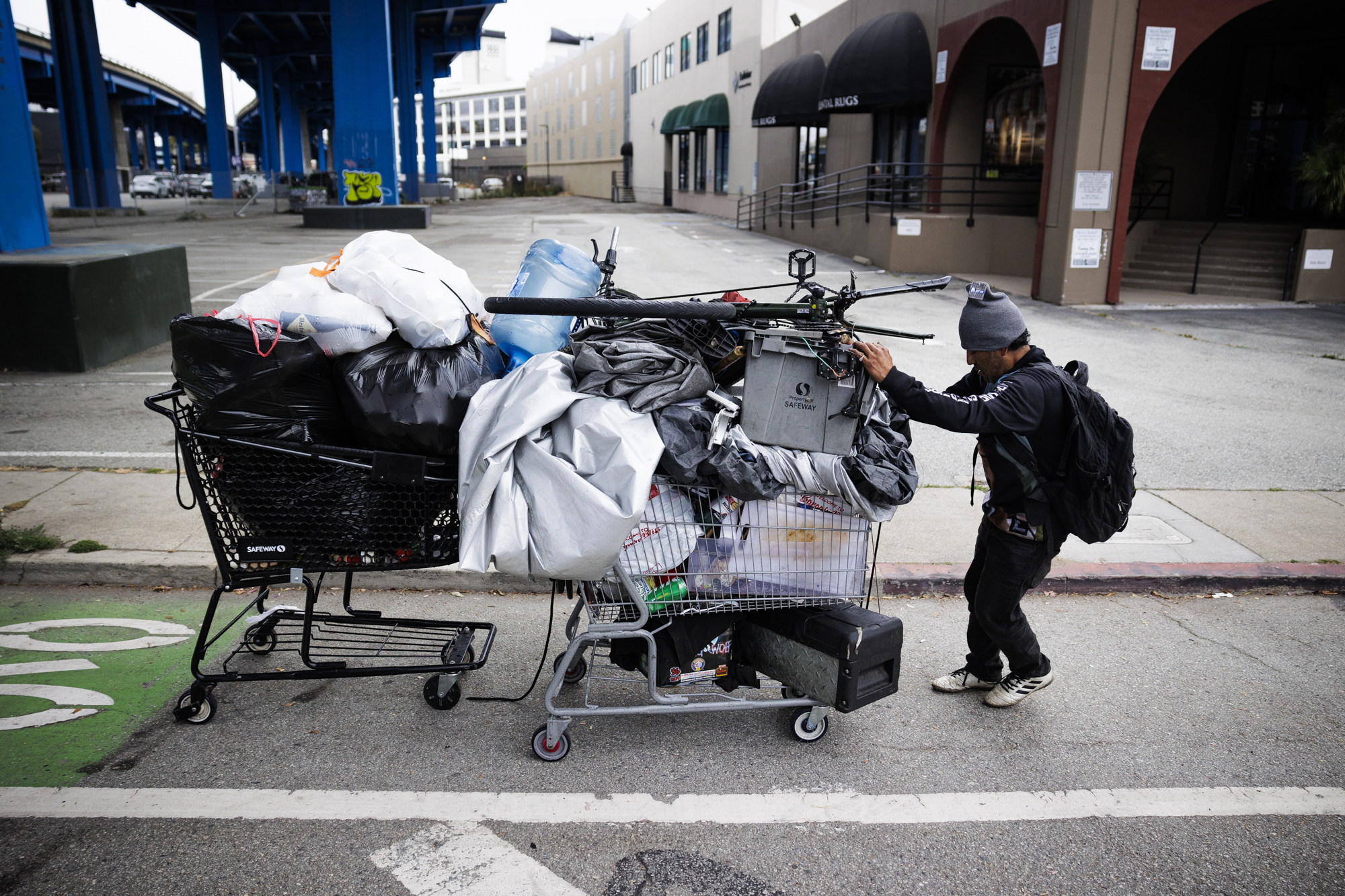
An unhoused man relocates his belongings to a new site in anticipation of an encampment sweep by San Francisco’s Department of Public Works near Showplace Square in San Francisco on Aug. 1, 2024. (Martin do Nascimento/KQED)
There were 7,972 people experiencing homelessness in January of this year, according to the Point in Time Count, a federal survey of the city’s homeless population.
The total marks a 4% dip from the 2024 survey. But the number of people successfully exiting the city’s homelessness response system, meaning they moved on to stable housing, has declined 14.3% year-over-year, according to the report.
“This is not a picture of success,” it reads.
 Felony, a Chihuahua-poodle mix, stands on a leash beside owner Kali Donlin outside the Gubbio Project at St. John’s the Evangelist Episcopal Church on Feb. 2, 2026, in San Francisco. (Gustavo Hernandez/KQED)
The report calls out the risks that people living in supportive housing or navigating the shelter system face, ranging from a higher likelihood of an overdose to falling back into homelessness, due to lagging tools and oversight.
The report points to public data showing that about 26% of all accidental drug overdose deaths in San Francisco occurred at permanent supportive housing sites in 2024.
“Homelessness is marked by lack of support, instability and trauma, and a lot of these things manifest itself in a homeless population that is high acuity,” said Gary Hsueh, one of the jurors. “But we have to take that stat and make sure that it’s headed in the right direction, which is down.”
While the city collects “critical incident reports” on deaths and other concerns that take place in permanent supportive housing, the report found that these reports are not systemically integrated into the system for informative feedback.
“The report raises important issues around data use, oversight, critical incident reporting and provider monitoring, and HSH recognizes that there are areas where we must continue to improve,” a spokesperson for the Department of Homelessness and Supportive Housing said in an email. “HSH is already advancing improvements in data infrastructure, contract management, provider oversight and coordination with city partners to better identify risks, strengthen accountability and support safer outcomes for clients and communities.”
Jurors also analyzed the city’s approach of contracting out homeless services to nonprofits, which run housing sites and other services targeted to people experiencing homelessness.
“How we address homelessness should begin to pivot less from, ‘let’s make sure we incubate these community-based organizations and nonprofits’ to actually delivering on housing units,” Hsueh said.
Several nonprofits tasked with providing homelessness resources have come under fire in recent years for mishandling funds or for underperformance.
“HSH and our nonprofit partners are doing urgent and complex work every day with people experiencing significant medical, behavioral health and housing challenges,” the department said. “That work has helped thousands of people move indoors, remain housed and access critical services.”
Lurie’s administration has also put an emphasis on building more short-term shelter and other transitional housing and drug treatment beds, in an effort to get more people off of the streets faster.
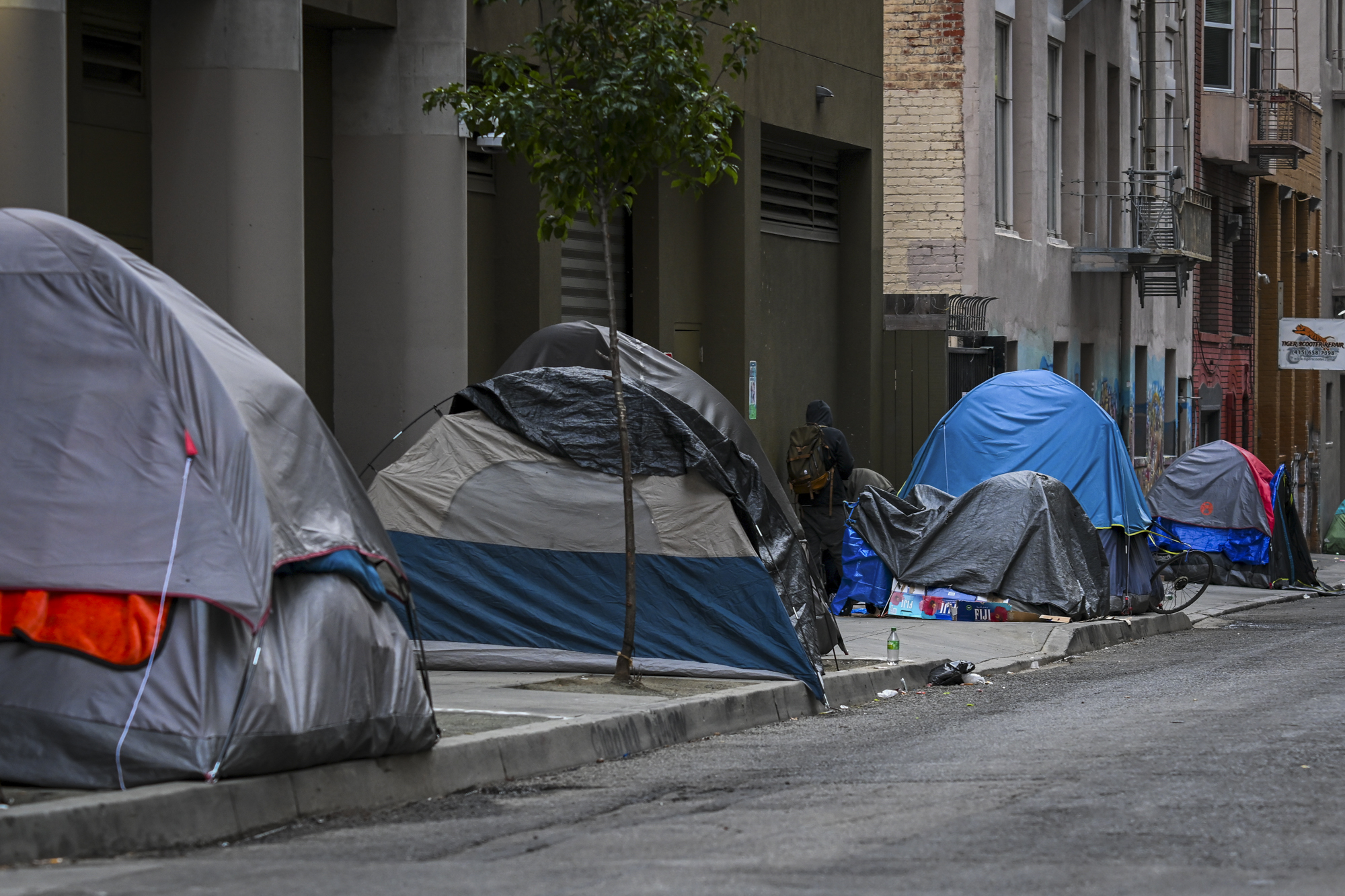 A homeless encampment on a sidewalk in San Francisco on Sept. 2, 2023. (Tayfun Coskun/Anadolu Agency via Getty Images)
This year, the number of people sleeping outside in tents or on sidewalks has decreased by roughly 22% compared to 2024, according to the PIT Count.
“More people are coming inside to get shelter and treatment, and we are moving in the right direction,” Lurie said after the latest PIT Count data was released.
But spots in one of San Francisco’s shelters are still hard to secure. On Tuesday, there were 446 people on the city’s online waitlist for shelter.
At the same time, the number of families experiencing homelessness has gone up. Some critics of the city’s current approach say there should be more investments into longer-term supportive housing options and rental subsidies.
The report did not make specific recommendations about how the city should allocate the roughly $700 million annually that is budgeted for the Department of Homelessness and Supportive Housing.