
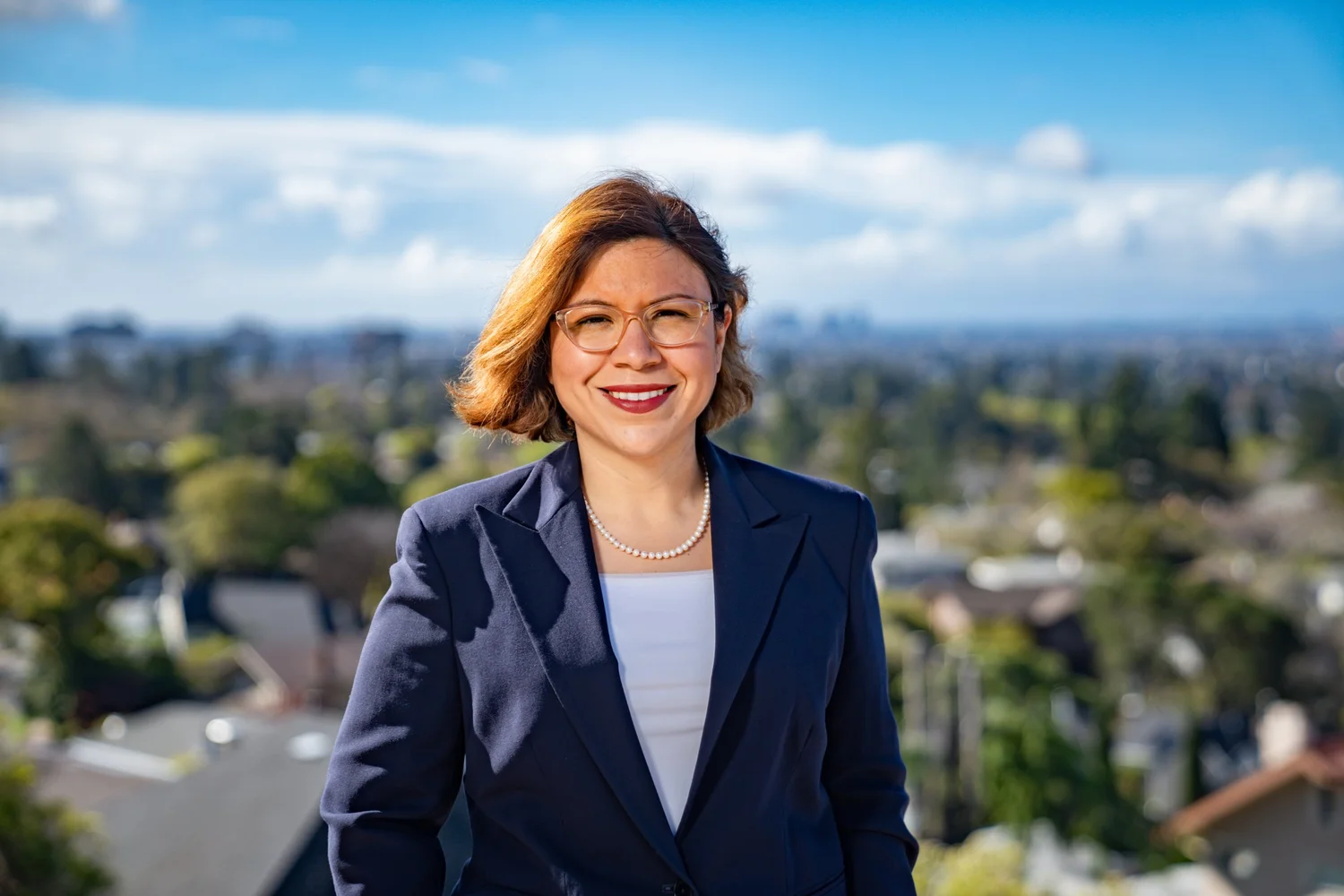
 Vasudeo served on the Berkeley Unified school board for six years, winning elections in 2020 and 2024. She will now represent Berkeley, Albany, Emeryville and parts of Oakland in her new role. Courtesy: Ana Vasudeo
Ana Vasudeo is stepping down on July 1 to join the Alameda County Board of Education, and the Berkeley school board voted unanimously earlier this month to start a process to appoint her successor rather than hold a special election.
“We’ve just spent a long time being a board of four,” director Jen Corn said at the June 3 school meeting, referring to Ka’Dijah Brown’s recent maternity leave, which ended in March. “I would like to, as quickly as possible, become a board of five again.”
Vasudeo has served on the Berkeley Unified School District (BUSD) board for six years, winning elections in 2020 and 2024 on platforms focused on supporting Black and brown students and those with disabilities, expanding street safety, and upholding progressive values during Donald Trump’s presidency.
Vasudeo ran unopposed for the Area 1 trustee seat — which represents Berkeley, Albany, Emeryville and parts of Oakland — on the Alameda County Board of Ed during the June 2 primary election. (Her name did not appear on the ballot.)
“I’m switching over into the county office, but make no mistake, that I do intend to make us ‘hashtag Berkeley proud,’” Vasudeo said Wednesday during the last board meeting of the 2025-26 school year. “I’m excited to fight for all our students in the county.”
Her BUSD term would have run through November 2028, and her appointed successor will hold the office until the end of the term.
Under the California Education Code, a board seat must be filled within 60 days of the resignation.
The district plans to release application details for the at-large school board seat over the summer, with an application deadline possibly in early August. Board members will review applicants, the full list of which will be publicly posted online.
Applicants supported by two board members will advance to a public interview conducted during a regular meeting (special meetings will need to be held this summer).
The board will vote to choose who will fill the vacant seat, with a majority needed. Berkeley voters will have 30 days after the appointment to petition for a special election if they disagree with the board’s decision.
A school board member hasn’t needed to be appointed since 2013, following President Leah Wilson’s resignation, Corn said, and directors sought advice during their June 3 meeting from the district’s lawyers about the process.
The board voted to appoint Corn and Brown to an ad hoc committee tasked with proposing a hiring timeline, drafting the board seat application, and creating a policy for this and future vacancies.
Vasudeo says she wanted to maintain Latino representation on Alameda County Board of Education
Vasudeo will succeed Joaquín Rivera, first elected in 2010, for a four-year term on the Alameda County Board of Education.
The Alameda County Office of Education board oversees the alternative schools that the county runs, which include an independent study school, schools for pregnant and parenting students, and schools for youth involved in the juvenile justice system. The county has also authorized 13 charter schools that enroll about 3,700 students. As the authorizer, the county school board makes decisions about charter renewals or big changes, like enrollment increases or relocations.
The board also weighs in when a student or family is appealing an expulsion decision from their home district, or appealing a decision about transferring to another district.
When Vasudeo learned that Rivera, the only Latino on the county board of education, would not seek another term, she said she decided to run to maintain representation for Alameda County’s large Latino student population. She also cited a desire to protect vulnerable students amid federal rollbacks on equity programs and initiatives.
“We’re seeing a lot of attacks on our students with disabilities, on our LGBTQ+ students, on our immigrant students,” Vadudeo said. “I see this happening at the federal level, and I really want to contribute my skills, pushing equity programs at the local level to protect all the districts in Alameda County.”
She acknowledges there will be learning curves in her new role.
Vasudeo will take on issues she didn’t encounter in Berkeley. Because BUSD has no charter schools, she completed professional development to understand the educational system.
Based on her BUSD experience, she hopes to strengthen county-district relationships and collaborate on school safety, immigrant student protections and transportation.
Vasudeo says she’s proud of Latinx Resolution and her work during the pandemic at BUSD
Of her personal highlights while on the BUSD board, Vasudeo fondly recalls her work with Latino students and her term during the pandemic.
In 2021, she and board member Brown introduced and helped pass the Latinx Resolution, aimed at closing achievement gaps, increasing family engagement and requiring regular progress updates. During her first term, she also led the update of BUSD’s Multilingual Learner Master Plan, created in 2013 to improve English proficiency and college and career readiness for English learners.
“Working with community groups and parents to draft the Latinx Resolution and make sure that we had funding set aside to implement it was really meaningful to me,” she said. “When I first got elected, our [University of California] admissions rate numbers weren’t super high.”
During the pandemic shutdown, Vasudeo was a managing director at Safely Opening Schools, where she co-authored a policy brief supporting Senate Bill 1479, which required COVID-19 testing in schools.
She said one of the more difficult moments in her later tenure came in 2024, when city and district leaders debated whether it was necessary to build a $27 million Berkeley High parking garage so teachers wouldn’t be ticketed or forced to frequently move their cars. She and other board members opposed using facilities funds for the project and pushed instead for the city to issue residential parking permits to district employees.
As she leaves BUSD, Vasudeo said she will miss graduations — especially meeting multilingual learners and their families — and volunteering in STEM classrooms. She hopes English learners continue to receive strong support, with improved reclassification rates and continued accountability through the Latinx Resolution.
“I would hope that whoever is appointed is someone who will carry the torch because Latinos are the largest minority group in BUSD, and that voice is incredibly important,” she said.
Vasudeo also urged more attention to unhoused students and stronger engagement through the district’s Disability Equity and Special Education Advisory Committee to support students with special needs as costs rise and funding tightens. As for her successor, Vasudeo advises accessibility, collaboration, and patience because she said meaningful change can take many years.
“I do truly believe that the staff and my colleagues on the board, even if we disagree on the exact way to get there, we’re all very invested in closing the opportunity gap for our focal populations and our most vulnerable students,” Vasudeo said.
Ashley McBride contributed reporting to this story.
“*” indicates required fields