
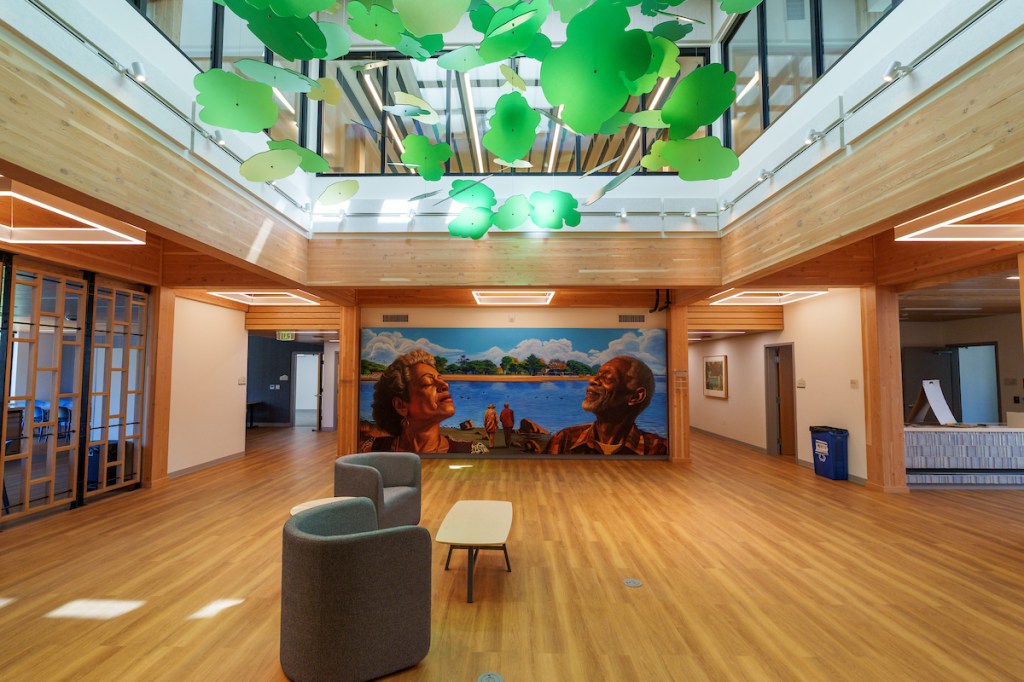
After years of wrangling, Arnold’s Place, a purpose-built recuperative care facility near the Island’s Crab Cove for the unhoused who’ve recently had surgery or are suffering from an illness, has opened its doors to 50 patients. The service, run by LifeLong Medical Care, moved from its former 27-bed facility in West Oakland.
Built on land that at one time housed several Naval Air Station Alameda buildings near the city’s Crown Beach, the new West End facility offers services such as primary medical care; follow-up appointment support and medication; three meals a day; clothing and personal hygiene assistance; and “supportive programming focused on recovery, connection and well-being,” according to a statement from LifeLong Medical. Also, pets are allowed.
Ryan Wythe, LifeLong Medical’s homelessness services director, describes recuperative care as providing housing along with nursing support for conditions that unhoused people would not be able to heal from completely.
“Recuperative care plays a really important part of our healthcare safety net in that it’s preventing a lot of preventable emergency room visits,” Wythe says. “After somebody’s been stabilized in the emergency department and their conditions are no longer needing that level of care, they can step down and finish their healing process at Arnold’s Place as opposed to being discharged to the street.”
Patients can stay at the facility for up to 90 days and are given a “vulnerability assessment” to determine their prospects for receiving a supportive housing voucher upon release. The vulnerability assessment gives patients a score that determines their place in line for the vouchers.
“Your score dictates where you fall on the list, and where you fall on the list will dictate your prioritization for a voucher,” says Wythe.
Scores are based on a combination of factors such as “how long you have been homeless,” he says. “If you’ve been homeless for longer, you would get a higher vulnerability score.
“It’s also looking at the combination of different chronic and acute health conditions or illnesses that you might be living with. The more complex your healthcare history is, the higher your score is going to be. That’s kind of how the scoring works. It’s based on vulnerability. And so the higher your score is, the higher you’re prioritized on the list for a voucher.”
As for the commonly held belief that unhoused people can’t find housing because they don’t want to obey rules, Wythe asserts that in general this is a pretty big mischaracterization and that the real culprit is a lack of affordable housing.
“Across the board in the state of California, we have underproduced the number of affordable housing units needed to house low- and no-income people,” says Wythe. “We have divested from transitional housing over the last decade.
“We’ve done away with redevelopment agencies, and so there’s been a lot of divestment in creating the necessary infrastructure for more affordable housing. So really the basis for which people are not indoors is because the housing part doesn’t exist.”
LifeLong Medical Care’s Dr. Jason Reinking says Arnold’s Place is not simply a short-term discharge stop with nowhere to go afterward. He says there is a whole network of places people can go afterward including transitional housing for the medically frail, shelters, substance use treatment programs and in some cases permanent housing.
“Less than 20% of our folks discharge back to the streets,” Reinking says.
Arnold’s Place, formerly known as the “McKay Wellness Center,” was definitely not built in a day. In 2019, opponents of the plan originally passed by the Alameda City Council got Measure B put on the Alameda ballot. This would have turned the area where the facility is located into a nature preserve. A competing initiative, Measure A, let the project move forward. Measure A passed 7,599 to 6,642 while Measure B failed 7,956 to 6,152.
Brenda Goldstein, LifeLong Medical’s chief of integrated services, says the road to building Arnold’s Place was based on a vision.
“For years, we were guided by a vision of Arnold’s Place as a space where patients—who might otherwise have been discharged to the streets—could heal with dignity and care. We imagined staff and patients working side-by-side, sharing meals, getting fresh air and reconnecting with community. Today, that vision is real. Arnold’s Place is not just a beautiful building — it is a living, healing community.”
Arnold’s Place is at 1245 McKay Ave. in Alameda. For more information, visit alamedawellnesscampus.org, the Alameda Point Collaborative’s website at apcollaborative.org or LifeLong Medical at lifelongmedical.org.
Paul Kilduff is a San Francisco-based writer who also draws cartoons. He can be reached at pkilduff350@gmail.com.