
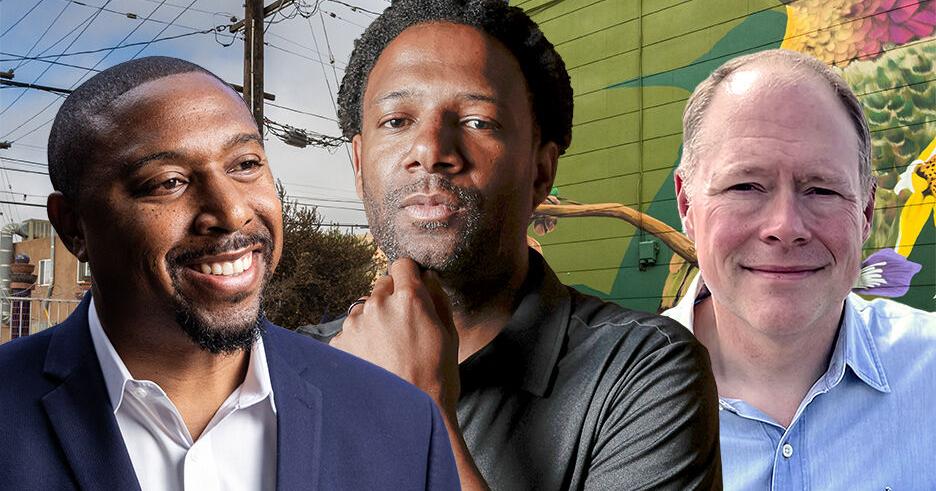
The race to succeed San Francisco District 10 Supervisor Shamann Walton, who is ineligible to run again after winning two terms, is a contest to represent a large and diverse swath of The City’s southeast that includes numerous residential and industrial areas, some of which are being developed into new neighborhoods.
The district — which stretches south roughly from Potrero Hill to Bayview-Hunters Point — includes numerous communities, including Bernal Heights, Candlestick Point, the Central Waterfront, Crocker Amazon, Dogpatch, the Excelsior, India Basin, McLaren Park, Potrero Hill, Silver Terrace, Sunnydale and Visitacion Valley.
Ten people have qualified for the race, according to the San Francisco Department of Elections website.
Of those, the following three candidates have campaign committees that have reported financial activity shown on the San Francisco Ethics Commission’s campaign finance dashboard.
In 2018, Ellington ran unsuccessfully for District 10 supervisor, finishing third when Walton won the first of his two terms in office.


Theo Ellington, right, a supervisorial candidate in District 10, speaks with owner Lawanda Dickerson of U3FIT on Third Street.
Craig Lee/The Examiner
He is a policy director at Brownstein Hyatt Farber Schreck, a legal and lobbying firm, who has primarily represented nonprofit entities and technology companies.
Ellington was previously the director of homelessness initiatives and community development for The Salvation Army San Francisco and the public-affairs director for the Golden State Warriors. He lives at the former Hunters Point Naval Shipyard with his wife, who is a nurse at UCSF, and their three young sons.
“I have the professional experience to be able to work on behalf of a community that has seen disinvestment and uneven development for decades,” Ellington said
Ellington has been endorsed by Lt. Gov. Eleni Kounalakis, State Treasurer Fiona Ma, U.S. Rep. Kevin Mullin, state Sen. Scott Wiener, Assemblymember Catherine Stefani, former Mayor London Breed and Supervisors Matt Dorsey, Bilal Mahmood, Danny Sauter and Stephen Sherrill, among others.
A spokesperson for Ellington’s campaign said recently that it had raised nearly $200,000. City records show the campaign had also received $255,000 in public financing.
Financial support has included contributions from some notable business figures, including venture capitalists Ron Conway and Garry Tan, along with San Francisco Chamber of Commerce President and CEO Rodney Fong.
Ellington said he was born and raised in the Bayview, where his grandfather bought a house after coming to San Francisco from Natchez, Miss., and finding work as a laborer on roads and bridges.
Ellington said that today, his grandfather would not be able to afford that house. He said a top priority of his as supervisor would be finding ways to make The City more affordable.
The City needs a fresh community and economic-development plan for the district, particularly for the area south of Dogpatch, as well as better coordination among government agencies, he said.
“We just need the political will to push things forward and provide a bold vision for the southeast side of San Francisco,” Ellington said.
Ellington said his interest in public service traces back to when he was 13 and his cousin was shot dead in Bayview-Hunters Point — just one of numerous local killings Ellington knew of as a boy.
“I realized then, just as I know now, that the conditions we live in on this side of town are not normal compared to the rest of San Francisco,” he said.
Ellington was the first in his family to graduate from college, earning a bachelor’s degree in political science from Notre Dame de Namur University in Belmont. He later received a master’s degree in urban affairs from the University of San Francisco.
At the age of 24, Ellington rallied a coalition that delivered thousands of signatures to City Hall to argue against the potential use of what he called the “predatory policing” practice of stopping people to frisk them, a strategy The City ultimately did not adopt.
Ellington at the time co-founded Black Young Democrats of San Francisco, which later evolved into the Black Citizen initiative.
Ellington has served on four city commissions, including The City’s Human Rights Commission and the Community Investment and Infrastructure Commission, the latter of which has overseen development of market-rate and below-market-rate homes in the Mission Bay, Transbay and Hunters Point Shipyard-Candlestick Point neighborhoods.
He was a lead plaintiff in a federal lawsuit that alleged homes at the former U.S. Navy shipyard were built over toxic waste. The lawsuit resulted in a $6.3 million settlement with developers.
“I have a history of fighting for justice,” Ellington said. “One, you can’t come to this side of town and have your way with the land or the people. And number two, we deserve the same energy investment and urgency as the rest of San Francisco.”
Ellington said another top priority of his would be facilitating progress on multiple long-planned developments on large former industrial sites in the district, while making sure that people who live in the district share in the benefits. Emerging technology companies in the area give reason for hope, he said.
In the political realm, Ellington was a member of the board of directors for Neighbors for a Better San Francisco from 2022 until 2025. The richly funded group has been controversial in part because its supporters have included businessman William Oberndorf, who has made extensive political donations to Republicans, as well as to Democrats.
Ellington is currently the executive director of the historic Ruth Williams opera house, a nonprofit cultural center at 4705 3rd St. in the Bayview that was built in 1888.
Under Ellington’s leadership, the opera house has had major equipment upgrades, provided job training, and awarded grants funded by The City’s Office of Economic and Workforce Development and Human Rights Commission.
The Opera House has also collaborated on programming with organizations such as SFJazz and San Francisco Opera, Ellington said.
Dion-Jay ‘D.J.’ Brookter
Until April, Brookter — now a full-time candidate — was the CEO of the nonprofit Young Community Developers, which works primarily in Bayview-Hunters Point. It offers programs that provide education, training, career development and housing services.

A two-year pilot will let local organizations and merchants associations adopt and improve areas near intersections with physical infrastructure

Facility using a $1.66 million gift from Salesforce to purchase new vehicle that will provide breast-cancer screenings, support for women

He says the way to improve student outcomes statewide is to apply the lessons he’s learned as president of San Diego’s school board

Dion-Jay “D.J.” Brookter, a District 10 supervisorial candidate, is seen at Hans Schiller Plaza in Visitacion Valley.
Craig Lee/The Examiner
Brookter had been in the CEO position since 2019, when Walton — his predecessor in the job — left to become District 10 supervisor.
Walton has endorsed Brookter, as have Supervisors Connie Chan and Myrna Melgar, former Mayor Art Agnos, former San Francisco police Chief Bill Scott and former Supervisors Dean Preston, Aaron Peskin, Sophie Maxwell and John Avalos, among others.
Brookter said his campaign had raised about $75,000.
He said his experience leading an organization providing workforce development and affordable housing has prepared him well to be a supervisor. Young Community Developers has codeveloped more than 200 below-market-rate housing units, including 148 for ownership.
“We have designed programs, we have created and developed educational pipelines, we’ve worked with the school district, we’ve done [academic] credit-recovery programs in the school system, we have developed internships and externships for a number of years, and we also have built affordable housing,” Brookter said. “We come in already ready to roll up our sleeves and get to work.”
The majority of the funding for Young Community Developers came from The City, though Brookter said he sought as CEO to diversify income sources to include more philanthropy.
Brookter said he was born and raised in Fresno, where his father worked in maintenance for the city school district; his mother died when Brookter was a junior in high school. He got a full-ride scholarship to play football at Utah State University, where he played outside linebacker and earned a bachelor’s degree in communications with an emphasis in business.
After graduation, Brookter said, he worked for a couple of years for an organization in Fresno helping men and women coming out of the prison system. He also went back to school and got a master’s degree in business administration from University of Phoenix.
Brookter said that in December 2010, he accepted a mentor’s invitation to come to San Francisco to work with youths on probation at Young Community Developers. He was a deputy director when he left in 2016 to work for the San Francisco Public Utilities Commission as executive director of the Southeast Community Facility Commission, a seven-member mayoral-appointed body that provides guidance to the SFPUC and Board of Supervisors regarding plans and operations for the Southeast Community Facility and Greenhouses.
In addition to focusing on the facilities — which were built to mitigate environmental and social effects on the Bayview-Hunters Point area from Southeast Treatment Plant expansion projects during the 1970s and ’80s — the commission promotes and advocates for special services and the improvement of the general economic, health, safety and welfare of area residents.
After nearly 2½ years, Brookter returned to Young Community Developers to take the top job.
Brookter, who said he lives in Candlestick Point with his partner, said he left his role with Young Community Developers to devote himself entirely to running for office.
“I understood that in order to run the race that we needed to run, I had to be 10 toes down, fully invested in the running for this position,” Brookter said. “I really feel like this has been my calling. It’s my purpose.”
Brookter said his priorities include finding ways to better connect the district’s neighborhoods, for example with improved transit; promoting the area as a welcoming destination, for example with night markets; and deploying more ambassadors into neighborhoods to clean and monitor conditions, a service that can deter problematic behavior and provide valuable employment opportunities.
Eppler is an attorney who runs his own firm, Eppler Legal, in Potrero Hill. He said he has been a resident there since 2010 and currently lives with his wife and son.
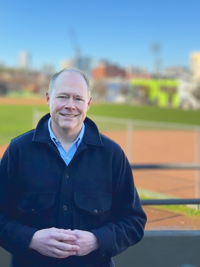
Attorney J.R. Eppler, a Potrero Hill resident, is a candidate for District 10 supervisor.
Courtesy J.R. Eppler
Eppler said his campaign had raised about $50,000. He had been endorsed by Donovan Lacy, the executive director of the Green Benefit District; Katherine Doumani, the chair of Friends of Dogpatch Hub; Dontaye Ball, the president of the Bayview Merchants Association; and Keith Goldstein, the president of the Potrero Dogpatch Merchants Association, among others.
Eppler served as an appointed member of The City’s Board of Appeals for three years before launching his candidacy, and was he on the Building Inspection Commission for nearly a year.
In addition, for the past 14 years, Eppler has been a leader of the Potrero Boosters Neighborhood Association, and he has been a Potrero Hill Democratic Club board member for more than 14 years.
Eppler said it has been an exciting and important time to be involved in local affairs because his neighborhood has been changing dramatically, particularly with residential development moving into former industrial areas.
“It was a part of The City that was kind of ignored, formerly surrounded by industry,” he said.
Over time, he said, the changes will increasingly spread southward.
Among other things, Eppler has represented the Potrero and Dogpatch neighborhoods on the UCSF Community Advisory Group. In that role he has provided input concerning the clinical- and life-sciences building that UCSF is now building on The City’s central waterfront in the heart of a brand-new neighborhood taking shape on the site of the shuttered Potrero Power Station.
Eppler said that in his various roles he has been able to advocate for transit, community centers, commercial corridors, and parks and open space in the northern portion of the district.
“That’s the experience that I have, and that’s why I wanted to run and bring that through the rest of the district,” Eppler said. “My background over the last decade of work has been working with neighbors in this district to actually deliver the results that they want to see in order to build more complete, vibrant, and connected neighborhoods.”
Eppler said a top priority is getting The City to pay the same level of attention to District 10 as it does to other parts of The City, for example by cleaning and maintaining public rights of way.
“District 10 residents should not be paying taxes to clean District 2 streets and not their own streets,” he said.
Eppler said he also wants to see more connections established between residential neighborhoods.
A native of Oklahoma City, Okla., Eppler said he came to California to attend Stanford University as an undergraduate. He later earned dual law and master’s in business administration degrees from UCLA before moving to San Francisco.
Editor’s Note
OTHER CANDIDATES
A total of 10 individuals have qualified for the District 10 race, according to the San Francisco Department of Elections. The following seven hopefuls have not reported any contributions to campaign committees thus far.
Pearci “P.J.” Bastiany III, MPA graduate student, tae kwon do black belt, small-business owner
Deandra Bryant, emergency-housing case manager and advocate for children with disabilities
Ellsworth “Ell” M. Jennison Jr., carpenter
Mike Trouble Lin, small-business consultant
Jamo Muhammad, “The Brother,” CEO of We Got Winners Big Brother Program
Jessica Pessecow, nurse, legal representative
Shawn M. Richard, CEO and executive director, Brothers Against Guns