
The union-backed half-cent tax hike aims to generate millions annually for LAFD staffing and infrastructure upgrades.
Voters will decide this November whether to raise the city’s sales tax to supply hundreds of millions of dollars in dedicated funding for the Los Angeles Fire Department, following a unanimous decision by the City Council on Tuesday.
The 14-0 vote authorizes a half-cent sales tax increase to appear on the upcoming ballot. Backed by the United Firefighters of Los Angeles City, the union representing local firefighters, the citizen-led initiative secured its spot after organizers submitted more than 225,000 signatures to election officials. Councilmember Traci Park was absent from the vote, which passed without council discussion.
If approved, the measure would increase the city’s current sales tax rate from 9.75% to 10.25%, generating an estimated $345 million in its first year. Proponents emphasize that the rate would remain below several neighboring municipalities, such as Culver City and Santa Monica, where sales taxes reach 10.75%.
Union President Doug Coates urged the council’s support, arguing the revenue is vital to reverse decades of underinvestment. According to union data, the fire department currently operates with the same number of firefighters as it did in the 1960s, despite managing five times the call volume with six fewer stations. Dozens of existing facilities are more than 50 years old, with several exceeding 80 years in service.
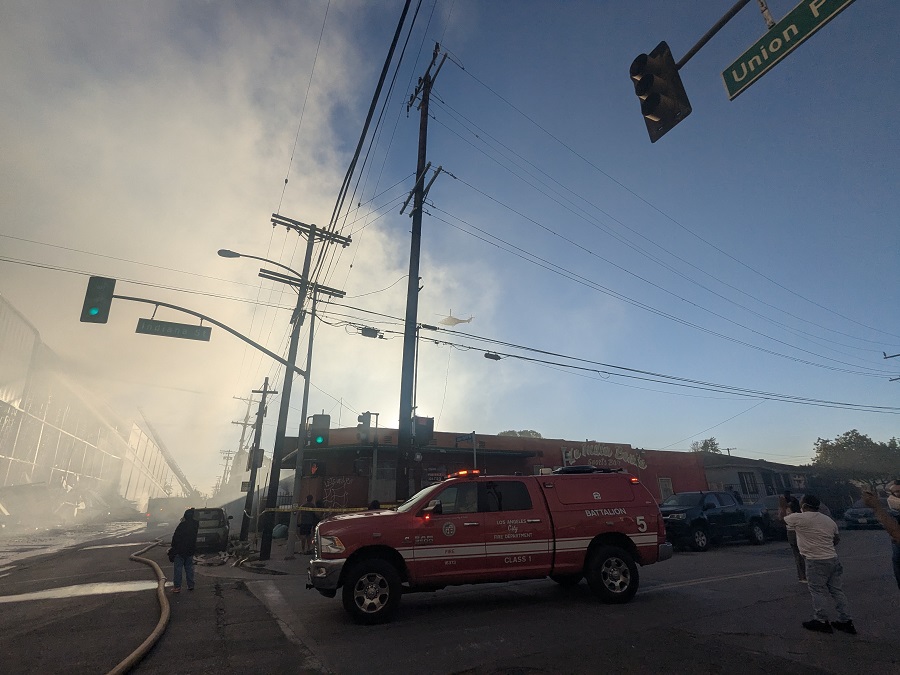
One of the things that an LAFD spokesperson said during a briefing on the Lineage Logistics fire that part of the problem is that they did not have enough resources to fight the fire efficiently, but had received assistance from other fire departments after the state and local governments declared an emergency.
The proposed funding would be legally locked into a special account dedicated exclusively to core fire department operations, including hiring firefighters and paramedics, modernizing equipment, and repairing aging stations. To prevent city leaders from redirecting existing municipal funds away from the department, the measure includes a “maintenance of effort” clause guaranteeing that the new tax revenue supplements, rather than replaces, current general fund allocations. Financial accountability would be managed through annual public audits and an independent citizens’ oversight committee.
Fiscal conservatives and taxpayers’ advocacy groups have mounted opposition to the hike, arguing that local tax rates are already burdensome and disproportionately impact low-income residents. The Howard Jarvis Taxpayers Association criticized the ballot placement, pointing out that state constitutional amendments under Proposition 13 and Proposition 218 traditionally require a two-thirds supermajority for special-purpose local taxes. However, state courts have ruled since 2017 that those strict supermajority thresholds do not apply to citizen-led initiatives.
The tax would remain in effect indefinitely unless repealed by voters in a future election.