
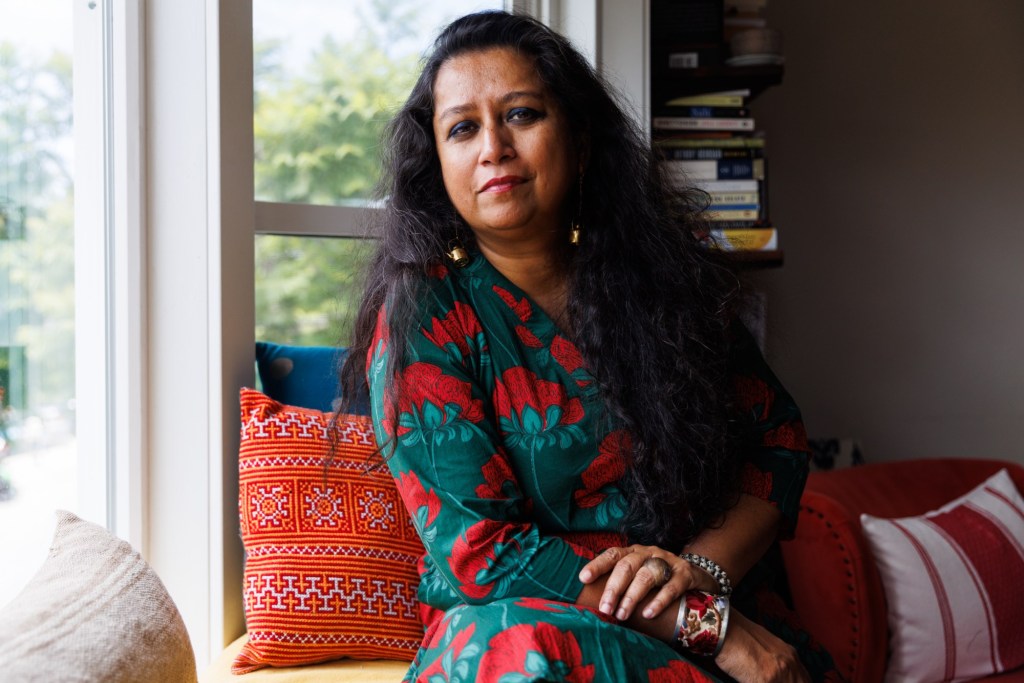
For The Union-Tribune
Dressed in a vibrant green and red salwar kameez, a contemporary version of the traditional tunic-and-trousers attire worn by many South Asian women, Madhushree Ghosh welcomed us to her sunny Mission Hills home overlooking San Diego Bay.
We’ve come to discuss her new book, “Safar: Finding Home, History, and Culture through Punjabi Food in the American West” (Bloomsbury), and photograph a few dishes she’s prepared from the book. The recipes chosen represent the North Indian cuisine as it has traveled and transformed in the U.S. Southwest, absorbing Mexican influences.
Ghosh, an Indian-born Ph.D. biochemist with a post-doctoral fellowship in molecular biology, spends her days as an oncology diagnostics strategist, navigating the intersection between cutting-edge research and its commercialization benefiting cancer patients.
Her early mornings and evenings she devotes to her passion for writing, particularly about the meaning of home, how it’s expressed through food and how the two interweave in culture and social history.
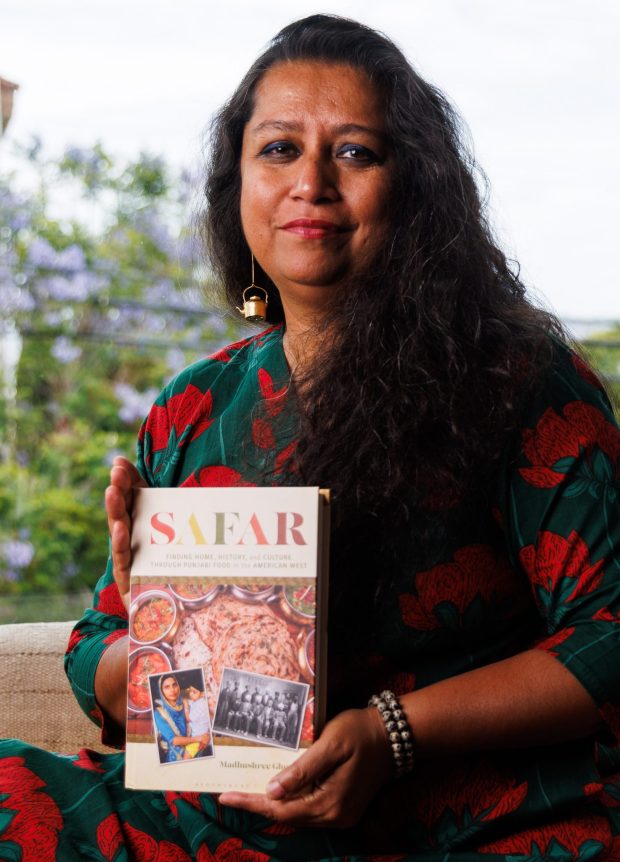 “Safar: Finding Home, History, and Culture through Punjabi Food in the American West” by Madhushree Ghosh (June 2026, Bloomsbury) is the author’s second book. (Kristian Carreon / The San Diego Union-Tribune)
Although her subjects are serious, Ghosh is warm, funny and caring in person. Her writing reflects her personality and eclectic life. Always a writer, descended from a long line of journalists, she had to sacrifice personal writing to the rigors of graduate school. Later, trying to make sense of her life following her divorce, she resumed writing.
“When I started writing about it, I realized I was really writing about food. I was talking about the emotion,” she explained.
Those intertwined writings about food, family, marriage and divorce culminated in the 2022 publication of her award-winning first memoir, “Khabaar: An Immigrant Journey of Food, Memory, and Family” (University of Iowa Press). The term “khabaar” means food in Bengali.
Ghosh, a staunch feminist, activist and advocate for causes she believes in and a generous mentor to others, is not your typical food writer, nor is “Safar” a conventional cookbook. Part memoir, it’s more narrative nonfiction and a compelling read, delving into the fraught history of the Indian subcontinent, including the underdiscussed multigenerational trauma resulting from the partition of India and Pakistan in 1947. This affected her own Hindu family, rendering her parents refugees after leaving what is now Bangladesh. Prior to independence, British rulers forced Hindus living in Pakistan to relocate to India and Muslims in India to move to Pakistan.
She braids her own story of migration with the stories of four women and their families representing three waves of Sikh and Muslim immigrants — farmers from the northwestern Indian state of Punjab — to the agricultural regions of the American Southwest, incorporating accounts of early intercultural marriages with Mexican farmworkers.

Like her latest book, Ghosh’s home reflects Indian and Mexican influences, with “Bengali Girl,” left, a painting by artist Joyeeta, and artwork from Oaxaca, background, on display. (Kristian Carreon / The San Diego Union-Tribune)

Artwork of Hindu goddess Kali, created by artist Joyeeta, on display at Ghosh’s Mission Hills home. (Kristian Carreon / The San Diego Union-Tribune)

A bull alebrije figurine from Oaxaca at Ghosh’s home. (Kristian Carreon / The San Diego Union-Tribune)

An antique cabinet. (Kristian Carreon / The San Diego Union-Tribune)

Ghosh’s home also features photographs that she took in India. (Kristian Carreon / The San Diego Union-Tribune)
Show Caption
1 of 5
Like her latest book, Ghosh’s home reflects Indian and Mexican influences, with “Bengali Girl,” left, a painting by artist Joyeeta, and artwork from Oaxaca, background, on display. (Kristian Carreon / The San Diego Union-Tribune)
To tell the story of these immigrants properly, she delved into the region’s background, describing how the political, social and religious history of the Sikh religion, founded in Punjab, along with the associated unrest and violence impacted both India and Punjabi Sikh immigrants’ new lives in the U.S.
A San Diego resident since 2002, Ghosh herself is not Punjabi. She grew up in a highly educated Bengali family in New Delhi, the daughter of a bank officer and a teacher whose families resettled in Kolkata, West Bengal in eastern India after losing everything during the partition.
“It’s easy to write about yourself, I think, because you lived it. I wanted to use the example of a community that I’m not part of, but show them with dignity and respect, primarily because they have been maligned throughout the years, not only in their own country of origin, but also in this country. It was a writing challenge for me to write from other people’s perspectives,” she explained.
The seeds for “Safar,” meaning journey in Hindi, Urdu and Farsi, were sown on the 1993 Thai Airways flight whisking her from her old life in India to the U.S. for graduate study in biochemistry at the age of 22. Her protective father advised her to not talk or engage with anyone on her travels to New York.
Still, she talked to her seatmate, a chatty Punjabi farmer who explained that he was from Yuba City in California, “where all the farms are,” and that he was the son of a Punjabi Sikh who had married a Mexican. At the time, she doubted his unlikely story of a union between an Indian Punjabi and a Mexican farmworker.
It took root in her consciousness, however, and flowered 30 years later as the inspiration for “Safar,” as she met other descendants of Punjabi Mexican marriages. Among them were the woman she calls Sheila Singh, whose life story Ghosh recounts along with Sheila’s Mexican mother’s interpretation of Punjabi recipes.
Ghosh had begun cooking, trying to recreate her mother’s curries, as a young homesick student in New York hungering for a taste of home.
“Everything my Bengali family does is around food,” she said, explaining her lifelong passion for food.
“When we would go from Delhi (to the family home in Kolkata), we could sit in the kitchen, drink tea with the elders, but watch them grind spices or cook vegetables. All these things would come fresh every morning. My uncle would bring the fresh fish, the chicken, the vegetables,” she recalled.
At home in Delhi, both parents prepared their meals. Her mother, an excellent cook, would cook, but helpers did most of the prep, because she believed a woman shouldn’t spend her time slaving over a stove. Her mother felt that “a woman should be at the dining table, talking politics with all,” Ghosh explained. She added that her mother, “one of the smartest women I know,” shaped her world view and interest in social causes.
Ghosh often accompanied her father on his trips to the market, buying fish, chicken and vegetables, teaching her how to select them.
“My dad would also help clean the fish and chicken and cut the difficult vegetables,” she said.
After she moved to the U.S. and despite her often-intense work travel schedule, Ghosh pursued her fascination with the U.S. immigrant experience and its expression in food. The old seeds of the story of Punjabi migrants in California planted 30 years earlier began germinating.
She networked with the daughters of Punjabi farmers who’d settled long ago in agricultural regions in the Southwest. Ghosh connected with Sikh farmers through their Stockton gurdwara, or temple, discovering their stories. She traveled up and down California, visiting Sikh gurdwaras and Sikh-run truck stops, documenting their history and their cuisine. While recounting their stories of migration to a new land, incorporating their recipes, she also wove in her own.
“Safar,” a fascinating read, is the result. Expect to learn about the cooking, but far more about the unexpected and complex intersection of South Asian immigration and Southwestern agriculture.
To learn more about Madhushree Ghosh, visit her website at writemadhushree.com or follow her at @writemadhushree and @khabaarco on Instagram. For information about her literary salons, visit khabaarco.com.
Book signing
Ghosh will be in conversation with chef Claudia Sandoval and sign books at 7:30 p.m. on June 24 at Warwick’s Books, 7812 Girard Ave., La Jolla. To reserve a seat online, visit warwicks.com/event/ghosh-2026.
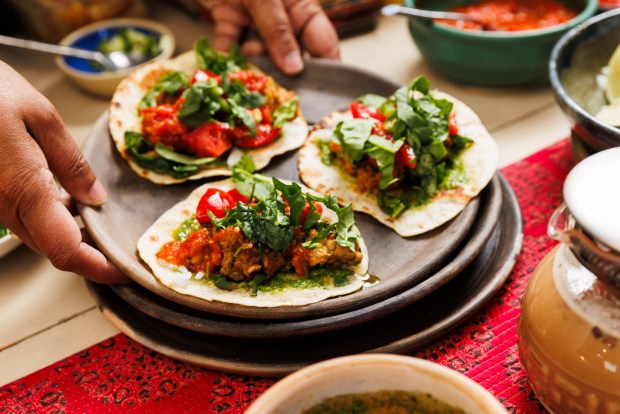 Desi Tacos incorporate ground chicken thighs with Indian spices, chutney and Sonoran-style flour tortillas. (Kristian Carreon / The San Diego Union-Tribune)
Desi Tacos (Indian-Spiced Tacos)
This represents the fusion of Indian and Mexican cuisine found in blended Punjabi Mexican families. (“Desi” means of Indian origin.) Madrushree Ghosh’s recipe riffs on a dish served at Yuba City’s El Ranchero restaurant run by the Rasul family, an American Punjabi Mexican family. Serve the chicken alone with rice or topped by a fried egg, or substitute pork or other meat.
INGREDIENTS
Makes 3 to 4 servings (12 tacos)
For the tandoori chicken:
1 pound chicken thigh meat, chopped
1 teaspoon each garam masala, tandoori masala, ground cumin, ground coriander and chili powder (see Note on spices)
2 tablespoons ground ginger
1/2 cup chopped jalapeños
1 cup each chopped onions, cilantro leaves and tomatoes
Salt and pepper to taste
1 cup avocado oil
Lemon juice as needed
For the tomato chutney:
1/2 pound cherry tomatoes
3 tablespoons chaat masala mix (see Note on spices)
1 teaspoon chili powder
Salt and pepper to taste
Lemon juice as needed
2 to 3 tablespoons avocado oil
For the tortillas:
12 store-bought flour mini tortillas
2 to 3 drops avocado oil
1 cup diced tomatoes
1 cup diced onions
3 cups chopped spinach
1 cup chopped cilantro
Lemon juice
Salt and pepper

Ghosh prepares Desi Tacos in her Mission Hills kitchen. (Kristian Carreon / The San Diego Union-Tribune)

The elements for Desi Tacos are ready for assembly, clockwise from bottom left: ground chicken thigh cooked with tandoori masala spice, garlic, ginger and topped with spinach; tomato chutney; store-bought flour tortillas; and cilantro chutney. (Kristian Carreon / The San Diego Union-Tribune)

Ghosh layers the chicken over cilantro chutney. (Kristian Carreon / The San Diego Union-Tribune)

Tomato chutney tops the completed Desi Tacos. (Kristian Carreon / The San Diego Union-Tribune)
Show Caption
1 of 4
Ghosh prepares Desi Tacos in her Mission Hills kitchen. (Kristian Carreon / The San Diego Union-Tribune)
Expand
DIRECTIONS
1: Make the tandoori chicken: Saute the chicken on medium-low in avocado oil.
2: Add garam masala, tandoori masala, cumin, coriander and chili powder to the chicken.
3: Saute for 2 to 3 minutes on medium heat.
4: Add chopped onions to the chicken and cover the pan to slow cook the mixture.
5: Add diced tomatoes after 2 to 3 minutes, slow cook.
6: Add salt and pepper to taste.
7: Add more spice mix, as per tolerance.
8: Dry the chicken mix on low, place in a bowl and set aside.
9: Make the tomato chutney: Heat the tomatoes on medium-low in avocado oil.
10: Add the spices and salt and pepper to taste.
11: Cook for 3 to 4 minutes until the tomatoes soften.
12: Add more chaat masala as needed.
13: Pull chutney off heat and add lemon juice to taste.
14: Blend the mixture in a blender on high for 30 seconds and set aside.
15: Assemble Desi Tacos: Heat the mini tortillas on medium-low, with 2 to 3 drops of avocado oil.
16: Coat one side with 1 teaspoon tomato chutney per tortilla.
17: Add 2 tablespoons chicken mixture in the middle of tortilla in a line.
18: Sprinkle 1 tablespoon diced onions, 2 tablespoons chopped spinach, 1/2 tablespoon tomatoes, 1/2 teaspoon cilantro.
19: Add 1/2 teaspoon chutney on top to taste.
20: Sprinkle lemon juice to taste.
21: Serve hot and enjoy!
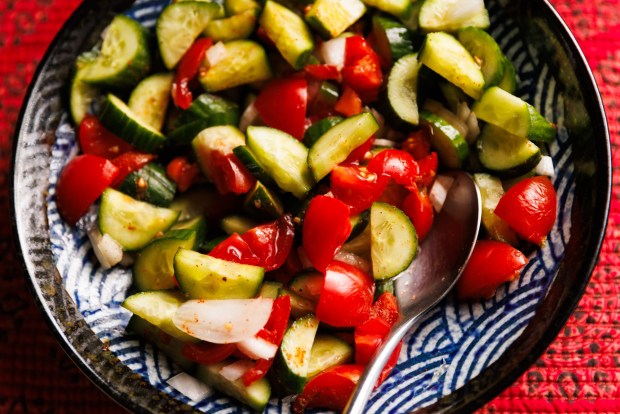 Fresh cucumber and tomatoes fill the spiced Desi Salad. (Kristian Carreon / The San Diego Union-Tribune)
Desi Salad
INGREDIENTS
4 Persian cucumbers, diced
3 Roma tomatoes, diced
1 small to medium onion, diced
1/2 serrano chile, diced
1 cup cilantro leaves, chopped
1/2 cup lemon juice
Salt and Kashmiri chili powder to taste (see Note on spices)
1 1/2 to 2 teaspoons chaat masala, to taste
DIRECTIONS
1: Gather the chopped cucumbers, tomatoes, onions, serrano and cilantro in a bowl.
2: Add spices and salt and then lemon juice.
3: Cover and chill for 30 minutes.
4: Before serving, garnish with more cilantro leaves and chaat masala to taste,
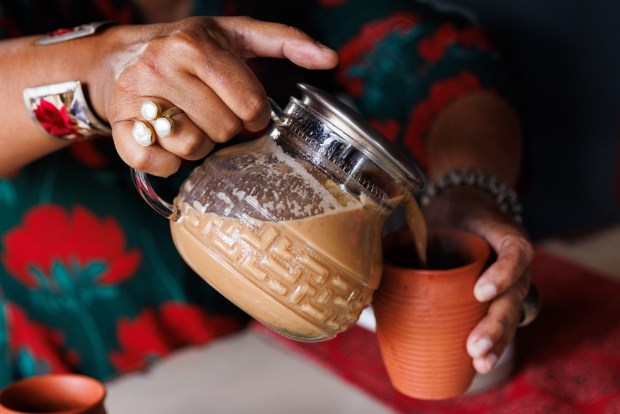 The welcoming warmth of Masala Chai is a familiar sight in many Indian households. (Kristian Carreon / The San Diego Union-Tribune)
Masala Chai
A standard beverage in most Indian households, this chai was offered to Ghosh in every Sikh temple or gurdwara she visited.
INGREDIENTS
4 cups water
1/2 cup whole milk
1 teaspoon ground chai masala made of equal portions of green cardamom, cloves and black pepper ground into a blended mix (see Note on spices)
1 tablespoon ground ginger
Sugar to taste (optional)
3 to 4 teaspoons CTC Assam tea or gunpowder chai (both strong teas)
DIRECTIONS
1: Boil the water in a saucepan, medium-low heat.
2: Add spices with ginger and set to boil.
3: Add tea leaves. Boil for 2-3 minutes.
4: Add milk and sugar (optional), boil and take off heat.
5: Pour the chai through a sieve into a teapot to remove the tea leaves and spice debris.
6: Serve in teacups with store-bought Parle-G or Nice biscuits.
Punjabi Mexican Curry Powder
Makes about 1 scant cup
INGREDIENTS
3 tablespoons turmeric powder
4 tablespoons coriander seeds
2 tablespoons cumin seeds
1/2 teaspoon ground cinnamon
2 teaspoons chili powder
1/2 teaspoon nutmeg (whole)
1/2 teaspoon mace (whole)
2 teaspoons ground black pepper
1 teaspoon ground cloves
DIRECTIONS
1: Slow roast coriander seeds, cumin seeds, chili powder, nutmeg and mace for 2 or 3 minutes on the cooktop and take off heat. Grind them into a fine powder and set aside.
2: Mix the black pepper and cloves with the turmeric and rough grind them.
3: Mix the roasted spices with the mix from above.
4: Store in an airtight container.
Note on spices: For high quality Indian spices, Ghosh recommends Akshar Cash and Carry, 9520 Black Mountain Road, and Miramar Cash and Carry, 9262 Miramar Road — both in the Miramar area — as well as the spice selection at Barrio Logan’s Northgate González Market, 1950 Main St., San Diego.
Recipes adapted from Madhushree Ghosh.
 Ghosh also hosts a literary salon and supper club. (Kristian Carreon / The San Diego Union-Tribune)