
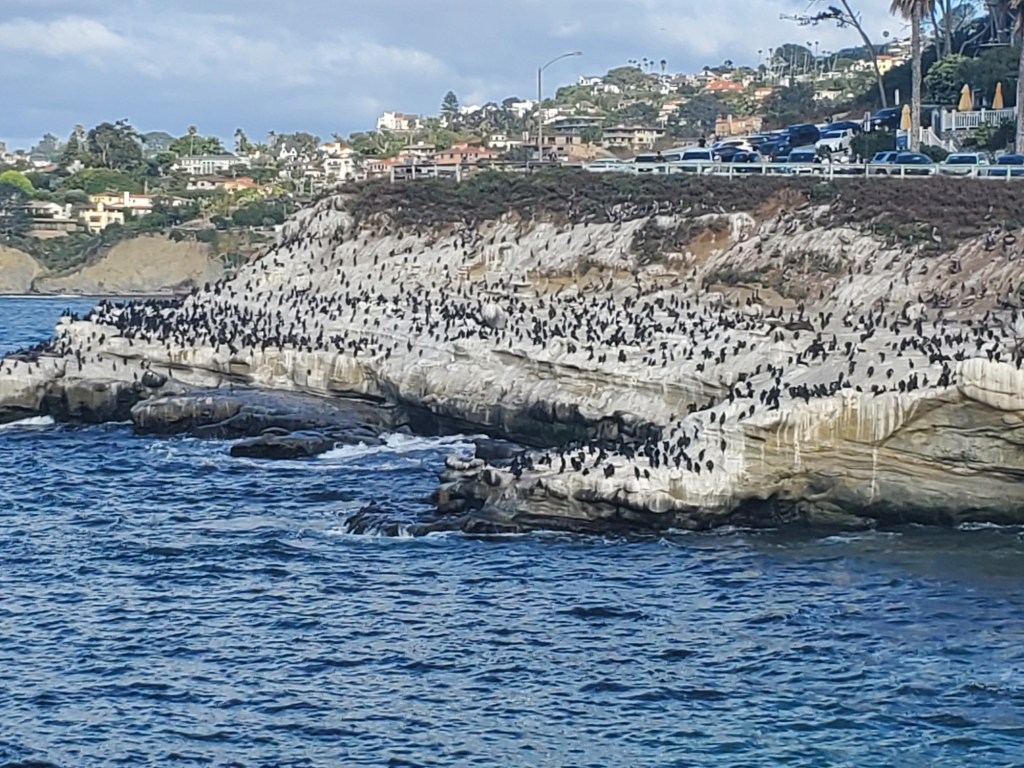
As the city of San Diego plans to revive its odor abatement program at La Jolla Cove, the La Jolla Parks & Beaches board decided June 22 to form a working group to learn more about the proposed spraying product and possibly explore alternatives.
LJP&B members discussed their concerns about the spraying at their meeting this week, citing what they consider a lack of information about the product and whether it is safe.
An application filed in early June by the San Diego Parks & Recreation Department seeks a coastal development permit from the city to “abate noxious odors where accumulated bird and sea lion excrement pose a health hazard to the public.”
The area covers about 2,180 square feet of the bluffs overlooking La Jolla Cove north of Coast Boulevard.
The city intends to spray a non-pathogenic bacterial agent onto the bluffs to effectively “eat” the animal waste. The product, BIOCAAC (Bioactive Odor Counteractant and Cleaner), is from Coronado-based Ark Environmental Solutions. The city used a similar project in a spraying effort more than a decade ago.
“BIOCAAC is a water-based blend of cultured, non-pathogenic bacteria and surfactant, similar to those in household soaps, which acts as a foaming effect to prevent the application from running off the bluffs,” said city spokesman Benny Cartwright. “The bacteria activates when diluted with water [approximately 100 gallons of water for every 10 gallons of product] and then digests and accelerates the breakdown of animal waste, reducing the odors associated with high ammonia levels and harmful bacteria. The byproducts of that breakdown are water, oxygen and carbon dioxide. Once the medium dries out, the bacteria dies and stops working.”
Representatives of Ark could not be reached for comment.
Funding for the project, which would cost about $325 per application, would come from the city’s general fund. The spray is expected to be applied as needed and not on a set schedule.
At the LJP&B meeting, board member Melinda Merryweather said she has concerns about applying a bacterial agent to areas that could run off into the water via waves, fog or rain.
“We, as the public, should know what is in it and if it can go in public waterways,” she said. “If it is something that shouldn’t go into the public waterways, it shouldn’t be going on the bluffs.”
Merryweather said she tried to reach the manufacturer to learn more about the product but her calls were not returned.
Years ago, the city applied a similar agent to the bluffs above La Jolla Cove to diminish the odor. The city stopped the spraying in 2013 after calling it a success.
The U.S. Environmental Protection Agency says “most daily-use surfactants are safe in small, diluted quantities,” though it also says that “concentrated exposure can cause skin irritation, eye damage or respiratory issues.”
During public comment at the meeting, local swimmer Eric Fletcher raised additional concerns about the spraying’s potential impact on people and animals.
“When applied near active nesting colonies, these [products] can degrade the waterproofing layers on the feathers of native protected birds, posing severe risks to adults and chicks,” Fletcher said. “For humans, these surfactants strip eye and skin mucus barriers, leaving swimmers and divers exposed to membrane irritation and waterborne pathogens.”
Fletcher also argued that runoff of the spray “may damage the mucilage layers of our depleted giant kelp forests and prevent their microscopic kelp spores from naturally attaching to objects to grow. The byproduct of this spray are highly bioavailable nutrients like nitrates and phosphates. These nutrients act as a direct fertilizer that feeds toxic algal blooms that are responsible for the catastrophic domoic acid poisoning witnessed in our regional marine life.”
Marine scientists describe the algae blooms as a “natural phenomenon” in which algae flourish during upwelling, when winds blow from north to south along the coast, pushing water offshore and bringing nutrient-rich deep water to the surface.
A type of plankton called pseudo-nitzschia, which produces the neurotoxin domoic acid, responds rapidly to upwelling, scientists say.
LJP&B member Bob Evans, the board’s immediate past president of four years, said he is “concerned and alarmed” at the prospect of the spraying product going into the ocean.
However, speakers in favor of the spraying wondered whether it also could be applied in areas such as the Children’s Pool and Point La Jolla.
Odor attributed to marine mammal and bird waste has long been the subject of complaints from local residents and visitors to The Cove and the Children’s Pool. It was even given a name in the early 2010s: the “Cove stench.”
Other Parks & Beaches news
South Casa Beach stairs: LJP&B member Brenda Fake said the next steps in a plan to repair the beach access stairway at South Casa Beach include permitting and determining final costs.
The stairway has been closed since early 2024 because of storm damage.
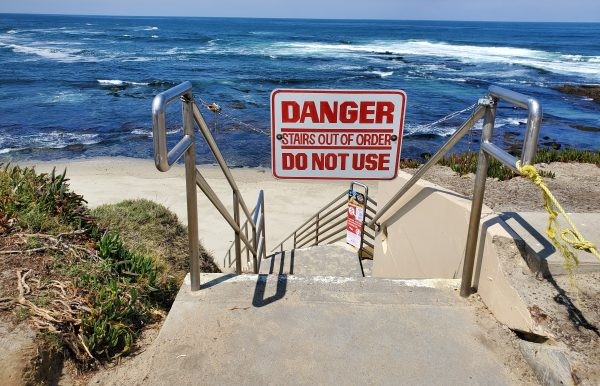 The beach access stairway at La Jolla’s South Casa Beach has been closed since early 2024. (Ashley Mackin-Solomon)
With input from a donor and a structural engineer, the La Jolla Coastal Conservancy drafted a conceptual plan that was approved by the city of San Diego and the California Coastal Commission this month. It includes repairing the bottom half of the staircase and a platform at the base. The existing footprint will remain.
“We are looking to work with [the San Diego Development Services Department] as early as next month,” said Fake, who also is a member of the Coastal Conservancy. “If we can figure out how to work with the city and streamline this, then we can move forward.”
Additional updates will be given at future LJP&B meetings.
Phyllis Minick: The board eulogized member Phyllis Minick, who died June 20 at age 97.
“She had so much energy, enthusiasm and optimism,” said board member Diane Kane. “She was so sweet, loving and kind, but tough as nails.”
Kane also praised Minick’s “magic” writing skills.
 Longtime La Jolla community activist Phyllis Minick, pictured in 2015, died June 20 at age 97. (File)
During her decades on the LJP&B board, Minick helped with several projects related to the Children’s Pool, including orchestrating a renovation to the walking area above the beach that became known as the Children’s Pool Plaza and raising funds for repairs to the seawall.
Minick also is credited with being one of the area’s first certified female scuba divers, receiving her certification in 1966. Her final dive was at Australia’s Great Barrier Reef when she was in her 80s.
In lieu of flowers, Minick’s family requested that donations be made in her honor to La Jolla Parks & Beaches and/or the La Jolla Historical Society.
Next meeting: The La Jolla Parks & Beaches board next meets at 4 p.m. Monday, July 27, at the La Jolla/Riford Library, 7555 Draper Ave. The agenda will be posted in advance at lajollaparksbeaches.org. ♦