
The Ottawa Senators have kicked the NHL’s trade market into high gear with the NHL Entry Draft days away.
First, the Senators shocked the hockey world by doing what was, in hindsight, inevitable: trading Brady Tkachuk to Florida to play with his brother, Matthew. The return was a haul that included the ninth overall pick in this year’s draft. Ottawa then turned around and flipped the ninth overall pick to San Jose in return for forward William Eklund. Trades that involve picks toward the top of the draft are notoriously hard to make, but somehow the ninth overall pick has changed hands twice in as many days.
Losing Brady Tkachuk is a brutal blow for an Ottawa team that, despite sterling underlying numbers, already lacked higher-end firepower. If it wasn’t for porous goaltending in the regular season, the Senators could have been one of the best teams in the league. Tkachuk being held scoreless as his team was swept by Carolina in the first round of the playoffs has hurt his image a bit, but there’s no denying that he’s a top-line forward in his prime.
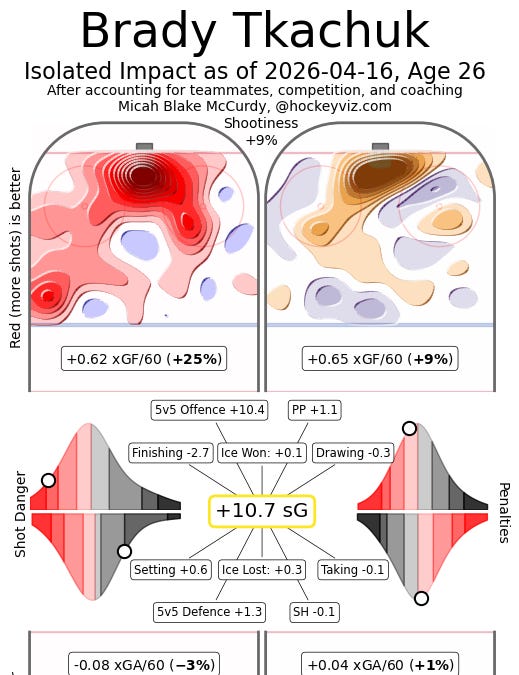
It didn’t always show up on the scoreboard, but Tkachuk was borderline irreplaceable for the Senators last season. Tkachuk was the team’s leader in points per 60 (both at all strengths and at five-on-five), and his 3.48 points per 60 at all strengths ranked 17th in the league. The goal differential with and without Tkachuk last year at five-on-five was basically the same, but the difference in underlying numbers is stark. Without Tkachuk, Ottawa had a 52.9 percent expected goal share, per Natural Stat Trick. With him, that number shot up to 60.5 percent, thanks to a serious uptick in offensive chance creation. It’s hard to find a player like that, even with the ninth overall pick.
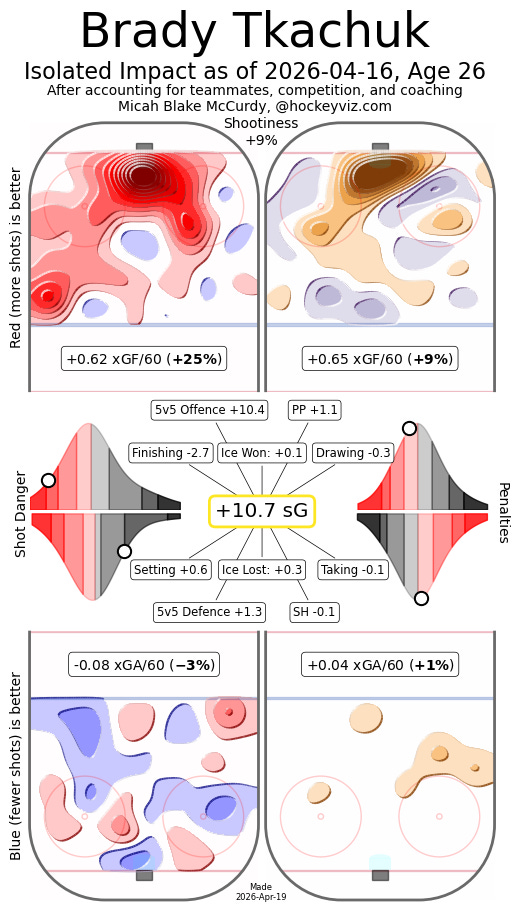
Tkachuk not wanting to stay after his contract expires in a couple years obviously changes the math for Ottawa, and Ottawa sold him at the peak of his value. Tkachuk having a no-move clause also made it hard for the Senators to get the most out of it.
With Tkachuk’s trade, Ottawa had a gaping hole in its forward corps, while San Jose had the opposite problem. After the Sharks won the lottery for the second overall pick, Eklund immediately seemed like the odd man out. The Sharks have taken a forward with a top-four pick in the prior three drafts, and Swedish forward Ivar Stenberg is the likely second overall pick this year. With holes on defense and plenty of young, talented forwards between the likes of Macklin Celebrini, Will Smith, Michael Misa, Igor Chernyshov and more, it felt like the Sharks had to move one of them to address their needs.
Eklund isn’t Brady Tkachuk, but he doesn’t necessarily have to be. The Senators still have two first-round picks (the 25th overall pick this year and a conditional first-rounder from Florida in 2029) and a second-round pick from that trade. But those two first-round picks should be later in the draft, and the 2029 pick is top-10 protected anyway. The ninth overall pick this year was the centerpiece of that transaction, which has been turned into Eklund. In the Eklund trade, the Senators also received a pair of prospects in Kasper Halttunen and Brandon Svoboda, but their scoring profiles suggest that they’re longshots to even make it to the NHL.
Eklund is an interesting player. His underlying numbers are fine, but not great. He’s coming off a year where his production declined a little bit, thanks in part to some rather poor finishing luck. Eklund scored just 15 goals on roughly 23 expected at all strengths last year, making him one of the worst shooters in the league. A nasty wrist injury at last year’s world championships probably didn’t help matters.
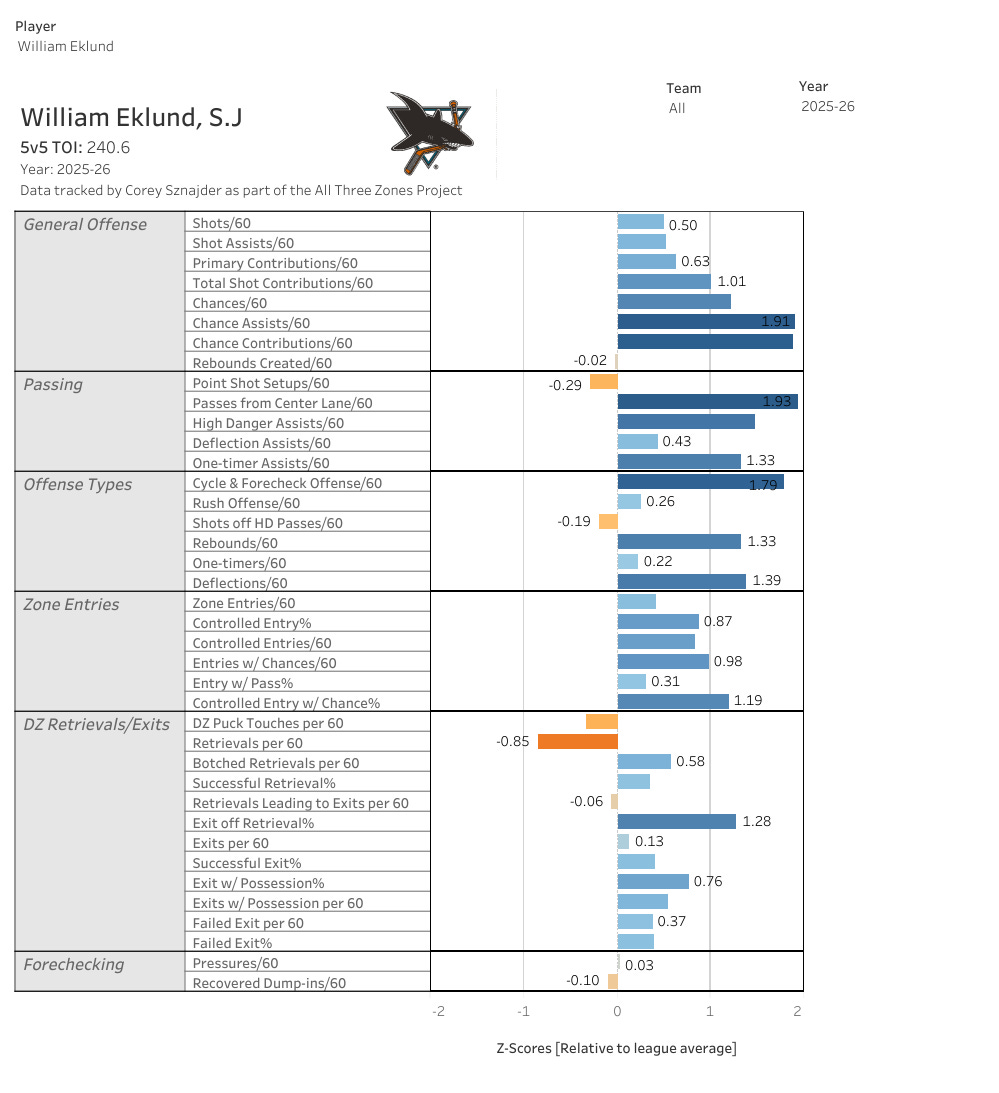
But Eklund did a lot of the right things on a bad team, and that’s why it’s felt like he’s been due for a breakout the last couple years. He’s a little undersized at 5-foot-10, but he plays a lot bigger than that and isn’t afraid to get his hands dirty to win puck battles. He’s a good skater and excels as a playmaker. Corey Sznadjer’s All Three Zones data shows Eklund’s skill set perfectly. When Eklund has the puck on his stick, something is always about to happen.
The problem with Eklund is that he hasn’t been able to transfer that skill set into either elite production or top-line underlying numbers. Over the last two years, Eklund’s 1.73 points per 60 at five-on-five are 156th in the league among players with at least 50 games played, while he ranks 188th in HockeyStats’ WAR model. He’s handy on the power play and, unlike Tkachuk, stays out of the box. Micah McCurdy’s sG model has Eklund as a fringe top-line forward. I think that’s a little optimistic, but, again, there’s still a lot to like about Eklund. It’s just that, so far, he’s the kind of player whose eye test is a little better than what the data shows.
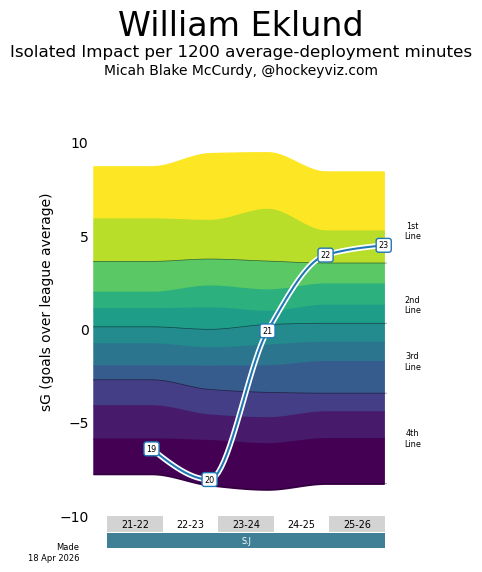
At his best, he’s a second-line forward who can be a complementary piece on the top line. Throw in some regression on the shooting front, and this could be a nice add for Ottawa, especially with Eklund on a $5.6 million deal for three more seasons.
The hope for Ottawa is that Eklund’s playmaking skills on a better team unlocks something that simply couldn’t happen in San Jose. Eklund turns 24 near the start of the season, so while he doesn’t have a ton of runway left, there’s still a little room to grow. Plus, reuniting with countryman and close friend Fabian Zetterlund is a nice touch. The key question is: Is all of that worth the ninth overall pick?
Meanwhile, for San Jose, trading Eklund for a top-10 pick instead of a defenseman who can help the Sharks now creates some interesting possibilities. The Sharks have already done some jockeying around in the draft, trading back from the 20th pick to the 27th and nabbing defenseman Michael Kesselring. With both the second and ninth picks, they’re now free to take Stenberg and then pick the best defenseman available in a draft that is more defense-heavy after the top-two picks. With the trade market for defensemen being so insane that apparently Bowen Byram is worth more than the fourth overall pick, maybe the best way for San Jose to acquire a defenseman is through the draft, even if it takes a couple years for that player to become a Shark.
But they’re also free to shake things up on draft day. Could both the ninth and 27th picks be used to trade up even further into the draft? Is the ninth pick the centerpiece in another blockbuster trade? After seven straight seasons without making the playoffs, there has to be some urgency in San Jose to finally end the drought, especially with Celebrini and Smith needing significant pay raises after this coming season.
Cap space hasn’t been a problem in San Jose for a while, but the Sharks now have over $46 million in cap space with the forwards and goaltending pretty much set outside of a Collin Graf extension. They’ll have to sort some things out on the defensive end — Sam Dickinson and Dmitry Orlov are the only full-time NHLers signed to a contract — but some of that should be sorted out by affordable contracts for Kesselring, Vincent Desharnais and Shakir Mukhamadullin, plus perhaps Luca Cagnoni making the roster. The Sharks will have to spend a bit to reach the cap floor, and a weak free agent class makes it unwise to depend on that.
The William Eklund trade was one of several major transactions on an insane day in the NHL. With slim pickings in free agency and most teams having a surplus of cap space, prepare for insanity. The Senators are heading into the trenches feeling like they’ve at least patched the hole that Tkachuk left when he wanted out, and it doesn’t feel like they’re done making moves. The Sharks are heading into the next couple weeks with plenty of valuable chips that they can cash in on at any second.
Prepare for chaos.
Data is from Hockey Stats unless otherwise noted. You can find me here on Substack, plus on Twitter/BlueSky @bfarrell727