
When CJ Andrews bought a parched avocado farm in Valley Center and started working the land in 2022, she thought she had a roadmap, like which grants to apply for and how to farm efficiently given high water rates.
But last spring the federal government halted a program, nicknamed LFPA, that helped anti-hunger nonprofits buy fruits and vegetables from farms like hers and distribute them to people in need.
“Every (federal) program that I was approved for was then defunded,” Andrews said. “And so, it was quite catastrophic for our farm. To try to be able to afford all the things that are necessary to grow — it just was a really rough year.”
Now Andrews is hopeful again. Her farm, Avocado Bliss Retreat, is one of about 30 San Diego County farms selling its produce to Feeding San Diego, an anti-hunger nonprofit. Funds come from the Conrad Prebys Foundation, which gave $1.5 million each to Feeding San Diego and the Jacobs & Cushman San Diego Food Bank so they can buy produce locally and distribute it to San Diego households in a program similar to LFPA.
“For my farm, it’s actually been a huge saving grace to have this contract for so long, to have this guaranteed buy. So now we can invest in our production and know that, for sure, we’re going to sell it,” Andrews said.
Prebys announced the year-long program after the U.S. Department of Agriculture canceled its Local Food Purchase Assistance program last spring.
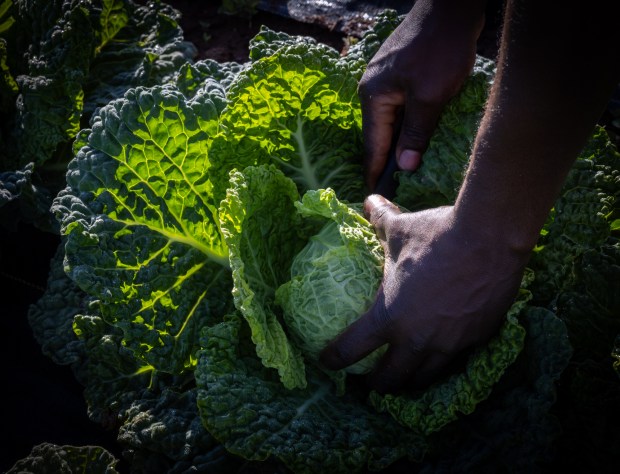 Vegetables harvested in spring 2025, shortly after the announcement that a federal program that funded the purchase of produce from small farms was halted. Byron Nkhoma, the farmer, rents 4 acres to grow produce and also sells to farmers’ markets. “We’re growing this food for the community,” Nkhoma said while harvesting a bulb onion. (Ana Ramirez / The San Diego Union-Tribune)
“When our community safety nets start to fray, as they are now, we must act quickly and strategically,” Grant Oliphant, the Prebys Foundation’s CEO, said in a news release. “Preventing hunger among our fellow San Diegans should be non-negotiable, along with sustaining a robust local network of food suppliers and farmers who can keep our neighbors from falling into hunger and malnutrition.”
How San Diego County farms are getting squeezed by funding freezes and tariffs
While other private donors have stepped up help in the wake of federal funding cuts, what is unique about this donation is its size, said Patty O’Connor, Feeding San Diego’s chief operations officer. “It is very generous and allows us to continue supporting the farmers who were supplying the LFPA program. It did make a huge difference in San Diego County, and we are very grateful.”
Prebys and other private donors have been especially vital this year, O’Connor said, given that demand for food assistance has increased amid steadily rising food costs, changes to eligibility for Cal-Fresh and a government shutdown this spring that halted paychecks.
For now, private donations to Feeding San Diego are offsetting federal cuts, she added. The nonprofit’s hope is that private donations will continue, given that state funding for a California LFPA is expected to not match what the federal government had been spending on the program.
Investing in local farming is important, O’Connor said. Most of the produce Feeding San Diego distributes to San Diegans comes from other parts of California and nearby states, “but there’s something really, really important about getting the produce locally,” O’Connor said.
It is “really good for the economy. It’s providing jobs to the owner of the farm, but also to the farm workers. And it’s boosting small businesses.”
She added, “When we buy local, we’re not just feeding people today, but we’re helping secure tomorrow’s food supply in San Diego. Because we’re investing in that farming infrastructure, the farming economy.”
Bok choy in the desert
One target of Feeding San Diego’s privately funded program, called Seed to Feed, is people experiencing hunger.
On a Tuesday in April, cars and trucks lined up on a field in Ranchita, a community with several hundred residents about halfway between Ramona and the Salton Sea — with a Yeti as its mascot — and waited.
At noon, it was time. Feeding San Diego’s pop-up drive-through pantry, where people could pick up food donations, was open. Cars started rolling through the tent, and farmer Byron Nkhoma said hello and helped load the produce he’d grown at his Ramona farm, Hukama Produce. The items were harvested the day before, he said.
A pantry that includes produce has been running at that site for several years, but the occasional addition of very fresh, very local produce using the Prebys grant is a precious new perk for Ranchita’s residents.
Jamie Ketelsen, 47, the pantry’s site lead, showed off the bulging bags of fresh vegetables heading home with people. “Really beautiful, healthy, sturdy produce,” she said. “This is super important for our community, because it provides a lot of fresh food that might not be accessible for people otherwise.”
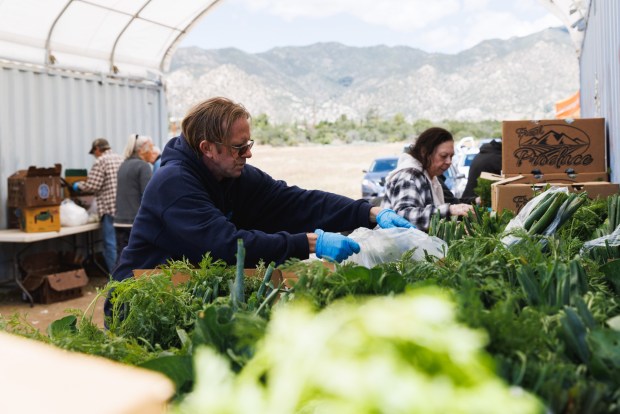 Nick Ketelsen, president of Montezuma Valley Volunteer Community Service Organization, packages vegetables in preparation for distribution at a mobile pantry in Ranchita in April. (Kristian Carreon / The San Diego Union-Tribune)
Ranchita, with an average household income of $35,625 according to 2024 U.S. Census figures, is a place where people tend to struggle to afford food and gas. The nearest markets, in Borrego Springs and Warner Springs, are a 25-minute drive, and bigger shopping trips require a trip to Ramona, almost 40 miles southwest. This makes Ranchita a food desert.
It is also a high desert, on a brushy plain ringed by mountains and lashed by hot or icy winds, depending on the season. Dark skies make Ranchita a magnet for stargazers.
Nick Ketelsen, a community leader and Jamie’s husband, said conditions can be brutal in winter. Volunteers at the pantry sometimes work in wind, snow, rain.
Under the big white tent that warm Tuesday, truck beds and back seats were loaded with pantry goods and freshly harvested onions, carrots and bok choy from Hukama Produce. The pantry was stocked to feed as many 100 households. Some people took items for relatives and neighbors who couldn’t drive.
People come from as far as the Salton Sea, Jamie Ketelsen said.
“A lot of older people up here. I’m delivering for two older families,” said Ranchita resident Debbie Zittle, in a car with her sister, who lives in Borrego Springs, and a friend who was driving.
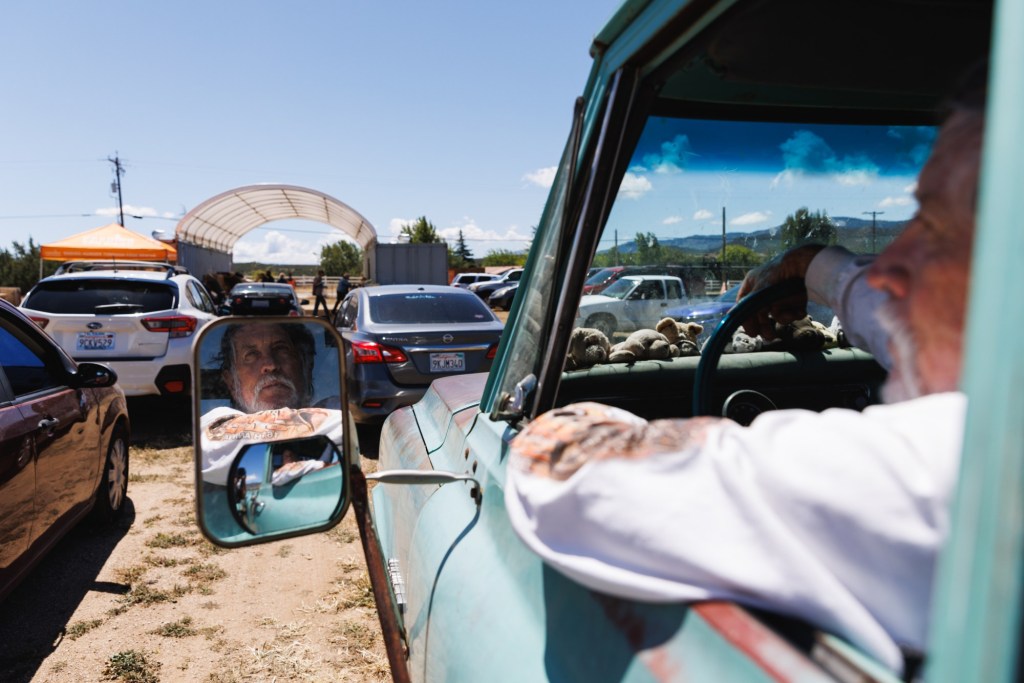
From behind the steering wheel of his 1969 Chevy C20, Tom Markel, a retired truck driver and landscaper, said he prefers not to drive far these days, given the cost of fuel. A trip to pick up groceries costs $12, he said. “The produce is really appreciated,” Markel added. “I could go down to Borrego, or I could go down to Don’s Market (in Santa Ysabel). But that’s a 4,000-foot elevation change each direction.”
The farmers and the funds
Another target of the Prebys funding and the Seed to Feed program, like the federal LFPA program that came before them, is small local farms.
When the LFPA program ended last year, San Diego farmers lost two key customers: Feeding San Diego and the San Diego Food Bank, which had been buying their produce through the federal program.
That put “so much stress on the farm,” said Nkhoma, whose Ramona farm had been part of LFPA. He cut back on planting and focused on grant applications and finding new buyers for crops already growing.
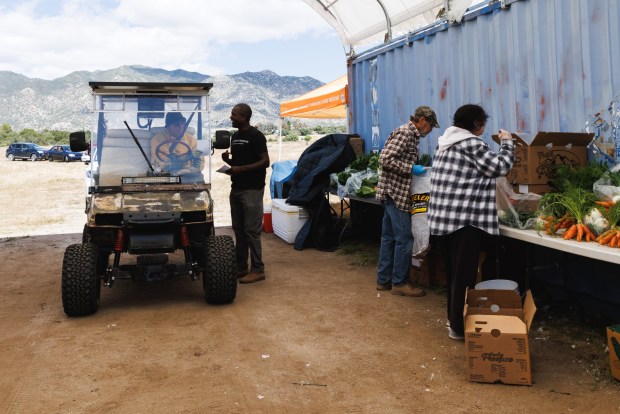 Farmer Byron Nkhoma, of Hukama Produce, speaks with Ranchita resident Miguel Estrima, 70, during a food distribution at a mobile pantry in Ranchita in April. Estrima said that as a disabled veteran, he appreciates programs like this. (Kristian Carreon / The San Diego Union-Tribune)
“To have this program come back in such a way, it’s very helpful,” he said of Seed to Feed. Having a 12-month contract has helped him plan ahead, once again. “We’ve invested into food safety,” Nkhoma said. He also bought the shade structures he had put off last year.
San Diego County’s $1.67 billion agriculture industry is anchored by thousands of small farms like his, from Julian’s apple orchards to the flower fields and fowl ranches sprinkled across suburban lots and rural corridors. The county had more than 4,000 farms in 2022, more than half of which were smaller than 10 acres, according to U.S Census figures. The number of farms fell 21% from five years earlier.
“When we talk about the local food system,” Nkhoma said, “it is very much not supportive to small farms. It is very difficult to find consistent channels to sell our produce. If you compare that to our overheads, it is very easy for a small farm to actually collapse. So the grants do help us, in so many ways. They offset a lot of our overhead costs, they help us in the infrastructure, they help us with irrigation and resiliency.”
The proposed state legislative budget, which Gov. Newsom has until the end of the month to sign or amend, includes $15 million over three years for the state’s LFPA program — a third of the $45 million farmers asked for.
Casey Ng, the New Markets Lead of Foodshed, a San Diego County farm cooperative, said large farms get “constant handouts from the federal government.” Small farms, which contribute to local soil health and are “circulating local dollars,” are underappreciated and underfunded, he said.
Seeds of stability
Norma Lopez, the board president of Foodshed, said farmers are getting paid slightly less per pound under the Seed to Feed program. Feed to Seed’s farmers get $24.50 per 10-pound CSA box and were paid $27.50 before under LFPA, she said. This price does not include payment to Foodshed for CSA box supplies and processing. The current contract, on the other hand, gives farmers a little more leeway as to how much variety to include.
Even with what she said is slightly lower compensation, Lopez said the contract is valuable because of the stability it offers.
“It is hard on the farmer, but we are willing to do it just because it is a reliable contract,” Lopez said.
Feeding San Diego said the boxes now are smaller, so the price per pound is unchanged, and said a key goal of Seed to Feed is to build stable and fair revenue for local small farms.
Uncertainty is something farmers are used to, between pricing, demand and weather, said Lopez, the co-owner of Behneman Farms, which grows 10-pound boxes of citrus, avocados and seasonal vegetables for Feed to Seed.
“Programs like this create a more reliable outlet for our produce,” she said.
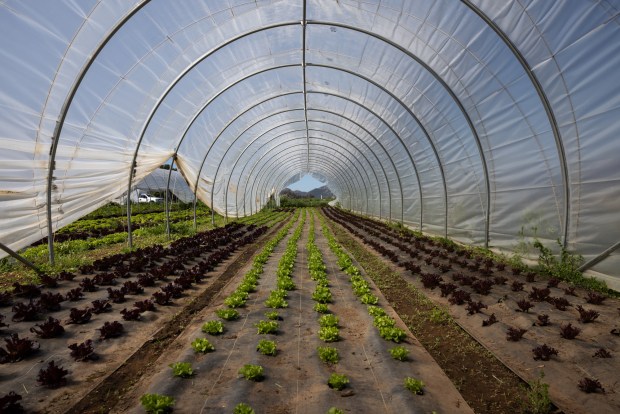 A shade structure, photographed last spring, on the farm of Byron Nkhoma. (Ana Ramirez / The San Diego Union-Tribune)
When the Prebys funds dry up, and if the state provides partial funding for LFPA, farms will again face uncertainty: Will they get another contract to sell fruit and vegetables to nonprofits combating hunger? What might that contract look like?
Nkhoma is using this year of stable revenue to find new customers and to advocate for the continuation of the LFPA and Seed to Feed programs, which he called “a true lifeline for small farms.”
From her 3.5-acre avocado farm in Valley Center, Andrews is using the Seed to Feed contract as an opportunity to grow more varieties of crops than before and develop paths to greater self-reliance. She is trying out five kinds of potatoes and finding crops and new clients.
“Now we know exactly what we can grow,” she said. As the Prebys contract wanes, she said, she will have gathered data about which crops grow well, which crops will sell well, and which to double down on.